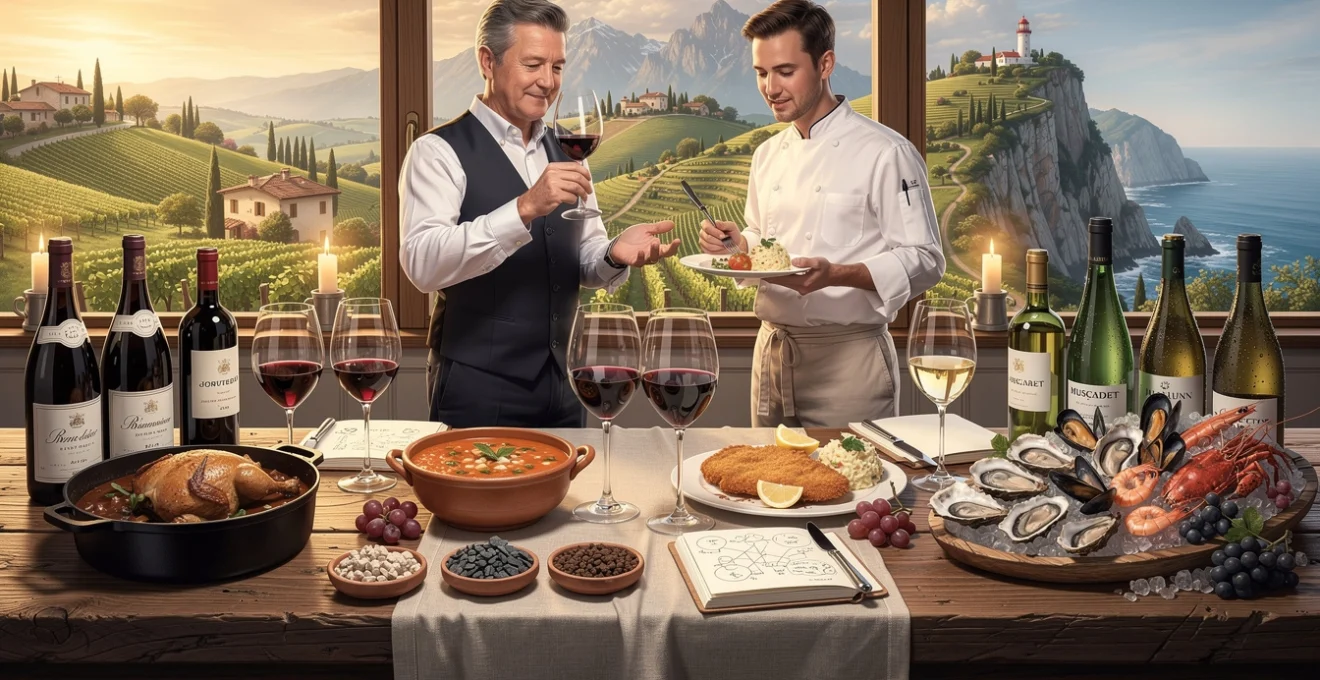
The ancient wisdom that “if they grow in the same place, they’re a good match” forms the cornerstone of regional wine and food pairing. This principle, developed over centuries of culinary evolution, recognises the profound connection between local terroir and traditional cuisine. When regional wines meet their homeland dishes, the resulting harmony transcends mere flavour compatibility—it becomes a cultural expression that embodies the essence of place itself.
Understanding this relationship requires examining how geographical factors, from soil composition to microclimates, influence both grape development and local culinary traditions. The most celebrated pairings in gastronomy—Burgundian Pinot Noir with coq au vin, Chianti Classico with ribollita, or Muscadet with fresh oysters—demonstrate how centuries of shared evolution create synergistic relationships that enhance both wine and food simultaneously.
Modern gastronomy continues to embrace these time-tested combinations whilst exploring new possibilities within regional frameworks. The key lies in understanding the scientific principles behind successful pairings, from tannin-protein interactions to acidity balancing, whilst respecting the cultural heritage that created these magnificent culinary partnerships in the first place.
Terroir-driven wine selection principles for regional gastronomy
Terroir represents the complete environmental fingerprint that shapes both wine character and regional cuisine. This concept encompasses not merely geographical location, but the intricate interplay of geology, climate, topography, and human intervention that defines a region’s agricultural identity. Understanding terroir-driven selection requires examining how these environmental factors create complementary flavour profiles in local wines and traditional dishes.
Soil composition impact on varietal expression in local vintages
Soil composition profoundly influences grape development and subsequently affects food pairing compatibility. Limestone-rich soils, prevalent in Burgundy and Champagne, impart mineral complexity and crisp acidity to wines—characteristics that complement the region’s butter-rich cuisine and delicate preparations. The calcium carbonate in these soils promotes phenolic ripeness whilst maintaining natural acidity, creating wines perfectly suited to cream-based sauces and subtle poultry dishes.
Clay soils, common in Pomerol and parts of Tuscany, produce wines with greater concentration and softer tannins. These characteristics align beautifully with the hearty, slow-cooked dishes traditional to these regions. The water-retention properties of clay create wines with sufficient structure to stand up to rich tomato sauces and aged cheeses, whilst maintaining enough elegance to avoid overwhelming delicate flavours.
Microclimate influence on phenolic development and food compatibility
Microclimatic variations within wine regions create subtle but significant differences in grape maturation that directly impact food pairing success. Cool, foggy conditions in coastal areas like Muscadet promote high acidity and mineral expression—precisely the characteristics needed to complement briny seafood and raw preparations. The maritime influence preserves natural freshness whilst developing complex mineral notes that echo the oceanic terroir.
Conversely, warm, dry microclimates produce wines with riper fruit character and higher alcohol levels. These conditions favour the development of concentrated flavours that pair beautifully with grilled meats and robust vegetable preparations common in Mediterranean cuisine. The key lies in recognising how these microclimatic influences create complementary intensity levels between local wines and traditional cooking methods.
Indigenous grape varieties and their historical food pairings
Indigenous grape varieties represent thousands of years of natural selection and human cultivation, creating perfect harmony with local culinary traditions. Sangiovese, native to central Italy, developed alongside tomato-based cuisine and aged cheeses, creating natural affinity through shared evolution. Its moderate tannins and bright acidity provide ideal structure for tomato’s natural acidity whilst complementing the umami richness of aged Pecorino.
Similarly, Grüner Veltliner evolved in Austria’s alpine environment, developing the crisp acidity and herbal notes that perfectly complement the region’s emphasis on fresh herbs, root vegetables, and lean proteins. These indigenous varieties offer insights into evolutionary pairing principles that transcend simple flavour matching,
offering a template for how grapes and recipes co-evolve when they are exposed to the same seasons, preservation methods, and everyday cooking needs.
Harvest timing effects on acidity levels and culinary balance
Harvest timing serves as one of the most powerful tools for aligning local wines with regional meals. Early-picked grapes generally retain higher acidity and lower potential alcohol, producing wines that act like a squeeze of lemon on the food, brightening flavours and sharpening textures. In seafood-focused regions or places with cream-heavy dishes, these high-acid wines provide the lift needed to keep the palate refreshed throughout a meal.
Later harvests, by contrast, lead to riper fruit expression, softer acidity, and higher alcohol—attributes that suit slow-cooked stews, game, and robust, meat-driven cuisines. Think of a late-harvest Sangiovese in a warm vintage: the extra ripeness and rounder mouthfeel make it an ideal partner for deeply savoury ragù or grilled wild boar. When you consider harvest dates the same way you would seasoning levels in a dish, you start to see why certain vintages feel “made” for particular regional recipes.
In practice, this means that chefs and sommeliers planning regional food and wine pairings should pay close attention to vintage reports and picking windows. A cooler year with earlier harvesting might call for dishes that showcase freshness and acidity, whereas a hot, late-harvest year will tolerate more richness, spice, and fat on the plate. By aligning harvest timing with culinary weight, you ensure that local wines and regional meals speak the same structural language.
Classic regional pairings: burgundian pinot noir with coq au vin methodology
Few combinations illustrate the art of pairing local wines with regional meals as clearly as Burgundian Pinot Noir with coq au vin. In this classic preparation, the same wine that fills the glass often forms the base of the braising liquid, creating a seamless bridge between what you drink and what you eat. This is not merely tradition for tradition’s sake; it reflects a deep understanding of how Pinot Noir’s structure, acidity, and aromatic profile interact with slow-braised poultry, lardons, and mushrooms.
The beauty of this pairing lies in the way Burgundian Pinot Noir mirrors the dish’s layers of flavour. Red fruit notes echo the sweetness of caramelised onions and root vegetables, while earthier nuances resonate with mushrooms and reduced stock. When executed well, the combination demonstrates how regional food and wine pairings can amplify flavour and texture without either element overpowering the other.
Tannin structure analysis in Gevrey-Chambertin and protein interaction
Gevrey-Chambertin, one of Burgundy’s most renowned Pinot Noir appellations, often displays firmer tannic structure than many neighbouring villages. These fine-grained tannins interact with the proteins in braised chicken and lardons, softening on the palate and creating a velvety mouthfeel. In chemical terms, tannins bind to saliva proteins and meat proteins, reducing perceived astringency and allowing underlying fruit and savoury notes to emerge.
From a practical standpoint, this means that the richer the preparation of coq au vin—more bacon, more stock reduction, more gelatin extracted from bones—the better it can tame the wine’s structural elements. Have you ever noticed how a Gevrey-Chambertin that seems slightly austere on its own becomes supple and generous alongside a plate of braised poultry? That is tannin-protein synergy in action, turning an intellectual wine into an irresistibly drinkable one at the table.
For sommeliers, choosing the right Gevrey for coq au vin involves balancing intensity and finesse. Village-level wines often provide enough structure for classic recipes, while premier cru bottlings pair beautifully with more elaborate, sauce-driven versions of the dish. In all cases, understanding the interaction between tannin and protein helps you select a wine that enhances texture rather than competing with it.
Acetic acid balance in wine reductions and flavour amplification
When cooking regional dishes with local wine, the concentration of volatile acidity—primarily acetic acid—becomes a crucial factor in flavour balance. During the slow reduction of a coq au vin sauce, both desirable acidity and subtle volatile components intensify. If the base wine is already high in acetic acid, the final dish may taste sharp or harsh, overwhelming delicate aromatics from herbs and vegetables.
By contrast, a well-made Burgundian Pinot Noir with moderate natural acidity and low volatile acidity will reduce into a sauce that feels bright yet rounded, providing lift without harshness. Think of the reduction as turning up the volume on every component: if the raw wine is balanced, the finished sauce becomes an amplified but harmonious version of those flavours. If the wine is flawed or excessively volatile, the reduction simply magnifies the fault.
For chefs and home cooks alike, the practical takeaway is clear: choose clean, balanced wines with fresh acidity and controlled volatility for braising and reduction. You do not need a grand cru for the pot; you need a local wine whose structural profile will withstand concentration and still taste integrated, both on the plate and in the glass.
Temperature service protocols for optimal aromatic release
Serving temperature strongly influences how Burgundian Pinot Noir behaves alongside regional dishes like coq au vin. Too cold, and the wine’s delicate red fruit and floral notes retreat, leaving only acidity and tannin to interact with the food. Too warm, and alcohol becomes more prominent, clashing with the dish’s savoury richness and subtle herbs. The sweet spot for most village and premier cru Burgundies typically lies between 14–16°C (57–61°F).
At this range, aromatic complexity unfolds gradually in the glass as the wine warms, echoing the evolving flavours on the plate as the dish cools slightly during the meal. You could think of temperature as the “volume control” for aroma and structure: cooler service emphasizes freshness and precision, while slightly warmer service brings out textural richness and spice. For coq au vin, a moderate temperature lets the wine’s brightness cut through the sauce while still offering enough warmth to feel comforting.
In restaurant settings, following precise temperature service protocols for Burgundian Pinot Noir can dramatically improve guest perception of pairing quality. At home, simply removing the wine from the refrigerator 20–30 minutes before serving—or giving a room-temperature bottle a brief chill—often achieves a similar result. Small adjustments here can transform a good regional pairing into a truly memorable one.
Decanting techniques for mature burgundies with traditional braised dishes
The question of whether to decant mature Burgundy, especially with a classic braised dish, sparks lively debate among professionals. On the one hand, older Pinot Noir can be fragile, with delicate aromatics that dissipate quickly in an overly oxygenated environment. On the other, a careful, short decant can remove sediment and allow shy tertiary notes—dried flowers, forest floor, sous-bois—to emerge more clearly, aligning beautifully with slow-cooked poultry and mushrooms.
A practical approach is to tailor decanting to the age and style of the wine. Younger village and premier cru wines (under 8–10 years) often benefit from 30–60 minutes in a wide-based decanter, especially when paired with rich, gelatinous dishes like coq au vin. More mature bottles may require only a gentle, “service” decant: transfer slowly off the sediment immediately before serving, using a narrow carafe that minimizes surface area.
For diners exploring the art of pairing local wines with regional meals, decanting should feel like fine-tuning rather than a rigid rule. Ask yourself: does the wine seem closed or reduced when opened? Does the dish call for more aromatic openness from the wine or greater structural definition? Answering these questions helps you decide whether a careful decant will help the Burgundy and the braise perform in harmony.
Mediterranean wine and cuisine synergy: sangiovese with tuscan ribollita
The Mediterranean offers some of the most intuitive examples of pairing local wines with regional meals, and Sangiovese with Tuscan ribollita is a textbook case. Ribollita, a thick bread-and-bean soup enriched with kale, olive oil, and seasonal vegetables, was born from peasant necessity and the need to reuse stale bread. Sangiovese, the backbone of Chianti, evolved in the same landscape of sun-drenched hillsides, olive groves, and modest farm kitchens, developing a profile that naturally supports this rustic cuisine.
Structurally, Sangiovese’s bright acidity and moderate tannin act as a counterpoint to ribollita’s soft, starchy texture and gentle bitterness from cavolo nero. The wine’s sour cherry and dried herb notes mirror the dish’s tomato, rosemary, and sage, while the savoury, slightly earthy undertones interact with beans and slow-cooked vegetables. The result is a pairing that feels less like two separate elements and more like different expressions of the same Tuscan countryside.
For travellers and professionals alike, this combination also highlights an important principle: in Mediterranean regions, olive oil often plays the role that butter does in cooler climates. Wines like Sangiovese, with firm but refreshing acidity, are built to cut through that oil, cleanse the palate, and prepare you for the next spoonful. This is why a well-chosen Chianti Classico with ribollita often feels more refreshing than a lighter, softer red from another region.
Alpine region pairings: grüner veltliner with austrian wiener schnitzel
Alpine regions may conjure images of hearty, cheese-laden dishes and powerful reds, but some of their finest regional pairings are surprisingly delicate. Grüner Veltliner with Wiener Schnitzel is one of Austria’s most celebrated food and wine combinations, illustrating how a crisp, peppery white can stand up to a dish that is both fried and subtly rich. Here, the alpine climate and local culinary techniques converge to create a pairing that feels both comforting and precise.
Wiener Schnitzel, typically made from veal (or sometimes pork), is pounded thin, breaded, and fried in clarified butter or oil until crisp and golden. On paper, you might expect a richer white or even a light red. However, Grüner’s hallmark traits—high acidity, gentle phenolics, and notes of white pepper, lime, and green apple—make it ideally equipped to slice through the fat, lift the breading, and accentuate a squeeze of lemon. The combination works much like a well-judged squeeze of citrus on fried seafood.
From a structural perspective, Grüner Veltliner’s phenolic “grip” acts almost like very fine tannin, giving the wine enough texture to hold its own on the palate without overwhelming the delicate flavour of the veal. This is a useful reminder that not all food-friendly structure comes from red-wine tannin; in many alpine whites, subtle bitterness and phenolic tension play a similar supporting role, especially with fried, breaded, or herb-accented dishes.
Coastal wine integration: muscadet sur lie with breton plateau de fruits de mer
Coastal regions often produce some of the most transparent expressions of terroir, and Muscadet Sur Lie with a Breton plateau de fruits de mer is a quintessential example of how local wines and regional seafood can mirror each other. Muscadet, made from Melon de Bourgogne near the Atlantic-influenced Loire estuary, is famed for its bracing acidity, low alcohol, and pronounced mineral character. When paired with a tower of oysters, clams, whelks, shrimp, and crab, the wine feels less like a separate beverage and more like an extension of the sea.
What makes this pairing so compelling for anyone exploring the art of pairing local wines with regional meals is its simplicity. The seafood is usually prepared with minimal intervention—perhaps a wedge of lemon, a dab of mayonnaise, some shallot-vinegar mignonette—so the Muscadet’s role is to frame, not dominate. Its saline edge, lees-derived texture, and citrus notes echo the ocean character of the shellfish, reinforcing the idea that if wine and food grow up in the same maritime environment, they will almost always find harmony.
Salinity mineral content in loire valley whites and oyster brininess
While the notion of “salinity” in wine remains partly metaphorical, many tasters perceive a distinct mineral, sea-spray character in Loire Valley whites like Muscadet. This impression often derives from a combination of high acidity, low fruit sweetness, and certain mineral compounds rather than literal salt. When you sip Muscadet alongside briny oysters from the Breton or Vendée coasts, the overlap becomes striking: both deliver a crisp, saline sensation that feels cleansing rather than drying.
Chemically, oysters contain natural salts and amino acids that create umami and briny depth, while Muscadet’s high acid and mineral profile enhance those flavours much like a squeeze of lemon without adding extra aromatic distraction. Have you ever tasted an oyster and wine pairing where it felt as though the wine simply elongated the aftertaste of the shellfish? That is the effect of complementary “salinity” at work, giving the impression of one continuous maritime flavour line across both glass and plate.
For sommeliers building coastal wine programmes, highlighting these saline, mineral-driven whites alongside raw and lightly cooked shellfish provides a clear, memorable demonstration of terroir in action. Guests quickly grasp that this is not an arbitrary pairing; it is geography translated into taste.
Lees contact duration and textural complexity with shellfish
Muscadet Sur Lie owes much of its pairing power to extended lees contact, where the wine rests on dead yeast cells after fermentation. This ageing process releases mannoproteins and polysaccharides, subtly increasing mouthfeel and adding flavours of bread dough, biscuit, and savoury complexity. With shellfish, this texture softens the razor-sharp edges of acidity and introduces a creamy undercurrent that resonates with the natural sweetness of crab, prawns, and scallops.
In effect, lees ageing allows Muscadet to play two roles at once: a high-acid, palate-cleansing white and a gentle textural companion to the meatier, sweeter components of a seafood platter. It is rather like pairing a crisp apple with a piece of buttered toast; the contrast and complement both operate simultaneously. With a plateau de fruits de mer, that added lees-derived weight means the wine can move beyond oysters to support richer items like langoustines and lobster.
From a practical menu-planning perspective, knowing the duration of lees contact helps you select the right Muscadet style for different shellfish-focused dishes. Lighter, shorter-aged wines work well as aperitifs and with raw oysters, while longer lees-aged bottlings can accompany warm seafood dishes, beurre blanc sauces, or even simple fish stews without being overwhelmed.
Citric acid levels and their role in cutting through maritime richness
Acidity, particularly citric and malic acid, plays a central role in making Muscadet an ideal partner for rich seafood. Shellfish may seem light, but the natural glycogen (stored sugar), proteins, and, in some cases, added butter or mayonnaise create a perception of richness on the palate. Muscadet’s bright acid profile acts much like a squeeze of lemon, cutting through that richness and restoring clarity to the taste buds after each bite.
In sensory terms, high acid wines shorten the perceived length of fat and protein on the palate, preparing you for the next mouthful. This is vital when enjoying large seafood platters, where variety and repetition can easily lead to palate fatigue. Have you ever found that a neutral or low-acid white wine makes a seafood meal feel heavy by the second plate? That is the absence of sufficient acidity to do the palate-cleansing work.
When designing coastal food and wine pairings, focusing on wines with a strong acid backbone—Muscadet, Albariño, certain coastal Chardonnays—ensures that even the most indulgent maritime feasts retain a sense of lightness and progression. Muscadet Sur Lie, with its combination of bright acidity and subtle texture, simply embodies this principle in its purest regional form.
Seasonal pairing adaptations: vintage variation impact on menu planning
Even within a single region, no two years are identical, and vintage variation has a significant impact on how local wines pair with regional meals. Cooler seasons may produce lighter-bodied, higher-acid wines, while warmer years yield fuller, richer examples with higher alcohol and riper fruit. For chefs, sommeliers, and serious enthusiasts, adapting menus to these shifts is essential if you want to maintain harmony between what is on the plate and what is in the glass.
Rather than treating regional pairings as fixed rules, we can view them as flexible frameworks that respond to seasonal and vintage conditions. A classic pairing—Burgundy with game, Sangiovese with Tuscan stews—remains conceptually sound, but the exact style of wine you choose should adjust to the year’s character. This dynamic approach turns vintage variation from a challenge into an opportunity for creativity and deeper terroir expression.
Cool climate vintage characteristics and autumn game preparations
In cooler vintages, many classic regions produce wines with higher acidity, lower alcohol, and more pronounced herbal or peppery notes. For autumn game dishes—think venison, hare, or wild duck—these attributes can be an asset, bringing clarity and lift to preparations that often include rich sauces, roasted root vegetables, and game jus. The leaner structure mirrors the season’s crisp air and the natural leanness of much wild meat.
However, this also means that you may need to adjust cooking methods slightly. With particularly high-acid, firm wines, slow braises, longer resting times, and generous use of stock or bone marrow can create additional richness on the plate to meet the wine halfway. Imagine pairing a taut, cool-year Northern Rhône Syrah with a gently stewed venison dish rather than a fiercely grilled steak; the softer, saucier texture gives the wine more room to express its peppery, savoury notes without feeling sharp.
For menu planning, cool vintages are perfect moments to feature classic autumn game recipes that incorporate braising, roasting, and long reductions. The wines’ brightness cuts through any inherent gaminess, while their herbal complexity amplifies foraged ingredients like mushrooms, juniper, and wild herbs.
Warm vintage alcohol levels and summer preservation techniques
Warm vintages often lead to riper fruit, higher potential alcohol, and softer acidity. While these wines can feel generous and approachable, they may overpower lighter, traditionally paired dishes if you do not adapt your recipes. One effective strategy is to lean into regional preservation techniques that introduce acidity, salt, and texture: pickling, curing, fermenting, and marinating.
For example, pairing a warm-vintage Mediterranean red with grilled meats accompanied by pickled vegetables, citrus-based marinades, or yoghurt sauces helps rebalance the plate. The preserved elements add bite and freshness, countering the wine’s ripeness and higher alcohol. It is a bit like turning up the “contrast” on a photograph so that bright and dark areas stand out more clearly.
In practice, this could mean serving a fuller, sun-drenched Chianti with grilled lamb and a salsa verde rich in vinegar and herbs, or matching a warm-year Rioja with cured meats and tangy escabeche-style vegetables. By borrowing from local preservation traditions, you can keep regional wine and food pairings energetic even when the wines themselves are lush and powerful.
Late harvest considerations for winter root vegetable dishes
Late-harvest wines, whether dry or off-dry, bring concentrated flavour, lower acidity, and sometimes residual sugar—traits that can feel indulgent but tricky to pair. Winter, with its abundance of roasted root vegetables, squash, and caramelised onions, offers a natural canvas for these wines. The inherent sweetness and earthiness of roots like parsnips, carrots, and beetroot find an echo in the honeyed, baked-fruit notes of late-harvest whites and certain passito-style reds.
To keep these pairings balanced, it is important to manage sweetness on the plate. Dishes that rely more on natural caramelisation and gentle spice—roasted carrots with cumin and yoghurt, baked pumpkin with sage and brown butter—tend to work better than overtly sugary glazes. The goal is to create a dialogue between the wine’s concentration and the vegetables’ sweetness without tipping into cloying territory.
Professionally, late-harvest wines can be used not only for desserts but also for savoury winter courses that highlight root vegetables, chestnuts, and aged cheeses. When you align their richness with the season’s flavours, they become powerful tools for showcasing the depth of both the vineyard and the cold-weather larder.
Spring release timing and fresh herb integration strategies
Spring releases—young rosés, early-bottled whites, and lighter reds—arrive just as regional cuisines shift toward fresh herbs, tender greens, and delicate proteins. These wines typically emphasize bright fruit, crisp acidity, and low to moderate alcohol, making them ideal partners for dishes that showcase the year’s first produce. Think asparagus with lemon butter, herb omelettes, pea risotto, or lightly grilled river fish.
Integrating fresh herbs into spring dishes provides a direct bridge to the aromatic profiles of many newly released regional wines. A Loire Sauvignon Blanc shares grassy, citrusy notes with chives and parsley; a Provençal rosé mirrors thyme, rosemary, and fennel; a young Valtellina Nebbiolo echoes the floral, slightly bitter edge of spring greens. By intentionally seasoning with local herbs that reflect the wine’s bouquet, you amplify the sense of place in both glass and plate.
For those planning seasonal menus, this offers a simple strategy: look at which wines the region bottles and releases in spring, then design dishes that highlight raw or barely cooked vegetables, aromatic herbs, and gentle cooking methods. In doing so, you let the new vintage’s energy meet the season’s freshness, completing the annual cycle of pairing local wines with regional meals in a way that feels both natural and deeply satisfying.