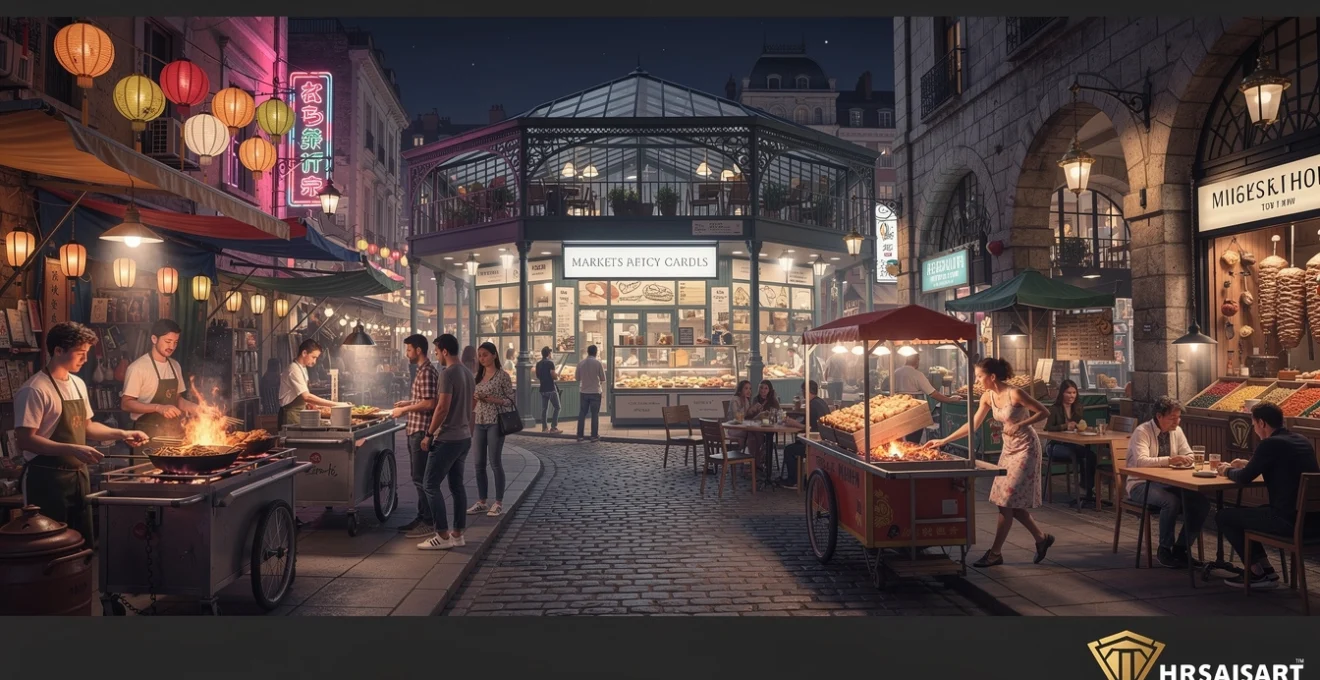
The world transforms after sunset, and nowhere is this metamorphosis more delicious than in the bustling night markets that emerge across the globe. From the neon-lit stalls of Asia’s megacities to the cobblestone charm of European food quarters, after-dark dining has evolved into a sophisticated cultural phenomenon that transcends mere sustenance. These nocturnal food ecosystems represent the intersection of tradition, innovation, and urban development, creating spaces where authentic flavours meet contemporary dining expectations. The night food scene has become a critical component of modern tourism infrastructure, generating billions in revenue while preserving cultural heritage through culinary expression.
Asian night market culinary ecosystems: street food infrastructure and vendor networks
Asian night markets represent the pinnacle of organised street food culture, demonstrating how centuries-old traditions can adapt to modern urban demands whilst maintaining their authentic character. These markets operate as complex ecosystems where vendor relationships, customer flow patterns, and municipal regulations converge to create uniquely efficient food service environments. The success of Asian night markets lies not merely in their culinary offerings, but in their sophisticated understanding of space utilisation, crowd management, and supply chain logistics.
The economic impact of these markets extends far beyond individual transactions. In Taiwan alone, night markets contribute approximately £2.3 billion annually to the economy, supporting over 180,000 jobs directly and indirectly. This economic engine relies on intricate vendor networks where suppliers, cooks, and service staff work in carefully orchestrated shifts to maintain consistent quality throughout extended operating hours.
Shilin night market taipei: High-Density food court operations and traffic flow management
Shilin Night Market exemplifies the art of maximising culinary diversity within constrained urban spaces. This 30,000 square metre complex accommodates over 500 food vendors whilst maintaining pedestrian flow rates that would challenge many shopping centres. The market’s underground food court demonstrates innovative crowd control methodologies, using designated eating zones and strategic vendor placement to prevent bottlenecks during peak hours between 8pm and midnight.
The vendor allocation system at Shilin operates on a sophisticated rotation basis, ensuring that both established operators and emerging culinary entrepreneurs have access to premium locations. This approach has fostered innovation, with vendors constantly developing new dishes to maintain competitive advantage. The famous *xiaolongbao* queues, whilst appearing chaotic to visitors, actually follow precise service protocols that maximise throughput whilst preserving the traditional steaming process that cannot be rushed.
Chatuchak weekend market bangkok: Multi-Zone food distribution and vendor specialisation patterns
Bangkok’s Chatuchak Weekend Market demonstrates how zoning strategies can enhance both vendor efficiency and customer experience in large-scale night food operations. The market’s transition from daytime retail to evening food service involves a complete transformation of infrastructure, with temporary kitchens emerging in spaces that host clothing stalls during daylight hours. This dual-use approach maximises land utilisation whilst creating distinct atmospheres for different operating periods.
The vendor specialisation patterns at Chatuchak reflect broader trends in Asian food culture, where *expertise depth* takes precedence over *menu breadth*. Individual stalls focus on perfecting single dishes or closely related items, creating quality standards that rival established restaurants. The som tam vendors, for instance, prepare over 15 variations of papaya salad, each requiring specific preparation techniques and ingredient sourcing that has been refined over generations.
Donghuamen night market beijing: traditional hutong food stall architecture and service models
Donghuamen Night Market represents the preservation of traditional Chinese street food culture within Beijing’s rapidly modernising urban landscape. The market’s architecture deliberately incorporates elements of hutong design, using narrow corridors and intimate stall configurations that recreate the neighbourhood food culture that characterised old Beijing. This design philosophy prioritises authentic cultural experience over operational efficiency, demonstrating how night markets can serve as cultural preservation vehicles.
The service models employed at Donghuamen emphasise artisanal preparation methods that have become increasingly rare in modern Chinese cities. Vendors still hand-pull noodles, char meats over traditional charcoal braziers, and prepare dumplings using techniques passed down through family lines. These methods, whilst labour-intensive, create distinctive flavour profiles that cannot be replicated through industrial food preparation.
Myeongdong night market
Myeongdong Night Market in Seoul illustrates how a traditional street food district can reinvent itself as a showcase for K-food while absorbing global street food influences. Operating primarily along pedestrian shopping streets rather than in a single enclosed complex, this market relies on mobile stalls that roll into place each evening, transforming a retail zone into a dense corridor of grills, griddles and steaming pans. The core offer remains distinctly Korean – think tteokbokki, hotteok and skewered grilled meats – yet many vendors experiment with international formats, such as corn dogs layered with mozzarella and fries, or macarons filled with matcha and red bean.
From an operational standpoint, Myeongdong’s vendors align their service models closely with retail trading hours, peaking between 6pm and 10pm when both shoppers and tourists converge. Portable infrastructure is crucial: collapsible counters, integrated gas cylinders and modular signage allow stalls to set up and clear out within strict municipal timeframes. For visitors, this means a constantly shifting landscape of choice, where the most successful operators are often those who can respond quickly to social media trends without abandoning core Korean techniques and flavours. If you are looking to understand how K-food travels globally, Myeongdong’s night market is effectively a live R&D lab in the open air.
European after-hours food quarter development: urban planning and licensing frameworks
Across Europe, night food markets and after-hours food quarters operate within far tighter regulatory frameworks than many of their Asian counterparts. Instead of organically evolving from informal street trading, most European evening food districts emerge from deliberate urban planning, zoning decisions and negotiated licensing regimes. City authorities balance noise restrictions, alcohol service rules and heritage conservation with the desire to stimulate a vibrant night-time economy. As a result, many European night food scenes take the form of semi-permanent food halls or upgraded historic markets that extend their operating hours.
This planned approach can bring notable benefits: improved food safety oversight, better waste management systems and more predictable trading conditions for vendors. However, it can also limit spontaneity and slow the entry of new operators, particularly smaller street food entrepreneurs. The most successful European night food markets are those that manage to reconcile these tensions by creating flexible licensing models, shared infrastructure and curated vendor rosters. For travellers and locals, the outcome is a set of spaces where you can move from casual street-style snacks to more structured sit-down dining without leaving the same urban micro-district.
Borough market london: Late-Night artisan food trading and regulatory compliance systems
London’s Borough Market offers a compelling case study in how a historic daytime market can grow a sustainable after-dark food scene within strict regulatory boundaries. While the core wholesale and retail operations still concentrate on daytime trading, a growing cluster of permanent food outlets, wine bars and specialist restaurants in and around the market now operate into the evening. These venues must comply with Southwark Council’s licensing conditions on alcohol, noise and outdoor seating, leading to carefully managed closing times and capacity controls.
Rather than attempting to run a full-scale night market, Borough has adopted a hybrid model: selected traders and bricks-and-mortar operators stay open later, creating a “market nights” atmosphere without the logistical risks of hundreds of temporary stalls. Shared waste collection, coordinated delivery windows and agreed extraction standards help reduce the environmental footprint and neighbour complaints. For visitors, the key practical insight is timing: if you want to experience Borough after dark, focus on its small plates bars, modern British restaurants and elevated street food vendors tucked into the surrounding arches, rather than expecting the full daytime bustle.
Mercado de san miguel madrid: glass architecture food hall design and extended operating hours
Mercado de San Miguel in Madrid exemplifies the European trend toward enclosed gourmet food halls with long evening trading hours. Encased in an iron-and-glass structure dating from the early 20th century, the market has been reimagined as a curated collection of tapas bars, dessert counters and specialist produce stands. Here, night-time operations benefit from controlled access points, centralised cleaning teams and temperature management systems, all of which support consistent food safety standards even during peak late-night service.
The market’s licensing framework allows many stalls to serve alcohol until midnight or later, turning the space into a social hub where locals and tourists share counter space over small plates. Operationally, its extended hours are supported by staggered staff shifts and delivery schedules that prioritise early-morning restocking to minimise disruption. If you are planning a visit, think of Mercado de San Miguel not as a budget street food stop, but as a premium night food experience where you can sample multiple regional Spanish specialities under one roof while observing how design and regulation work together.
Naschmarkt vienna: historic market preservation with contemporary night dining integration
Vienna’s Naschmarkt demonstrates how a city can preserve a historic open-air market while weaving in modern night dining options. By day, the market is dominated by fresh produce, spices and speciality food shops; as evening approaches, a parallel layer of bars and restaurants that line the market’s central spine comes to life. These venues operate under standard restaurant and bar licences rather than street trading permits, which means fixed kitchens, indoor dining areas and permanent utilities rather than mobile stalls.
This dual system allows Naschmarkt to retain its visual identity – wooden stalls, traditional awnings, long rows of kiosks – while meeting contemporary hygiene and safety requirements. For night-time visitors, the experience feels more like a linear restaurant quarter than a chaotic night bazaar, yet the proximity to daytime traders helps maintain a sense of continuity. If you want to explore European night food markets but prefer a calmer, reservation-friendly environment, Naschmarkt offers a template where heritage and modern dining coexist comfortably.
Grand bazaar istanbul: ottoman-era food vendor heritage and modern night economy adaptation
Although the Grand Bazaar in Istanbul is best known as a daytime trading labyrinth, its surrounding streets and satellite alleys host a vibrant after-dark food scene that draws on centuries of Ottoman food vendor heritage. Tea houses, dessert shops and kebab stands extend their hours into the evening, serving both late-working locals and visitors exploring the old city after sunset. Unlike purpose-built night markets, there is no single defined “night bazaar”; instead, food culture seeps into doorways, side streets and courtyard cafés, creating a dispersed but interconnected network.
Modern licensing rules, fire safety regulations and heritage protection laws shape what can and cannot be modified within the historic structures. Many food businesses therefore focus on incremental upgrades – improved refrigeration, stainless-steel prep areas, better ventilation – while preserving the visual fabric of arched ceilings and tiled interiors. For curious eaters, this means you can taste baklava, grilled meats and salep in spaces that still carry the atmosphere of earlier trading eras, yet operate with 21st-century safety expectations.
Latin american nocturnal food culture: regional specialities and service methodologies
Across Latin America, nocturnal food culture is less about formalised markets and more about dispersed networks of carts, puestos and family-run fondas that emerge as temperatures cool. From Mexico City’s taco al pastor stands to Lima’s anticuchos grills and Bogotá’s arepa vendors, evening and late-night trade can account for a significant share of daily turnover. These operations often rely on highly standardised menus built around a small number of regional specialities, enabling fast service throughput and simplified supply chains.
Service methodologies in Latin American night food environments prioritise speed, informality and repeat local custom. Seating, if available, tends to be modular – plastic stools and folding tables that can be deployed or packed away in minutes. For travellers, the challenge is often not finding food, but choosing between overlapping offers and understanding local etiquette. Do you order at the cart and pay per item, or sit down and settle the bill at the end? Observing regulars for a few minutes usually reveals the system, and in many cases, vendors are happy to explain their process when asked.
Middle eastern and north african night food service models: cultural authenticity and tourism integration
In the Middle East and North Africa (MENA) region, night food markets and evening street dining are deeply tied to social rituals, religious calendars and climate. High daytime temperatures and long summer evenings encourage families and friends to meet outdoors, often well past midnight. Classic examples such as Marrakech’s Jemaa el-Fnaa square, Amman’s downtown shawarma corridors and the Corniche kiosks of Alexandria show how public spaces can double as large-scale dining rooms. Here, cultural authenticity is not a marketing tagline but a lived reality, as many recipes and service styles have changed little over decades.
At the same time, tourism integration has become an important driver for how these night food scenes are managed and presented. Municipal authorities may pedestrianise certain streets after dark, install improved lighting and invest in sanitation facilities to make them more accessible to international visitors. This raises important questions: how do you enhance comfort and safety without diluting the character that made these markets compelling in the first place? The most successful destinations work with local vendor associations, ensuring that pricing, menu language and service expectations adapt just enough to welcome new audiences while still prioritising local diners.
Operationally, many MENA night markets employ family-based labour models, where multiple generations share responsibilities across cooking, service and procurement. This structure supports remarkable continuity of flavour and technique but can make formalisation and scaling more complex. For travellers, it means that when you sit down for a bowl of harira or a plate of mixed grills after dark, you are often engaging with a micro-enterprise whose identity is inseparable from the family running it. If your goal is to experience genuinely local night food scenes, seeking out these family-run operations beyond the most photographed squares can be particularly rewarding.
Food safety protocols and hygiene standards in after-dark dining environments
As night food markets grow in popularity, food safety and hygiene standards in after-dark environments have come under increasing scrutiny. Operating outdoors or in semi-open structures presents specific challenges: variable ambient temperatures, limited storage space and the need to manage waste and grey water without fixed restaurant-style infrastructure. In response, many city authorities have introduced dedicated night market regulations covering everything from potable water access and waste segregation to mandatory food handler training and inspection schedules.
For example, several Asian and European cities now require night market vendors to complete certified hygiene courses before obtaining or renewing their trading licences. Temperature control for high-risk foods – dairy, meat, seafood – is often mandated through the use of chilled display units and regular probe thermometer checks. Portable handwashing stations, colour-coded cutting boards and clearly labelled ingredient containers may seem like small details, but together they form the backbone of safe night-time food operations.
As a visitor, how can you assess food safety when choosing where to eat at a night market? Visual cues remain powerful: clean work surfaces, frequent glove changes or handwashing, separate tongs for raw and cooked items, and food that is cooked to order rather than left sitting out. Many cities publish hygiene ratings online or display them at stalls, giving you an extra layer of reassurance. While no environment is risk-free, markets that embrace transparent standards and visible hygiene practices tend to maintain stronger reputations and long-term customer loyalty.
Economic impact analysis: night food markets as urban development catalysts
Beyond their culinary appeal, night food markets increasingly function as catalysts for wider urban development. By extending economic activity into the evening, they generate additional employment, support adjacent businesses and help activate underused public spaces. Studies from cities such as Taipei, Seoul and London suggest that well-managed night-time food districts can increase local footfall by 20–40% after standard retail hours, with knock-on benefits for transport operators, retail outlets and cultural venues.
The multiplier effect is particularly evident in neighbourhoods undergoing regeneration. Establishing a curated night market or food hall often serves as a low-risk first step in repositioning an area, attracting early adopters and creative businesses. Over time, improved lighting, greater police presence and increased visitor numbers can shift perceptions of safety and desirability, encouraging further private investment. However, this process is not without trade-offs. Rising property values and rents may price out the very vendors and residents who contributed to the district’s appeal in the first place.
For policy-makers, the challenge is to harness the economic energy of night food markets while managing issues of noise, congestion and gentrification. Tools such as graduated licence fees, rent caps for long-standing traders and reinvestment of market revenues into local community projects can help balance interests. For travellers, understanding this broader context adds another layer to the experience: when you queue for late-night noodles or tapas in a redeveloped warehouse district, you are not just tasting a city’s flavours, you are participating in an urban experiment in how we eat, work and socialise after dark.