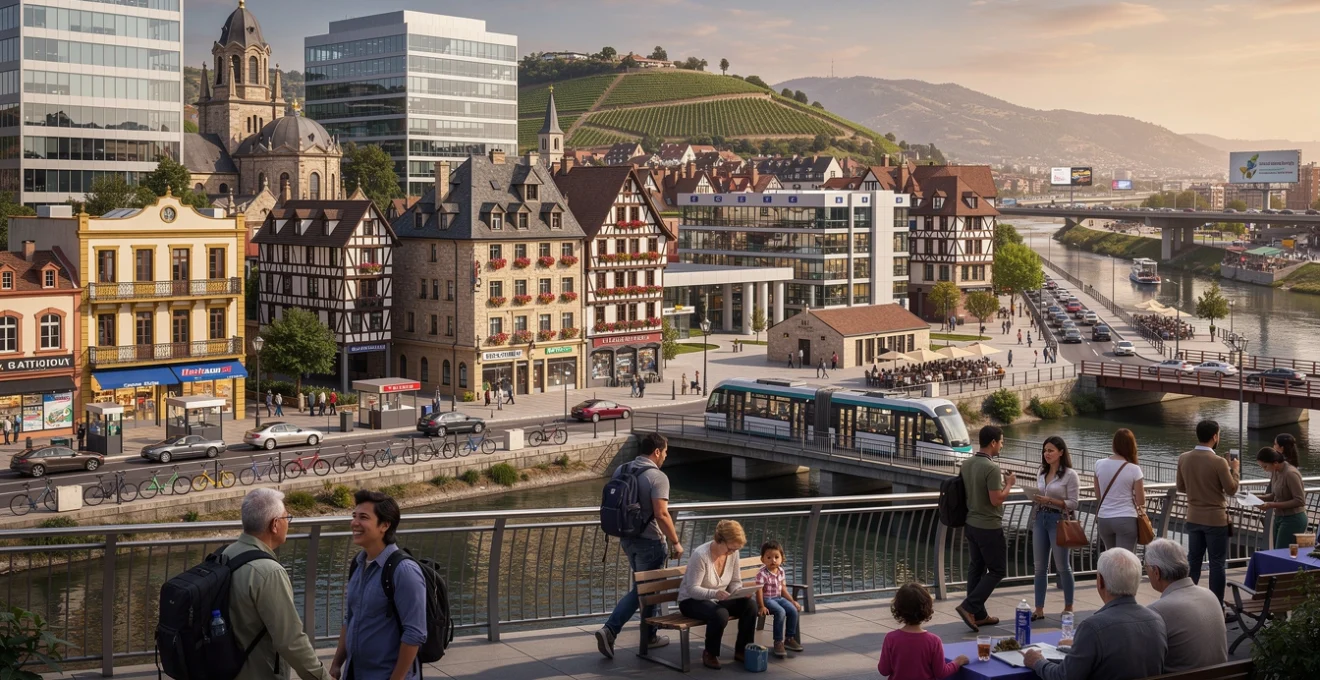
Border towns occupy a unique position in the global landscape, serving as living laboratories where cultures collide, merge, and create something entirely new. These liminal spaces—neither fully one nation nor another—have fascinated anthropologists, urban planners, and travellers for centuries. From the bustling crossings between Mexico and the United States to the quietly integrated communities along European borders, these frontier settlements offer profound insights into human adaptability, economic symbiosis, and the persistence of cultural identity against political division. The approximately 47 million annual crossings at San Ysidro alone demonstrate the vitality of these border communities, whilst simultaneously highlighting the complex dance between sovereignty and integration that defines modern frontier life.
Cross-border urban geography: how frontier settlements create hybrid cultural landscapes
Border towns develop distinctive urban morphologies that reflect their dual nature. Unlike inland cities that grow organically from a single cultural centre, frontier settlements often mirror each other across political boundaries, creating what urban geographers call “twin cities” or binational conurbations. These paired communities share infrastructure, economic systems, and cultural practices whilst maintaining separate legal jurisdictions—a phenomenon that produces fascinating architectural, linguistic, and social outcomes.
The physical landscape of border regions tells stories of convergence and divergence. Streets that run parallel to international boundaries often display dramatically different building codes, signage regulations, and public space utilisation within metres of each other. Yet despite these visible distinctions, deeper patterns of cultural exchange create hybrid spaces that belong fully to neither nation. Markets selling goods from both countries, restaurants serving fusion cuisine, and public squares where multiple languages intertwine demonstrate how frontier populations navigate between regulatory systems whilst building shared communities.
Architectural vernacular in Tijuana-San diego: blending spanish colonial and american modernism
The Tijuana-San Diego metropolitan region exemplifies architectural hybridity born from proximity. Tijuana’s built environment showcases Spanish Colonial revival elements alongside mid-century American commercial architecture, creating a distinctive aesthetic that reflects decades of cross-border influence. Building materials, construction techniques, and design philosophies flow across the border as freely as the architects and builders themselves, many of whom maintain professional practices on both sides.
This architectural conversation extends beyond high-profile projects to everyday residential construction. Homes in border communities often incorporate design elements that address climatic conditions shared across the boundary whilst adapting to different regulatory frameworks. The result is a vernacular architecture that serves as physical evidence of cultural negotiation—walls that tell stories of adaptation, compromise, and creative problem-solving in spaces where two nations meet.
Linguistic Code-Switching patterns along the Strasbourg-Kehl rhine corridor
The Rhine River dividing France and Germany has created one of Europe’s most fascinating linguistic borderlands. In Strasbourg and its German counterpart Kehl, residents routinely engage in sophisticated code-switching between French and German, often within single conversations. This isn’t merely bilingualism—it represents a distinct frontier linguistic practice where word choice reflects subtle cultural negotiations and identity positioning.
Research into Rhine corridor speech patterns reveals that border residents develop unique vocabularies incorporating terms from both languages, particularly for concepts related to cross-border commerce, bureaucracy, and daily life. Unlike formal language instruction, these linguistic adaptations emerge organically from practical necessity. Children growing up in these communities often acquire trilingual competency (including English) as a natural consequence of their environment, demonstrating how border town populations develop cognitive flexibility that serves them throughout their lives.
Culinary fusion ecosystems in basel’s dreiländereck triangle
Where Switzerland, France, and Germany meet near Basel, culinary traditions have blended to create one of Europe’s most distinctive regional cuisines. The Dreiländereck (Three Countries Corner) hosts restaurants where French culinary techniques meet German portion sizes and Swiss precision, often within single menus. This isn’t fusion cuisine in the contemporary chef-driven sense—it’s authentic regional cooking that has evolved over generations of cultural exchange.
Market halls in this tri-border region showcase produce, meats, and specialty items from all three countries, with vendors fluent in multiple languages and currencies. The food culture here demonstrates how proximity breeds innovation—chefs and home cooks alike draw inspiration from neighbouring traditions whilst maintaining distinct regional identities. Wine from Alsace pairs with
wine from Baden and cheeses from the Swiss Jura in ways that feel entirely natural to locals yet delightfully unexpected to visitors. For travellers, following these cross-border foodways becomes a practical way to understand how political lines on a map are softened daily by shared tastes, seasonal rhythms, and family recipes that ignore customs posts.
These culinary fusion ecosystems also support a dense network of small producers and independent restaurants that benefit from cross-border tourism. Weekenders from Zurich might cross into France for an afternoon at a farmhouse inn, while German shoppers come into Switzerland for specialty chocolates or high-end patisserie. Over time, such habits create an invisible mesh of economic and social ties that bind the tri-border region together more tightly than any formal treaty.
Religious syncretism in nogales: Catholic-Protestant interface architecture
On the U.S.–Mexico border at Nogales, religious life mirrors the broader hybridity of the frontier. Church facades, shrines, and informal worship spaces blend Catholic iconography with architectural cues more typical of U.S. Protestant congregations: simple box structures, multipurpose halls, and modular signage. It is not unusual to find a modest stucco chapel with a traditional cross-sharing streetscape with a steel-framed worship centre whose branding and interior layout could belong to a suburban megachurch.
This interface architecture reflects not only theological diversity but also the practical realities of transnational congregations. Families may attend Mass in Sonora on one weekend and a bilingual evangelical service in Arizona the next, carrying devotional practices, music styles, and even building use patterns across the line. The result is a religious landscape where altars coexist with drum kits, votive candles with stackable chairs, and where architectural choices quietly negotiate between older Mexican Catholic traditions and contemporary U.S. evangelical forms.
Public religious events further reinforce this hybrid character. Cross-border processions for the Virgen de Guadalupe, for example, adapt to security infrastructure and checkpoints, turning bridges and ports of entry into temporary sacred corridors. In doing so, they symbolically reclaim the frontier as shared spiritual territory, even as nations assert control over movement. For observers, Nogales shows how border towns can transform rigid lines into flexible spaces of devotion, solidarity, and cultural continuity.
Economic symbiosis: cross-border commerce and labour market integration
Beyond their cultural richness, border towns are powerful engines of economic symbiosis. They operate as gateways for trade, labour mobility, and specialised services, often punching far above their demographic weight in national accounts. Because price levels, regulations, and tax regimes can differ sharply on either side of a frontier, residents, entrepreneurs, and cross-border commuters learn to navigate these contrasts with remarkable sophistication.
Viewed from above, the economic geography of a border region resembles a tightly interlaced mesh rather than two separate markets. Supply chains, retail ecosystems, and service industries criss-cross the line daily, making frontier settlements critical nodes in global and regional networks. Understanding how these cross-border economies function helps explain why many border residents resist simplistic narratives that reduce their home to security concerns alone.
Retail arbitrage dynamics in ciudad del Este–Foz do Iguaçu–Puerto iguazú tri-border area
The tri-border zone where Paraguay, Brazil, and Argentina meet near the Iguazú Falls is one of the world’s most vivid examples of retail arbitrage in action. Ciudad del Este in Paraguay, in particular, has developed into a vast market hub, drawing shoppers from across the region with lower taxes, flexible import regimes, and competitive pricing on electronics, apparel, and household goods. Its streets and shopping centres form a labyrinth where multiple currencies and languages flow as freely as people.
On the Brazilian side, Foz do Iguaçu offers a more regulated commercial environment, with formal retail outlets and tourism services that cater to both domestic and international visitors. Meanwhile, Puerto Iguazú in Argentina balances duty-free shopping with hospitality infrastructure tied to the nearby natural attractions. Together, the three cities create a triangular marketplace where consumers choose where to spend based on exchange rates, product availability, and perceived quality—often on the same day.
For local entrepreneurs, these arbitrage opportunities are both a lifeline and a challenge. Profit margins depend on staying ahead of regulatory changes, customs enforcement patterns, and currency fluctuations. Yet this adaptability is precisely what makes tri-border economies such compelling case studies: they show how border towns function as agile, real-time laboratories of globalisation, long before policy-makers finish their reports.
Daily cross-border commuter flows between geneva and annemasse
On the Franco–Swiss frontier, the Geneva–Annemasse corridor illustrates another facet of border-town economics: labour market integration. Every weekday, tens of thousands of so-called frontaliers commute from France into Switzerland, attracted by higher wages and strong demand in sectors such as finance, healthcare, hospitality, and international organisations. Many then return to homes in the neighbouring Haute-Savoie, where housing costs and some living expenses can be lower.
This daily movement creates a finely tuned ecosystem of cross-border transport, taxation agreements, and social security coordination. Joint institutions manage issues such as income tax sharing, healthcare coverage, and public service funding, recognising that Geneva’s prosperity is inseparable from its French hinterland. For you as a visitor, this integration is visible in the multilingual signage, mixed license plates on commuter trains, and residential developments marketing themselves explicitly to cross-border workers.
But such flows also raise complex questions: How do cities maintain affordable housing when they are magnets for foreign workers? How can public transport systems be planned when commuters are taxed in one country but use infrastructure in another? Geneva–Annemasse shows that, while border towns benefit tremendously from integrated labour markets, they must constantly renegotiate the balance between openness and local sustainability.
Currency exchange microeconomies in the Laredo–Nuevo laredo conurbation
Laredo, Texas, and Nuevo Laredo, Tamaulipas, form one of the busiest land trade corridors between the United States and Mexico. Alongside the truck lanes and freight yards, a more subtle border-town economy thrives: the microeconomy of currency exchange. Dozens of casas de cambio cluster near the bridges, offering competitive rates to shoppers, truck drivers, and families who live binational lives denominated in both dollars and pesos.
These small businesses do far more than swap banknotes. Many offer bill payment services, money transfers, and informal financial advice, acting as community hubs where people learn about cross-border price differentials, seasonal trends, and regulatory shifts. Their posted exchange rates function almost like a public barometer of binational economic health: a sudden swing can alert residents to macroeconomic turbulence long before national headlines filter down.
For border residents, mastering this financial choreography is a daily skill. A family might receive remittances in dollars, pay school fees in pesos, and make mortgage payments pegged to yet another benchmark. In this way, Laredo–Nuevo Laredo demonstrates how border towns cultivate a high level of financial literacy and resilience, born from living at the junction of two monetary systems.
Pharmaceutical tourism infrastructure along the Mexicali–Calexico border
Further west, the twin cities of Mexicali (Mexico) and Calexico (United States) showcase another form of economic symbiosis: pharmaceutical and medical tourism. U.S. residents cross into Mexicali to access lower-cost medications, dental care, and specialist consultations, supported by a dense network of clinics, pharmacies, and medical brokers that orient services toward English-speaking, insured or semi-insured patients.
Over time, this has given rise to a highly specialised urban infrastructure. Streets near the crossing host bilingual signage, shuttle services from parking lots, and waiting rooms designed to reassure patients who may be unfamiliar with Mexican healthcare systems. Clinics often coordinate directly with U.S. laboratories and insurers, smoothing paperwork and follow-up care. For many Americans facing high out-of-pocket costs, these border-town medical corridors provide a pragmatic alternative rather than a symbolic political statement.
However, the benefits are not evenly distributed. Local residents sometimes face upward pressure on prices for certain services, and public systems must adapt to an influx of foreign patients. Policymakers in both countries are increasingly aware that what looks like an individual choice—“I’ll just cross for cheaper medicine”—has systemic implications that need to be managed through bilateral dialogue.
Identity formation in liminal spaces: sociological perspectives on border town populations
Living in a border town means constantly moving between worlds. Sociologists describe these communities as liminal spaces—zones of transition where established categories of nationality, language, and belonging are blurred. In such places, identity is less about ticking a box on a census form and more about negotiating a web of family ties, personal histories, and everyday practices that stretch across frontiers.
Rather than producing confusion, this in-between condition often fosters a distinctive sense of self. Border residents may describe themselves as fronterizos, borderlanders, or simply “from both sides,” asserting an identity that refuses to be fully captured by a single flag. Their experiences—whether of crossing for school every day, speaking multiple languages at home, or dealing with different legal systems—illustrate how borders shape not only movement but also how people understand who they are.
Dual nationality dynamics in Baarle-Hertog and Baarle-Nassau enclaves
The Belgian–Dutch enclaves of Baarle-Hertog and Baarle-Nassau offer a particularly intricate stage for identity formation. Here, the border twists so finely through streets and buildings that some houses are literally divided between two countries, with front doors determining legal jurisdiction. Residents navigate a patchwork of regulations on taxation, schooling, and commercial opening hours, sometimes by simply stepping into another part of the same building.
Many locals hold dual nationality or, at minimum, deep practical familiarity with both legal systems. Children grow up seeing border markers embedded in pavements and café floors, turning the abstract concept of sovereignty into something quite tangible—and mundane. For them, choosing where to shop or which municipality to register a business in is less about national loyalty and more about pragmatic calculation.
Yet this does not mean identity is purely transactional. Community festivals, local sports clubs, and shared schools cultivate a sense of belonging that is simultaneously Belgian, Dutch, and distinctly Baarle. In this microcosm, we see how border-town residents can embrace multiple affiliations without feeling divided, treating the frontier as a resource rather than a line of fracture.
Language preservation movements in Tornio–Haparanda Swedish–Finnish communities
In the twin towns of Tornio (Finland) and Haparanda (Sweden), language is at the heart of borderland identity. Historically part of the same cultural region before 19th-century boundary changes, the area is home to Finnish, Swedish, and Meänkieli (Tornedalian Finnish) speakers. Globalisation and national language policies have sometimes threatened minority tongues, prompting local movements aimed at preservation and revitalisation.
Schools, cultural associations, and media initiatives on both sides of the border promote bilingual and trilingual education, recognising that language skills are both cultural heritage and economic asset. Bilingual signage, cross-listed place names, and joint festivals serve as daily reminders that linguistic diversity is normal in this frontier space. For young people, growing up hearing multiple languages in shops, schools, and family gatherings helps normalise complex identities that span more than one national story.
These efforts matter beyond nostalgia. In a world where smaller languages often struggle to survive, Tornio–Haparanda demonstrates how border towns can function as shelters for linguistic variety. By anchoring language preservation in practical cross-border cooperation—shared libraries, joint teacher training, coordinated curricula—the community links cultural pride with concrete opportunities for the next generation.
Transnational family networks across the el Paso–Ciudad juárez metroplex
On the U.S.–Mexico frontier, the El Paso–Ciudad Juárez metroplex exemplifies the deeply personal dimensions of life in a borderland. Families here are frequently spread across both sides of the Rio Grande, with grandparents in one country, children in another, and cousins crossing back and forth for school, work, or celebrations. Before heightened security measures in the early 21st century, it was common for residents to treat the border almost like a river to be crossed in daily routine, rather than a barrier.
These transnational family networks create dense webs of obligation and support. Remittances, childcare, cross-border caregiving for elderly relatives, and shared investment in property or small businesses all knit the cities together. When political tensions flare or crossings become more difficult, it is these intimate arrangements that feel the impact first—missed birthdays, postponed medical appointments, or delays in delivering essential goods.
Yet the same networks also generate resilience. Many borderlanders develop sophisticated strategies for navigating documentation requirements, work permits, and residency rules, often with the help of community organisations and legal clinics. Their stories remind us that, for millions of people, the border is not an abstract policy debate but a daily negotiation of love, responsibility, and identity.
Heritage tourism and cultural diplomacy in frontier regions
As border towns mature, many leverage their unique position to develop heritage tourism and soft-power initiatives. Instead of being viewed solely as peripheries, these places position themselves as gateways: to neighbouring countries, to shared histories, and to narratives that complicate neat national myths. In doing so, they become laboratories for cultural diplomacy, where visitors can experience cooperation and contestation side by side.
Heritage projects, binational festivals, and cross-border cultural routes all play a role in reshaping public perceptions. When you stroll from one jurisdiction to another on a historic bridge, attend a concert organised by twin municipalities, or follow a wine trail that ignores customs posts, you are participating in a subtle but powerful form of diplomacy—one that unfolds taste by taste, story by story.
UNESCO world heritage site designation in Gorizia–Nova gorica joint european capital of culture 2025
The Italian–Slovenian twin towns of Gorizia and Nova Gorica, jointly designated as European Capital of Culture for 2025, embody this new frontier narrative. Once divided by the Iron Curtain, with physical barriers running through streets and squares, the cities now present themselves as a single cultural space branded Go! Borderless. Their shared programme foregrounds the ways in which post-war divisions have given way to cooperation within the European Union’s Schengen Area.
UNESCO-related heritage initiatives in the region—covering everything from World War I battlefields on the nearby Isonzo Front to historical Jewish sites—are being integrated into cross-border visitor itineraries. Museums coordinate exhibitions, public spaces host bilingual installations, and former checkpoints are reimagined as information centres rather than control points. For travellers, walking from Gorizia to Nova Gorica today is not only a physical journey but a curated experience of Europe’s 20th-century traumas and 21st-century reconciliations.
This transformation illustrates how border towns can shift from symbols of division to showcases of cooperation. By consciously framing their shared history and inviting outside visitors to engage with it, Gorizia and Nova Gorica turn their once-contested frontier into a stage for cultural diplomacy, where art, architecture, and storytelling do the work that once fell to diplomats alone.
Peace park tourism models: Waterton–Glacier international peace park cross-border visitation
In North America, the Waterton–Glacier International Peace Park linking Canada and the United States provides another model of frontier cooperation built around tourism. Established in 1932 as the world’s first International Peace Park, it unites Waterton Lakes National Park in Alberta with Glacier National Park in Montana, emphasising the idea that ecosystems—and visitors—do not recognise political boundaries.
Hiking trails, scenic drives, and interpretive programmes encourage visitors to appreciate the shared natural heritage of the Rocky Mountains region. While border controls still apply, especially in the post-9/11 era, coordinated management of wildlife, fire regimes, and visitor flows underscores the practical necessity of collaboration. When a bear crosses from one side of the line to the other, or a forest fire ignites in a transboundary valley, park authorities must respond as partners rather than as isolated bureaucracies.
For tourists, the Peace Park model offers more than just spectacular scenery. It provides a tangible demonstration that borders can be sites of cooperation rather than conflict, and that environmental stewardship often demands cross-border thinking. In a warming world, such examples of pragmatic collaboration carry symbolic weight far beyond the mountain passes where they are enacted.
Historical narrative contestation in nicosia’s buffer zone museum quarter
Nicosia, the divided capital of Cyprus, presents a more complex and contested picture of heritage and tourism in a frontier setting. The city’s buffer zone, patrolled by the United Nations, cuts through historic neighbourhoods and has frozen many streets in time. Around this zone, museums, memorials, and cultural centres on both the Greek Cypriot and Turkish Cypriot sides offer sharply differing narratives of the island’s modern history.
For visitors, walking through Nicosia’s museum quarter can feel like moving between parallel realities. Exhibitions emphasise different dates, heroes, and traumas, reinforcing distinct national memories even as tourists physically cross checkpoints on foot. Yet recent years have also seen the emergence of initiatives that seek to bridge these narrative divides: joint cultural events, bi-communal heritage restoration projects, and experimental tours that explicitly address multiple perspectives.
Nicosia thus serves as a reminder that border-town heritage is rarely neutral. While cultural diplomacy can soften divisions, historical wounds do not vanish overnight. If we approach such places with curiosity and humility, however, they can also teach us how contested memories coexist—and how future-oriented cooperation might gradually reshape the stories cities tell about themselves.
Gastronomic trail development along the alsatian wine route crossing borders
The Alsatian Wine Route in northeastern France, long famous for its picturesque villages and Riesling vineyards, has in recent decades extended its reach into neighbouring Germany and Switzerland. Cross-border gastronomic trails now invite visitors to explore a trinational terroir, pairing French Alsatian wines with Baden cuisine and Swiss charcuterie in carefully curated itineraries. The result is a culinary landscape where cyclists and drivers cross frontiers as casually as they taste different vintages.
Local tourism boards, vintners’ associations, and restaurant collectives work together to harmonise signage, events calendars, and promotional materials across borders. Wine festivals are scheduled to complement rather than compete with each other, and joint marketing highlights the shared Rhine cultural corridor rather than strictly national branding. For producers, this offers a way to attract international visitors looking for immersive, multi-country food and wine experiences within a compact geographic area.
From the traveller’s perspective, following these cross-border gastronomic routes turns the border itself into an attraction. Tasting similar grape varieties vinified under different regulatory regimes, or comparing how neighbouring villages on opposite banks of the Rhine interpret traditional dishes, makes clear that culture does not stop at customs posts. Instead, it adapts, blends, and sometimes gently resists, offering a nuanced palate of identities that no single nation can fully claim.
Infrastructure challenges: transport networks and urban planning across jurisdictions
To function as integrated spaces, border towns need infrastructure that can keep up with their realities. Yet transport networks, utilities, and planning systems are usually designed within national frameworks, not across them. This creates a constant tension: how do you design a tramline, a bridge, or a water system that serves a single urban region while satisfying two or more sets of laws, standards, and political priorities?
Frontier regions that succeed in this balancing act often do so through painstaking negotiation and innovative governance models. Joint planning bodies, cross-border public authorities, and shared technical standards can help overcome the friction of divided sovereignty. But progress is rarely linear. Each new infrastructure project forces communities and governments alike to confront questions about control, cost-sharing, and long-term commitment.
Integrated public transit systems: the eurodistrict Strasbourg–Ortenau tram extension
The extension of Strasbourg’s tramway across the Rhine into Kehl, Germany, stands as a landmark example of integrated public transport in a border region. Opened in 2017, the line allows passengers to travel between the French city centre and its German neighbour with the same ticket, seamlessly crossing a frontier that, only decades ago, symbolised deep European division. The project required coordination on everything from technical specifications to fare structures and operating subsidies.
For daily commuters, students, and shoppers, the tram extension has transformed perceptions of distance and accessibility. What once felt like a trip “abroad” now resembles moving between districts of a single metropolitan area. Ridership figures exceeded early projections, underscoring latent demand for convenient cross-border mobility. At the same time, the tram’s very visibility—gliding over the river on a distinctive bridge—serves as a physical expression of Franco–German rapprochement.
Yet the project also highlights ongoing challenges. Differences in labour law, public procurement rules, and safety standards required elaborate legal workarounds and bilateral agreements. Maintaining such infrastructure demands continuous political will on both sides of the Rhine. As other border regions consider similar projects, Strasbourg–Ortenau offers both inspiration and a reminder that integration is as much a legal and administrative exercise as an engineering one.
Customs facilitation technology at the Detroit–Windsor ambassador bridge
On the Canada–U.S. border, the Ambassador Bridge between Detroit, Michigan, and Windsor, Ontario, is a critical trade artery, handling a substantial share of automotive and manufacturing goods between the two countries. To keep traffic flowing while maintaining security and regulatory compliance, authorities have invested heavily in customs facilitation technologies: advanced license-plate readers, pre-clearance systems, and integrated data platforms that link shippers, carriers, and inspection agencies.
These systems aim to implement the often-cited principle of “smart borders”: focusing scrutiny where risk is higher while allowing low-risk, pre-vetted cargo to move quickly. For logistics companies and drivers, this reduces costly delays and makes just-in-time manufacturing feasible across the border. For governments, it promises better targeting of enforcement resources without choking off economic activity—a delicate balance in any frontier region.
However, reliance on digital infrastructures and private-public partnerships raises new vulnerabilities. Cybersecurity, data privacy, and unequal access to technology among smaller firms can all create points of friction. As additional cross-border structures like the Gordie Howe International Bridge come online, decision-makers in Detroit–Windsor and beyond will need to ensure that technical sophistication translates into equitable and resilient mobility for both goods and people.
Shared water management protocols in the paso del norte aquifer region
Beneath the surface of the El Paso–Ciudad Juárez region lies another, less visible cross-border infrastructure: the shared aquifers and river systems that supply water to both cities. In an era of climate variability and growing urban demand, managing this resource sustainably has become a pressing challenge. Droughts, extreme heat, and upstream diversions can quickly strain supplies, making coordinated planning essential.
Bilateral institutions and technical committees work to develop shared models of groundwater recharge, extraction limits, and long-term conservation strategies. Desalination plants, wastewater reuse projects, and efficiency campaigns are designed with an awareness that overuse on one side of the border will inevitably affect the other. In this context, the frontier functions less as a line of separation and more as a shared zone of vulnerability and responsibility.
For residents, the politics of water may be less visible than bridges or tramlines, but their impacts are felt in household taps, irrigation channels, and utility bills. As with many border-town issues, the key challenge is aligning time horizons: infrastructure investments last decades, while political cycles are much shorter. Paso del Norte illustrates both the urgency and difficulty of building genuinely transboundary resilience under such constraints.
Geopolitical tensions and cooperation: border towns as diplomatic barometers
Because they sit at the intersection of national jurisdictions, border towns are often the first to feel the effects of geopolitical shifts. Regulatory changes, trade disputes, and security crises can all manifest quickly in frontier regions, altering traffic flows, investment patterns, and even the social atmosphere. In this sense, border settlements function as sensitive barometers of international relations.
At the same time, they can also act as stabilising forces. Longstanding personal relationships, business ties, and shared infrastructures often create constituencies for cooperation, even when national-level rhetoric hardens. By watching how life in these liminal spaces changes—or stubbornly continues—we gain a grounded perspective on the real-world impact of abstract diplomatic decisions.
Post-brexit regulatory divergence in the Dundalk–Newry corridor
The Irish border, particularly around the towns of Dundalk (Republic of Ireland) and Newry (Northern Ireland, UK), has become one of the most scrutinised frontiers in the post-Brexit era. For decades after the Good Friday Agreement, the boundary was effectively invisible, with people and goods moving freely under shared European Union frameworks. The UK’s decision to leave the EU introduced the risk of renewed checks and regulatory divergence in a region where cross-border life had become routine.
In practice, the Northern Ireland Protocol and subsequent Windsor Framework attempted to keep the land border open by shifting many checks to ports and creating complex arrangements for goods moving between Great Britain, Northern Ireland, and the EU. For residents and businesses in the Dundalk–Newry corridor, this has meant adapting to new paperwork, certification requirements, and supply chain uncertainties—especially in agri-food and retail sectors.
Yet everyday life continues to defy simple division. Workers still commute in both directions, families remain interlaced across the line, and shared services—from hospitals to emergency cooperation—remain vital. The corridor’s experience underscores that, while regulatory divergence can be managed on paper, it must align with the lived realities of a population that has grown used to treating the border as a historical artefact rather than a daily obstacle.
Security architecture evolution in the ras al-Khaimah–Musandam exclave interface
In the Gulf region, the interface between the Emirate of Ras al-Khaimah (United Arab Emirates) and Oman’s Musandam exclave illustrates another dimension of border-town geopolitics. Here, rugged mountains plunge into the Strait of Hormuz, a chokepoint for global energy shipments. The area’s strategic significance has led to evolving security architectures that balance local cross-border movement with broader concerns about maritime traffic, smuggling, and regional tensions.
Roads and small ports facilitate daily life for residents who have long navigated between Emirati and Omani jurisdictions for trade, family visits, and employment. At the same time, enhanced surveillance systems, maritime patrols, and controlled crossing points reflect a world in which security cooperation and competition coexist. For travellers drawn by Musandam’s dramatic fjords and diving sites, these dynamics are visible in the layered presence of local police, coast guards, and sometimes foreign naval vessels.
The Ras al-Khaimah–Musandam frontier demonstrates how border regions can be simultaneously peripheral and central: local in their social fabric yet embedded in global strategic calculations. As security architectures evolve, ensuring that community needs remain part of the conversation is crucial if these borderlands are to remain places where cultures meet, rather than zones defined only by military maps.
Cross-border healthcare agreements: the Cúcuta–San antonio del táchira humanitarian corridor
On the Colombia–Venezuela border, the twin cities of Cúcuta (Colombia) and San Antonio del Táchira (Venezuela) have become focal points for humanitarian and healthcare cooperation amid political and economic crisis. As Venezuela’s healthcare system has struggled, many patients have crossed into Colombia seeking medical attention, vaccinations, and essential medicines. In response, international organisations and local authorities have sought to formalise humanitarian corridors and cross-border healthcare agreements.
These arrangements aim to provide safe passage for vulnerable populations—pregnant women, children, the chronically ill—while managing public health risks and administrative burdens. Mobile clinics, vaccination campaigns, and health information points have been set up near crossing areas, often staffed by binational teams who understand the cultural and linguistic context on both sides. For medical professionals, working in this frontier environment demands not only clinical skills but also sensitivity to migration, trauma, and legal precarity.
The Cúcuta–San Antonio corridor highlights both the potential and the limits of border-town cooperation under extreme stress. While local initiatives can alleviate suffering and model pragmatic solutions, they operate within a wider political landscape that may alternately facilitate or obstruct their work. Still, these efforts reaffirm a central theme of border-town life: even in times of tension, the frontier remains a place where human needs and solidarities transcend lines on a map.