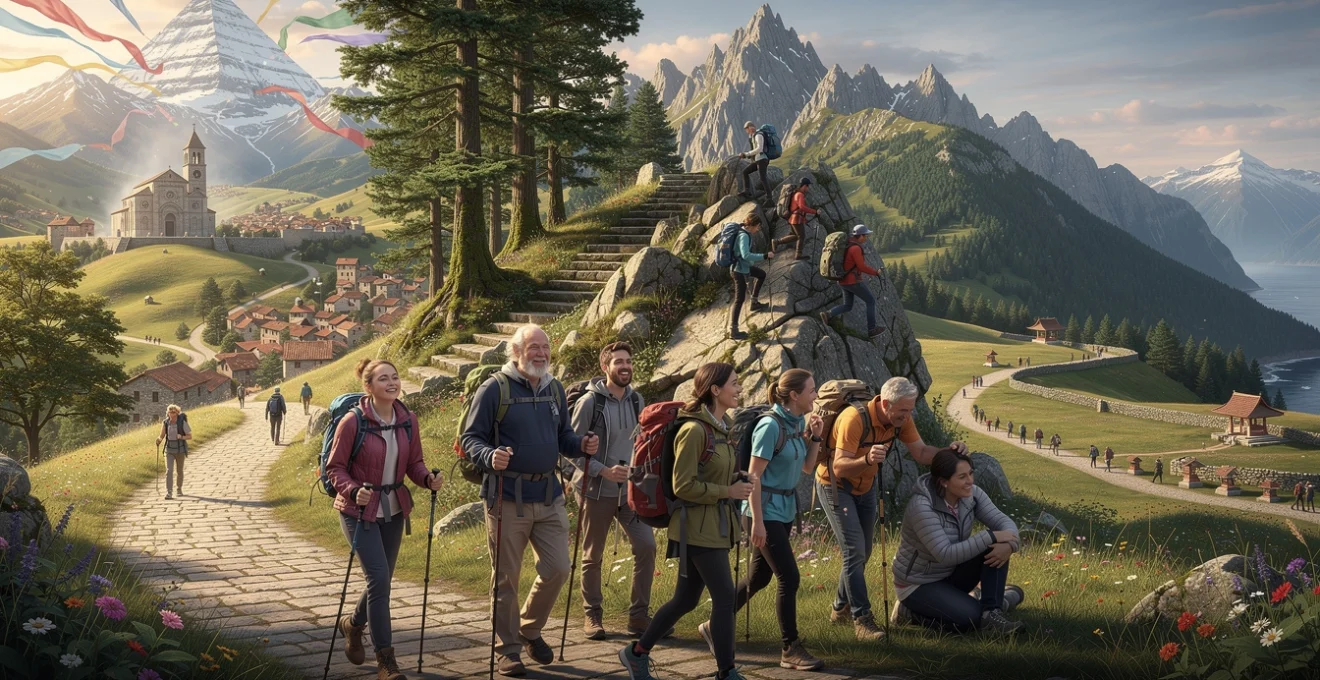
The resurgence of pilgrimage in our secular age presents a fascinating paradox. While traditional religious observance declines across the Western world, millions of people are lacing up their walking boots and embarking on journeys along ancient sacred routes. From the Camino de Santiago attracting nearly 400,000 walkers annually to forgotten medieval paths being revived across Europe, these journeys offer something beyond spiritual salvation. They provide profound experiences of personal transformation, cultural discovery, environmental connection, and therapeutic healing that transcend religious boundaries.
Modern pilgrimage represents a convergence of multiple human needs: the desire for authentic experience in an increasingly digital world, the search for meaning beyond material success, and the pursuit of physical and mental wellbeing through immersive travel. These ancient pathways have evolved into multifaceted networks serving diverse contemporary purposes, from heritage preservation and economic regeneration to cutting-edge therapeutic interventions and environmental conservation.
Ancient pilgrimage routes as cultural heritage corridors
Historic pilgrimage routes function as living museums, preserving centuries of human culture, art, and tradition. These pathways represent some of Europe’s most significant cultural heritage corridors, connecting medieval towns, Romanesque churches, and traditional crafts that might otherwise be forgotten. The transformation of these routes from purely religious journeys to comprehensive cultural experiences reflects our contemporary understanding of heritage as dynamic rather than static.
Santiago de compostela’s camino frances: literary and artistic renaissance
The Camino Frances has become a catalyst for literary and artistic revival across northern Spain. Villages along the 800-kilometre route have witnessed a renaissance of traditional crafts, with local artisans finding new markets among international pilgrims seeking authentic cultural souvenirs. Contemporary artists have established studios in former pilgrim hostels, creating modern interpretations of medieval themes. The route’s cultural impact extends beyond Spain, inspiring literary festivals, photography exhibitions, and documentary projects that explore themes of journey, transformation, and human connection.
Writers and artists regularly undertake the Camino as creative residencies, producing works that blend personal narrative with historical reflection. This artistic engagement has generated a new genre of travel literature that moves beyond simple memoir to explore deeper questions of meaning, purpose, and cultural identity in the modern world.
Via francigena’s medieval trade network revival
The Via Francigena, stretching from Canterbury to Rome, represents one of Europe’s most ambitious heritage preservation projects. Originally a crucial medieval trade route, its modern revival has reactivated economic networks across four countries. Local communities have rediscovered traditional food production methods, with pilgrims driving demand for authentic regional cuisine prepared using historical recipes and techniques.
The route’s restoration has sparked academic interest in medieval commerce and cultural exchange. Universities along the path now offer specialised courses in medieval studies, using the route as a practical laboratory for understanding historical migration patterns, trade relationships, and cultural diffusion. This academic engagement has elevated the Via Francigena beyond tourism to become a significant educational resource.
Kumano kodo’s forest therapy and ecological preservation
Japan’s Kumano Kodo network demonstrates how ancient spiritual paths can serve contemporary environmental and wellness objectives. The forest bathing practices integral to Japanese culture have found new expression through guided pilgrimage experiences that combine traditional walking meditation with modern forest therapy techniques. Scientific research conducted along these routes has documented measurable benefits including reduced cortisol levels, improved immune function, and enhanced psychological wellbeing.
The preservation of the Kumano Kodo has become a model for sustainable tourism development. Local communities have implemented sophisticated visitor management systems that protect fragile ecosystems while providing economic opportunities through traditional accommodation and cuisine services. The integration of ancient wisdom with contemporary environmental science offers valuable insights for heritage site management worldwide.
Shikoku henro’s contemporary mindfulness tourism
The 88-temple circuit of Shikoku has evolved into a leading destination for mindfulness-based tourism. The structured nature of the traditional pilgrimage, with its defined stages and ritual elements, provides an ideal framework for contemporary meditation practices. International visitors increasingly combine the physical challenge of the 1,200-kilometre journey with intensive mindfulness training, often working with Buddhist teachers to develop sustained attention and emotional regulation skills.
This slow, repetitive rhythm of walking, pausing, and reflecting has made the Shikoku Henro especially attractive to people seeking stress reduction and mental clarity rather than traditional religious merit. Local communities have responded by developing simple, pilgrim-friendly accommodation, multilingual waymarking, and educational materials that explain the cultural context without assuming Buddhist belief. In this way, the Henro has become a bridge between ancient monastic practices and contemporary interests in mindfulness, “digital detox,” and long-distance walking as a form of mental health care.
Secular walking networks for personal transformation
Alongside revived sacred routes, explicitly secular long-distance trails now function as modern pilgrimage routes, even when they have no formal religious focus. These paths attract walkers who are less interested in venerating saints than in testing their limits, tracing industrial history, or reconnecting with wild landscapes. Yet the core elements of pilgrimage remain: a clear route, a meaningful destination, and an inner journey shaped by the physical demands of the trail. Many hikers describe these routes as life markers, using them to navigate career changes, grief, or questions of identity.
GR20 corsican trail: psychological resilience building
The GR20 in Corsica is often described as one of Europe’s toughest waymarked trails, with rugged ascents, exposed ridges, and unpredictable mountain weather. For many, tackling its 180 kilometres is less about scenery alone and more about developing psychological resilience. Multi-week exposure to physical challenge, managed risk, and simple daily routines (walk, eat, sleep, repeat) creates a laboratory for observing how we respond to fear, fatigue, and frustration.
Outdoor psychologists increasingly use trails like the GR20 as case studies in resilience training, noting how repeated small successes—navigating a tricky scree slope, enduring a storm at a refuge—translate into greater self-efficacy back home. If you arrive on the trail after burnout or a period of uncertainty, the GR20 can act like a pressure cooker that quickly reveals habitual coping strategies. With the right preparation and support, that intensity becomes a structured rite of passage rather than mere hardship.
Pennine way’s industrial heritage documentation
Britain’s Pennine Way runs like a spine up the country, crossing moorland, mill towns, and former mining communities. While celebrated as a wilderness route, it is also an open-air archive of the Industrial Revolution, connecting disused railway lines, gritstone quarries, and canal systems that once powered the British economy. Walking the Pennine Way becomes a way of documenting industrial heritage with your own feet, tracing how landscapes of production have become spaces of recreation.
Heritage organisations and local councils along the route have developed interpretive boards and mobile apps that highlight abandoned lead mines, textile mills, and workers’ settlements. For walkers curious about social history, these resources transform the trail into a narrative of labour, class struggle, and environmental change. You are not just traversing hills; you are walking through the layered stories of those who dug, built, and endured in these harsh upland environments.
Appalachian trail’s environmental activism catalyst
In the United States, the 3,500-kilometre Appalachian Trail has long been associated with personal reinvention, but it also functions as an incubator for environmental activism. Many thru-hikers begin their journey attracted by the physical and psychological challenge, yet months immersed in fragile ecosystems often sharpen their awareness of conservation issues. When you watch forests shift with altitude, encounter invasive species, or see the impact of erosion and climate extremes, environmental headlines suddenly have a visceral, local meaning.
Non-profit organisations connected to the trail, such as the Appalachian Trail Conservancy, actively harness this shift in perception by offering citizen science projects and volunteer maintenance days. Former hikers frequently become advocates for public land protection, sustainable trail use, and climate policy. The trail thus operates like a long, winding classroom, turning casual outdoor enthusiasts into informed guardians of the landscapes they have come to love.
Te araroa new zealand’s indigenous cultural immersion
New Zealand’s Te Araroa, “The Long Pathway,” stretches from Cape Reinga to Bluff, linking beaches, forests, farmland, and urban zones over more than 3,000 kilometres. What sets it apart as a modern pilgrimage route is its potential for engagement with Māori culture and concepts of whenua (land) and kaitiakitanga (guardianship). Many sections pass close to marae (meeting grounds) and sites of historical significance, offering opportunities to learn about Treaty history, traditional place names, and local stories.
For non-Māori walkers, Te Araroa can become an extended cultural immersion if approached with humility and curiosity rather than as a mere endurance challenge. Trail organisations increasingly encourage hikers to understand protocols (tikanga), seek local guidance where appropriate, and recognise they are guests on ancestral land. In this way, the trail functions less like a neutral line across a map and more like a thread stitching together diverse communities and perspectives.
Coast to coast walk’s social connectivity framework
Alfred Wainwright’s Coast to Coast Walk, running from St Bees on England’s Irish Sea coast to Robin Hood’s Bay on the North Sea, is not an official national trail, yet it has achieved iconic status. Its great appeal lies in the informal social network that has grown around it: B&Bs, village pubs, luggage transfer services, and small businesses that now sync their calendars to the walking season. For many, the route becomes a social pilgrimage as much as a geographical one.
Because most people walk eastward and follow similar daily stages, you repeatedly encounter the same faces—a loose, temporary community who share blisters, weather forecasts, and stories. Solo walkers, in particular, often find the Coast to Coast an accessible way to experience both independence and connection. In a world where many of us feel isolated despite constant digital contact, the trail offers an analogue social network formed by shared effort and shared horizon.
Therapeutic pilgrimage models in modern healthcare
As evidence grows for the mental and physical health benefits of time in nature, structured walking journeys are beginning to appear in therapeutic settings. Clinicians, chaplains, and outdoor therapists are adapting pilgrimage frameworks to support patients dealing with grief, addiction, trauma, and chronic stress. While these programmes may reference particular spiritual traditions, they are increasingly designed to be inclusive of diverse beliefs, focusing on embodied experience, ritualised movement, and reflective practice.
Meditation circuit integration at mount kailash
Mount Kailash in Tibet has long been revered by multiple faiths, yet in recent years, secular and interfaith meditation groups have begun to integrate the mountain’s 52-kilometre kora (circumambulation) into structured retreats. These programmes often blend traditional practices—such as prostrations or mantra recitation—with contemporary mindfulness and breathwork techniques. The aim is not to appropriate specific doctrines but to use the circular journey as a framework for sustained contemplative attention.
Because the high altitude and challenging conditions demand careful pacing, facilitators typically schedule regular pauses for guided meditation, body scans, and journalling. Participants learn to observe fluctuating sensations—shortness of breath, tiredness, elation—without panic or attachment, much as they would observe thoughts in a meditation hall. In this sense, the Kailash circuit becomes a moving monastery, an environment that nurtures insight into impermanence, interdependence, and the limits of individual control.
Grief processing pathways on celtic coastal routes
Celtic coastal routes in places like Wales, western Ireland, and Scotland are emerging as powerful settings for grief-focused pilgrimages. Their combination of ancient sacred sites, dramatic sea views, and weather-worn chapels creates a natural backdrop for contemplating loss and continuity. Some hospices and bereavement charities now offer guided walks along these paths, framing them as “grief journeys” where participants can externalise inner transitions by physically moving through landscapes shaped by tides and storms.
Structured exercises might include leaving written messages in quiet coves, engaging in simple rituals at holy wells, or sharing stories around evening fires. The steady sound of the sea provides a kind of acoustic holding environment, mirroring the ebb and flow of emotions. For people who feel stuck in their mourning, the act of walking each day—sometimes in silence, sometimes in conversation—offers a gentle, embodied way to process complex feelings that can be hard to access in a clinical room.
Addiction recovery programs through ignatian spirituality walks
Ignatian spirituality, with its emphasis on discernment, reflection, and finding the sacred in everyday experience, has inspired several walking-based recovery programmes. Jesuit centres and affiliated organisations in Europe and the Americas have experimented with structured “Ignatian Caminos,” where people in addiction recovery walk sections of traditional routes like the Camino de Santiago while following adapted versions of the Spiritual Exercises. These journeys are not limited to practising Catholics; many are open to people of any or no faith who resonate with the introspective framework.
Daily routines often combine morning movement meditations, periods of silent walking, and evening group reflection using Ignatian tools such as the Examen (a guided review of the day’s experiences). The physical effort of walking supports detoxification and sleep regulation, while the reflective components help participants examine triggers, patterns, and desires with greater clarity. As you might expect, the symbolism of “taking one step at a time” on the trail aligns powerfully with the incremental nature of recovery.
PTSD treatment protocols via wilderness pilgrimage therapy
For individuals living with post-traumatic stress disorder (PTSD), carefully designed wilderness pilgrimages are being explored as adjuncts to conventional therapies. These protocols—sometimes called “wilderness pilgrimage therapy”—typically involve multi-day walks in remote but managed environments, facilitated by teams that include mental health professionals and experienced outdoor guides. Routes are chosen not for religious significance but for their capacity to offer challenge, safety, and a sense of awe.
Sessions of trauma-informed practices—such as grounding exercises, controlled breathing, and gradual exposure to mild stressors—are woven into the walking day. Nightly debriefs allow participants to link responses on the trail (startle reactions, avoidance, hypervigilance) with their broader symptom patterns. Early research suggests that combining evidence-based treatments like EMDR or cognitive processing therapy with extended time in nature may enhance outcomes, in part because the landscape itself models resilience: forests that regrow after fire, coastlines reshaped yet not destroyed by storms.
Economic regeneration through heritage trail development
Beyond individual transformation, pilgrimage routes and long-distance trails have proven to be powerful tools for rural economic regeneration. When managed thoughtfully, they shift visitor flows away from overcrowded cities to smaller communities, distributing tourism income more evenly. Accommodation providers, cafés, luggage transport companies, and local artisans all benefit from the predictable seasonal rhythm of walkers passing through. What begins as a spiritual or recreational path can quickly become a backbone for local development strategies.
European regions along the Camino de Santiago and Via Francigena have documented substantial economic gains from route revitalisation, with some studies estimating that each pilgrim spends between €30 and €50 per day in local economies. Importantly, these benefits often extend to areas previously facing depopulation and declining agricultural incomes. When a village reopens its last bar or converts an empty house into a simple hostel, it is not just catering to outsiders; it is also restoring social infrastructure for residents.
However, the economic potential of pilgrimage routes comes with real risks. Without clear zoning, carrying capacity assessments, and community consultation, trails can drive up property prices, strain water supplies, and transform quiet villages into seasonal theme parks. Sustainable models prioritise locally owned businesses, slow growth, and reinvestment in heritage conservation. They also encourage visitors to travel in shoulder seasons, use public transport, and respect local customs, ensuring that economic regeneration does not come at the cost of cultural erosion.
Digital age pilgrimage: virtual reality and augmented walking experiences
In an age where much of life is mediated through screens, it might seem odd that pilgrimage—so rooted in physical movement—is thriving. Yet digital technologies are reshaping how we plan, experience, and even simulate pilgrimage routes. Smartphone apps now provide GPS navigation, historical commentary, and community forums in multiple languages, allowing you to access local knowledge with a tap. Social media networks create virtual pilgrim communities that share real-time advice, encouragement, and reflections across continents.
More experimentally, virtual reality (VR) projects are offering immersive tours of sacred routes to people who cannot physically travel due to disability, financial constraints, or global crises. For instance, 360-degree video walks along sections of the Camino or Kumano Kodo enable hospital patients or care home residents to “join” a journey from their chairs. While a VR pilgrimage cannot replicate the fatigue in your legs or the smell of pine forests after rain, it can still evoke a sense of wonder and connection, much like reading a powerful travel memoir.
Augmented reality (AR) is also beginning to enrich on-the-ground experiences. Imagine pointing your phone at a ruined monastery and seeing a reconstruction of its medieval form, or receiving audio stories triggered by GPS as you cross a historic battlefield. Used sparingly, these tools can deepen your engagement with place rather than distract from it. The key question, of course, is whether we let technology become another layer of noise—or whether we use it as a subtle guide that helps us pay closer attention to the path beneath our feet.
Environmental conservation through sacred geography protection
Many pilgrimage routes pass through landscapes that are ecologically sensitive as well as culturally significant. This overlap has given rise to the concept of “sacred geography,” where environmental protection is motivated not only by biodiversity goals but also by respect for sites imbued with spiritual or historical meaning. When a forest is understood as both a carbon sink and the setting of an ancient vision or miracle, arguments for its conservation gain extra moral and emotional weight.
Conservation organisations are increasingly partnering with religious institutions, local elders, and pilgrim associations to protect these shared spaces. Examples include designating buffer zones around holy mountains, regulating visitor numbers at sacred springs, and promoting low-impact infrastructure such as boardwalks and composting toilets. In some regions, walkers are invited to participate in habitat restoration days—planting native trees, removing litter, or helping to monitor wildlife—turning their journey into a form of practical stewardship.
For modern pilgrims and long-distance walkers, this raises a simple but challenging invitation: can our search for meaning go hand in hand with a commitment to reduce our ecological footprint? Choosing routes accessible by train, supporting eco-certified accommodations, carrying reusable bottles, and staying on marked paths are small but significant acts. Just as ancient pilgrims understood themselves as guests on sacred ground, we too can approach these landscapes with a blend of curiosity, gratitude, and responsibility, recognising that every footprint is both literal and symbolic.