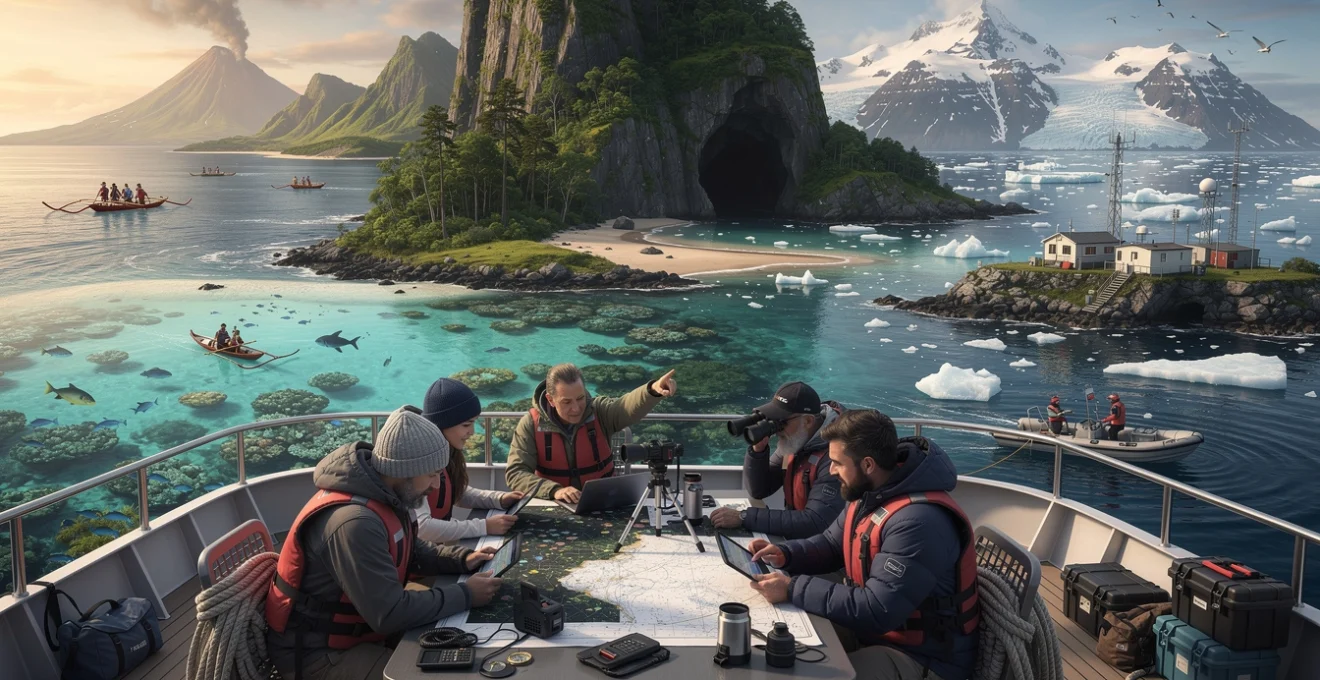
Beyond the well-trodden paths of Santorini’s sunset crowds and the Maldives’ overwater bungalows lies a world of extraordinary archipelagos that remain largely untouched by mass tourism. These remote island chains offer something far more valuable than Instagram-worthy backdrops: they provide genuine encounters with pristine ecosystems, authentic cultures, and landscapes that challenge our understanding of what tropical and polar paradises can be. From volcanic formations rising from Antarctic waters to coral atolls monitoring climate change in real-time, these lesser-known archipelagos represent some of the planet’s most significant natural laboratories and cultural treasures. The challenge isn’t finding these destinations—it’s accessing them responsibly while contributing to their preservation and understanding their profound scientific importance.
Remote archipelagos of the south pacific: vanuatu’s outer islands and tuvalu’s pristine atolls
The South Pacific conceals some of the world’s most extraordinary island chains, where traditional navigation techniques still guide seafarers and coral reefs serve as living climate monitoring stations. These archipelagos represent biodiversity hotspots that harbour endemic species found nowhere else on Earth, whilst simultaneously functioning as crucial research platforms for understanding ocean acidification, sea-level rise, and marine ecosystem adaptation.
Vanuatu’s banks and torres islands: volcanic formations and traditional navigation
The Banks and Torres Islands, located at Vanuatu’s northernmost frontier, showcase a remarkable fusion of active volcanism and maritime cultural heritage that spans over 3,000 years. These 13 islands support approximately 8,000 residents who maintain traditional navigation systems using wave patterns, bird behaviour, and stellar observations—knowledge that modern GPS technology cannot replicate.
Gaua Island’s Mount Garet remains one of the region’s most accessible active volcanoes, featuring a crater lake at 800 metres elevation that serves as a natural laboratory for volcanological research. The island’s unique geological composition creates microclimates that support endemic bird species, including the critically endangered Vanuatu megapode, which uses volcanic heat to incubate its eggs.
Traditional outrigger canoe construction on Vanua Lava Island demonstrates sophisticated engineering principles that enable vessels to navigate the treacherous waters between volcanic peaks. Local craftsmen select specific timber species based on their density and flexibility characteristics, creating vessels capable of withstanding the powerful swells generated by underwater volcanic activity.
Tuvalu’s funafuti conservation area: coral reef biodiversity and climate monitoring
Tuvalu’s Funafuti Atoll operates as one of the Pacific’s most critical climate monitoring stations, where coral bleaching events are documented in real-time and sea-level measurements contribute to global climate models. The atoll’s unique geography—a narrow ring of coral islands surrounding a central lagoon—creates ideal conditions for studying the relationship between ocean temperature fluctuations and coral adaptation mechanisms.
The Funafuti Conservation Area encompasses 33 square kilometres of marine protected zones where researchers have identified over 350 fish species and 40 coral varieties, many of which demonstrate remarkable resilience to temperature variations. These coral communities serve as natural archives, with core samples revealing climate patterns dating back centuries through their growth ring structures.
Traditional Te Ika fishing techniques practised by Tuvaluan communities provide valuable data about fish population dynamics and migration patterns that complement scientific monitoring programmes. Fishermen’s observations about seasonal abundance patterns have proven crucial for understanding how climate change affects subsistence fishing communities across the Pacific region.
New caledonia’s loyalty islands: melanesian culture and limestone cave systems
The Loyalty Islands—Lifou, Maré, and Ouvéa—represent a unique geological formation where raised coral atolls have created extensive limestone cave networks that harbour endemic species and preserve archaeological evidence of Melanesian settlement patterns spanning over 3,000 years. These islands support distinct tribal cultures that maintain traditional governance systems alongside modern conservation practices.
Lifou Island’s Jokin Cliffs system contains over 100 mapped caves, including the spectacular Grotte de Luengöni, where freshwater lenses float above saltwater infiltration, creating unique ecological niches for cave-adapted
crustaceans and blind fish. Speleological surveys in these karst systems have also uncovered human artefacts, shell middens, and burial sites that trace early Austronesian migration routes across the Pacific. For visiting researchers, the caves function as time capsules, preserving both climatic records in stalagmites and oral histories encoded in petroglyphs and rock art.
On Ouvéa, sometimes described as the “closest island to paradise” by locals, a 25-kilometre crescent of white sand shields a lagoon that forms part of New Caledonia’s UNESCO World Heritage-listed barrier reef complex. Here, community-managed marine areas limit fishing effort and restrict motorised boat access during turtle nesting seasons. Travellers who time their visit with customary festivals can witness pilou dances, yam ceremonies, and kava rituals that illustrate how Melanesian cosmology is intertwined with reef conservation and land stewardship.
Solomon islands’ temotu province: remote polynesian outliers and endemic species
Temotu Province, at the eastern edge of the Solomon Islands, is one of the Pacific’s least-visited archipelagos, yet it contains some of the most intriguing cultural and biological mosaics in Oceania. Scattered across hundreds of kilometres of open ocean, islands such as Tikopia, Anuta, and Duff Islands are classified as “Polynesian outliers”—communities of Polynesian heritage situated within an otherwise Melanesian nation-state. Linguistic studies here reveal conservative Polynesian dialects that have preserved grammatical structures lost in other parts of the Pacific.
From a biodiversity perspective, Temotu supports numerous endemic species, including the Santa Cruz ground dove and the Temotu flying fox, which are restricted to small forest fragments vulnerable to logging and cyclone damage. Recent expeditions by conservation biologists have documented previously undescribed reptiles and invertebrates in the cloud forests of Nendo Island, underlining the region’s status as a frontier for species discovery. However, these same forests are also critical watershed areas for subsistence communities who rely on taro terraces and agroforestry systems that have been refined over centuries.
Accessing Temotu typically involves multi-leg journeys via Honiara and inter-island flights or cargo vessels that run on flexible schedules. For those committed to off-the-radar island-hopping, the reward is the opportunity to observe resilient social systems where customary marine tenure, population controls, and strict land-use rules have enabled communities like Tikopia to live within the limits of their small islands for nearly a thousand years—offering rare real-world case studies in long-term sustainability.
Arctic and sub-antarctic island chains: svalbard, south georgia, and the faroe islands
At the opposite climatic extreme from the South Pacific, the high-latitude island chains of the Arctic and sub-Antarctic function as sentinel outposts for a warming planet. Here, glaciers retreat in real time, seabird populations respond to shifting ocean productivity, and permafrost stores millennia of climatic information beneath a thin active layer of summer thaw. These remote islands are not just backdrops for dramatic ice and mountain imagery; they are working laboratories where international research teams, local communities, and carefully regulated expedition vessels intersect.
Svalbard’s research stations: permafrost studies and arctic wildlife monitoring
Svalbard, a Norwegian archipelago located between mainland Europe and the North Pole, has evolved into one of the world’s most densely instrumented Arctic observatories. Around Longyearbyen and Ny-Ålesund, permafrost boreholes, atmospheric sampling stations, and satellite ground receivers collectively track changes in temperature, greenhouse gas concentrations, and snow cover. Permafrost monitoring sites, some drilled to depths of over 100 metres, record thaw progression that influences everything from building foundations to carbon release into the atmosphere.
For wildlife biologists, Svalbard offers unparalleled opportunities to study Arctic species such as polar bears, Svalbard reindeer, and ivory gulls under rapidly changing conditions. Long-term telemetry projects tag bears and seabirds to map shifting foraging grounds as sea ice retreats and seasonal ice edges form later each year. If you join a science-support expedition or citizen science cruise here, you may find yourself helping to deploy passive acoustic recorders for marine mammals or assisting with photograph-based identification of individual whales.
Because of strict environmental regulations under the Svalbard Environmental Protection Act, visitors must follow detailed biosecurity and polar bear safety protocols. Small-ship operators implementing low-impact Arctic island-hopping itineraries typically coordinate with research stations to avoid sensitive breeding areas and to schedule landings outside key wildlife disturbance periods. As a result, Svalbard demonstrates how tourism, logistics, and science can coexist in one of the most fragile archipelagos on Earth.
South georgia’s biological research: king penguin colonies and marine protected areas
South Georgia, a rugged sub-Antarctic island administered by the United Kingdom, is often described as a “Serengeti of the Southern Ocean” thanks to its immense biomass of penguins, seals, and seabirds. Decades of intensive whaling and sealing drove many of these populations to the brink of collapse in the early 20th century, but a combination of strict protections and ecosystem-scale management has facilitated dramatic recoveries. Today, king penguin colonies at St Andrews Bay and Salisbury Plain host hundreds of thousands of breeding pairs, forming dense, multi-sensory landscapes that are central to long-term population studies.
The Government of South Georgia & the South Sandwich Islands has implemented one of the world’s largest sustainably managed fisheries, focused primarily on Patagonian toothfish and krill, within an extensive marine protected area exceeding one million square kilometres. Research vessels and licensed fishing boats are fitted with satellite tracking and observer programmes to minimise bycatch and to document interactions with albatross and petrels. On land, multi-year invasive species eradication campaigns have removed reindeer and rats from large sections of the island, enabling native vegetation and ground-nesting birds to rebound.
For travellers arriving on ice-strengthened expedition ships, shore landings are carefully choreographed to reduce trampling in sensitive tussac grass and to maintain minimum distances from wildlife. You are more likely to encounter a field biologist checking penguin flipper bands or weighing fur seal pups than a cocktail bar, which is precisely the appeal for those seeking island-hopping experiences rooted in conservation rather than cliché.
Faroe islands’ sustainable tourism model: grass roof architecture and pilot whale conservation
Set in the North Atlantic between Iceland and Scotland, the Faroe Islands have transformed from a fishing-dependent economy into a case study in controlled tourism growth. With a population of around 54,000 spread across 18 main islands, the Faroes actively limit visitor numbers on certain hiking trails and bird cliffs, working with local landowners who retain customary rights over paths and grazing lands. This community-based approach to island access stands in contrast to the open-door model of many better-known destinations.
Architecturally, the archipelago is instantly recognisable for its turf-roof houses, where grass layers insulate timber structures against horizontal rain and hurricane-force winds. Contemporary buildings in Tórshavn and smaller villages reinterpret this vernacular style with green roofs designed to absorb rainfall and reduce heating demand, aligning traditional aesthetics with modern sustainability metrics. For visitors, staying in a refurbished boathouse or sheep farm with a living roof offers a tangible connection to how Faroese communities have adapted to their maritime climate for centuries.
The islands are also at the centre of complex debates around pilot whale drives, known locally as the grindadráp. While controversial globally, these hunts are tightly regulated, limited to local consumption, and embedded in Faroese identity. Conservation organisations and local authorities now collaborate more closely to monitor toxin levels in whale meat and to reduce unnecessary suffering. For travellers, engaging with these discussions on the ground—through museums, community talks, and responsible guiding—provides a more nuanced understanding of how small island societies balance cultural continuity with evolving ethical and ecological standards.
Jan mayen island: volcanic activity monitoring and weather station operations
Jan Mayen, a remote Norwegian island alone in the North Atlantic between Iceland and Svalbard, is dominated by the 2,277-metre Beerenberg volcano, one of the world’s northernmost active stratovolcanoes. The island has no permanent civilian population; instead, a rotating crew of approximately 30 personnel maintain a meteorological station, navigation aids, and emergency infrastructure. Despite its isolation, Jan Mayen plays an outsized role in regional weather forecasting, feeding real-time atmospheric and oceanographic data into European and global models.
Volcanologists keep a close watch on Beerenberg through seismic monitoring networks, satellite imagery, and periodic field campaigns that sample lava flows and glacial meltwater. Eruptions in the 1970s reshaped coastal headlands and created new lava deltas, offering rare opportunities to study how pioneer mosses, lichens, and seabirds colonise fresh basalt surfaces in a polar environment. Because access is tightly controlled and often limited to scientific charters or naval vessels, Jan Mayen remains one of the least-disturbed volcanic islands on the planet.
For the very few expedition cruises that secure landing permissions, visiting Jan Mayen feels more akin to stepping into a field station briefing than a typical shore excursion. Strict timing windows, mandatory briefings on biosecurity, and close coordination with station staff underscore how logistics here are dictated primarily by operational and research needs rather than tourism demand. In many ways, Jan Mayen exemplifies the most extreme form of island-hopping without clichés: an experience where scientific instrumentation outnumbers visitor cameras.
Indian ocean’s hidden archipelagos: socotra, lakshadweep, and the chagos
Stretching from the Arabian Sea to the central Indian Ocean, several remote island chains host ecosystems so unusual that they are often described in terms more suited to science fiction than travel writing. Dragon blood trees that resemble giant umbrellas, atolls closed to the public for decades due to military installations, and coral reefs recovering from mass bleaching events all feature in this region. For travellers willing to navigate complex permitting and limited infrastructure, these archipelagos present some of the most distinctive island environments on Earth.
Socotra, a Yemeni archipelago in the Arabian Sea, is perhaps the most striking example. Often called the “Galápagos of the Indian Ocean,” it boasts endemism rates exceeding 30 per cent for plants and reptiles. Iconic Dracaena cinnabari trees, known as dragon blood trees for their crimson sap, dominate upland plateaus, casting umbrella-like silhouettes against pale limestone. Political instability has made access highly variable in recent years, and potential visitors must monitor security advisories closely and work with operators experienced in humanitarian logistics as much as tourism.
Further east, India’s Lakshadweep Islands form a chain of 36 coral atolls and reef islets dispersed across the Laccadive Sea. Entry requirements are stringent: foreign nationals need restricted area permits, and even Indian citizens must apply in advance, helping to keep visitor numbers low. For marine scientists, Lakshadweep functions as a natural laboratory for long-term reef resilience research, with monitoring programmes tracking coral cover, fish biomass, and the impacts of cyclones and bleaching events. For you as a visitor, this translates into exceptional snorkelling and diving in lagoons where reef structures remain relatively intact compared to more famous Indian Ocean destinations.
The Chagos Archipelago, administered as the British Indian Ocean Territory, represents one of the world’s largest no-take marine protected areas, encompassing over 640,000 square kilometres of ocean. Civilian access is currently almost non-existent due to the presence of a major military base on Diego Garcia and unresolved legal disputes regarding the displaced Chagossian community. Yet scientific expeditions have revealed coral reefs here that, until recently, were considered near-pristine benchmarks for Indian Ocean ecosystems. As debates continue about sovereignty, resettlement, and conservation, the Chagos highlight how some of the most ecologically valuable island systems are effectively off-limits to conventional tourism, raising difficult questions about who gets to experience and manage these places.
Atlantic ocean’s forgotten islands: st helena, tristan da cunha, and the azores’ remote islets
In the vastness of the South and North Atlantic, scattered island groups once known mainly to navigators, whalers, and exiled leaders are slowly emerging as destinations for travellers seeking history-rich, low-density alternatives to crowded coastal hubs. With sparse air connections, limited harbour capacity, and small resident populations, these archipelagos demand more planning than a typical island-hopping itinerary—but they also reward patience with a depth of engagement difficult to replicate elsewhere.
St helena’s endemic flora: wirebird conservation and cloud forest restoration
St Helena, a British Overseas Territory located more than 1,900 kilometres from the nearest mainland, is best known in popular history as the island of Napoleon’s final exile. Yet for botanists and conservationists, it is equally famous for its extraordinary endemic flora, much of which clings to steep valleys and mist-shrouded ridges. Over one-third of the island’s 1,000+ recorded species are found nowhere else, including the critically endangered St Helena ebony and the iconic wirebird (Charadrius sanctaehelenae), a plover that serves as the national bird.
Conservation programmes led by the St Helena National Trust and local government focus on restoring degraded cloud forests in the central highlands, where invasive flax and New Zealand flax were once cultivated intensively. Replanting efforts use nursery-grown seedlings from remnant populations to recreate native “tree fern thickets” that stabilise soils, capture fog moisture, and provide habitat for invertebrates and birds. If you join a guided hike through areas like Diana’s Peak National Park, you can see first-hand how these restoration plots are stitched into surviving fragments of original forest, much like patchwork repairs on an antique sail.
The wirebird, whose population fluctuates between 300 and 600 individuals, is monitored through regular island-wide surveys, nest protection schemes, and predator control. Access to key breeding sites is restricted during nesting seasons, and visitors are asked to keep to marked paths to avoid trampling fragile grassland. In this way, even casual walkers become part of a larger conservation choreography designed to keep one of the Atlantic’s rarest shorebirds from extinction.
Tristan da cunha’s isolation studies: genetic research and sustainable lobster fisheries
Tristan da Cunha, often described as the world’s most remote inhabited archipelago, sits roughly halfway between South Africa and South America. Its main settlement, Edinburgh of the Seven Seas, houses around 250 residents, all descended from a small number of founding families. For population geneticists and epidemiologists, this isolation presents a natural experiment in how small communities manage hereditary disease risks, social cohesion, and resource distribution over generations.
Collaborative research projects with Tristan islanders have explored topics ranging from genetic diversity and hearing loss to the social impacts of climate change on subsistence agriculture. Importantly, these studies now emphasise community consent and data ownership, moving away from the extractive research models of the mid-20th century. As a visitor, you are more likely to encounter the outcomes of this research in practical forms: well-organised health clinics, rotational farming plots, and community decision-making structures that balance external scientific input with local priorities.
Economically, Tristan da Cunha relies heavily on a certified sustainable rock lobster fishery managed under strict quotas and Marine Stewardship Council (MSC) guidelines. Lobster traps are carefully distributed to avoid overfishing, and catch data feed into stock assessments used to set annual quotas. The limited cargo capacity of infrequent supply vessels effectively caps production volumes, preventing the kind of boom-and-bust cycle seen in less-regulated fisheries. For travellers arriving on expedition ships or the occasional fishing vessel, understanding this fishery provides a concrete example of how remote island economies can integrate global certification schemes without sacrificing local control.
Azores’ corvo island: crater lake ecosystem and migratory bird research
Among the nine inhabited islands of Portugal’s Azores archipelago, tiny Corvo stands out both for its dramatic topography and its scientific value. The entire island is dominated by a single volcanic crater, the Caldeirão, whose floor hosts a mosaic of wetlands, peat bogs, and small lakes that support unique plant communities. This crater functions as a giant natural amphitheatre, capturing clouds and rainfall that feed into groundwater reserves sustaining the island’s roughly 400 residents.
Corvo occupies a strategic position along the East Atlantic Flyway, making it a magnet for migratory and vagrant bird species crossing between Europe and the Americas. Ornithologists and dedicated birders descend on the island each autumn to survey arrivals, documenting rare sightings that can reshape understanding of migration routes and climate-driven range shifts. For a brief period each year, this otherwise quiet island becomes a hub of high-intensity fieldwork and data sharing, with temporary ringing stations and observation posts overlooking the crater rim.
Because of Corvo’s small size and limited infrastructure, local authorities have adopted a cautious approach to tourism development. Short hiking circuits, low-impact guesthouses, and interpretive centres emphasise natural history rather than mass-market amenities. When you hike up to the Caldeirão, simple boardwalks and designated viewpoints help to protect fragile moss carpets and peat soils, reminding visitors that this is first and foremost a research landscape and a drinking water catchment, not just a photogenic backdrop.
Ascension island’s conservation programme: green turtle nesting and invasive species management
Ascension Island, another British Overseas Territory in the tropical South Atlantic, has undergone a remarkable ecological transformation over the past two centuries. Once described as a barren volcanic outcrop, it was subject to an ambitious 19th-century “green mountain” project that introduced hundreds of plant species to create a more hospitable environment for passing ships. While this experiment succeeded in greening the island’s summit, it also unleashed invasive species that have since outcompeted many native plants and altered hydrological patterns.
In response, contemporary conservation programmes now focus on restoring key habitats and protecting internationally significant green turtle nesting beaches. Ascension hosts one of the world’s largest rookeries for Chelonia mydas, with tens of thousands of females hauling out each year to lay eggs on dark volcanic sands. Night-time tagging programmes, nest monitoring, and satellite tracking have revealed migration routes stretching across the Atlantic to feeding grounds off Brazil and West Africa, highlighting how a single island can anchor a basin-wide life cycle.
Island-wide invasive species management includes controlling feral cats to protect ground-nesting seabirds, trialling biological control agents for aggressive weeds, and mapping remaining pockets of native vegetation for targeted restoration. Visitors who secure permits—often as part of research teams or military-affiliated travel—are encouraged to participate in beach clean-ups and simple monitoring tasks. In practice, your footprints on Ascension’s shores may be carefully counted and factored into management plans, underscoring how human presence is now treated as just another variable to be modelled in fragile island systems.
Logistical frameworks for remote archipelago exploration
Reaching these lesser-known archipelagos requires more than simply booking a flight and a beachfront villa. Whether you are a researcher, expedition planner, or an adventurous traveller, successful island-hopping in remote regions hinges on robust logistical frameworks that anticipate environmental constraints, regulatory requirements, and emergency scenarios. In practice, careful preparation becomes the invisible scaffold that allows you to move through these landscapes lightly, rather than leaving a heavy operational footprint.
Charter vessel selection: ice-class requirements and fuel range calculations
Selecting the right vessel is arguably the most critical decision for remote archipelago expeditions, particularly in polar or cyclone-prone waters. In the Arctic, for example, choosing an ice-class ship with a reinforced hull and appropriate propulsion systems is non-negotiable when transiting through sea ice or navigating around calving glacier fronts. Classification societies such as DNV and Lloyd’s Register define specific ice classes that dictate operating limits; aligning your itinerary with these technical specifications is essential to avoid unsafe routings.
Fuel range calculations are another cornerstone of voyage planning. Unlike more familiar island-hopping routes where bunkering options are frequent, many of the archipelagos described here may offer only one or two refuelling points—or none at all. Planners typically model fuel consumption under different sea states, wind conditions, and power configurations, building in generous reserves for diversions or extended station time. Think of it as budgeting time and fuel the way you might budget money on a long trip: conservative estimates reduce the risk of hard trade-offs later.
For smaller-scale projects using sailing yachts or research catamarans, additional considerations include freshwater generation capacity, redundancy in navigation systems, and the ability to deploy and recover tenders safely in surf or ice. Asking potential charter operators detailed questions about maintenance regimes, crew polar experience, and emergency drills is not overkill—it is the maritime equivalent of checking safety records before boarding a mountain cable car.
Permit acquisition processes: research station coordination and environmental impact assessments
Gaining legal access to remote islands often involves multi-layered permitting processes that can take months, or even years, to complete. Protected areas, military zones, and indigenous territories each operate under distinct governance frameworks, and failure to secure the appropriate permissions can result in denied entry or legal penalties. In Svalbard, for example, even collecting rocks or plant samples requires specific approvals from the Governor’s office, while in the Chagos or Socotra, entire archipelagos may be off-limits without high-level diplomatic clearances.
Environmental impact assessments (EIAs) are increasingly required for research and documentary projects that go beyond minimal tourist activity. These documents outline proposed activities, potential disturbances to wildlife or habitats, and mitigation measures ranging from seasonal timing adjustments to strict group size limits. In some cases, you may be asked to coordinate with existing research stations, aligning your logistics with their resupply schedules and respecting exclusion zones around sensitive monitoring equipment.
For independent travellers, the practical takeaway is to treat permits not as bureaucratic obstacles but as expressions of how host communities and authorities wish their archipelagos to be used. Starting applications early, providing transparent itineraries, and being willing to adapt your plans in response to feedback significantly increase the likelihood of approval. It also helps to partner with local organisations—whether national parks, universities, or community councils—who can both advocate for your project and ensure that it delivers tangible benefits on the ground.
Emergency preparedness protocols: satellite communication systems and medical evacuation procedures
In remote island chains, distance magnifies minor mishaps into potentially critical incidents. A simple sprained ankle on a popular Greek island might mean a quick taxi to a clinic; on Jan Mayen or Tristan da Cunha, it could trigger a multi-day evacuation involving helicopters, ships, and coordination with multiple national authorities. Robust emergency preparedness plans are therefore not optional extras but core components of responsible expedition design.
At a minimum, any voyage beyond regular air ambulance coverage should carry redundant satellite communication systems—typically a combination of satellite phones, broadband terminals, and emergency beacons such as EPIRBs and PLBs. These devices ensure that distress signals and medical consultations can be transmitted even when far beyond mobile coverage. Increasingly, expedition teams also use remote telemedicine services, enabling doctors to review vital signs transmitted from portable monitors and to advise on on-board treatment before evacuations are initiated.
Medical evacuation procedures must be tailored to each archipelago’s infrastructure and sovereignty arrangements. In the South Pacific, this might involve coastguard vessels and regional hospitals in Fiji or New Caledonia; in the Arctic, search-and-rescue assets may be coordinated through national Joint Rescue Coordination Centres in Norway, Canada, or Russia. Before departure, teams should conduct tabletop exercises that simulate scenarios ranging from severe allergies to hypothermia or fractures, clarifying decision thresholds for calling for external assistance.
For you as a traveller, choosing operators who can articulate these protocols clearly—and who invest in crew first-aid training, emergency equipment, and realistic drills—is one of the most effective ways to ensure that your pursuit of lesser-known archipelagos remains an exercise in informed adventure rather than unnecessary risk. Ultimately, the goal is to explore islands where the clichés have yet to land, while ensuring that the safety standards match the remoteness of the places you are privileged to visit.