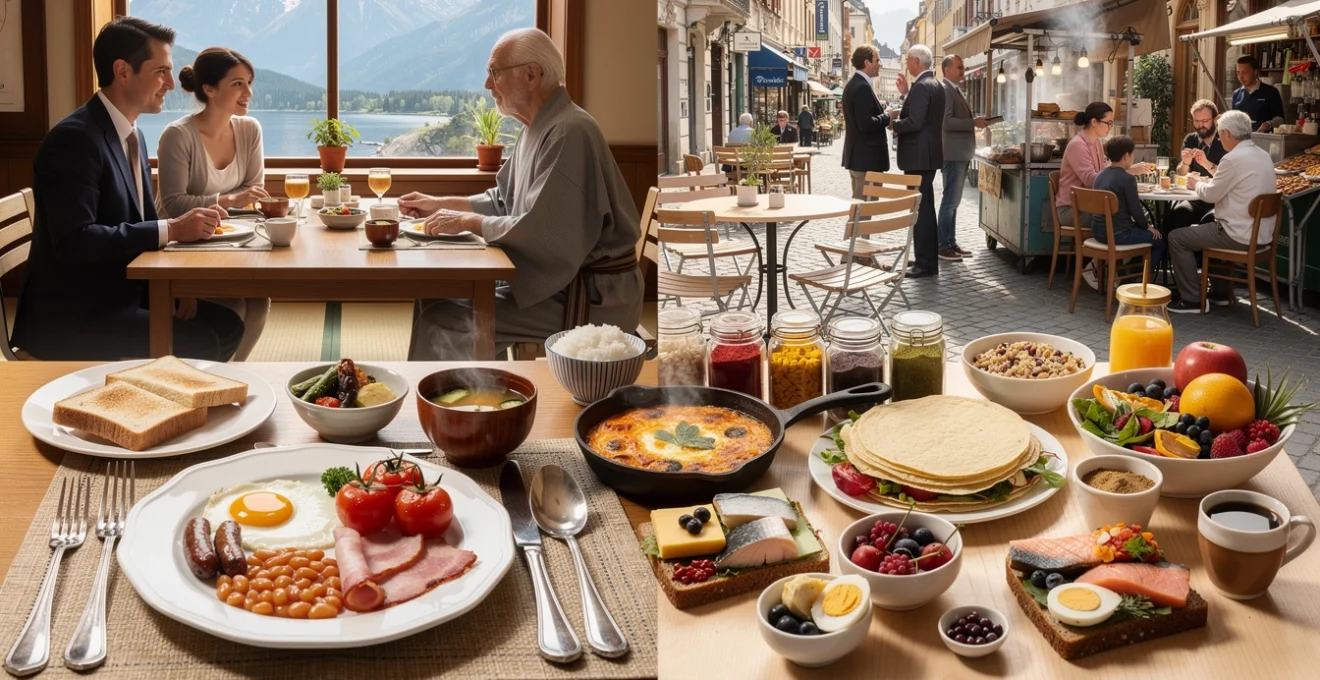
When you observe a community’s breakfast rituals, you’re witnessing centuries of cultural evolution distilled into the most intimate meal of the day. From the elaborate Turkish kahvaltı with its twenty-eight different dishes to the simple Spanish coffee and pastry, morning meals reveal profound truths about local values, economic structures, and social hierarchies. These traditions aren’t merely about nutrition—they’re anthropological blueprints that illuminate how societies organise themselves, preserve their heritage, and adapt to changing circumstances.
The etymology of breakfast itself tells fascinating stories: whilst English literally means “breaking the fast,” Turkish kahvaltı translates to “under the coffee,” suggesting a meal’s subordinate relationship to the sacred coffee ritual. Spanish desayuno similarly breaks the fast, yet the cultural implementation couldn’t be more different from Anglo traditions. These linguistic variations hint at the deeper cultural currents that shape how communities approach their morning sustenance and social interaction.
Cultural anthropology of morning meal rituals across global communities
Morning meal rituals function as sophisticated cultural transmission mechanisms, encoding complex social information within seemingly simple food practices. The transformation of breakfast from a peasant necessity to a middle-class institution reflects broader societal shifts in industrialisation, urbanisation, and class mobility. In many cultures, breakfast serves as a daily referendum on family values, with parents using morning meals to instil discipline, nutritional awareness, and cultural identity in their children.
The temporal aspects of breakfast consumption reveal significant cultural attitudes towards time management and productivity. Mediterranean cultures often embrace leisurely morning routines that prioritise social connection over efficiency, whilst Germanic and Scandinavian traditions emphasise substantial, energy-dense meals that prepare individuals for productive labour. These differences aren’t merely personal preferences—they reflect fundamental cultural philosophies about work-life balance and the role of food in social bonding.
Traditional english full breakfast: social class stratification through food presentation
The traditional English breakfast serves as a particularly revealing case study in how food choices reflect and reinforce social hierarchies. The “full English” with its array of proteins—bacon, sausages, black pudding, eggs—originally demonstrated a household’s economic prosperity and access to diverse food sources. Working-class families who could afford such elaborate morning meals were making powerful statements about their upward mobility and rejection of poverty-associated food scarcity.
Modern interpretations of the English breakfast reveal ongoing class negotiations. Artisanal versions featuring heritage breed bacon and organic eggs signal cultural capital and environmental consciousness, whilst traditional greasy spoon establishments maintain their role as community anchors for working-class identity. The presentation style—from chipped ceramic plates in transport cafés to elegant porcelain in boutique hotels—continues to encode social messaging about respectability and belonging.
Japanese Ichijuu-Sansai philosophy: minimalist aesthetics and regional identity
Japanese breakfast traditions exemplify how minimalist aesthetics can convey maximum cultural information. The ichijuu-sansai principle—one soup, three sides—reflects Buddhist influences on portion control and seasonal awareness whilst demonstrating sophisticated understanding of nutritional balance. Each component’s careful presentation reveals deep respect for natural ingredients and the labour involved in their preparation.
Regional variations in Japanese breakfast ingredients serve as precise geographical markers. Hokkaido’s emphasis on dairy products reflects its historical development as a frontier region with different agricultural practices, whilst Okinawan breakfast traditions incorporate subtropical ingredients that distinguish island culture from mainland Japanese identity. These variations aren’t merely culinary—they’re assertions of regional autonomy and cultural distinctiveness within a relatively homogeneous national culture.
Mediterranean colazione italiana: café culture and urban social dynamics
Italian breakfast culture demonstrates how urban social dynamics shape food consumption patterns in profound ways. The tradition of standing at café bars for morning espresso and cornetto creates temporary communities amongst strangers, with subtle protocols governing conversation, personal space, and social interaction. This ritual serves multiple functions: efficient caffeine delivery, social reconnaissance, and community belonging verification.
The resistance to heavy morning meals in Mediterranean cultures reflects deeper philosophical differences about energy management and digestive health. The belief that substantial morning food consumption interferes with productivity and wellbeing contrasts sharply with Northern European traditions,
where a more substantial lunch is still culturally framed as the day’s main event. In Rome or Milan, a hurried colazione italiana at the bar before work is less about refuelling and more about reaffirming one’s place in the city’s social rhythm. The choreography of ordering, paying, and consuming within minutes reveals how urban Italians negotiate time pressure, public space, and personal relationships before the working day has properly begun.
These breakfast customs also reveal subtle regional and generational differences. Younger professionals might opt for takeaway cappuccinos and high-protein yogurt, signalling alignment with global wellness trends, while older patrons maintain the ritual of dunking their cornetto in frothy milk at the counter. Through these micro-choices, colazione becomes a daily negotiation between tradition and modernity, between rooted local life and a cosmopolitan, mobile identity.
Scandinavian smörgåsbord traditions: seasonal adaptation and resource management
Scandinavian breakfast traditions exemplify how harsh climates and historical scarcity shape morning meals. The classic smörgåsbord, with its array of breads, cheeses, cured fish, and pickled vegetables, originated as a practical way to preserve and rotate resources across long winters. What seems like an abundant spread is, in fact, a carefully calibrated system of seasonal adaptation and resource management.
In Sweden, Norway, and Denmark, breakfast tables often feature rye bread, oats, fermented dairy, and preserved fish, all designed to deliver slow-release energy for physically demanding work in cold conditions. Contemporary hotel buffets across the region replicate this logic on a grand scale, yet the underlying ethos remains: waste is frowned upon, variety is built on preservation techniques, and local ingredients are prioritised. The smörgåsbord thus functions as both a nutritional strategy and a quiet manifesto of Nordic values around frugality, self-sufficiency, and respect for the environment.
Ethnographic food mapping: regional breakfast ingredients as cultural markers
When we map breakfast ingredients across regions, we effectively draw a parallel map of cultural history, trade routes, and ecological constraints. What appears on the morning table in any given place is rarely random; it is the outcome of centuries of adaptation to climate, soil, livestock, and political borders. Analysts who study food geography often treat breakfast plates like archaeological sites, reading layers of influence in every grain, spice, and cooking fat.
This ethnographic food mapping reveals, for example, how dairy-heavy Swiss breakfasts differ from olive oil–based Mediterranean morning meals or rice-centric East Asian rituals. Each pattern encodes environmental realities—mountain pastures, coastal plains, rice paddies—as well as past empires and contemporary supply chains. For travellers seeking to understand local life quickly, examining what is considered a “normal” breakfast can offer a clearer snapshot than any museum exhibit.
Alpine müesli evolution: swiss canton-specific variations and health consciousness
The story of Swiss Müesli is a textbook example of how a regional breakfast can evolve into a global health symbol while still carrying local nuance. Originally developed in the early 20th century by Swiss physician Maximilian Bircher-Benner as a restorative dish for patients, Birchermüesli used soaked oats, grated apple, nuts, and yogurt to deliver fibre and vitamins in an easily digestible form. Its medical origins already framed breakfast as a site of health optimisation rather than mere sustenance.
Across Swiss cantons, however, Müesli manifests in subtly different ways that reflect local agricultural patterns and cultural preferences. In German-speaking regions, you might find versions heavy on dairy and seeds, while French-speaking cantons lean towards fruit-forward, slightly sweeter mixes. Mountain communities often incorporate dried fruits and nuts produced or traded along historic Alpine routes. As Swiss society has become more health conscious—Switzerland consistently ranks in the top 10 of global life expectancy indices—Müesli has shifted from a niche sanatorium dish to a mainstream breakfast staple, symbolising a national commitment to balanced, functional food.
Middle eastern shakshuka preparation: spice trading routes and historical migration
Few breakfast dishes illustrate historical migration and trade as vividly as shakshuka. Today it is most commonly associated with Israeli cafés and brunch menus worldwide, yet its roots lie in North African and broader Middle Eastern culinary traditions. The core technique—poaching eggs in a spiced tomato and pepper sauce—travels easily, absorbing new influences wherever it goes, much like the communities that carried it across borders.
The spices used in shakshuka—cumin, paprika, chilli, sometimes harissa—trace the legacy of trans-Saharan and Mediterranean trade routes that connected North Africa to the Levant, the Ottoman Empire, and Europe. Each regional variation tells a migration story: Tunisian versions might rely heavily on fiery harissa, while Levantine renditions are often milder, incorporating local herbs like parsley or coriander. In this way, a simple pan of eggs and tomatoes becomes a living map of spice flows, colonial encounters, and contemporary diasporas reshaping breakfast culture from Marrakech to Berlin.
Latin american desayuno patterns: indigenous corn-based traditions vs colonial influences
Latin American breakfast patterns reveal an ongoing negotiation between indigenous food systems and colonial legacies. In Mexico and Central America, corn remains the backbone of the morning meal, materialising as tortillas, tamales, or atole, a warm maize-based drink that predates European contact. These dishes carry deep symbolic weight, given that many indigenous cosmologies regard humans as literally made from corn.
Alongside these ancient staples, we find strong colonial influences: coffee plantations introduced by Europeans now shape daily rhythms; wheat breads, sweet pastries, and sugary spreads echo Iberian traditions. In urban areas, you might see office workers grabbing factory-made rolls and instant coffee, while in rural communities, handmade tortillas and beans still structure the first meal of the day. This coexistence—and sometimes conflict—between corn-based breakfasts and wheat- or sugar-heavy alternatives reflects broader tensions over land use, health, and cultural identity across the region.
Southeast asian morning markets: street food economics and community gathering spaces
In much of Southeast Asia, breakfast is not confined to the private kitchen; it unfolds in bustling morning markets and on sidewalks, turning public space into a shared dining room. From Vietnamese pho stalls at dawn to Indonesian warung selling rice porridge and fried snacks, street vendors supply affordable, freshly cooked meals that match local tastes and working schedules. These markets double as economic engines, providing livelihoods for thousands of micro-entrepreneurs.
The organisation of these morning markets tells us a lot about local governance, gender roles, and informal economies. Many stalls are run by women, who balance cooking with negotiations over credit, sourcing, and waste management. Regular customers often return to the same vendor daily, transforming transactional relationships into social bonds that support mutual aid in times of crisis. For visitors, joining this breakfast ecosystem offers a rare immersion into the heartbeat of the city, far from curated tourist zones.
Temporal breakfast consumption patterns and socioeconomic indicators
The timing and regularity of breakfast consumption can act as surprisingly accurate indicators of socioeconomic conditions. In high-income countries, research from the OECD and national health surveys shows that lower-income households are more likely to skip breakfast or rely on ultra-processed options, often due to irregular work schedules, long commutes, or limited access to fresh food. By contrast, affluent urban professionals may frame a carefully curated breakfast—think avocado toast with single-origin coffee—as both a wellness ritual and a social signal of control over time.
Cross-cultural studies also reveal how labour patterns influence when and how people eat in the morning. Agricultural communities often favour early, substantial breakfasts to fuel manual work, while service-based economies may shift caloric intake later into the day, aligning with office hours and social dinners. Intermittent fasting trends, with their emphasis on delayed eating windows, further complicate traditional narratives about breakfast as “the most important meal of the day.” What looks like a personal dietary choice can, on closer inspection, reflect broader anxieties about productivity, body image, and health optimisation in late-capitalist societies.
Religious and ceremonial morning food practices in local communities
Religious traditions have long used morning meals and pre-meal rituals as tools for moral education, community cohesion, and metaphysical reflection. Whether it’s a shared porridge in a monastery or a pre-dawn meal before fasting, these practices embed theological principles into daily routines. You can often understand a faith’s view of the body, discipline, and generosity by observing how it structures food consumption at the start of the day.
From an anthropological perspective, these ceremonial breakfasts function as recurring, low-intensity rites of passage. They gently remind participants of their place within a moral universe and a social hierarchy, without the drama of major festivals. Over time, even small gestures—saying grace, sharing specific foods, sitting in particular configurations—shape how believers think about obligation, gratitude, and community responsibility as they step into their working day.
Islamic suhoor traditions: ramadan fasting preparation and community solidarity
In Muslim communities, suhoor—the pre-dawn meal during Ramadan—illustrates how breakfast can be reoriented around spiritual discipline and solidarity. Unlike everyday breakfasts, suhoor is carefully timed to maximise both physical endurance and religious merit before a full day of fasting. Nutrient-dense foods such as oats, dates, eggs, and yogurt are favoured to provide slow-release energy, reflecting a practical understanding of metabolism woven into faith practice.
Suhoor also has a powerful communal dimension. In some cities, mosques or neighbourhood associations organise shared suhoor gatherings, while in others, extended families coordinate wake-up calls and meal preparation across multiple households. In recent years, social media has added another layer, with people sharing suhoor recipes and reflections online, reinforcing a sense of global ummah. Observing how a community organises suhoor—who cooks, who wakes whom, who eats first—offers deep insight into gender roles, intergenerational ties, and conceptions of mutual care.
Hindu prasadam distribution: temple-based morning rituals and caste dynamics
In many Hindu contexts, the first “meal” of the day may be less about personal satiety and more about divine reciprocity. Morning visits to temples often culminate in the distribution of prasadam—food that has been offered to a deity and then shared among devotees. This sanctified breakfast can take the form of sweet rice, semolina-based sheera, or simple fruits, depending on regional traditions and temple resources.
The logistics of prasadam preparation and distribution, however, intersect with longstanding caste and class dynamics. Historically, only certain caste groups could cook or serve temple food, reinforcing social hierarchies even within an ostensibly egalitarian spiritual setting. Contemporary reform movements and legal interventions have challenged these restrictions in many places, opening kitchens to a wider range of volunteers. Watching who lines up where, who serves whom, and who cleans up after the morning ritual can reveal how modern Indian communities are renegotiating caste boundaries through the seemingly humble medium of breakfast offerings.
Christian continental european sunday breakfast: post-mass social hierarchies
In many Catholic and Protestant communities across continental Europe, Sunday breakfast or brunch occupies a special position at the intersection of religion, family life, and social status. Traditionally, families would attend early Mass or service and then return home for a more elaborate morning meal, often featuring breads, cured meats, eggs, and pastries reserved for the weekend. This pattern still persists in countries like Germany, Austria, and Poland, where bakeries see their busiest hours on Sunday mornings.
The social composition of these post-service breakfasts can quietly reinforce local hierarchies. Extended family gatherings in spacious homes, complete with artisan cheeses and fine china, signal economic comfort and stable kin networks, while solitary brunches in cafés may reflect urbanisation, mobility, or secularisation. In some towns, the choice of venue after church—modest local café versus upscale hotel brunch—operates as a subtle marker of class. By tracing where congregants disperse to eat and with whom they share their Sunday bread, we gain a nuanced picture of how religion, status, and changing family structures intersect in everyday life.
Modern urbanisation impact on traditional breakfast culture preservation
Rapid urbanisation has transformed breakfast more dramatically than perhaps any other meal. As cities expand and working hours intensify, the slow, multi-dish breakfasts of rural life often give way to portable, standardised options: coffee in disposable cups, energy bars, and pre-packaged pastries. Food industry data from major metropolitan regions shows steady growth in “on-the-go” breakfast categories, alongside a decline in time spent eating at home in the morning.
This shift raises pressing questions about cultural preservation. When younger generations in Istanbul, Mexico City, or Nairobi reach for globalised convenience foods instead of the traditional morning dishes of their grandparents, what gets lost beyond taste and nutrition? Some communities respond with creative adaptation: weekend-only traditional breakfasts, heritage cafés that reconstruct rural spreads, or school programmes that introduce children to local morning foods. Others lean into hybridisation, accepting that a bowl of cereal alongside miso soup or a smoothie next to arepas reflects contemporary, plural identities. Ultimately, the fate of traditional breakfast culture in cities may depend on whether communities perceive these rituals as negotiable comforts or as non-negotiable anchors of collective memory.
Generational transmission of morning culinary knowledge systems
The stories we inherit about breakfast—how to brew tea, season eggs, fold dough, or time rice—are rarely written down. They are transmitted through repetition, observation, and correction in kitchens and dining rooms, usually in the quiet rush of weekday mornings. Grandmothers showing grandchildren how to roll paratha, fathers demonstrating the perfect French press technique, older siblings teaching younger ones how to assemble school sandwiches: these small acts form a living curriculum of morning culinary knowledge.
Yet this transmission is under strain. As more households rely on pre-prepared foods and as intergenerational cohabitation declines, fewer children witness the full process of breakfast preparation from scratch. Digital platforms have stepped into this gap, with recipe videos and food influencers attempting to document and revive traditional morning dishes. Still, watching a clip is not the same as feeling dough under your own hands or absorbing the unspoken rules around who eats first and who serves whom. If we want to understand a culture’s future, we might ask: which breakfast rituals are being lovingly taught to the next generation, and which are quietly disappearing between alarm clock and commute?