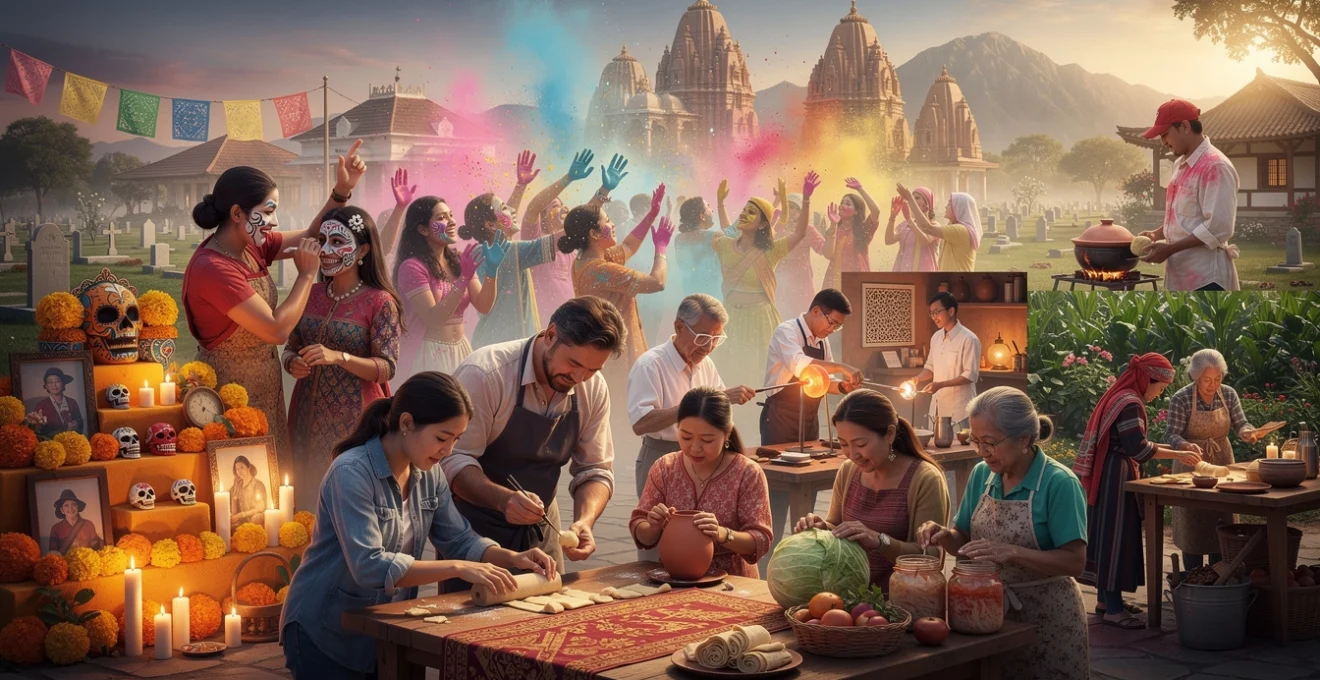
Standing in the shadow of world-famous monuments or capturing sunset photographs from well-known viewpoints can certainly create memorable travel experiences. Yet something profound happens when you move beyond the surface of a destination and immerse yourself in its living traditions. The true essence of any place reveals itself not through its landmarks alone, but through the customs, rituals, and time-honoured practices that shape daily life and connect generations. When you engage authentically with local traditions, you transform from a passive observer into an active participant in cultural exchange—creating connections that resonate long after your journey ends.
Cultural traditions serve as windows into the collective soul of communities, offering insights into values, beliefs, and ways of life that have been refined over centuries. Whether you’re witnessing a sacred ceremony in a remote highland village, learning ancient craftsmanship techniques from master artisans, or sharing meals prepared according to recipes passed down through generations, these encounters provide context and meaning that no guidebook can adequately convey. The richness of human diversity becomes tangible when you participate in traditions that have sustained communities through changing times.
Cultural immersion through participatory festival engagement
Festivals and celebrations represent some of the most concentrated expressions of cultural identity, combining spirituality, artistry, community bonds, and historical memory into vibrant public displays. Participating in these events—rather than merely observing them from a distance—offers transformative opportunities to understand what matters most to the communities you visit. These celebrations often mark significant seasonal transitions, honour ancestral spirits, or commemorate historical events that shaped local identity. When you engage respectfully and authentically with festival traditions, you gain privileged access to cultural knowledge that might otherwise remain inaccessible to outsiders.
The key to meaningful festival participation lies in approaching these events with genuine curiosity, humility, and respect for their cultural significance. This means learning about the historical and spiritual context beforehand, following local etiquette carefully, and recognising that your role is to honour rather than consume the experience. Many communities welcome respectful participation from visitors, viewing it as an opportunity for cultural exchange and preservation of traditions that globalisation threatens to erode.
Experiencing día de los muertos rituals in oaxaca’s indigenous communities
The Day of the Dead celebrations in Oaxaca represent one of Mexico’s most profound cultural traditions, blending pre-Hispanic indigenous beliefs with Catholic influences into a unique philosophy about death and remembrance. In rural Zapotec and Mixtec communities surrounding Oaxaca City, families spend weeks preparing elaborate home altars adorned with marigold flowers, favourite foods of deceased relatives, candles, and traditional sugar skulls. When you participate in these preparations alongside local families, you begin to understand that this is not a morbid occasion but rather a joyful reunion—a time when the boundary between the living and dead becomes permeable, allowing families to commune once more with departed loved ones.
Spending the night of November 1st in village cemeteries as families gather around graves, sharing stories, music, and meals with both the living and the dead, offers a perspective-shifting experience. The reverence, warmth, and acceptance of mortality embedded in these rituals challenge Western attitudes toward death and grief. By participating respectfully—perhaps helping to clean and decorate gravesites, contributing to communal meals, or simply sitting quietly alongside families—you witness how traditions can provide meaningful frameworks for processing loss and maintaining connections across generations.
Joining holi celebrations in mathura and vrindavan sacred sites
The Hindu festival of Holi, celebrating the arrival of spring and the triumph of good over evil, reaches its most exuberant expression in the Braj region of northern India, particularly in the sacred cities of Mathura and Vrindavan associated with Lord Krishna. What might appear to outsiders as simply joyful chaos—people throwing vibrant coloured powders and water at one another—carries deep spiritual and social significance. Holi temporarily dissolves hierarchies of caste, age, and gender, creating a sanctioned space for playfulness and equality that reflects ancient Hindu philosophical principles.
Participating in temple ceremonies at Banke Bihari Temple in Vrindavan or joining the Lathmar Holi tradition in nearby Barsana—where women playfully beat men with sticks while men defend themselves with shields—reveals layers of
playful devotion, mythology, and regional folklore. To engage meaningfully, it helps to visit with a local guide who can explain temple customs, appropriate dress, and photography etiquette, as well as the symbolic stories behind each ritual. You quickly realise that the colour-throwing is not just for spectacle; it is a participatory blessing, a way of dissolving social boundaries and expressing bhakti, or loving devotion. By accepting coloured powder from elders, joining chants in temple courtyards, and observing quiet rituals at shrines before or after the street celebrations, you experience Holi as a living spiritual tradition rather than just a photogenic party.
Because Holi can be intense—crowded streets, loud music, and exuberant participants—it is important to set clear boundaries and travel with trusted locals or reputable tour operators. Simple precautions, such as wearing modest, disposable clothing, protecting your eyes with glasses, and keeping valuables secure, allow you to focus on the joy and symbolism of the festival. When approached with respect, Holi in Mathura and Vrindavan offers a powerful reminder that play, colour, and shared celebration can be vehicles for spiritual connection and social harmony.
Witnessing toraja funeral ceremonies in sulawesi’s highland villages
In the misty highlands of South Sulawesi, the Toraja people practise some of the world’s most elaborate funeral rites—ceremonies that can last several days and involve entire communities. For Torajans, death is not a sudden rupture but a gradual transition; families may spend years preparing for a funeral, saving money, and planning complex rituals that honour the deceased and reaffirm social bonds. Visitors who are invited to attend quickly see that these events blend solemnity, communal pride, and spiritual belief in ways that challenge conventional Western notions of mourning.
As a guest, you might witness water buffalo sacrifices, traditional dances, and the sharing of copious food and coffee with extended family and neighbours. While some aspects can feel intense, especially for those unaccustomed to animal sacrifice, local guides can help you understand the cosmological meaning behind each element. The ceremonies are seen as a final act of love—ensuring that the soul is well-provisioned for its journey to the afterlife and that the deceased is remembered with dignity. Observing these rituals from within the community, rather than at a distance, reveals how funerals function as both spiritual milestones and vital social gatherings.
Respectful behaviour is essential. You should never treat a Toraja funeral as a spectacle; instead, follow your host’s instructions on where to sit, when to take photographs, and how to offer small gifts, such as coffee or sugar, which are customary. By entering these spaces with humility, you bear witness to a worldview in which death is integrated into the fabric of daily life. The experience can prompt you to reflect on your own culture’s relationship with mortality and remembrance, deepening your understanding of how local traditions give structure and meaning to life’s most profound transitions.
Participating in songkran water blessings across northern thailand
Every April, Thailand welcomes the traditional New Year with Songkran, a festival now globally famous for its exuberant water fights. Yet in northern cities like Chiang Mai, Lampang, and Chiang Rai, Songkran retains a quieter spiritual heart rooted in Buddhist concepts of cleansing, renewal, and merit-making. Before the streets fill with celebratory splashing, locals visit temples to pour scented water over Buddha statues and the hands of elders, symbolically washing away misfortune and beginning the year with a clear, compassionate mind.
Participating in these water blessings offers a more contemplative side of Songkran that many casual visitors overlook. You might join families as they carry small silver bowls of jasmine-scented water, gently pour it over sacred images, and receive blessings from monks in return. Later, as you step into the lively street celebrations—with locals joyfully dousing one another from pickup trucks and roadside barrels—you can see the connection between playful water-throwing and older ritual meanings of purification and goodwill. The experience becomes less about “a giant water fight” and more about communal renewal.
To engage respectfully, dress modestly, store electronics safely, and be mindful of those who may not wish to be splashed, such as elders or street vendors in the midst of work. Visiting smaller neighbourhood ceremonies and temple events, rather than only the main tourist zones, also allows for more genuine interaction with local families. In doing so, you encounter Songkran as a layered tradition—part sacred ritual, part community festival—that reveals how Thai culture weaves joy, respect, and spirituality into a single, flowing celebration.
Ethnographic learning through traditional craftsmanship workshops
Traditional crafts are more than beautiful objects for sale; they are living archives of collective memory, encoded in materials, motifs, and methods that have been refined over generations. When you take part in craftsmanship workshops, you are not just “making a souvenir”—you are stepping into a lineage of skills, stories, and social roles. These hands-on experiences function almost like informal ethnographic fieldwork: by working alongside artisans, you observe the rhythms of daily life, the dynamics of apprenticeships, and the economic realities behind heritage industries.
Unlike a museum visit, where objects are static and often removed from their original context, a workshop lets you see how tradition adapts to modern pressures. How do craftspeople price their work in a global market? Which techniques are preserved, and which are simplified to meet tourist demand? As you learn to handle tools and materials, you also hear the narratives that rarely appear in guidebooks—tales of family workshops, guild rivalries, or the challenges of passing on skills to younger generations. In this way, traditional craft workshops help transform you from a consumer into an engaged participant in cultural continuity.
Mastering batik wax-resist dyeing techniques in yogyakarta textile studios
In Yogyakarta, on the island of Java, batik is not just a pattern—it is a sophisticated visual language laden with symbolism, status markers, and regional identity. Taking a batik workshop in a local textile studio introduces you to the intricate wax-resist dyeing process, where designs are hand-drawn with a canting (a small copper tool) or stamped with carved copper blocks. As you trace lines of hot wax across cotton, you begin to appreciate the extraordinary dexterity and patience required to produce even a simple motif.
Artisans often explain the meanings behind traditional patterns: certain motifs once reserved for royalty, others associated with fertility, protection, or philosophical concepts like harmony and balance. By choosing a design and attempting to reproduce it, you engage with batik as both an artistic practice and a carrier of Javanese worldview. You may notice how workshop conversations drift between technique and storytelling, revealing how textile production is woven into family histories and local economies.
For a responsible travel experience, seek studios that prioritise fair wages, safe working conditions, and the preservation of hand-drawn techniques over purely industrial production. Purchasing a piece directly from the artisan who taught you ensures that the economic benefits of cultural tourism flow back into the community. Your finished cloth, no matter how imperfect, becomes a tangible reminder of the hours of labour and generations of knowledge that underlie each traditional textile.
Apprenticing with murano glass masters in venice’s artisan botteghe
On the island of Murano, near Venice, glassmaking has been elevated to an art form over more than 700 years. Many visitors watch quick demonstrations in crowded showrooms, but a deeper understanding comes from spending extended time in an artisan bottega, where you can observe or even assist in the step-by-step process. In these smaller workshops, you feel the heat of the furnace, hear the constant low hum of the flame, and watch masters shape molten glass with a balance of strength and delicacy that borders on choreography.
When you apprentice for a few hours or a day—blowing a simple ornament, helping to prepare materials, or cold-working a finished piece—you gain insight into the discipline and collaboration required to control such a temperamental medium. Artisans may share stories of how techniques were traditionally kept secret within families, as well as contemporary struggles to compete with mass-produced glass imported from elsewhere. Through these candid conversations, you see how Murano glass embodies both local pride and vulnerability in a globalised market.
Choosing to support small, family-run workshops rather than purely commercial showrooms helps sustain the island’s fragile craft ecosystem. Ask questions about where raw materials come from, how long apprentices typically train, and how designs evolve over time. These interactions turn a decorative object on your shelf into a narrative-rich artefact, connecting you to the living community that continues to breathe life into centuries-old glassmaking traditions.
Learning ancient pottery methods at santa fe pueblo communities
In the high desert around Santa Fe, Pueblo communities such as San Ildefonso, Santa Clara, and Acoma preserve ceramic traditions that predate European contact by many centuries. Participating in a pottery workshop with Indigenous artisans offers rare access to techniques and philosophies that are often passed down within families. You may learn how local clays are sourced and prepared, how hand-coiling methods differ from wheel-thrown pottery, and how natural slips and firing techniques produce the distinctive black-on-black or polychrome designs for which the region is known.
Yet the most meaningful lessons usually extend beyond technique. Artisans often explain how certain motifs refer to clouds, rain, corn, or sacred stories tied to the land—demonstrating that each pot is not merely functional but spiritually resonant. As you shape clay in your hands, you are invited to reflect on the relationship between craft, landscape, and identity: how does working with local materials anchor people to place? How do artists balance respect for tradition with personal creativity?
Because these are living cultures, not open-air museums, it is crucial to participate in workshops offered directly by Pueblo members or through trusted cultural centres that work in genuine partnership with communities. Respect any topics that are off-limits, especially sacred stories or restricted designs. When you approach Pueblo pottery as a window into ongoing cultural life, rather than as a collectible commodity, you support both the economic resilience and cultural sovereignty of Indigenous artisans.
Understanding moroccan zellige tilework in fez’s historic medersas
Walk through the old medersas (religious schools) and riads of Fez, and you are surrounded by zellige—intricate geometric tilework that transforms walls, fountains, and courtyards into shimmering mosaics. At first glance, the patterns may seem purely decorative, but a guided workshop with local craftspeople reveals a rigorous mathematical and spiritual framework. Traditional zellige involves hand-cutting individual tiles from glazed terracotta, then assembling them, puzzle-like, into complex starbursts and interlocking polygons that obey strict geometric rules.
During a hands-on session, you might try scoring and breaking a tile, then arranging simple motifs on a board. The process is humbling; what looks effortless in historic palaces actually represents decades of practice. Artisans often explain how zellige patterns echo Islamic concepts of unity and infinity—repeating forms that, like a mantra, invite contemplation of the divine. You begin to understand why certain colours dominate (cobalt, green, white, and ochre) and how regional styles developed over centuries of cultural exchange between Andalusia and North Africa.
Fez’s zellige tradition faces modern pressures from cheaper, industrial tiles and changing architectural tastes. By investing in authentic workshops and purchasing directly from artisan cooperatives, you help keep these intensive skills economically viable. Perhaps more importantly, you leave with a deeper appreciation for the intellectual and spiritual labour embedded in every square metre of mosaic, seeing the city’s walls not as mere decoration but as stone-and-clay expressions of a worldview.
Gastronomic heritage discovery through regional culinary practices
Cuisine is one of the most accessible gateways into local traditions, yet it is also one of the most easily superficialised when limited to restaurant menus alone. To truly understand a region’s gastronomic heritage, you need to step into kitchens, markets, farms, and communal dining spaces where recipes are lived rather than simply served. Food traditions reflect climate, trade routes, social structures, and spiritual beliefs; learning to cook a dish with local mentors is like reading a history book written in flavours and aromas.
As global food trends spread rapidly through social media, many communities are working to protect their culinary identities through slow food movements, appellation systems, and educational programs. Participating in farm-to-table apprenticeships, fermentation workshops, or ritual food preparations allows you to support these efforts while gaining practical skills. You also become more attuned to the ethical dimensions of eating abroad: who grows the ingredients, who cooks the food, and who benefits economically from your meal?
Farm-to-table apprenticeships in tuscany’s slow food presidia networks
In rural Tuscany, the rolling hills dotted with vineyards and olive groves are more than postcard scenery; they are the backbone of a food culture that has long prized seasonality, simplicity, and locality. Joining a farm-to-table apprenticeship, even for a few days, immerses you in the daily routines of small producers who often collaborate with Italy’s Slow Food Presidia network—a movement dedicated to protecting traditional foods and farming methods. You might help harvest grapes, press olives, or tend heritage-breed livestock, learning firsthand how terroir and tradition shape taste.
Afternoons often transition from field to kitchen, where you assist in preparing regional dishes like ribollita, pappardelle al cinghiale, or bruschetta made with just-picked tomatoes and peppery extra virgin olive oil. Farmers and cooks explain why certain olive varieties are blended, how weather patterns affect vintages, and which food-and-wine pairings are rooted in centuries of local habit rather than recent marketing. By the time you sit down to a communal meal, you can trace nearly every ingredient back to a specific field, tree, or farmer you have met.
Experiences like these encourage you to rethink hyper-processed, anonymous food systems back home. They also highlight how supporting small-scale agriculture through agriturismi stays and local purchases helps preserve landscapes and ways of life threatened by industrialisation and rural depopulation. Your memories of Tuscany’s flavours become intertwined with the stories of the people who steward them.
Fermentation techniques at korean hanok village kimchi-making sessions
In South Korea, kimchi is far more than a side dish; it is a culinary cornerstone with deep historical and cultural roots. Participating in kimchi-making sessions in traditional hanok villages—such as those in Jeonju or Andong—gives you an intimate view of how fermentation embodies Korean values of community, resilience, and resourcefulness. Under the guidance of local cooks, you learn to salt cabbage, mix chilli paste with garlic and ginger, and pack the mixture into jars or onggi earthenware pots.
As you work, you hear how families once gathered for gimjang, the collective preparation of kimchi for winter, and how different regions favour their own variations, from watery radish kimchi to pungent, aged versions served with stews. The science of fermentation—beneficial bacteria transforming simple ingredients into complex flavours—becomes an apt metaphor for cultural preservation: given time and the right environment, traditions deepen rather than decay.
With global interest in gut health and fermented foods on the rise, these workshops also highlight how ancient practices intersect with contemporary wellness trends. You leave not only with a jar of homemade kimchi but with a more nuanced understanding of how everyday foods can carry centuries of environmental knowledge and social meaning.
Traditional tagine preparation in berber mountain kitchens
In Morocco’s Atlas Mountains, Berber communities welcome travellers into their homes to learn the art of cooking tagine—a slow-simmered stew named after the conical clay pot in which it is prepared. Sitting at a low table in a village kitchen, you might chop onions and carrots, layer lamb or vegetables with preserved lemons and olives, and carefully arrange spices like cumin, saffron, and paprika under the watchful eye of a home cook who has learned by doing rather than from written recipes.
As the tagine simmers over charcoal or gas, conversation often turns to topics far beyond food: rainfall patterns that determine harvests, the role of communal ovens, or the significance of hospitality in mountain life. Sharing the finished dish with the family—eating from a common plate with pieces of flatbread—gives you a visceral sense of how meals reinforce social bonds and mutual care. The tagine thus becomes not just a “Moroccan dish” to tick off a list, but a lived experience of place, family, and rhythm.
Choosing homestays or community-run guesthouses that include cooking lessons ensures your culinary curiosity directly benefits local households. Back home, every time you prepare a tagine, you will likely recall not only the taste but the faces, voices, and mountain landscapes that accompanied your first lesson.
Sacred ayurvedic cooking principles in kerala’s spice plantations
Kerala, on India’s southwestern coast, is renowned for its lush spice plantations and strong Ayurvedic traditions. Participating in Ayurvedic cooking classes—often hosted on working spice estates—introduces you to a holistic view of food as medicine. In these sessions, you learn how ingredients like turmeric, black pepper, ginger, and cardamom are used not only for flavour but to balance the body’s doshas (energetic constitutions) according to classical Ayurvedic texts.
Instructors might guide you through preparing dishes tailored to different constitutions, explaining why certain foods are considered cooling or heating, grounding or stimulating. You see how cooking methods, meal timing, and even the emotional state of the cook are believed to influence the therapeutic impact of a meal. The experience can shift how you think about “healthy eating,” expanding it from calorie counts and nutrients to a more integrated view of digestion, mood, and environment.
Visiting the surrounding spice gardens—smelling fresh nutmeg, seeing pepper vines climb tall trees, or tasting raw cinnamon—further anchors culinary theory in the local landscape. This deeper understanding of Ayurvedic food traditions can inspire more mindful, seasonally aligned cooking long after your trip ends.
Oral history preservation through community storytelling encounters
Many of the world’s most valuable cultural insights are not found in archives or textbooks but in the memories of elders, artisans, and community storytellers. Engaging with oral history during your travels—whether through organised storytelling evenings, informal conversations in village squares, or community theatre performances—allows you to witness how stories function as vessels of identity. They carry accounts of migration, resistance, humour, and everyday resilience that might otherwise fade within a generation.
When you listen attentively, you are participating in an act of preservation as much as consumption. You may hear a grandmother recount life before a major political upheaval, a fisherman describe changes in the sea over decades, or a musician trace the lineage of a song through wars and weddings. These narratives often complicate official histories, adding nuance and personal emotion to broader events. In many Indigenous and minority communities, where written records may be sparse or biased, oral histories serve as a crucial counter-archive.
To engage ethically, it is important to ask permission before recording stories or sharing them publicly, and to respect requests for anonymity or limits on what can be disclosed. Supporting local cultural centres, purchasing books or recordings produced by community historians, or simply paying fair fees for guided storytelling experiences helps sustain this fragile yet powerful heritage. As you travel, you might ask yourself: whose voices are amplified, and whose are missing? Seeking out oral histories is one way to rebalance that equation and ensure your understanding of a place includes those who have lived its changes most intimately.
Anthropological understanding via indigenous ritual participation
Participating in or witnessing Indigenous rituals can offer profound anthropological insight, revealing how communities conceptualise relationships between humans, ancestors, spirits, and the natural world. From Andean offerings to Pachamama (Mother Earth) to Maori powhiri welcome ceremonies in Aotearoa New Zealand, these practices embody entire cosmologies in carefully choreographed gestures, chants, and offerings. When you are invited to join—or even simply to observe respectfully—you see how ritual weaves together ethics, ecology, and social structure.
However, the line between meaningful participation and cultural appropriation can be thin. Not every ceremony is open to outsiders, and not every “Indigenous experience” marketed online is legitimate or respectful. Anthropological understanding begins with acknowledging this complexity and prioritising the leadership and consent of local communities. A good rule of thumb is to ask: who is organising this ritual participation, and who benefits from it—both spiritually and economically?
When rituals are shared on community-defined terms, they can become powerful platforms for intercultural dialogue. You might learn why a particular mountain is considered an ancestor, why certain dances must be performed only at specific times, or how taboos around hunting or fishing function as traditional conservation laws. These insights challenge narrowly materialist worldviews and highlight sophisticated environmental ethics developed long before modern sustainability discourse. Much like learning a new language, learning to read ritual signs—gestures, songs, offerings—helps you think with, rather than merely about, another culture.
Practical steps for ethical engagement include working with community-owned tourism initiatives, following dress codes and behavioural guidelines to the letter, and refraining from intrusive photography during sacred moments. After the experience, consider how you recount it to others: do you frame it as exotic spectacle, or as a privileged educational encounter that carries responsibilities? In approaching Indigenous rituals with humility and reciprocity, you honour both the people who welcomed you and the deeper meanings embedded in their traditions.
Sustainable tourism development through heritage conservation initiatives
As travel continues to grow globally—UN Tourism recorded over 1.3 billion international arrivals in recent pre-pandemic years—the pressure on cultural and natural heritage sites has intensified. Overtourism can erode exactly what travellers come to see, from fragile archaeological remains to living traditions strained by commercialisation. Engaging with heritage conservation initiatives offers a way to align your curiosity about local traditions with long-term benefits for the communities that uphold them. In effect, you become a partner, rather than a passive consumer, in sustaining cultural landscapes.
Many destinations now host community-led projects that combine tourism with preservation, whether through restoration workshops, visitor-funded cultural festivals, or training programs for young artisans. Joining such initiatives—perhaps by taking part in a heritage walk curated by local historians, or visiting a museum co-managed by Indigenous groups—gives you a clearer picture of the behind-the-scenes work required to keep traditions vibrant. You may see how funds from entry tickets support language revitalisation classes, or how craft cooperatives negotiate fair prices in the face of mass-produced imitations.
Sustainable cultural tourism also involves subtle choices that you make each day on the road. Do you support locally owned guesthouses and eateries, or international chains that repatriate profits? Do you bargain vendors down to the lowest possible price, or pay a fair rate that reflects the labour behind handmade goods? These decisions, multiplied across millions of visitors, shape whether cultural practices remain viable livelihoods or become mere performances staged for cameras.
In many places, travellers are invited to contribute beyond their wallets—through volunteering specialist skills, sharing feedback on ethical guidelines, or simply respecting carrying-capacity limits and visiting during off-peak times. This might mean choosing a lesser-known festival instead of a headline event, or exploring a secondary city where heritage initiatives are hungry for recognition and support. Like tending a garden rather than picking wildflowers, sustainable engagement with local traditions requires patience, care, and a willingness to give back at least as much as you take in inspiration.
Ultimately, discovering local traditions in responsible ways is not just about creating more meaningful journeys for yourself; it is about helping ensure that the stories, skills, and ceremonies that move you today will still be thriving for future generations. By approaching festivals, crafts, cuisines, stories, and rituals as living partnerships rather than backdrops, you turn each trip into a small act of cultural stewardship—one that deepens your understanding of the world while honouring the people who make it so richly diverse.