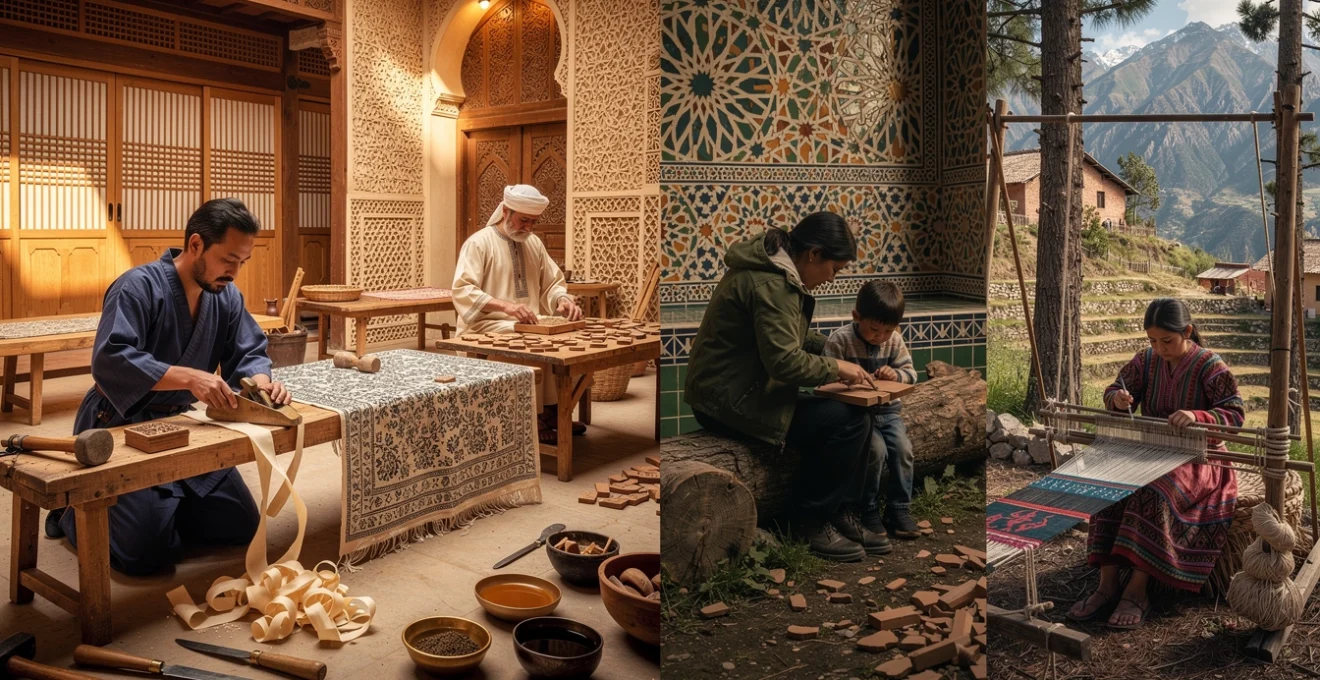
In an age dominated by mass production and algorithmic efficiency, something remarkable persists in workshops, studios, and homes across the globe: ancient craftsmanship techniques that continue to shape the objects we use every day. These aren’t museum pieces gathering dust behind glass; they’re living traditions that inform how we build our homes, prepare our food, wear our clothes, and interact with the material world. From the sub-micron precision of Japanese hand planes to the mathematical perfection of Moroccan tilework, these ancestral methods represent more than historical curiosity—they embody knowledge systems refined across centuries, each technique a testament to humanity’s enduring relationship with natural materials and patient skill.
The survival of these crafts in our modern world raises fascinating questions. What makes a 4,000-year-old textile technique relevant when industrial looms can produce fabric in seconds? Why would anyone hand-cut ceramic tiles when machines offer uniformity and speed? The answers lie not in nostalgia, but in the unique qualities these methods produce—qualities that no factory can replicate. The breathability of a hand-thrown fermentation vessel, the structural integrity of mortise-and-tenon joinery, the depth of colour from natural dyes—these aren’t aesthetic choices but functional superiorities born from generations of empirical testing.
Japanese woodworking: kanazuchi hammers and nokogiri saws in contemporary carpentry
Japanese woodworking represents perhaps the most refined wood-shaping tradition on Earth, with tool designs that have remained fundamentally unchanged for over a millennium. The kanazuchi hammer, with its asymmetrical head and precise weight distribution, delivers impact forces that split along wood grain rather than crushing fibres. Unlike Western hammers that push forward, these tools pull work toward the craftsman, offering superior control and reducing fatigue during extended sessions. Contemporary carpenters in Tokyo and Kyoto still commission custom hammers from specialist forges, specifying head weights down to the gram and handle lengths calibrated to their arm proportions.
The nokogiri saw exemplifies Japanese woodworking philosophy even more dramatically. These pull-saws cut on the backstroke, allowing thinner blades that create narrower kerfs and waste less precious timber. A skilled craftsman can cut joints with tolerances of 0.1 millimetres using nothing but hand-eye coordination and tactile feedback. Modern Japanese construction—particularly in temple restoration and high-end residential projects—still relies on these tools for critical joinery work, even when power tools handle rough dimensioning. The reason is simple: you can feel what a pull-saw is doing in ways that remain impossible with motorised equipment.
Oire nomi chisels and Mortise-and-Tenon joinery without metal fasteners
Oire nomi chisels represent the cutting edge of traditional Japanese toolmaking, featuring laminated construction where hard steel cutting edges are forge-welded to softer, shock-absorbing bodies. This composite structure allows razor-sharp edges that hold their geometry through repeated impact, essential for cutting precise mortises in dense hardwoods like Japanese oak and cypress. The angles, bevels, and hollow-ground backs of these chisels follow specifications codified during the Edo period, when master carpenters discovered optimal geometries through generations of trial and refinement.
Mortise-and-tenon joinery without metal fasteners might seem primitive until you witness a 400-year-old temple structure withstanding earthquakes that topple modern buildings. The secret lies in understanding wood behaviour across seasonal moisture cycles and designing joints that tighten rather than loosen as materials expand and contract. Japanese carpenters still calculate joint dimensions using traditional measurement systems based on the shaku (approximately 30.3 centimetres), finding that these proportions produce more harmonious structural relationships than metric or imperial systems. Contemporary architects increasingly specify traditional joinery for earthquake-prone regions, recognising that flexible, fastener-free connections offer superior seismic performance.
Kanna hand planes for achieving Sub-Micron surface finishes
The Japanese kanna hand plane can produce wood surfaces so smooth they appear polished, with surface finishes measuring less than one micron in roughness. Annual competitions in Japan
push craftsmen to compete for the thinnest continuous shaving—sometimes under 3 microns thick, finer than a human hair split dozens of times. To achieve this, the kanna is tuned with obsessive precision: the blade is hollow-ground and hand-lapped on natural stones, the wooden body is pared with ink marks as guides, and the mouth opening is adjusted with paper-thin increments. Rather than pushing the plane forward as in Western practice, the craftsperson pulls it toward the body, allowing greater feedback through the arms and core. In high-end joinery shops, a final pass with a perfectly tuned kanna replaces sandpaper entirely, leaving a burnished surface that resists moisture and highlights the natural chatoyance of the grain. The result is not only aesthetic; a planed surface has fewer crushed fibres, which means better adhesion for natural oils and lacquers and improved long-term durability.
Sukiya-zukuri architecture preservation in kyoto’s machiya townhouses
Nowhere is Japanese woodworking’s quiet precision more visible than in Kyoto’s remaining machiya townhouses, many of which follow the principles of sukiya-zukuri architecture. These slender wooden homes, once dismissed as outdated fire risks, are now recognised as vital cultural assets and are being restored with the same joinery methods used centuries ago. Carpenters trained in temple building adapt techniques like hidden dovetails and sliding mortise joints to accommodate modern needs—integrating insulation, wiring, and plumbing without violating the original timber framework. When you step into a restored machiya, sliding a paper-clad door that glides along a perfectly planed rails, you’re interacting with an architectural language developed in tea houses and samurai villas. Developers in Kyoto increasingly partner with traditional carpentry guilds, realising that preserving these timber skeletons not only protects heritage but also creates durable, flexible housing suited to dense urban life.
Maintaining authenticity in sukiya-zukuri restorations demands materials and methods that respect the original logic of the building. Rather than substituting laminated beams or synthetic panels, craftspeople source hinoki cypress, kaya and keyaki timbers, often from forests historically linked to temple construction. Walls are re-plastered with clay and lime, allowing the house to “breathe” and regulate humidity naturally—essential in Kyoto’s hot, wet summers. This approach can seem inefficient compared to modular, steel-framed construction, yet owners frequently report lower maintenance costs over decades and a microclimate that’s more comfortable without aggressive mechanical cooling. The renewed popularity of machiya guesthouses and cafés shows how an ancient architectural vocabulary can anchor contemporary urban life, offering a tactile alternative to concrete and glass.
Kumiko lattice patterns: geometric precision in shoji screen construction
Inside many of these townhouses, intricate kumiko latticework transforms simple softwood into luminous partitions. Kumiko involves assembling hundreds or even thousands of slender wooden strips into interlocking geometric patterns—without a single metal nail. Craftspeople cut each piece with variations of less than 0.1 millimetres, relying on tiny tapered joints that lock under compression. Traditional motifs like asanoha (hemp leaf) and <em{kikkō} (tortoise shell) are more than decorative; their geometry controls how light diffuses into a room, softening harsh sunlight while preserving privacy. In modern interiors—from minimalist apartments in Tokyo to boutique hotels in Europe—architects now incorporate kumiko panels as sliding doors, wall features, and acoustic baffles, bringing an ancient craft directly into daily circulation.</em{kikkō}
What keeps kumiko relevant in a world of CNC routers and laser-cut screens? The answer lies in the material intelligence built into each joint. Because the components are friction-fit, the panels can flex minutely with changes in humidity without cracking, an essential property in Japan’s seasonal climate. Artisans still rely on specialised hand planes and saws to produce strips consistent in thickness to within a few hundredths of a millimetre, a level of control many machines overshoot by default. For homeowners and designers interested in sustainable interiors, kumiko offers a compelling model: lightweight, repairable, and made from fast-growing species like sugi (cedar), yet capable of lasting generations with simple care. When you slide open a shoji screen and feel its effortless movement, you’re experiencing the cumulative effect of this quiet precision.
Moroccan zellige tilework: mathematical tessellation in fez medina architecture
Thousands of kilometres away, another form of geometric mastery shapes daily life in the medinas of Fez and Marrakech: Moroccan zellige tilework. Walk into a courtyard fountain or mosque ablution area and you’ll often see floors, walls, and benches covered in intricate mosaics—dazzling, yet made from nothing more than clay, pigment, and hand tools. Unlike printed tiles or vinyl decals, each zellige composition is a true tessellation, where individually cut pieces fit together like a three-dimensional jigsaw. Patterns derive from centuries-old treatises on Islamic geometry, ensuring that the resulting surfaces are not only beautiful but mathematically sound, capable of covering vast areas without visual fatigue. In an era of mass-produced ceramics, why do craftsmen still sit for hours at low wooden benches, chiselling tiles one by one?
Kharbga technique: Hand-Cutting geometric patterns in clay tiles
The answer begins with the kharbga technique, the core process behind authentic zellige. Artisans start with square biscuit-fired tiles called bejmat, typically made from local clay around Fez whose mineral content gives a dense yet workable body. Using a simple hammer and sharpened menkach chisel, they split and trim these tiles into shapes—stars, lozenges, crosses—guided only by chalk lines and experienced eye. Each strike must be decisive: too hard, and the tile shatters; too soft, and the edge crumbles. Because no two pieces are absolutely identical, the installer on site constantly adjusts spacing and orientation, reading the tiny variations as a musician responds to the nuances of a live ensemble.
From a distance, a finished panel looks mechanically perfect, but step closer and you see minuscule irregularities that give the surface its vitality. These human-scale variations scatter light differently than factory edges, creating a subtle shimmer when water plays across a fountain or sunlight rakes along a courtyard wall. For architects restoring riads or designing contemporary hotels that reference Moroccan identity, specifying hand-cut zellige means accepting longer lead times and higher costs—but also gaining a surface that ages gracefully. Unlike printed glazes that chip to reveal white ceramic beneath, kharbga-cut tiles carry colour through their thickness, so wear only adds to their depth.
Natural pigment formulations from ochre and cobalt oxide
The colours that make zellige so memorable—deep cobalt, emerald green, saffron yellow—also trace back to ancient craft chemistry. Traditionally, glazes were mixed from ground minerals and metallic oxides suspended in a lead or alkali flux, then applied by hand to the tile surfaces. Blue relied on cobalt oxide imported along historical trade routes; green emerged from copper compounds, while earthy reds and browns came from iron-rich ochres. Artisans learned through experience how firing temperature, kiln atmosphere, and glaze thickness could shift a hue from muddy to luminous, much like adjusting a recipe until it “tastes” right.
Today, environmental regulations have pushed many workshops to reformulate glazes without toxic lead, yet the underlying logic remains rooted in the same mineral palette. In Fez, some of the most respected kilns still fire with gas or wood in traditional updraft kilns, precisely because their uneven heat produces the slight colour variation prized by designers. If you’ve ever wondered why a handmade Moroccan tile wall seems to glow compared to flat, industrial tiles, this is why: microscopic differences in pigment melt create a surface that reflects light in complex ways. For home renovators and architects seeking to bring “authentic Moroccan tilework” into modern kitchens or bathrooms, understanding these glaze traditions can help in choosing suppliers who respect the original craft rather than offering printed imitations.
Ben youssef madrasa restoration using traditional qallaline craftsmen
One of the highest-profile demonstrations of zellige craftsmanship in recent years is the restoration of Marrakech’s Ben Youssef Madrasa, a 16th-century Islamic college renowned for its courtyard clad in carved stucco and elaborate tilework. Rather than outsourcing production to industrial factories, conservation teams turned to master maâlems—tile artisans sometimes called qallaline, after historic ceramic workshops in nearby Tunisia. These craftspeople didn’t simply replicate damaged tiles; they reactivated full historical workflows, from clay selection to firing schedules, to match the original surfaces in colour, sheen, and dimensional tolerance. The project created rare opportunities for apprentices to work on large-scale commissions, learning skills that everyday building projects no longer demand.
This approach also reframed how heritage sites can influence contemporary building practice. Architects who visited the restoration workshops saw firsthand how long it takes to cut, sort, and assemble tiles into twelve-point stars and interlaced polygons, prompting them to design new spaces that respect human limits rather than assuming instant fabrication. In turn, several boutique hotels and private residences in Marrakech began commissioning similar panels from the same workshops, ensuring that the skills honed on Ben Youssef didn’t disappear when the scaffolding came down. It’s a vivid example of how historic conservation, when done with integrity, can act as a living school for endangered crafts instead of freezing them in static display.
Moorish star patterns: Twelve-Fold symmetry in islamic sacred geometry
At the heart of many zellige compositions are Moorish star patterns based on twelve-fold symmetry—designs that blend art, mathematics, and theology. Craftmasters rely on compass and straightedge constructions rooted in classical geometry, generating complex networks of circles and lines that define where each tile will sit. Unlike decorative motifs that repeat without deeper structure, these patterns encode ratios and angles associated with harmony and unity, reflecting Islamic philosophical ideas about an ordered universe. You don’t need to understand the underlying math to feel its impact; the eye instinctively recognises the balance and rhythm in a fountain rimmed with alternating stars and rosettes.
Intriguingly, digital designers now study these same geometric rules to create algorithms for generative art and parametric façades. Yet many admit that trying to code what artisans in Fez can lay out with a compass is humbling. Where software often produces sterile perfection, hand-drawn star grids incorporate micro-adjustments born from a lifetime of practice—like a calligrapher’s stroke that deviates just enough to feel alive. For travellers and homeowners drawn to “Moorish-inspired” interiors, choosing work made by living maâlems is one way to keep this embodied geometry active in the world, rather than letting it drift into purely theoretical design studios.
Indian block printing: sanganeri and bagru Hand-Stamped textiles
Textiles offer another arena where ancient craftsmanship still shapes everyday life, particularly in the printing towns of Rajasthan, India. In places like Sanganer and Bagru, just outside Jaipur, the thud of hand-carved wooden blocks meeting cloth is a daily soundtrack. Here, families who have printed cotton for centuries still supply fashion houses and homeware brands around the world, even as digital printers and rotary machines dominate the mass market. What keeps clients coming back to these “slow” methods? The answer lies in the unique character of hand block printed fabrics—their slightly irregular repeats, their deep yet soft colours from natural dyes, and the way patterns seem to sit in the cotton rather than on top of it.
Teak wood block carving methods for ajrakh pattern registration
At the centre of this tradition are the printing blocks themselves, often carved from seasoned teak for its stability and resistance to warping. For complex patterns like Ajrakh—a highly structured style with repeating stars, flowers, and interlocking geometry—carvers must achieve near-perfect registration between multiple blocks. Using nothing but handheld chisels, tiny gouges, and a keen eye, they cut negative spaces so fine that individual lines can be less than a millimetre thick. A single motif may require four or more blocks: one for the outline, others for different colours, and sometimes additional ones for highlight details.
Maintaining alignment across metres of fabric demands both precise carving and deep muscle memory from the printers. Each time they press a block into the cloth, they align it by touch and sight against faint guide marks, adjusting pressure to ensure even penetration of dye. Unlike screen printing, where a frame fixes registration mechanically, block printing keeps that responsibility in human hands. This flexibility allows printers to “read” the fabric—compensating for slight stretches or weave inconsistencies—and is one reason why Ajrakh shawls or dupattas drape so naturally. For designers interested in sustainable fashion, collaborating with block carvers and printers means embracing these subtle variations as marks of authenticity, not flaws.
Natural mordant chemistry: alum and ferrous sulphate in colour fixation
The deep, wash-fast colours in traditional Sanganeri and Bagru textiles rely on an invisible layer of chemistry: mordants that bind dye molecules to cellulose fibre. Craftspeople have long used alum (potassium aluminium sulphate) as a primary mordant, painting or printing it onto cloth in specific areas before dyeing. When the fabric enters a dye bath made from madder root, indigo, or pomegranate rind, the mordanted regions absorb and fix colour more strongly, creating crisp patterns without synthetic resins. Iron-based mordants, often derived from rusted nails or ferrous sulphate, darken hues to deep charcoals and near-blacks, adding contrast and complexity to designs.
What might sound like laboratory work is, in practice, a craft honed by observation: printers monitor water hardness, ambient temperature, and even seasonal changes that affect how dyes and mordants interact. Modern eco-textile research often confirms what these artisans already know—that alum and plant-based dyes, used carefully, can produce colours with surprisingly high lightfastness and rub resistance. For consumers navigating a sea of “hand-printed” claims, asking about mordant practices is one way to distinguish workshops that genuinely follow traditional processes from those that simply imitate the aesthetic with synthetic inks.
Dabu Mud-Resist technique for Multi-Layer pattern development
Among Rajasthan’s most distinctive contributions to global textile craft is dabu, a mud-resist printing method that allows for layered, almost three-dimensional pattern effects. Printers mix local clay with wheat chaff, lime, and sometimes tree gum to form a thick paste, then apply it to fabric through carved blocks. Once sprinkled with fine sawdust to prevent sticking, the cloth can be dipped into indigo or other dye baths; areas covered in dabu resist the colour, remaining pale. By repeating this process with different blocks and dye strengths, printers build up complex designs that seem to float above a mottled background.
If you’ve ever admired a Bagru indigo dress where delicate florals sit against a cloudy, textured blue, you’ve likely seen dabu in action. The technique demands physical stamina—each length of fabric is carried, dipped, rinsed, and spread to dry multiple times under Rajasthan’s fierce sun. Yet the results are uniquely suited to modern wardrobes: breathable, visually rich cotton that hides wrinkles and wears gracefully over years. For anyone looking to support living craft traditions through their clothing choices, seeking out genuine dabu prints is a tangible way to keep this labour-intensive, earth-rooted process viable.
Scandinavian sloyd knife skills in modern bushcraft and outdoor education
In northern Europe, an unassuming tool—the slöjd or sloyd knife—anchors another living lineage of craftsmanship. Originating in Scandinavian rural communities, sloyd once described a holistic system of handcraft education: teaching children to shape wood with simple tools as a way to develop patience, problem-solving, and respect for materials. Today, those principles thrive in forest schools, bushcraft camps, and outdoor education programmes from Sweden to Canada and Japan. A single fixed-blade knife with a Scandinavian grind, combined with green branches or seasoned billets, becomes a gateway to carving spoons, tent pegs, tool handles, and even simple toys.
What makes sloyd particularly relevant now is its emphasis on competence over consumption. Instead of buying another plastic utensil or gadget, you learn to whittle one from a birch branch, understanding grain direction, knife angles, and safe body mechanics along the way. In many modern bushcraft courses, instructors explicitly reference classic sloyd texts and exercises, treating them as a curriculum for self-reliance. The knife’s distinctive bevel, flush from edge to spine, allows beginners to register the blade flat against wood, reducing the risk of slips—a design refined through generations of use by farmers and foresters. As urban dwellers rediscover outdoor skills, this simple, ancient cutting geometry quietly shapes how they interact with the landscape, one controlled shaving at a time.
Peruvian andean backstrap weaving: Warp-Faced textile production in cusco villages
High in the Peruvian Andes, the rhythmic clack of wooden heddles and the soft beat of woven cloth still echo through village courtyards. Backstrap weaving, practiced for at least a millennium in this region, relies on one of the simplest looms imaginable: a set of sticks holding warp threads under tension, with one end tied to a post and the other around the weaver’s waist. By leaning forward or backward, the weaver adjusts tension, effectively becoming a living part of the loom. The resulting textiles—belts, carrying cloths, ponchos—are typically warp-faced, meaning the lengthwise threads dominate the surface, allowing incredibly dense, intricate patterns in bright, naturally dyed colours.
Drop spindle yarn production from alpaca and vicuña fibres
Before a single thread is warped onto the loom, fibre must be prepared, and here too ancient methods persist in daily life. In communities around Cusco and in Q’ero territories, women spin alpaca, llama, and occasionally vicuña fibres using handheld drop spindles. Walking between fields, tending flocks, or chatting in communal spaces, they twist fibres into yarn almost unconsciously, keeping the spindle in constant motion. This portability makes spinning an integral part of daily routine rather than a separate workshop activity, ensuring a steady supply of yarn without industrial machinery.
The choice of fibre matters deeply. Alpaca offers warmth, softness, and durability well-suited to high-altitude climates; vicuña, though rarer and often reserved for ceremonial pieces, yields some of the finest animal fibre in the world. Spinners learn to control twist and thickness by feel, producing yarns calibrated to specific textile types—tighter, stronger warps for load-bearing aguayos, loftier wefts for blankets. For visitors buying Andean textiles, asking whether yarn was spun on a drop spindle or machine can reveal much about how closely a piece is tied to this living tradition.
Natural dyeing protocols using cochineal beetles and chilca plants
Colour in Andean textiles is rarely accidental. Dyers follow protocols refined over centuries, using local plants, minerals, and insects to achieve stable, vibrant hues. One of the most famous is cochineal, a scale insect that lives on prickly pear cacti and, when dried and ground, yields carminic acid—a powerful red dye. Combined with different mordants such as alum, iron, or copper salts, cochineal can produce shades from scarlet to purple. Yellow and green tones often come from chilca and qolle plants, while bark, mosses, and lichens fill out the palette.
Rather than following printed recipes, Andean dyers read environmental cues—water pH, altitude, wood fuel type—to adjust their methods. Boiling times, dyestuff quantities, and the sequence of mordanting versus dyeing all influence the final colourfastness. Recent collaborations between weavers’ cooperatives and textile scientists have shown that many of these “intuitive” practices align closely with best practices identified in modern dye chemistry. For those of us choosing naturally dyed textiles as an alternative to petrochemical colours, understanding this depth of knowledge can turn a simple scarf into a story of ecological attunement.
Complementary warp patterning techniques in q’ero textile traditions
Among the most sophisticated expressions of Andean weaving are the complementary warp techniques seen in Q’ero textiles. Here, two sets of warp threads in contrasting colours interlace so that one dominates on the front of the fabric and the other on the back, creating reversible patterns without floats or loose threads. Weavers memorise complex sequences of heddle lifts, picking out motifs that reference mountains, rivers, agricultural cycles, and cosmological beliefs. Unlike printed or embroidered designs applied after the fact, these images are structurally integral to the cloth itself.
Learning complementary warp weaving is akin to mastering a musical instrument: beginners start with simple stripes, while experienced weavers can “compose” entire bands of iconography without written patterns. In Q’ero communities, such fabrics are still worn during festivals and rituals, linking cosmology, social identity, and everyday protection against the cold. When these textiles enter global markets, they carry that layered meaning with them. Supporting artisans who maintain complementary warp methods—often identifiable by dense, two-sided patterns and a slightly firmer hand—helps preserve a knowledge system that encodes both technical and spiritual understanding of place.
Sacred valley weaving cooperatives: economic sustainability models
Backstrap weaving might have faded under pressure from factory cloth if not for the emergence of cooperative models in the Sacred Valley and beyond. Organisations formed by and for weavers—many led by Quechua-speaking women—now coordinate everything from raw material sourcing to international sales. By pooling resources, they can negotiate fairer prices, invest in natural dye gardens, and offer training to younger members who might otherwise leave for urban work. Some cooperatives also host visitors, turning weaving demonstrations into direct educational and economic opportunities.
These models respond to a hard reality: while tourists and brands frequently romanticise “traditional textiles,” artisans still need stable income, healthcare, and schooling for their children. Co-ops that are transparent about their governance, pricing, and distribution help ensure that the value added by ancient craftsmanship doesn’t disappear into long supply chains. For travellers and buyers, choosing to purchase directly from such groups—or from partners who can trace their relationships—means that each handwoven belt or blanket actively supports the conditions that allow the craft to continue.
Korean onggi pottery: fermentation vessel production for kimchi and doenjang
In Korean kitchens, another ancient craft quite literally ferments daily life: onggi pottery. These porous, brown-glazed earthenware jars have been used for centuries to store and ferment staples like kimchi, doenjang (soybean paste), and gochujang (chilli paste). While stainless steel and plastic containers have made inroads, many cooks and fermentation enthusiasts insist that food simply tastes better when matured in onggi. The jars’ micro-porous walls allow subtle air exchange while retaining moisture, creating a stable, oxygen-limited environment ideal for lactic acid bacteria. In effect, each vessel acts as both container and collaborator in the fermentation process, something industrial materials struggle to replicate.
High-iron clay bodies and Salt-Glazing chemistry at 1200°C
The functional magic of onggi begins with its clay body, typically rich in iron and grog (pre-fired clay particles) that increase strength and porosity. Potters coil and paddle or wheel-throw large forms, sometimes over a metre tall, working in teams to manage the sheer weight of wet clay. Once leather-hard, the jars receive a simple slip and, in many traditional kilns, a salt glaze created by introducing coarse salt during firing at around 1200°C. The sodium vapour reacts with silica in the clay to form a thin, glassy surface peppered with fine orange-peel texture.
This salt-glazed skin is semi-vitreous: it sheds liquid water yet still permits microscopic gas exchange, a balance well-suited to steady fermentation. The high firing temperature also locks iron and other minerals into a stable matrix, reducing leaching and making onggi safe for long-term food contact. From a sustainability standpoint, these jars stand in stark contrast to short-lived plastic containers; with basic care, a single onggi can serve a household for generations. For home fermenters worldwide now seeking “traditional Korean fermentation crocks,” understanding these material properties can guide more informed purchases.
Jangdokdae earthenware storage systems in modern urban apartments
Traditionally, families stored onggi outdoors on raised stone platforms called jangdokdae, where exposure to sun, wind, and seasonal temperature shifts contributed to the food’s flavour development. Even today, you’ll see clusters of brown jars on rooftops and balconies in Korean cities, a visible reminder that ancient foodways persist amid high-rise skylines. As apartment living has tightened and indoor refrigeration expanded, some households have scaled down to smaller jars or moved them indoors, yet the principle remains: dedicating space to living foods that change over weeks and months.
Contemporary designers in Seoul and beyond have begun reimagining the jangdokdae concept for modern interiors—integrating ventilated niches in cabinetry, designing balcony railings with built-in jar stands, or even creating communal rooftop fermentation gardens. These innovations suggest that we don’t need to choose between convenience and tradition; instead, we can adapt storage systems to new constraints while preserving their core logic. For anyone interested in “slow food” or zero-waste kitchens, adopting an onggi jar or two can turn a window ledge or patio into a micro jangdokdae, reconnecting daily meals to seasonal cycles.
Microbial porosity control for optimal Lacto-Fermentation environments
At the microscopic level, onggi embodies a sophisticated understanding of fermentation ecology. The jar’s controlled porosity allows carbon dioxide from active lactobacilli to escape slowly, preventing pressure build-up, while limiting oxygen ingress that could encourage mould or spoilage organisms. Potters influence this balance by adjusting clay composition, firing duration, and wall thickness—choices once guided purely by experience but now increasingly studied by food scientists. Recent research comparing kimchi fermented in plastic versus onggi has found differences in microbial community structure and flavour compounds, often favouring the traditional vessels.
For home cooks and chefs, this raises an intriguing question: if the container shapes the culture, how might choosing different materials influence not just taste but nutrition and shelf life? Using onggi is akin to hiring an expert collaborator for your fermentation projects—one whose knowledge is baked into its very walls. As interest in probiotics and artisanal ferments grows globally, supporting the potters who still make these jars by hand helps ensure that this deeply intertwined craft and culinary tradition continues to evolve rather than being reduced to a design trend.