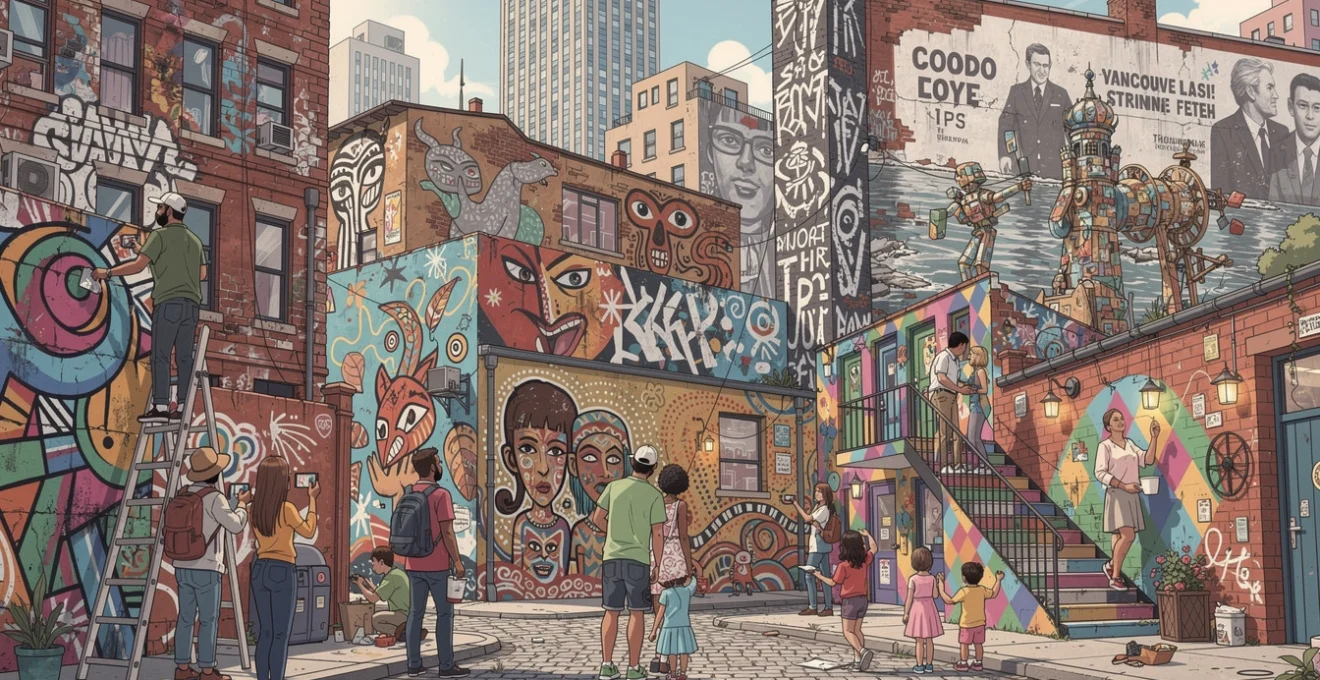
Urban art has evolved far beyond simple decoration. Today, murals, graffiti, and public installations serve as living archives of community identity, political struggle, and cultural heritage. When you walk through certain neighbourhoods around the world, the walls speak with authority about displacement, resistance, celebration, and transformation. These artistic interventions don’t merely beautify deteriorating infrastructure—they document histories that official records often overlook, giving voice to communities whose stories might otherwise remain invisible.
From the political murals of Belfast to the indigenous storytelling of Vancouver, neighbourhood art creates a visual language that transcends traditional communication barriers. These works preserve collective memory while simultaneously challenging viewers to consider uncomfortable truths about gentrification, colonialism, and social inequality. Understanding how different communities use public art to assert their presence in urban spaces reveals much about power, belonging, and the ongoing negotiation of who gets to shape the visual character of our cities.
Street art as urban narrative: how muralism transforms public spaces into cultural archives
The transformation of street art from vandalism to valued cultural expression represents one of the most significant shifts in contemporary urban planning. Cities that once aggressively prosecuted graffiti artists now commission them to create landmark installations. This evolution reflects a growing recognition that muralism serves documentary functions that formal institutions cannot replicate. When communities paint their own stories on public walls, they claim ownership over neighbourhood narratives in ways that resist sanitised corporate development.
Street art functions as a democratic archive because it exists outside traditional gatekeeping structures. You don’t need institutional permission to view these works, and artists don’t require gallery representation to share their perspectives. This accessibility creates dialogues between diverse audiences who might never enter conventional art spaces. The ephemeral nature of many pieces—subject to weather, buffing, and overpainting—paradoxically increases their cultural significance, as communities document and share works before they disappear, creating layered digital archives that complement physical ones.
The evolution of graffiti culture in new york’s lower east side and bushwick
New York’s Lower East Side witnessed graffiti’s transition from subcultural rebellion to internationally recognised art form. During the 1970s and 1980s, artists developed sophisticated tagging systems and large-scale pieces that challenged traditional notions of artistic legitimacy. The neighbourhood’s abandoned buildings provided canvases for experimentation with wildstyle lettering, character work, and political messaging that documented the lived experiences of marginalised communities during periods of municipal neglect and economic crisis.
Bushwick emerged as a major street art destination in the 2000s, attracting international artists through events like the Bushwick Collective. The neighbourhood’s industrial architecture and warehouse facades offer expansive surfaces for large-format works. However, this artistic renaissance coincided with rapid gentrification, creating tensions as long-term residents found themselves priced out of areas that murals had helped make desirable. This pattern illustrates how public art can inadvertently accelerate displacement even as it attempts to celebrate community identity.
Melbourne’s hosier lane: sanctioned street art as tourism infrastructure
Melbourne adopted an unusual approach by designating specific laneways as legal graffiti zones, transforming street art into official tourism infrastructure. Hosier Lane became internationally famous as a constantly changing outdoor gallery where artists can work without prosecution. This sanctioned approach eliminates the transgressive element that many consider fundamental to authentic street art culture, raising questions about whether institutional approval fundamentally alters the medium’s meaning and impact.
The tourism economy surrounding these lanes generates significant revenue, demonstrating how cities can monetise counter-cultural expressions. Yet this commodification creates new hierarchies, as prime wall space becomes contested territory and certain aesthetic styles receive preferential treatment. You’ll notice that the most photographed works often feature Instagram-friendly colour palettes rather than challenging political content, suggesting that commercial considerations increasingly shape which artistic voices achieve visibility.
Political muralism in belfast’s falls road and shankill road districts
Belfast’s political murals serve starkly different functions than those in most other cities. These works emerged during decades of sectarian conflict, with communities using walls to mark territory, commemorate violence, and assert political allegiances. The murals document the Troubles through imagery that remains deeply divisive—Republican murals celebrating Irish nationalism stand opposite Loyalist works affirming British identity
and unionism. In recent years, some murals have shifted from overt paramilitary imagery toward themes of peace, shared history, and labour struggles, yet the walls still operate as active political texts. Guided tours now frame these neighbourhoods as open-air museums of conflict, but for residents, these images remain part of an ongoing negotiation over identity, trauma, and the meaning of reconciliation in public space.
Understanding Belfast’s muralism requires acknowledging both its documentary power and its capacity to entrench division. When you walk along Falls Road and Shankill Road, you aren’t just viewing street art—you’re moving through a contested narrative landscape where each image has implications for how communities remember the past. Efforts by local organisations to commission cross-community murals demonstrate how public art can slowly re-script these narratives, yet they also reveal how difficult it is to transform symbols that have become embedded in everyday life.
Brazil’s pixação movement: são paulo’s cryptic vertical typography
In São Paulo, pixação represents one of the most controversial forms of urban inscription. Unlike colourful murals or figurative graffiti, pixação uses stark, cryptic typography painted vertically on high-rise facades and highway overpasses. Emerging during Brazil’s military dictatorship, the style developed as a coded language of defiance, with crews competing to reach ever more inaccessible surfaces, often at great personal risk. To many residents and authorities, these markings read as visual noise or urban blight, yet for practitioners, they operate as signatures of existence in a city that marginalises them.
Pixadores typically come from working-class peripheries, and their interventions mark a refusal to remain invisible in the urban hierarchy. While conventional street art often seeks aesthetic acceptance, pixação deliberately resists commodification and gallery translation, maintaining a raw, confrontational stance. Internationally, photographs of São Paulo’s letter-covered towers have become iconic images of contemporary urban culture, but on the ground, debates continue about criminality, property rights, and whose visual language is allowed to occupy the skyline.
Indigenous and aboriginal artistic interventions in urban landscapes
Across settler-colonial cities, indigenous and Aboriginal artists are using public art to reclaim space and challenge dominant historical narratives. Rather than treating urban centres as neutral backdrops, these works insist on the visibility of pre-colonial histories, ongoing sovereignty, and lived indigenous presence. Street art, murals, and sculptural installations become tools for language revitalisation, intergenerational storytelling, and healing from the impacts of displacement and erasure.
When you encounter a First Nations mural on a city street or an Aboriginal-designed plaza in a dense neighbourhood, you’re seeing more than decorative pattern. These interventions often encode ancestral knowledge about land, water, and kinship systems, translated into visual forms that speak simultaneously to local communities and global visitors. As cities grapple with how to incorporate indigenous perspectives into planning, public art offers one of the most immediate and visible ways to reshape narratives about who belongs in urban space.
First nations murals in vancouver’s granville island and gastown precincts
Vancouver’s Granville Island and nearby Gastown have become key sites for First Nations public art that challenges tourist-friendly, postcard versions of the city. Large-scale murals and sculptural works by Musqueam, Squamish, and Tsleil-Waututh artists foreground traditional forms like Coast Salish ovoids and formline design while addressing contemporary issues such as land rights and environmental stewardship. These pieces remind viewers that the city sits on unceded territory, complicating narratives that present Vancouver as a young, purely cosmopolitan metropolis.
Art initiatives such as the Vancouver Mural Festival have increasingly prioritised indigenous-led projects, ensuring that local nations shape how their stories appear in public. You might see a mural that incorporates traditional salmon motifs alongside imagery of oil tankers, visually linking ancestral sustenance to modern ecological threats. By situating these works in commercial and tourist districts, artists assert that indigenous presence is not confined to museums or remote reserves but is integral to the daily life and visual identity of the city.
Māori street art revitalisation in wellington’s te aro quarter
In Wellington’s Te Aro quarter, Māori street art has become a powerful vehicle for language and cultural revitalisation. Murals featuring te reo Māori phrases, stylised tukutuku patterns, and figures from whakapapa (genealogy) transform alleyways and building facades into living classrooms. For young Māori, seeing their language and symbolic systems in central city spaces counters generations of assimilation policies that pushed indigenous identity to the margins.
Local councils and iwi (tribal) authorities have collaborated with artists to ensure that new developments include Māori-designed elements, from etched glass panels to large-scale wall works. These collaborations show how public art can function like a woven cloak over the built environment, allowing ancestral narratives to sit visibly atop colonial street grids. As you walk through Te Aro, you move through layers of meaning—English and Māori place names, Victorian storefronts and contemporary murals—that collectively tell a more complex story about Wellington’s past and future.
Aboriginal storytelling through public art in sydney’s redfern neighbourhood
Redfern, long recognised as a centre of Aboriginal activism in Sydney, uses public art to document struggles for land rights, housing, and self-determination. Iconic murals such as the “40,000 Years is a Long, Long Time” piece along Lawson Street emerged from community-led initiatives in the 1980s that sought to assert Aboriginal visibility in a rapidly changing inner-city landscape. These works blend political slogans with symbolic imagery—figures, animals, and patterns rooted in diverse language groups—that collectively narrate survival and resistance.
As Redfern experiences intense redevelopment pressure, new projects have expanded this visual archive. Contemporary murals incorporate portraits of local Elders, references to the 2004 Redfern riots, and affirmations of Aboriginal pride in the face of gentrification. For visitors, these artworks offer a counter-narrative to glossy real estate branding; for residents, they operate as anchors of memory and identity. The neighbourhood demonstrates how Aboriginal public art can function as both cultural assertion and a claim to urban belonging that predates modern property regimes.
Post-industrial regeneration through community-led art installations
Former industrial districts around the world are turning to public art as part of broader regeneration strategies. Decommissioned factories, rail yards, and docklands provide expansive canvases and unconventional spaces for installations, attracting visitors and creative industries. Yet the most meaningful transformations occur when community-led art initiatives shape how these sites evolve, ensuring that new cultural economies acknowledge rather than erase working-class histories.
Public art in post-industrial neighbourhoods often operates like a palimpsest: new creative expressions are layered over visible traces of machinery, soot, and brickwork. As you move through these spaces, you can read the changing economic story of a city through murals, sculptures, and adaptive reuse projects. The challenge—for planners, artists, and residents alike—is to leverage creativity for renewal without turning entire districts into homogenous lifestyle brands disconnected from their past.
Berlin’s east side gallery: cold war remnants as canvas
Berlin’s East Side Gallery exemplifies how physical remnants of conflict can become platforms for global artistic dialogue. After the fall of the Berlin Wall, a 1.3-kilometre stretch along the Spree River was preserved and opened to artists from around the world. Their murals transformed a symbol of division into an open-air gallery celebrating freedom, critique, and remembrance. Images like Dmitri Vrubel’s “Fraternal Kiss” quickly entered the international visual lexicon, demonstrating how place-specific art can achieve planetary recognition.
However, maintaining the East Side Gallery as both heritage site and living artwork poses ongoing tensions. Renovation efforts to protect deteriorating sections have sometimes resulted in partial demolition, sparking protests about the commodification and fragmentation of history. When you visit today, you encounter layers of restoration, overpainting, and tourist graffiti that complicate any simple narrative of preservation. The site raises key questions: how do we conserve politically charged art without freezing it, and who decides which messages remain on the wall?
Detroit’s heidelberg project: assemblage art in urban decay
In Detroit, the Heidelberg Project turned a largely abandoned street on the city’s east side into a globally recognised art environment. Beginning in 1986, artist Tyree Guyton started transforming vacant lots and derelict houses with brightly painted polka dots, found-object sculptures, and installations made from discarded toys, shoes, and appliances. What many initially dismissed as visual clutter evolved into a profound commentary on deindustrialisation, racial inequality, and the value society assigns to different neighbourhoods.
The Heidelberg Project attracted thousands of visitors annually and inspired similar community art initiatives, yet it also faced arson attacks, zoning disputes, and criticism from some residents and officials. Its evolution from spontaneous intervention to more structured non-profit illustrates the delicate balance between artistic freedom, neighbourhood safety, and long-term stewardship. Walking through the site feels like moving through a three-dimensional diary of Detroit’s boom, collapse, and slow reimagining—a reminder that urban art can materialise from the very materials a city has thrown away.
Liverpool’s baltic triangle: warehouse district transformation through creativity
Liverpool’s Baltic Triangle showcases how creative industries and public art can help rescript a former docklands warehouse district. Once dominated by storage facilities and light manufacturing, the area now hosts studios, music venues, and design agencies, with murals and installations punctuating brick walls and alleyways. Street art festivals and commissions have turned otherwise anonymous facades into markers of local identity, referencing maritime history, musical heritage, and contemporary youth culture.
Importantly, the Baltic Triangle’s transformation has been shaped by independent operators rather than top-down masterplanning alone. Pop-up galleries, maker spaces, and artist-run initiatives use murals and signage to claim space and signal alternative uses for old buildings. Yet, as property values rise and new residential developments proliferate, concerns echo those in other regenerated districts: will the very creativity that made the neighbourhood desirable eventually be priced out? For now, the area demonstrates how visual culture can help rebrand and reanimate a post-industrial quarter while debates over inclusive growth continue.
Philadelphia’s mural arts program: anti-graffiti initiative to civic beautification
Philadelphia’s Mural Arts Program, often cited as the world’s largest public art initiative, began in 1984 as an anti-graffiti effort and evolved into a comprehensive model for community-based muralism. Under the leadership of Jane Golden, the program shifted focus from simply removing tags to engaging graffiti writers as collaborators. Today, more than 4,000 murals across the city address themes from mass incarceration and public health to neighbourhood history and youth empowerment, turning entire districts into visual case studies in civic engagement.
The program’s process is as significant as its output. Extensive community meetings, participatory design workshops, and educational components ensure that each mural reflects local stories rather than external prescriptions. For visitors, following a mural route through areas like West Philadelphia or South Philly offers a nuanced perspective on the city’s challenges and strengths. For residents, the works function as anchors of pride and platforms for dialogue, demonstrating how mural programs can become long-term social infrastructure rather than one-off beautification projects.
Latin american barrios: social commentary through neighbourhood aesthetics
In many Latin American cities, neighbourhood aesthetics—brightly painted houses, improvised signage, intricate murals—operate as informal archives of social struggle and cultural resilience. Barrios that outsiders might reduce to statistics of poverty or violence often contain some of the most sophisticated visual storytelling in the urban landscape. Here, walls are not just canvases but tools for organising, educating, and asserting collective presence in the face of structural neglect.
These artistic practices blur boundaries between “high” and “low” art, professional artist and neighbour. A hand-painted political slogan, a carefully rendered portrait of a disappeared activist, and a colourful façade designed to attract customers all contribute to a dense semiotic environment. When you move through these districts with attention, you can read layers of commentary on state power, faith, migration, and everyday survival that rarely appear in official tourist brochures.
Valparaíso’s cerros: chilean port city’s hillside canvas tradition
Valparaíso’s cerros—the steep hills surrounding its historic port—form one of the most visually distinctive urban landscapes in South America. Homes painted in saturated blues, yellows, and reds climb the slopes like an irregular mosaic, while stairways, retaining walls, and funicular stations host an ever-growing collection of murals. Local and international artists alike use these surfaces to explore themes of maritime life, student protest, Mapuche identity, and environmental justice, turning the hillsides into a layered visual chronicle of Chilean society.
Grassroots organisations and resident collectives play a crucial role in commissioning and maintaining works, ensuring that tourism-focused imagery does not completely displace politically engaged art. As you ride an ascensor up to a hilltop viewpoint, you pass images that celebrate dockworkers, critique neoliberal reforms, or memorialise victims of dictatorship. The result is an urban environment where scenic beauty and sharp critique coexist, challenging visitors to look beyond postcard views to the socio-economic realities beneath.
Mexico city’s tepito: resistance art in working-class communities
Tepito, often caricatured as one of Mexico City’s roughest neighbourhoods, uses street art to push back against stigmatising narratives. Murals along market corridors and residential streets celebrate local boxers, street vendors, and religious icons like Santa Muerte, asserting pride in working-class identity. Artists from within the barrio collaborate with collectives from other parts of the city to create pieces that address police violence, informal economies, and the right to remain in place despite redevelopment pressures.
These works rarely appear on official cultural itineraries, yet they offer some of the most direct commentary on urban inequality. Visual references to Aztec iconography and revolutionary figures sit alongside depictions of contemporary hustlers, making clear the continuity of struggle. Walking through Tepito with a community guide, you quickly realise that what outsiders perceive as visual chaos is in fact a sophisticated graphic language of resistance and solidarity.
Buenos aires’ la boca: tango culture expressed through chromatic architecture
La Boca, historically a working-class dockside district in Buenos Aires, has long used colour as a tool of neighbourhood self-definition. The famous Caminito street, with its corrugated metal houses painted in vivid patchworks, originated as an artists’ project in the 1950s to revitalise a derelict railway route. Inspired by both Italian immigrant traditions and local resourcefulness, residents repurposed leftover ship paint to brighten façades, creating an aesthetic now synonymous with porteño identity and tango culture.
Today, murals throughout La Boca expand on this chromatic language, depicting dancers, football legends from Boca Juniors, and scenes from immigrant life. Yet beyond the tourist-heavy strips, new works address housing precarity, flooding, and industrial contamination along the Riachuelo River. The district illustrates how a neighbourhood’s iconic visual style—here, brightly coloured architecture tied to tango—can become both an economic asset and a platform for more critical storytelling about who benefits from cultural branding.
Asian metropolitan districts where calligraphy meets contemporary expression
In dense Asian metropolises, street art and public installations often weave traditional calligraphy, religious symbols, and pop culture references into hybrid visual languages. These works reflect rapid urbanisation, generational shifts, and contested political landscapes, using walls and underpasses as spaces where ancient scripts meet digital-age aesthetics. For locals, they can serve as familiar cultural anchors; for visitors, they offer an accessible entry point into complex histories and debates.
Because formal advertising and signage already saturate many Asian cityscapes, artists must compete with commercial messages while also navigating strict regulations on unsanctioned art. The result is a mix of subtle stencil interventions, sanctioned mural projects, and ephemeral wheat-paste posters that appear overnight and vanish just as quickly. Reading these districts is like parsing an animated manuscript, where each layer of text and image comments on the next.
Hong kong’s central-mid levels escalator: stencil art and political messaging
The Central–Mid-Levels Escalator system in Hong Kong, the world’s longest outdoor covered escalator, doubles as a moving gallery of stencil art, stickers, and posters. Along its elevated walkways and supporting walls, you encounter everything from small, cryptic symbols to bold slogans referencing housing affordability, labour rights, and democratic aspirations. During key protest periods, these surfaces have filled with Lennon Wall–style Post-it notes and hand-drawn graphics, turning circulation infrastructure into a collective bulletin board.
The location is strategic: hundreds of thousands of people use the escalator system each day, ensuring that messages reach a wide cross-section of residents and visitors. Authorities periodically remove materials, but new layers reappear, creating an ongoing cycle of erasure and re-inscription. As you ride up through Soho and Mid-Levels, you can watch this visual conversation unfold in real time, a reminder that even highly regulated financial hubs contain pockets of spontaneous expression.
Seoul’s ihwa mural village: government-sponsored neighbourhood revitalisation
Seoul’s Ihwa Mural Village demonstrates both the potential and pitfalls of government-led art interventions in residential areas. Launched in 2006 as part of the Naksan Project, the initiative invited artists and students to paint murals and create installations throughout a hillside neighbourhood facing depopulation. Whimsical stairway paintings—like giant koi or flower petals—quickly became social media favourites, drawing tourists who might never have ventured into the area otherwise.
Yet the influx of visitors brought noise, litter, and privacy concerns for long-term residents. Some locals painted over murals in protest, arguing that they had not been adequately consulted and that rising property speculation threatened their ability to stay. Ihwa’s story underscores a key lesson for planners and curators: successful mural-driven revitalisation must prioritise community consent and control, not just visual impact and visitor numbers. When you explore the village today, you see a mix of celebrated works, faded pieces, and blanked-out walls that together tell a more complicated story than any single image.
Tokyo’s shimokitazawa: underground culture and wheat-paste poster aesthetics
Shimokitazawa, often described as Tokyo’s bohemian enclave, nurtures a subtler form of street-level expression than large-scale mural districts. Narrow lanes around the train stations host layers of wheat-paste gig posters, hand-drawn flyers, and small stencils advertising indie theatres, live houses, and vintage shops. Rather than monumental murals, you find dense clusters of graphics on electricity boxes, shutters, and alley walls—an aesthetic closer to collage than to conventional graffiti.
This visual ecosystem reflects Shimokitazawa’s role as a hub for underground music, fringe theatre, and youth subcultures resisting large-scale redevelopment. As station area reconstruction projects threaten to homogenise the district, local activists and designers have used graphic campaigns and small interventions to advocate for human-scale streets and independent businesses. Walking through Shimokita, you read a living schedule of the neighbourhood’s creative life on every surface, an analogue feed that rivals any digital event platform.
European historic quarters balancing heritage preservation with artistic innovation
Historic European quarters face a unique challenge: how to maintain architectural integrity and UNESCO-style heritage status while allowing contemporary artistic expression to flourish. Strict preservation rules can limit what appears on façades and public squares, yet complete visual stasis risks turning living neighbourhoods into open-air museums devoid of local voice. In response, artists and curators are experimenting with ways to embed new work within old frameworks—using reversible installations, projection mapping, and collaborations with heritage bodies.
In these districts, the dialogue between past and present becomes especially visible. A stencil on a centuries-old stone wall, a tile mural referencing both traditional craft and current politics, or a festival that temporarily reshapes a plaza all invite residents and visitors to reconsider what “authentic” urban character means. Rather than seeing conservation and creativity as opposing forces, many communities are exploring how the two can reinforce each other when approached thoughtfully.
Lisbon’s bairro alto: azulejo tile traditions reimagined by contemporary artists
Lisbon’s Bairro Alto, known for its steep cobbled streets and nightlife, also serves as a laboratory for reinterpreting Portugal’s azulejo tile tradition. While historic blue-and-white panels depicting religious or pastoral scenes still adorn many buildings, contemporary artists have begun creating tile-based works that incorporate abstract patterns, typography, and social commentary. Some pieces play with the grid structure of azulejos to explore digital-era themes, turning façades into pixelated narratives about migration, tourism, or climate change.
Municipal programmes and private commissions alike have supported these experiments, recognising that tilework can bridge heritage and innovation. As you wander through Bairro Alto and adjacent districts like Chiado, you might encounter a façade that at first glance appears centuries old, only to realise that its imagery references smartphone addiction or housing protests. This layering of temporalities allows Lisbon to maintain its distinctive material vocabulary while ensuring that local art continues to tell the city’s evolving story.
Athens’ exarcheia: anarchist symbolism and counter-culture iconography
Exarcheia, long associated with student movements and anarchist organising in Athens, uses walls as primary vehicles for dissent. Large murals, tags, and political posters cover building fronts and university facades, featuring imagery ranging from clenched fists and masked figures to intricate allegorical scenes critiquing austerity measures and state repression. For many Athenians, Exarcheia’s dense graphic landscape functions as a barometer of political tension, changing rapidly in response to protests, evictions, and international events.
While media often portray the neighbourhood as chaotic or dangerous, walking its streets reveals a highly literate visual culture where symbols are carefully chosen and layered. Slogans in Greek, English, and other languages address local and global struggles, connecting Exarcheia to networks of resistance from Chiapas to Rojava. The district faces ongoing policing and development pressures, but its insistence on autonomous visual production keeps it at the forefront of debates about who controls public space in a city rich with ancient monuments and contested futures.
Bristol’s bedminster and southville: banksy’s legacy in stencil art geography
Bristol’s Bedminster and Southville neighbourhoods, south of the River Avon, have become key sites in the global geography of stencil art, thanks in part to the city’s association with Banksy. While the elusive artist’s early works helped put Bristol on the map, the area’s current vibrancy owes much to events like Upfest, Europe’s largest street art festival. Each year, hundreds of artists transform walls, shopfronts, and gable ends into temporary and semi-permanent murals, drawing visitors who might otherwise stay within the city’s historic core.
Local councils and residents have largely embraced this identity, integrating mural trails into neighbourhood planning and tourism strategies. Yet Bedminster and Southville also illustrate the double-edged nature of cultural capital: as house prices rise and independent shops compete with chain stores, some long-term residents worry that their community is becoming a backdrop for Instagram rather than a place where diverse populations can afford to live. For now, walking these streets offers a vivid lesson in how one artist’s legacy can seed a broader ecosystem of urban creativity—if, and only if, communities retain a stake in shaping how their walls are used.