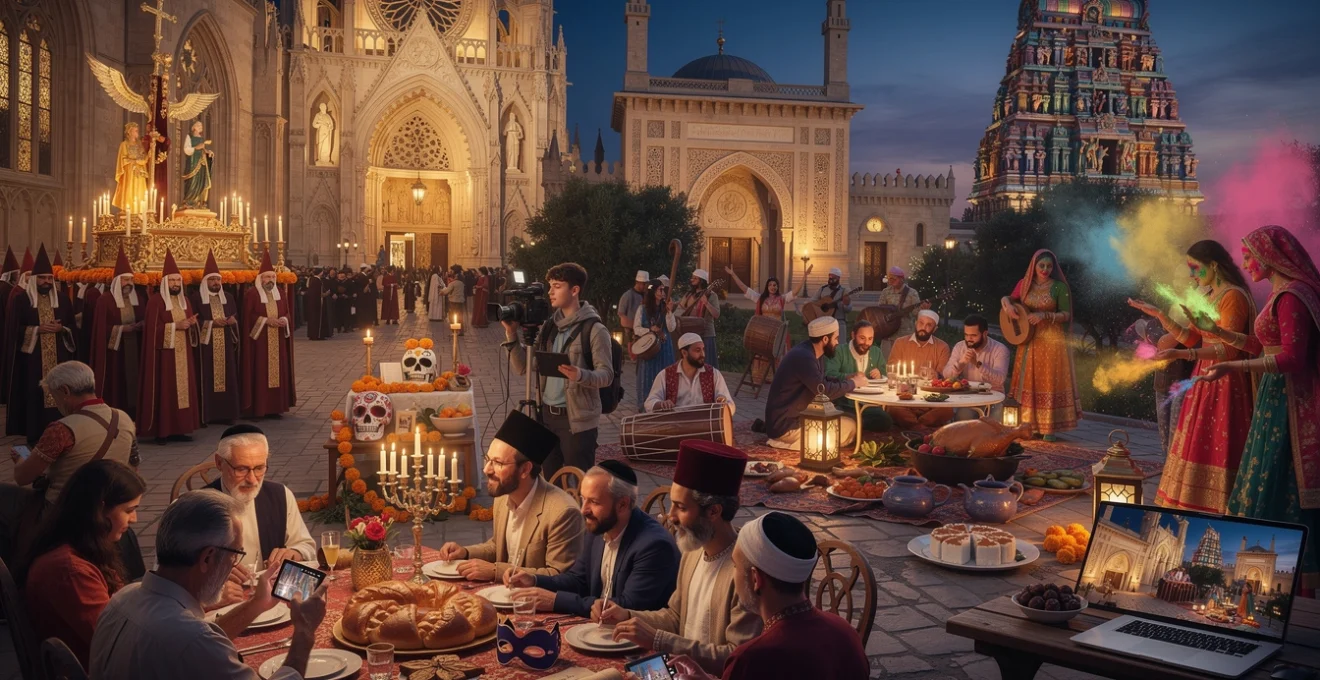
Religious celebrations constitute one of the most profound expressions of cultural identity, serving as living archives that preserve centuries of tradition, belief, and community values. These sacred observances transcend mere ritual performance; they embody the collective memory of communities, encoding historical narratives, social structures, and philosophical worldviews within their ceremonial frameworks. From the incense-laden processions of Semana Santa in Andalusia to the vibrant colour explosions of Holi in northern India, religious festivals function as dynamic repositories of intangible heritage, transmitting knowledge across generations through embodied practice rather than written documentation.
The academic study of religious celebrations has evolved considerably, moving beyond simplistic descriptions of exotic customs towards sophisticated analytical frameworks that recognise these events as complex cultural phenomena. Anthropologists, historians, and heritage specialists now understand that examining how communities celebrate sacred occasions reveals intricate details about their historical development, economic systems, artistic traditions, and social hierarchies. When you observe a religious festival, you witness not merely devotional expression but a carefully choreographed performance of identity that connects contemporary practitioners with ancestors who performed similar rituals centuries earlier.
Anthropological frameworks: decoding sacred rituals as cultural narratives
Understanding religious celebrations requires robust theoretical frameworks that can illuminate the deeper meanings embedded within seemingly straightforward ceremonial acts. Several influential anthropological theories have shaped how scholars interpret these events, each offering unique perspectives on the relationship between ritual performance and cultural meaning. These frameworks help decode the complex symbolism and social functions that characterise religious observances worldwide.
Émile durkheim’s theory of collective effervescence in festival contexts
The pioneering French sociologist Émile Durkheim introduced the concept of collective effervescence to describe the heightened emotional energy generated when communities gather for shared ritual experiences. During major religious celebrations, participants experience a profound sense of unity that transcends individual consciousness, creating what Durkheim termed the “sacred” as opposed to the mundane realm of everyday life. This theory proves particularly illuminating when examining large-scale pilgrimages or festival gatherings where thousands converge in devotional purpose.
When you witness the concentrated fervour of millions participating in the Kumbh Mela along the Ganges River, or the intense spiritual atmosphere during Hajj in Mecca, you observe collective effervescence in its most dramatic manifestation. These gatherings generate a palpable sense of something greater than the sum of individual participants, reinforcing social bonds and shared belief systems. Durkheim argued that such experiences fundamentally shape participants’ understanding of their community identity, creating lasting psychological impressions that sustain religious commitment during ordinary periods. The emotional intensity of these moments serves a crucial social function: it periodically revitalises the collective consciousness that holds communities together across temporal and geographical distances.
Victor turner’s liminality and communitas in pilgrimage traditions
Victor Turner’s anthropological work on ritual processes introduced two concepts particularly relevant to understanding religious celebrations: liminality and communitas. Liminality refers to the transitional state participants enter during ritual performance, where normal social structures temporarily dissolve and individuals occupy an ambiguous position “betwixt and between” established categories. During this liminal phase, participants often experience communitas—a sense of unstructured, egalitarian fellowship that transcends conventional social hierarchies.
Pilgrimage traditions exemplify these concepts brilliantly. When you embark on the Camino de Santiago, the Via Francigena, or any traditional pilgrimage route, you enter a liminal state where your ordinary social identity becomes temporarily suspended. A corporate executive and a farm labourer walking the same path share equal status as pilgrims, creating moments of communitas where authentic human connection flourishes beyond societal stratification. This temporary dissolution of hierarchy explains why pilgrimage experiences often prove transformative for participants, offering glimpses of alternative social possibilities that contrast sharply with everyday hierarchical structures.
Clifford geertz’s thick description applied to ceremonial symbolism
Clifford Geertz advocated for “thick description” as an anthropological methodology—detailed, context-rich analysis that interprets the multiple layers of meaning embedded within cultural practices. Rather than simply documenting what happens during a religious celebration, thick description explores the
web of symbols, stories, and social relationships that give those actions significance. A candle lit on an altar is never just a source of light; it may simultaneously evoke ancestral presence, divine protection, and local history. Applying thick description to religious celebrations means asking not only what people do, but how they themselves explain these actions and what wider narratives of origin, migration, power, or resistance they attach to them.
Consider the Balinese Galungan festival, where elaborately curved bamboo poles (penjor) line village roads. At a surface level, these are decorative markers of a holy period. Through a Geertzian lens, however, each penjor becomes a “text” that locals read as a sign of cosmic balance, agricultural fertility, and village prestige. Its height, adornment, and placement can index family status, adherence to tradition, and even political alignment. When you approach religious celebrations with thick description, you start to see how every costume, chant, and gesture encodes local heritage in ways that statistics or official archives often fail to capture.
Material culture analysis: votive offerings and religious artefacts as heritage markers
Alongside symbolic interpretation, anthropologists increasingly focus on material culture—the physical objects that circulate within religious celebrations—as a key to understanding local heritage. Votive offerings, devotional images, ritual tools, and processional sculptures are not passive decorations; they are active participants in social life. Their materials, workmanship, and circulation routes reveal much about economic histories, craft traditions, and regional exchange networks.
Take the wax ex-votos in Mediterranean Marian shrines, shaped like limbs, organs, or miniature houses. On one level, they represent prayers for healing or gratitude for cures. Yet their stylistic changes over time—shifting from hand-moulded folk pieces to factory-produced items—track broader transformations in local economies and craft guilds. Similarly, silver milagros in Latin American churches or colourful wooden masks used in Andean saints’ festivals act as portable archives of metallurgical skills, colonial trade, and Indigenous iconography repurposed within Catholic frameworks. When communities fight to conserve these artefacts, restore their chapels, or register them as protected heritage, they are also asserting claims over the historical narratives these objects embody.
Architectural patrimony: sacred structures as living heritage repositories
Sacred architecture provides another powerful lens through which religious celebrations reveal local heritage. Churches, mosques, synagogues, and temples are not only backdrops for ritual; they are spatial scripts that choreograph movement, sound, and vision during festivals. Their layouts, decorative programmes, and locations within the urban or rural landscape crystallise centuries of theological debate, artistic innovation, and political negotiation. When we examine how specific celebrations unfold within these spaces, we gain insight into how communities inhabit and reinterpret their architectural patrimony over time.
Gothic cathedrals and the easter vigil liturgical theatre in chartres
The Gothic cathedral of Chartres in France exemplifies how religious celebrations activate architectural heritage. During the Easter Vigil, the vast, dim interior becomes a liturgical theatre, guiding worshippers from darkness to light in a carefully staged sequence. The service begins outside, where the Paschal fire is kindled and the new candle blessed. As the congregation processes into the nave, the single flame is shared candle to candle, slowly revealing the intricate stone vaulting and stained glass narratives as the building fills with light.
This choreography is not accidental. The long nave focuses attention on the high altar, while the famous labyrinth inscribed in the floor evokes the spiritual journey from sin to salvation. Medieval builders designed the cathedral’s acoustics to carry chant and organ music along the stone surfaces, so that the Easter proclamation reverberates through every side chapel. By experiencing the Vigil in Chartres, you are also encountering the theological priorities of twelfth- and thirteenth-century bishops, the technical skills of medieval masons and glaziers, and the town’s historic role as a Marian pilgrimage centre. The celebration thus becomes a living reenactment of local and regional heritage encoded in stone and glass.
Synagogue architecture reflecting sephardic and ashkenazi purim customs
Synagogue architecture likewise crystallises layers of communal history that come to the fore during festive occasions such as Purim. In many historic Sephardic synagogues around the Mediterranean, the tevah (reader’s platform) stands centrally, facing an ornate hekhal (ark) along the eastern wall. Wooden balconies accommodate women’s galleries, their latticework drawing from Ottoman or Maghrebi design vocabularies. When the Book of Esther is chanted at Purim, congregants stamp their feet and rattle noisemakers at the mention of Haman’s name, filling this space with a distinctive sonic heritage shaped by centuries of diaspora life.
By contrast, many Central and Eastern European Ashkenazi synagogues developed different spatial solutions—sometimes with the bimah brought forward toward the ark, sometimes with painted ceilings filled with zodiac signs and local fauna. During Purim celebrations in these communities, comedic skits (Purimshpil), masquerades, and charitable collections animate side rooms and courtyards, turning the building into a multi-stage performance venue. The way children move between women’s galleries, main sanctuary, and communal halls during the festivities reflects inherited gender norms, educational practices, and migration histories. Reading Purim through its architectural setting therefore offers insight into how different Jewish communities negotiated majority cultures while sustaining their own ritual styles.
Islamic mihrab orientation and ramadan observance spatial dynamics
In Islamic architecture, the mihrab—the niche indicating the direction of Mecca (qibla)—anchors ritual orientation and reveals historical layers of knowledge and power. During Ramadan, this architectural feature shapes the spatial dynamics of nightly tarawih prayers and communal iftars. In historic mosques from Fez to Isfahan, the mihrab’s intricate calligraphy and muqarnas decoration signal patronage by particular dynasties, while its precise geographic alignment testifies to advances in medieval astronomy and geometry.
When hundreds gather shoulder to shoulder in these spaces after sunset, we see how religious celebrations transform architectural design into lived heritage. Courtyards fill with families breaking their fast, arcades become temporary dining halls, and adjoining madrasas host Qur’anic recitation competitions. In contemporary diaspora contexts, converted warehouses or community centres improvise their own qibla walls using portable prayer rugs and temporary partitions. Comparing these settings during Ramadan reveals not only theological continuity but also divergent local strategies for negotiating urban planning laws, property markets, and minority visibility.
Hindu temple gopurams as narrative platforms during diwali celebrations
In South India, towering temple gateways known as gopurams play a central role in linking Diwali celebrations to regional heritage. Covered in dense sculptural programmes depicting deities, mythic episodes, and local heroes, these gateways act as three-dimensional storybooks. During Diwali, strings of oil lamps trace their outlines, and processional deities are carried beneath them in palanquins, visually reactivating the narratives they portray.
Viewed through the lens of local heritage, each gopuram also encodes patronage histories: royal emblems, donor inscriptions, and stylistic features point to specific dynasties, artisan communities, and periods of renovation. When you walk through these gateways on Diwali evening—amid firecrackers, flower stalls, and sweet vendors—you participate in a ritual of passage that fuses mythic return of light with very concrete memories of urban growth, temple economics, and caste-based craft lineages. The architecture does not merely frame the festival; it is itself a protagonist in the ongoing story of the town or city.
Intangible cultural heritage: UNESCO-recognised celebratory practices
Beyond buildings and objects, many religious celebrations are now safeguarded as intangible cultural heritage—living practices recognised by UNESCO and national bodies as vital to community identity. This recognition underscores how songs, processions, and craft techniques carry historical knowledge just as surely as monuments do. Examining these festivals through an intangible heritage lens helps us understand how communities negotiate continuity and change, especially under pressures of tourism, urbanisation, and secularisation.
Semana santa processions in seville: baroque confraternity traditions
Holy Week (Semana Santa) in Seville offers a striking example of religious celebration formally recognised as heritage while still rooted in grassroots devotion. Dozens of cofradías (lay brotherhoods) organise night-long processions in which heavy wooden floats (pasos) bearing Baroque sculptures of Christ and the Virgin Mary are carried through narrow streets. The choreography of hooded penitents, brass bands, and candlelit images reflects Counter-Reformation piety, seventeenth-century artistic patronage, and neighborhood rivalries that have persisted for generations.
UNESCO-style heritage discourse has brought new layers of meaning. On the one hand, municipal authorities promote Semana Santa as a cultural asset that draws hundreds of thousands of visitors, supporting local economies and craft workshops that restore the floats. On the other hand, some Sevillanos worry that the influx of tourism risks turning their devotional practices into spectacle. When you watch a procession pause before a parish church while onlookers spontaneously sing a saeta (flamenco-style lament), you witness a negotiation between heritage branding and lived spirituality in real time.
Gion matsuri in kyoto: yamaboko float construction and shinto cosmology
In Kyoto, the Gion Matsuri—centred on elaborate yamaboko floats paraded each July—highlights how religious celebrations function as technical schools of heritage. Each neighbourhood committee oversees the construction and maintenance of its float, some of which can reach 25 metres in height and weigh several tons. Artisans use traditional joinery techniques without nails, while textiles from as far back as the sixteenth century, including imported Persian carpets and Chinese brocades, adorn the structures.
Although Gion Matsuri is often described as a Shinto festival dedicated to the Yasaka Shrine deity, its cosmological framework is deeply entangled with Buddhist and folk beliefs about purification and protection from epidemics. Participating households learn not just how to tie specific knots or chant particular prayers, but also how to narrate Kyoto’s history of fires, wars, and urban reconstruction. In this sense, float-building workshops operate like intergenerational classrooms where religious cosmology, urban memory, and artisanal expertise converge.
Day of the dead altars in oaxaca: pre-columbian syncretism with catholic rites
In Oaxaca, Mexico, Day of the Dead (Día de Muertos) altars exemplify how religious celebrations can condense centuries of cultural negotiation into a single domestic space. Families construct altars layered with marigolds, candles, photographs, sugar skulls, and the favourite foods of deceased relatives. Catholic symbols—crucifixes, images of the Virgin of Guadalupe—coexist with Indigenous motifs such as copal incense and representations of Mictlantecuhtli, the Aztec lord of the underworld.
Anthropologists point out that these altars reconfigure pre-Columbian ancestor veneration within a Catholic liturgical calendar that marks All Saints’ and All Souls’ Days. Local variations—such as the use of pan de muerto baked in specific shapes, or sand tapestries created in courtyards—also index village-level identities and craft specialisations. As tourism has increased, public altars in plazas and cemeteries have become stages for municipal heritage branding, yet many Oaxacan families insist that the most meaningful celebrations still occur at home. When you help place a favourite mezcal bottle on an altar, you are participating in a ritual that enacts both intimate family memory and a broader narrative of Indigenous resilience.
Holi festival chromatics: ayurvedic pigments and krishna mythology
The spring festival of Holi, celebrated across North India and beyond, is often portrayed in global media as a colourful street party. However, a closer look at its chromatic practices reveals dense layers of religious and medicinal heritage. Traditionally, Holi powders (gulal) were made from flowers, herbs, and spices associated with Ayurvedic properties—turmeric for purification, neem for its antiseptic qualities, and indigo-bearing plants for cooling the body as temperatures rise.
These pigments are not randomly chosen; they are keyed to stories of Krishna and Radha, whose playful exchanges of colour symbolise divine love that transgresses caste and gender boundaries. When neighbourhoods gather to throw colours, sing devotional songs, and share festive foods, they are also enacting agricultural rhythms tied to the end of winter and the beginning of the spring harvest. Recent concerns about synthetic dyes have sparked revitalisation efforts, with NGOs and local entrepreneurs promoting plant-based colours and workshops on traditional production techniques. In this way, Holi becomes a site where environmental ethics, public health, and religious mythology intersect.
Gastronomic heritage: ritual foods as edible historical documents
Food prepared and shared during religious celebrations offers one of the most tangible windows into local heritage. Recipes transmitted across generations function like edible archives, preserving information about historical trade routes, class relations, and technological change. When you knead dough, grind spices, or shape sweets for a festival, you are quite literally tasting the past—re-enacting decisions made by ancestors in different economic and ecological conditions.
Challah braiding techniques and shabbat household economies
In Jewish households, baking challah for Shabbat encapsulates both religious symbolism and domestic history. The enriched, slightly sweet dough recalls the manna that sustained the Israelites in the desert, while the braided form is often explained as representing love, unity, or the intertwining of sacred and secular time. But the specific number of strands and braiding styles—three, four, six, or even twelve—also reflect regional traditions carried by Ashkenazi, Sephardic, and Mizrahi communities.
From a heritage perspective, challah-making sheds light on household economies and gendered labour. Historically, women managed the weekly challenge of setting aside premium ingredients like eggs and white flour in contexts where such items were expensive. The obligation to separate a small portion of dough as an offering (hafrashat challah) connects everyday baking to ancient Temple practices. In contemporary diasporas, Shabbat baking workshops and online recipe exchanges act as informal archives, documenting how new ingredients—gluten-free flours, plant-based fats—are integrated without abandoning the festival’s core meanings.
Tsoureki spice routes: greek orthodox easter bread and byzantine trade networks
Greek Orthodox Easter brings another deeply symbolic bread to the table: tsoureki, a rich loaf flavoured with spices such as mahleb, cardamom, and sometimes mastic. These aromatics trace historic trade routes that once linked Byzantine ports to the Levant and beyond. Mahleb, ground from the seeds of wild cherry stones, points to Armenian and Middle Eastern connections, while mastic resin from the island of Chios speaks to tightly controlled Mediterranean commodity chains.
When families gather to braid tsoureki and nest dyed red eggs within the dough, they are not only commemorating Christ’s resurrection but also replaying centuries of commercial and cultural encounter. Variants across regions—some sweeter, some denser—index differences in local wheat quality, access to sugar, and patterns of labour migration. For food historians and heritage professionals, these loaves function as edible maps of empire and exchange, their aromas evoking vanished caravans and shipping lanes.
Mooncake iconography: Mid-Autumn festival and ming dynasty symbolism
In East Asia, the Mid-Autumn Festival centres on the sharing of mooncakes, pastries whose fillings and decorative motifs condense a wealth of historical symbolism. Traditional Cantonese-style mooncakes filled with lotus seed paste and salted egg yolks evoke both harvest abundance and the luminous full moon. The moulded designs on their surfaces—rabbits, cassia blossoms, Chang’e the moon goddess—act as visual shorthand for myths and moral lessons passed down since at least the Ming dynasty.
Some legends even attribute political subversion to mooncakes, such as the (likely apocryphal) story of messages hidden inside them coordinating uprisings against Mongol rule. Modern commercial variants—ice cream mooncakes, low-sugar versions for health-conscious consumers—demonstrate how festival foods adapt to contemporary lifestyles while keeping core narrative elements intact. When you crack open a mooncake and decipher its embossed characters, you are engaging with a layered script of family reunion, imperial nostalgia, and regional branding.
Lechona preparation in colombian corpus christi: Indigenous-Spanish culinary fusion
In parts of Colombia, the preparation of lechona—a whole stuffed pig slow-roasted until its skin crisps—has become tightly linked with Corpus Christi celebrations. The dish’s components reveal a fusion of Spanish and Indigenous culinary traditions: pork introduced by colonisers, native maize and peas, and seasonings that reflect Afro-Colombian influences. The labour-intensive process, often beginning the night before, turns home kitchens and village squares into collaborative spaces where knowledge is passed from elders to younger cooks.
During Corpus Christi, processions bearing the consecrated host may wind through streets scented with roasting lechona, tying Eucharistic theology about the body of Christ to very material experiences of feasting and satiation. For many communities, the ability to offer guests generous portions of lechona is a marker of status and hospitality, echoing older hierarchies tied to land ownership and livestock. As concerns about sustainability and animal welfare gain traction, some groups experiment with smaller-scale or plant-forward versions, negotiating tensions between ethical innovation and fidelity to inherited celebration forms.
Ethnomusicology and choreographic transmission: performance as heritage pedagogy
Music and dance are among the most powerful vehicles for transmitting religious heritage during celebrations. Melodic modes, rhythmic patterns, and choreographic sequences act as embodied archives, teaching participants how to feel and move as members of a particular tradition. Ethnomusicologists and dance scholars treat festivals as field sites where they can observe how communities rehearse, adapt, and sometimes politicise their sonic and kinetic repertoires.
Gregorian chant neumes in christmas midnight mass traditions
Within Christian liturgical traditions, Gregorian chant sung at Midnight Mass on Christmas Eve illustrates how notation systems themselves constitute heritage. The square neumes found in medieval manuscripts from monasteries like Solesmes encode not only melodic contours but also a theology of textual primacy and contemplative listening. When modern scholas reconstruct these chants from facsimiles, they are engaging in a kind of musical archaeology that reconnects present-day congregations with Carolingian reforms and later monastic revivals.
Experiencing chant in a resonant stone church at midnight—when lights are dim and the liturgy moves slowly—heightens awareness of time as sacred. For many worshippers, the familiar cadences of “Puer natus est nobis” or “Missa de Angelis” mark childhood memories tied to specific parishes and family rituals. Workshops on chant for parish musicians thus serve as informal heritage courses, teaching Latin pronunciation, modal theory, and historical performance practice alongside spiritual interpretation.
Sufi qawwali and urs celebrations at ajmer sharif dargah
At the Ajmer Sharif Dargah in India, annual Urs celebrations commemorating the death anniversary of the Sufi saint Khwaja Moinuddin Chishti provide a vivid example of music as devotional pedagogy. Qawwali ensembles perform through the night, alternating between classical poetry in Persian and vernacular Hindi-Urdu. Their call-and-response structures invite the audience into a shared emotional journey from longing (hijr) to union (visal).
From a heritage perspective, the melodic modes and rhythmic cycles used in Qawwali reflect centuries of Indo-Islamic synthesis, incorporating elements from Hindustani classical music and regional folk traditions. Younger singers learn not only technical skills from their ustads (masters) but also stories of past saints, patrons, and political upheavals that shaped the shrine’s fortunes. As recordings circulate globally and Qawwali appears on streaming platforms, debates emerge about commercialisation and authenticity—yet the core function of the music within the Urs remains to knit pilgrims into a translocal community of devotion.
Sephardic piyyutim: ladino poetry in rosh hashanah services
Among Sephardic Jewish communities, liturgical poems known as piyyutim—often sung in Hebrew or Judeo-Spanish (Ladino)—play a central role in High Holy Day services, especially Rosh Hashanah. Melodies and poetic forms carried from medieval Spain to North Africa, the Ottoman Empire, and later the Americas encode experiences of exile, persecution, and cultural flourishing. When congregations stand to sing “Aki esmo, mozos i viejos” or other piyyutim, they are reenacting a transgenerational act of memory.
Because many of these melodies were historically transmitted orally, contemporary cantors and community choirs function as vital custodians of an endangered repertoire. Ethnomusicological projects that record and notate Ladino piyyutim effectively freeze one moment in a much longer history of melodic variation, raising questions about how best to preserve a tradition whose richness lies partly in its fluidity. For younger participants, learning these songs can be a powerful introduction to their own family’s migration stories and to broader narratives of Sephardic resilience.
Digital heritage preservation: virtual ethnography of contemporary religious observances
In the twenty-first century, digital technologies have become crucial tools for documenting and transmitting religious celebrations as heritage. Virtual reconstructions, social media archives, and augmented reality experiences allow communities to share and reflect on their rituals in new ways. At the same time, they raise questions: What does it mean to “attend” a festival on a screen? How do we balance accessibility with respect for sacred boundaries? Exploring these developments through virtual ethnography helps us understand how religious life adapts to an increasingly networked world.
3D photogrammetry of kumbh mela temporary sacred geometries
The Kumbh Mela in India, often described as the world’s largest religious gathering, transforms entire riverfronts into temporary sacred cities. Using 3D photogrammetry, researchers and heritage professionals now capture detailed models of these ephemeral infrastructures: pontoon bridges, tented monasteries, processional routes, and bathing ghats aligned according to astrologically auspicious configurations. These digital reconstructions document not only engineering feats but also the sacred geometries that underpin the event’s spatial logic.
For planners and scholars, such models provide invaluable data on crowd flows, safety practices, and environmental impacts, supporting more sustainable future gatherings. For pilgrims who cannot travel—whether due to distance, health, or financial constraints—virtual tours offer a mediated way to engage with the festival’s landscapes. Yet many participants emphasise that no digital proxy can replicate the sensory intensity of cold river water at dawn or the collective effervescence of millions chanting together. Here, digital heritage functions as complement rather than replacement, an archive that preserves patterns likely to shift with climate change and urban development.
Social media ethnography: instagram narratives of eid al-fitr diaspora communities
For Muslim diasporas in Europe, North America, and beyond, platforms like Instagram and TikTok have become key spaces for narrating Eid al-Fitr celebrations. Hashtags cluster posts of new clothes, home-cooked feasts, mosque decorations, and charitable initiatives, creating a searchable visual archive of how communities adapt traditional practices to local contexts. Ethnographers analysing these feeds can trace how second- and third-generation Muslims negotiate questions of modesty, consumerism, and multicultural belonging through curated images.
At a micro level, a single carousel post showing a family’s Eid table might reveal hybrid menus—samosas alongside lasagne, for instance—pointing to intermarriage and culinary experimentation. At a macro level, mapping geotagged posts highlights neighbourhoods where public Eid lights or municipal greetings signal shifts in national identity narratives. While social media can flatten complex rituals into aestheticised snapshots, it also offers younger Muslims tools to assert their presence in public space and to connect with co-religionists worldwide.
Augmented reality applications for canterbury cathedral pilgrimage routes
In historic Christian sites such as Canterbury Cathedral in England, augmented reality (AR) applications are reshaping how visitors experience pilgrimage heritage. By scanning markers with a smartphone, you might see an overlay of medieval pilgrims processing with relics, or listen to reconstructed Middle English prayers at specific chapels associated with Saint Thomas Becket. These digital layers function like portable guides, translating dense historical scholarship into accessible storytelling for contemporary audiences.
From a heritage perspective, AR raises both opportunities and dilemmas. It can help disperse crowds by directing visitors to lesser-known areas, illuminate erased histories—such as the roles of women or lay confraternities—and offer multilingual interpretation without intrusive signage. Yet it also risks privileging spectacular narratives over quieter devotional practices still maintained by local worshippers. Successful projects tend to be those developed in collaboration with clergy, historians, and community members, ensuring that digital enhancements support rather than overshadow the living religious life of the site.