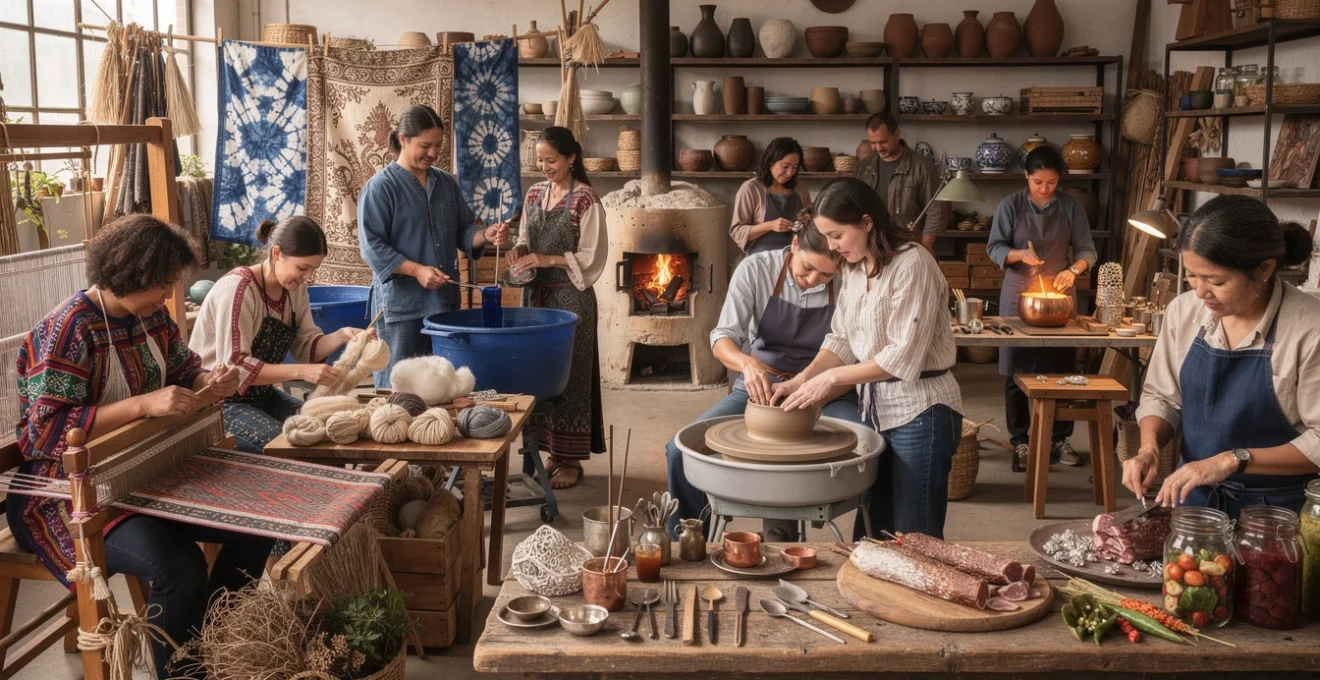
The rumble of a potter’s wheel in a centuries-old studio, the rhythmic clatter of a traditional loom, the satisfying ring of hammer against heated metal—these are the sounds of heritage crafts still alive in communities around the world. As modern life increasingly disconnects us from the tangible act of making, a growing movement invites travellers to do more than simply observe: to sit alongside master artisans, to feel raw materials transform under guided hands, and to carry home not just souvenirs but genuine skills passed down through generations.
Cultural craft workshops represent a profound shift in how we experience travel. Rather than racing through museums or snapping photographs at landmarks, you can spend a morning learning ikat weaving from Guatemalan cooperatives, an afternoon mastering indigo dyeing in rural Japan, or an evening forging copper vessels in Mexico. These immersive experiences connect you to the cultural DNA of a place—the techniques, materials, and traditions that have shaped communities for centuries. What emerges is something far more valuable than any mass-produced keepsake: authentic knowledge, meaningful human connection, and a deeper understanding of how craft continues to define cultural identity in the twenty-first century.
Traditional textile craftsmanship: weaving, dyeing, and natural fibre workshops
Textile traditions represent some of humanity’s oldest and most widespread craft practices, with techniques refined over millennia across every inhabited continent. From the complex backstrap looms of Central America to the elaborate resist-dyeing methods of Asia, fabric creation has always been intimately tied to cultural expression, economic survival, and community identity. Today, artisan workshops around the world invite you to participate in these living traditions, offering hands-on experiences that reveal both technical mastery and cultural significance.
The beauty of textile workshops lies in their accessibility—whilst achieving true mastery requires years of dedicated practice, even beginners can grasp fundamental techniques within a single session. You’ll discover how natural materials are transformed into dyes that produce colours chemical processes cannot replicate, learn why certain weaving patterns carry specific meanings within indigenous communities, and understand the relationship between local climate, available materials, and textile traditions. These workshops frequently operate as cooperatives or family enterprises, meaning your participation directly supports artisan livelihoods and helps preserve endangered skills.
Ikat weaving techniques in guatemala’s santiago atitlán cooperatives
The shores of Lake Atitlán in Guatemala’s highlands host some of Central America’s most vibrant textile traditions, particularly in Santiago Atitlán, where Tz’utujil Maya weavers maintain complex ikat techniques dating back centuries. Unlike simple dyeing methods, ikat requires extraordinary precision—artisans must bind and dye threads in specific patterns before weaving begins, so that the design emerges only when the fabric takes shape on the loom. This resist-dyeing process demands mathematical understanding and spatial visualisation that takes years to perfect.
Workshops with Santiago Atitlán cooperatives typically begin with natural dye preparation, using local plants like indigo, cochineal insects for brilliant reds, and various barks and flowers. You’ll observe the intricate thread-binding process that creates ikat’s characteristic blurred patterns, then work on backstrap looms—traditional devices where the weaver’s own body tension controls the fabric. Women’s cooperatives such as these provide not only cultural education for visitors but crucial economic independence for artisans in communities where opportunities remain limited. Sessions usually span half to full days, with participants creating small pieces they can complete within the timeframe.
Indigo dyeing masterclasses in japan’s tokushima prefecture
Tokushima Prefecture on the island of Shikoku has cultivated Japan Blue—the distinctive deep indigo that coloured samurai garments and working-class clothing for centuries—since at least the eighth century. The region’s sukumo indigo production involves fermenting Polygonum tinctorium leaves for roughly 100 days, creating a living dye vat that artisans treat with almost ceremonial reverence. This natural fermentation process produces colours that synthetic indigos cannot match, with depths ranging from pale
sky to near-black navy. In a typical indigo dyeing workshop, you will start by learning how the vats are cultivated and maintained, then practice folding, clamping, or binding fabric to create shibori resist patterns. Lowering your cloth slowly into the vat, then watching it oxidise from green to blue in the air, feels almost alchemical—a reminder that traditional craft often sits at the crossroads of art and chemistry.
Most Tokushima indigo dyeing masterclasses are designed for beginners and last from a couple of hours to a full day. You might work with cotton scarves, tenugui hand towels, or small fabric panels that fit into luggage, making this one of the most travel-friendly cultural workshops. Studios often combine hands-on practice with short lectures on indigo’s role in Japanese textile history, from samurai armour padding to workwear. Because the dye vats are living systems, seasonal temperature and humidity can affect colour results, so no two pieces ever turn out exactly alike—much like no two trips are ever the same.
Alpaca wool spinning and felting in peru’s sacred valley
High in Peru’s Sacred Valley, Quechua communities have relied on alpaca and llama wool for warmth, trade, and ceremonial dress for centuries. While visitors often see finished ponchos and blankets in markets, cultural workshops invite you into the earlier stages of the process: cleaning raw fleece, hand-spinning yarn, and transforming these fibres through felting. Sitting in a courtyard surrounded by mountains, you may find yourself carding fleece alongside weavers who learned these techniques as children, their motions as instinctive as breathing.
Introductory spinning sessions usually begin with a demonstration of the pushka (drop spindle), a deceptively simple tool that demands balance and coordination. You will practice drafting fibres and twisting them into strong, even yarn, an action that feels a bit like learning to ride a bicycle with your hands. Felting workshops, on the other hand, involve layering dyed alpaca fibres, then using warm water, soap, and friction to create dense, durable fabric for hats, slippers, or decorative panels. Many cooperatives in towns such as Chinchero or Pisac structure these cultural craft workshops so that your fee directly supports community-led education, healthcare, or heritage preservation projects.
Batik wax-resist methods at yogyakarta’s artisan studios
On the Indonesian island of Java, Yogyakarta is considered a cultural capital and the spiritual heartland of traditional batik. This wax-resist dyeing technique has been recognised by UNESCO as Intangible Cultural Heritage, and local studios offer structured batik workshops that walk you through every step of the process. Unlike printed textiles, authentic batik involves drawing or stamping molten wax onto fabric to protect specific areas from dye, building up complex motifs through repeated waxing and colouring.
In a typical Yogyakarta artisan studio, your batik experience begins with choosing a pattern—perhaps a classic parang (knife motif) associated with power, or a more contemporary floral design. You will learn how to handle the canting, a small copper pen with a reservoir that releases hot wax in fine lines, much like ink from a calligraphy brush. After applying wax, the fabric is dyed, dried, and sometimes rewaxed for additional colours before the wax is finally removed in hot water, revealing layered patterns. The rhythm of drawing, dipping, and revealing can feel almost meditative, and you leave not only with a hand-crafted cloth but also a deeper understanding of how motifs encode stories of status, region, and belief.
Ceramic and pottery making: hand-building, wheel-throwing, and kiln firing
Clay has been shaped into vessels, tiles, and sculptures in nearly every culture on earth, making ceramic workshops one of the most universal forms of cultural learning. Whether you are hand-building a small bowl with Pueblo potters in the American Southwest or experimenting with rapid, smoky raku firing in Japan, working with clay offers an immediate tactile connection to place. The soil under your fingers—its texture, colour, and firing behaviour—is literally the ground beneath local communities, transformed by skill and fire.
For travellers, pottery workshops offer both technical challenge and therapeutic focus. You will experience the tension between control and surrender as a spinning wheel magnifies every movement of your hands, or as a wood-fired kiln introduces beautiful unpredictability into glazes. Many ceramic cultural craft workshops purposely integrate local history, geology, and even spiritual beliefs into their teaching. As you shape clay, you will also learn how specific styles evolved in response to cooking methods, architectural needs, and trade routes.
Raku firing workshops in kyoto’s traditional pottery districts
In Kyoto, where tea ceremony and ceramics are deeply intertwined, raku firing workshops give you a front-row seat to one of Japan’s most dramatic pottery traditions. Unlike conventional kiln firings that take many hours, raku ware is pulled from a hot kiln while still glowing and then rapidly cooled, often in sawdust, leaves, or water. This shock creates crackled glazes, smoky markings, and surfaces that feel as though they’ve captured a fleeting moment in time.
During a typical Kyoto raku experience, you may begin by glazing a pre-thrown tea bowl, carefully brushing on glazes whose final appearance is far from obvious. After a short firing, you will stand at a safe distance as the kiln is opened, heat rushing out like a desert wind. With tongs, the instructor extracts each piece and places it into reduction chambers filled with combustible materials, where flames lick around the clay and oxygen is rapidly consumed. Watching your bowl change colour in seconds is like seeing a storm pass over a landscape—intense, unpredictable, and unforgettable. Because raku pieces are often small, they are easier to transport home as tangible reminders of both the tea culture and the philosophy of impermanence that underpin them.
Majolica glazing techniques in deruta and faenza, italy
In central Italy, the hilltowns of Deruta and Faenza have been synonymous with majolica ceramics since the Renaissance. These tin-glazed earthenwares are instantly recognisable by their bright white bases and intricate painted designs in cobalt, ochre, and green. Majolica workshops here focus less on forming clay from scratch and more on the painterly side of the craft, teaching you how to decorate tiles, plates, or small vessels using centuries-old motifs.
Cultural workshops in these Italian pottery centres typically provide pre-bisqued (already fired once) pieces, along with a palette of mineral-based colours that behave very differently from modern acrylic paints. You will learn how to outline designs on unfired glaze, then fill them with translucent colour that fuses into the surface during the second firing. As you copy or adapt motifs of heraldic shields, floral flourishes, or geometric borders, instructors explain how trade with the Islamic world and Spain influenced Italian ceramic aesthetics. The experience feels a bit like colouring in a sophisticated historical colouring book—calming, focused, and surprisingly accessible to all skill levels.
Coil-building methods with pueblo potters in new mexico
In New Mexico, Pueblo communities such as Santa Clara, San Ildefonso, and Acoma have preserved distinctive pottery traditions for generations. Unlike wheel-thrown ceramics, many Pueblo pots are built by hand using the coil method, where long ropes of clay are stacked and smoothed to form walls. When you join a hands-on workshop with Pueblo potters, you are not just learning a technique; you are entering a lineage where form, function, and ceremony have long been intertwined.
Workshops often begin with a discussion of clay gathering and preparation, highlighting the deep respect artisans hold for the land that provides their material. You will then roll coils and learn how to join them seamlessly, gradually shaping bowls or small jars with simple tools—often just gourds, stones, and your own hands. Instructors explain traditional burnishing methods, where surfaces are polished to a soft sheen without glaze, and may talk about firing practices that use open pits rather than enclosed kilns. Because many Pueblo designs are sacred or reserved for specific families, you will typically work with non-ceremonial patterns, but the stories shared around the work table offer invaluable context. The pace is slow, deliberate, and communal, like joining a shared conversation that has been going on for centuries.
Wood-fired anagama kiln sessions in north carolina’s seagrove
Seagrove, North Carolina, is home to one of the largest communities of working potters in the United States, with roots stretching back to the 18th century. Among its many studios, a handful operate anagama or other long-chamber wood-fired kilns inspired by East Asian traditions. Participating in an anagama firing is less a quick workshop and more a communal event—part science experiment, part all-night campfire vigil.
In these sessions, you might first create or bring bisque-fired pieces, then help load them into the long, tunnel-like kiln, carefully considering how flame and ash will move through the chamber. Over several days, potters take shifts feeding wood into the fire, monitoring temperature cones, and listening to the subtle sounds of the kiln breathing. As a visitor, you may join for part of this process, learning how variables like stoking rhythm and wood species influence results. When the kiln is finally opened after a slow cooling period, the reveal feels almost ceremonial: ash has melted into natural glaze, flame paths are etched onto clay surfaces, and no two pieces are alike. If you have ever wanted to understand ceramics as a collaboration between human intention and elemental forces, Seagrove’s anagama workshops offer a powerful introduction.
Metalworking and jewellery fabrication: silversmithing, forging, and casting
Metalworking sits at the intersection of art, engineering, and ritual, shaping everything from everyday tools to ceremonial regalia. In many cultures, techniques such as filigree, hammering, and casting are closely guarded family skills, yet today a growing number of master metalsmiths open their studios to visitors for structured cultural workshops. These experiences let you feel firsthand how malleable heated metal can be, how precise small adjustments must become at the jewellery scale, and how design traditions reflect local histories of trade, conquest, and belief.
Because metal carries both monetary and symbolic value, ethical considerations are especially important in this field. Many contemporary artisan workshops emphasise recycled silver or fair-trade gold, explain hallmarking systems, and discuss how global demand affects mining communities. As you learn to saw, file, solder, or hammer, you are also encouraged to consider the environmental and social footprint of adornment. The result is a richer appreciation of jewellery not merely as decoration, but as a cultural artefact embedded in networks of labour and meaning.
Sterling silver filigree techniques in portugal’s gondomar workshops
On the outskirts of Porto, Gondomar is renowned as Portugal’s capital of goldsmithing and silver filigree. Here, ultra-fine threads of precious metal are curled, twisted, and soldered into lace-like patterns that seem almost too delicate to be solid. In filigree workshops designed for visitors, you quickly realise that what looks light and airy on the surface is underpinned by meticulous geometry and years of muscle memory.
Your session might begin with a tour of a small atelier where artisans demonstrate traditional tools—drawplates for thinning wire, tiny pliers for shaping scrolls, and torches for fusing elements without melting them. Under guidance, you will practice forming basic spirals and hearts, arranging them on a base frame to create a small pendant or pair of earrings. The work demands patience and steady hands; even minor tremors can distort a pattern, much like how a single off-key note can disrupt a melody. Alongside the technical instruction, you will hear how filigree designs vary between regions and occasions, from everyday adornment to wedding finery and religious festivals.
Traditional copper hammering in santa clara del cobre, mexico
The town of Santa Clara del Cobre in Michoacán, Mexico, has built its identity around one material: copper. Walk through its streets and you will hear the rhythmic, almost musical sound of hammers striking metal as artisans shape glowing discs into pots, trays, and sculptures. Many workshops here invite travellers to try their hand at this age-old craft, discovering just how much coordination and physical effort lies behind a single smooth curve.
In a typical copper hammering workshop, you will start with a pre-cut disc heated in a forge until it reaches a workable temperature, then move to an anvil where the real choreography begins. Guided by a master coppersmith, you will take turns striking the metal in specific patterns, learning how each blow stretches or compresses different areas. The metal cools quickly, so pieces must be reheated repeatedly—a vivid lesson in how traditional craftspeople manage time and energy. As you work, you will also learn about Santa Clara’s history, from pre-Hispanic copper use to colonial-era guilds and contemporary design innovations. By the end, even a small hammered dish feels like an earned achievement and a direct connection to the town’s sonic landscape.
Lost-wax casting methods with balinese silversmiths in celuk village
In Bali’s Celuk village, where silver jewellery shops line the main road, many family-run studios still practice lost-wax casting—a method that dates back at least 6,000 years and has been used across Asia, Africa, and Europe. This technique allows artisans to create intricate three-dimensional forms by sculpting an original model in wax, encasing it in plaster-like investment, then melting out the wax and replacing it with molten metal. Learning this process in a cultural workshop setting feels a bit like stepping into a chemistry lab and an art classroom at once.
During a short-course in Celuk, you might not complete every stage personally due to safety and time constraints, but you will observe and participate where possible. You could carve a simple wax design—perhaps a small pendant featuring local floral or mythological motifs—while instructors show how trees of wax originals are prepared for casting. Watching molten silver poured into glowing moulds is always a visceral moment, underscoring the transformation from soft, easily dented wax to enduring metal. Many studios then guide you through finishing steps such as filing, sanding, and polishing, so you leave with a wearable piece that has literally passed through fire. Along the way, you will hear how Balinese aesthetics blend Hindu symbolism, local folklore, and contemporary tourism demand, and how artisans navigate that balance.
Woodworking and furniture making: joinery, carving, and traditional tool mastery
Woodworking cultural workshops invite you into a slower, deeply tactile relationship with material. Long before power tools, artisans across the world developed sophisticated methods for turning timber into everything from temple gates to household stools. Today, hands-on sessions in traditional joinery and carving help you understand why certain woods are prized, how grain direction affects strength, and why well-made furniture can last for generations without a single metal screw.
Participating in a woodworking workshop is often compared to learning a new language: at first, the names of tools and joints feel foreign, but as you handle chisels, planes, and saws, you begin to understand an underlying grammar of angles and pressure. In regions such as Scandinavia, Japan, or West Africa, local approaches reflect climate, available species, and cultural values. For example, Japanese sashimono joinery emphasises invisible joints and repairability, while Scandinavian traditions prioritise simplicity and ergonomic forms. Wherever you join a session, you can expect a strong emphasis on safety, respect for the forest, and the quiet satisfaction of shaping something functional from a rough board.
Short cultural craft workshops might focus on carving a spoon, stool, or small box using hand tools, giving you a compact project you can finish in a day or two. Longer intensives may introduce mortise-and-tenon joinery, surface finishing with natural oils, or decorative carving inspired by regional motifs. You may also learn how to sharpen tools—a foundational skill that many beginners overlook, but which transforms woodworking from a struggle into a more fluid, almost musical experience. As with other heritage crafts, choosing workshops that use locally sourced or reclaimed timber helps ensure that your learning journey supports sustainable forestry practices rather than undermining them.
Culinary arts and food preservation: fermentation, charcuterie, and regional cuisine
Culinary cultural workshops bridge the gap between craft and daily life perhaps more than any other category. Every region has dishes born from necessity, seasonality, and ingenuity—recipes designed to preserve harvests, transform humble ingredients, and bring communities together around a shared table. When you step into a local kitchen for a fermentation class in Korea or a cheese-making session in the French Alps, you are not only learning a recipe; you are stepping into a living archive of climate, trade, and tradition.
Hands-on food workshops are particularly rewarding because they engage all the senses. You might listen to the fizz of fermenting vegetables, feel the texture of dough as gluten develops, or inhale the complex aromas of spices blooming in hot oil. Many travellers find that cooking with local instructors deepens their understanding of markets they have already visited—suddenly, unfamiliar ingredients gain names, uses, and stories. And because cooking skills are so portable, you can bring a slice of your travels home, recreating flavours for friends and family long after your trip ends.
Common formats include half-day classes covering a regional meal from market to table, short intensives on a specific technique such as kimchi fermentation or sausage curing, and multi-day courses that explore broader themes like sustainable seafood or plant-based heritage cuisine. Practical considerations matter here: food safety standards, language barriers, and dietary restrictions all need attention, so it pays to research reputable schools or community-based initiatives. When in doubt, smaller classes that emphasise seasonal, locally sourced ingredients tend to offer the most authentic and responsible experiences.
Booking platforms and immersive cultural learning networks for artisan workshops
Once you start seeking out cultural workshops with local makers, a new question emerges: where do you actually find them, and how can you be sure they are ethical and worthwhile? In recent years, a range of platforms and networks has sprung up to connect travellers with artisan-led experiences, from large global marketplaces to small, curated collectives. Understanding how these systems work helps you choose options that prioritise fair pay, cultural respect, and meaningful learning over superficial “tourist shows.”
Major booking sites now host thousands of craft and culinary experiences, making it easy to filter by location, duration, or skill level. While this convenience is appealing, it is worth reading reviews carefully and looking for signs that workshops are truly led by local makers, not outsourced to generic tour operators. Descriptions that mention specific communities, co-operatives, or family histories often indicate deeper roots. When possible, cross-check information via the artisan’s own website or social media; many established studios maintain a modest online presence even if they rely on third-party platforms for bookings.
Alongside commercial marketplaces, non-profit organisations, cultural institutes, and artist residencies play a growing role in promoting heritage craft workshops. Some national craft councils maintain directories of accredited studios, while regional networks organise open-studio weekends or seasonal programmes. Homestay platforms occasionally feature stays with artisan families, integrating accommodation and learning into a single package—an excellent option if you are seeking extended immersion rather than a one-off session. Asking local tourism boards or cultural centres on arrival can also uncover opportunities not listed online, especially in smaller towns where word-of-mouth remains the primary marketing tool.
Whatever route you choose, a few guiding questions can help you evaluate options: Who benefits financially from this workshop—does the fee go directly to makers or through several intermediaries? Are group sizes small enough for genuine instruction? Does the description acknowledge cultural protocols, such as restrictions on photographing sacred designs or sharing certain techniques? By approaching cultural workshops with the same care you might give to responsible wildlife tours or eco-lodges, you help ensure that artisan communities are empowered, not exploited. In return, you gain access to richer, more reciprocal experiences where learning flows in both directions and the skills you carry home are grounded in genuine human connection.