# The Rise of Electric Scooters in Tourist Districts
Electric scooters have transformed the landscape of European tourism, becoming as ubiquitous as postcards and gelato in popular destinations. From the cobblestoned streets of Rome to the canal-lined pathways of Amsterdam, these compact mobility devices have redefined how millions of visitors explore historic city centres. The integration of e-scooters into tourist districts represents more than just a transportation trend—it’s a fundamental shift in urban mobility infrastructure that challenges traditional notions of heritage preservation, pedestrian safety, and sustainable tourism. As operators like Bird, Lime, and Voi compete for market dominance, cities grapple with balancing tourist convenience against the needs of local residents and the preservation of architectural treasures that define European cultural identity.
Electric scooter fleet deployment models in european tourist hubs
The deployment strategies employed by micromobility operators in European tourist destinations vary significantly based on regulatory environments, infrastructure constraints, and seasonal demand patterns. Understanding these operational models is essential for comprehending how e-scooters have achieved such rapid penetration in high-footfall areas. The choice between docked and dockless systems, the implementation of sophisticated geofencing technology, and the logistics of battery management all contribute to the viability of scooter operations in densely populated tourist zones.
Docked vs dockless systems: comparing bird and lime infrastructure in paris
Paris once stood as Europe’s largest e-scooter market before implementing its controversial ban on rental scooters in 2023, following a public referendum. Prior to this decision, the city served as a testing ground for competing deployment models. Bird predominantly utilized a dockless system, allowing users to leave scooters at any legal parking location within designated operational zones. This approach maximized convenience for tourists exploring landmarks like the Eiffel Tower and Champs-Élysées, who could pick up and drop off vehicles without detouring to fixed stations.
Lime, meanwhile, experimented with hybrid solutions that incorporated designated parking hubs in high-traffic tourist areas. These semi-docked arrangements attempted to address the chaotic sidewalk clutter that became synonymous with early e-scooter adoption. By creating recommended drop-off points near major attractions such as the Louvre and Notre-Dame, Lime sought to reduce the visual pollution that contributed to growing public resentment. However, enforcement remained challenging, as financial incentives for parking at designated locations proved insufficient to modify user behavior consistently.
The Paris experience reveals a fundamental tension in fleet deployment strategy: pure dockless systems optimize user convenience but create management nightmares for cities, while docked or hybrid models preserve urban aesthetics at the cost of reduced accessibility. This trade-off has shaped deployment decisions across European tourist hubs, with many cities now mandating minimum percentages of docked parking through permit conditions.
Geofencing technology implementation in barcelona’s gothic quarter
Barcelona’s Gothic Quarter presents unique challenges for e-scooter integration due to its narrow medieval streets, high pedestrian density, and UNESCO World Heritage status. To address these concerns, operators have implemented sophisticated geofencing technology that creates virtual boundaries controlling scooter behavior. These digital perimeters can enforce speed reductions, prevent parking in designated areas, or completely restrict access to certain zones.
In the labyrinthine alleys surrounding the Barcelona Cathedral, geofencing systems automatically reduce maximum speeds from 25 km/h to 10 km/h when scooters enter pedestrian-priority zones. The technology utilizes GPS coordinates combined with accelerometer data to detect location with precision ranging from 5 to 15 meters. When tourists attempt to ride through particularly sensitive areas like Plaça Sant Jaume, the scooters emit audible warnings and gradually reduce power assistance, encouraging riders to dismount.
Recent implementations have become increasingly granular, with time-based restrictions that adjust throughout the day. During peak tourist hours between 10:00 and 18:00, certain sections of Las Ramblas become complete no-ride zones, while evening hours permit controlled access. This dynamic approach acknowledges that the same street might safely accommodate scooter traffic during quiet morning hours but become dangerously congested when filled with cruise ship passengers and tour groups.
Battery
Battery management in such dense tourist districts is anything but trivial. Operators must balance the need for high scooter availability near attractions like the Museu Picasso with strict regulations on noise, waste, and nightly logistics. In practice, this has led to a shift away from ad hoc street collection towards more predictable, scheduled battery swaps and charging rounds. Tourist-heavy corridors are prioritized in the morning, when day-trippers arrive, while quieter swaps take place late at night or in the early hours to minimize disruption to residents.
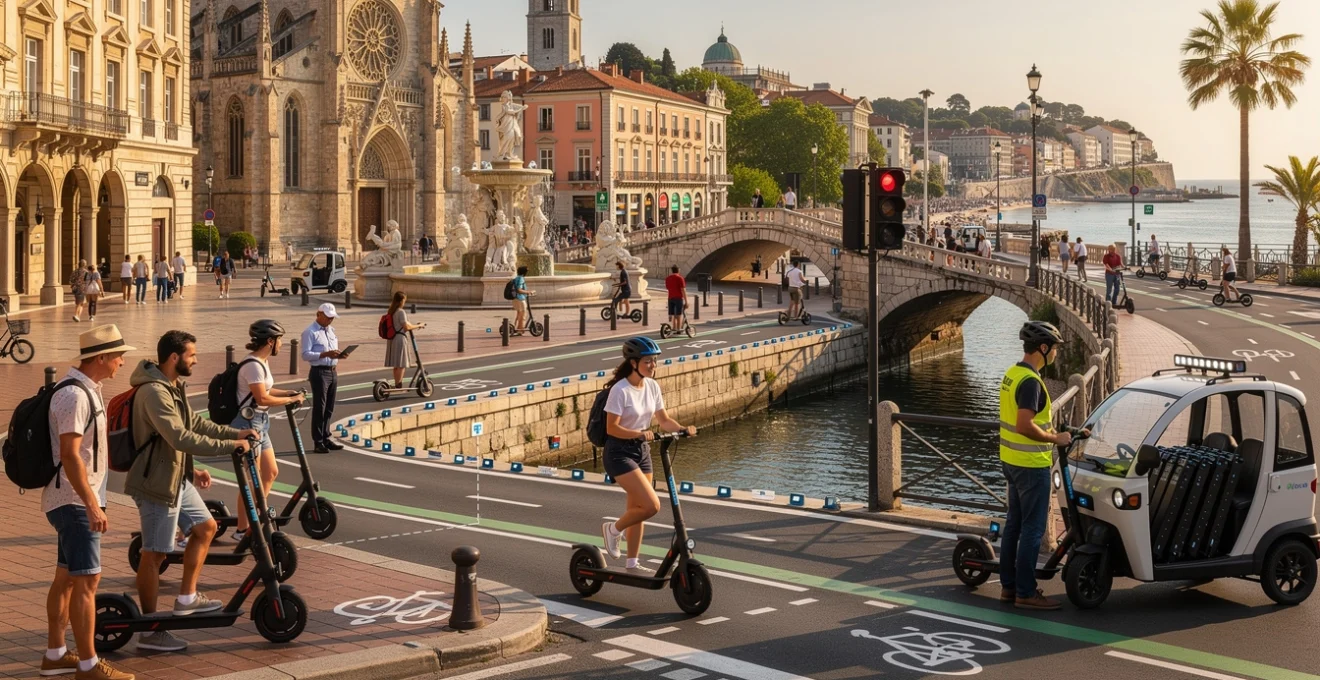
To reduce the number of vans circulating through the Gothic Quarter, some operators have experimented with cargo bikes and small electric vehicles for battery collection. This not only cuts emissions but also reduces the visual intrusion of logistics operations in heritage streets where even delivery windows are tightly controlled. Over time, cities like Barcelona have begun to require detailed battery logistics plans as part of permit applications, linking fleet size to demonstrated charging capacity and low-impact operations in historic tourist zones.
Battery swapping networks: voi’s operational strategy in copenhagen
Copenhagen, while not as architecturally fragile as some Southern European cities, has pioneered efficient battery swapping networks that are highly relevant for tourist districts. Voi’s strategy centers on modular, removable batteries that can be quickly exchanged in the field, rather than transporting entire scooters to depots. For visitors exploring Nyhavn or the Tivoli Gardens area, this translates into higher scooter uptime and fewer “dead” units cluttering prime sightseeing routes.
Operationally, Voi has mapped high-demand tourist corridors and installed micro-depots within short reach of these zones. Staff use e-cargo bikes loaded with fully charged batteries, following optimized routes derived from historic usage data and real-time telemetry. This approach allows a single operative to swap dozens of batteries per shift without contributing to traffic congestion, a key consideration in a city that markets itself as a global leader in sustainable urban mobility.
Copenhagen’s relatively flat topography and compact tourist areas make it an ideal testbed for battery swapping as a core component of tourist mobility services. By keeping scooters available near hotels, cruise terminals, and waterfront promenades, Voi taps into spontaneous trips—those short, unplanned rides that tourists take when a scooter happens to be nearby. For city authorities, the benefit lies in reduced van mileage, clearer streets, and data-driven insight into how tourists move between cultural sites, shopping streets, and transit hubs.
Permit allocation systems: london’s regulatory framework for tier and dott
London’s approach to micromobility in tourist districts is defined less by technical innovation and more by rigorous permit allocation systems. Through Transport for London (TfL) and participating boroughs, operators like Tier and Dott must compete for limited licenses, demonstrating robust safety protocols, parking management, and community engagement plans. The trial scheme, which covers key tourist areas such as Westminster, the South Bank, and parts of the City of London, illustrates how regulation shapes the presence of e-scooters in high-footfall destinations.
Instead of opening the market to unlimited operators, TfL has capped the number of providers and vehicles, linking fleet size to performance metrics such as parking compliance and incident rates. Data from 2024–2025 indicates that more than two million rental e-scooter trips were taken during the trial period, with a serious injury rate of just 0.0007% and no fatalities reported. For a city that hosts tens of millions of visitors annually, these figures help justify the continued presence of scooters around major attractions like the London Eye, Tate Modern, and Covent Garden.
Permit conditions also require detailed tourist education strategies, including multilingual in-app tutorials, geofenced slow-speed zones near landmarks, and mandatory parking in designated bays. While advocacy groups, particularly those representing blind and partially sighted people, remain critical of parking bays on pavements, London’s framework shows how a large metropolis can use licensing to gradually refine scooter operations. As legislation evolves, we can expect further integration of tourist flow modelling and accessibility audits into the permit process, especially in world-famous districts where every curb and crossing is heavily used.
Micromobility infrastructure integration in historic city centres
Integrating electric scooters into historic city centres is a delicate balancing act. Urban planners must accommodate modern mobility demands without undermining heritage value, pedestrian comfort, or the visual integrity of centuries-old streetscapes. In tourist districts, this challenge is amplified: visitor numbers peak during certain seasons, streets are often narrow, and public expectations around safety and aesthetics are high. How do you let thousands of tourists glide through UNESCO-listed neighbourhoods on e-scooters without turning them into open-air parking lots?
The answer lies in a combination of designated parking zones, adapted cycle lanes, targeted access restrictions, and emerging smart pavement solutions. Rather than treating e-scooters as an afterthought, forward-thinking cities are embedding them into broader micromobility strategies that also encompass bikes, e-bikes, and shared shuttles. In many ways, electric scooters act as a stress test for historic centres: if they can be integrated smoothly, it suggests that the underlying transport system is flexible and data-informed.
Designated parking zones in rome’s piazza navona district
Rome’s Piazza Navona district illustrates how designated parking zones can protect heritage while still supporting micromobility for tourists. Early experiments with free-floating scooter parking led to predictable problems: scooters leaning against Baroque facades, blocking entrances to churches, and clustering haphazardly in narrow vicoli. In response, the city introduced marked parking corrals positioned just outside the most sensitive squares and monuments, effectively creating a buffer between scooters and historic surfaces.
These zones are typically located at the edges of pedestrian areas, near taxi ranks and bus stops, so that tourists can easily transition between transport modes. White ground markings and vertical signage clearly indicate where scooters should be left, and operators are required to use geo-fenced parking so rides cannot be ended outside approved areas. For visitors, the experience resembles using a semi-docked system: you can still find scooters close to Piazza Navona or the Pantheon, but not directly under the fountains or against sculpted columns.
By concentrating parking in specific nodes, Rome has also simplified enforcement and fleet rebalancing. City inspectors and operator teams know exactly where scooters should be, reducing the time spent hunting for misplaced vehicles in complex alleys. The trade-off is that some spontaneity is lost—you might need to walk a minute or two to reach a parking zone. Yet for a district where every stone tells a story, this is a compromise that many heritage advocates and tourism boards are willing to accept.
Cycle lane adaptation for E-Scooters along amsterdam’s canal ring
Amsterdam’s Canal Ring, with its iconic bridges and narrow streets, has long relied on cycling as the dominant mode of local transport. The arrival of electric scooters presented both an opportunity and a challenge: could the existing cycling infrastructure safely absorb a new class of light electric vehicles used heavily by tourists? Rather than creating scooter-only lanes, the city opted to adapt and extend its bike lanes, introducing rules and design tweaks to accommodate shared use.
Speed governance plays a central role. In many segments along the Prinsengracht and Keizersgracht, scooters are required to match bicycle speed limits, typically capped around 20–25 km/h. Clear pavement markings and occasional pictograms remind riders that they are guests in a mature cycling ecosystem, not the primary users. This is crucial in tourist-heavy areas, where inexperienced riders on unfamiliar e-scooters may be sharing space with confident local cyclists commuting at peak hours.
Infrastructure upgrades have focused on visibility and conflict reduction at intersections and bridge approaches. Wider approach lanes, raised crossings, and improved lighting help reduce collisions between scooters, bikes, and pedestrians weaving between cafés and canal-side photo spots. While some local cyclists remain sceptical of increased scooter traffic, early data from pilot periods suggests that shared micromobility lanes—when properly signed and enforced—can function without a spike in serious accidents. For visitors, the benefit is seamless continuity: you can ride from Central Station through the Jordaan and around the Canal Ring on a single, legible network.
Pedestrian zone access restrictions in venice’s san marco area
Venice offers a stark counterpoint: in the historic centre, electric scooters are effectively absent, and for good reason. With its labyrinth of narrow calli, countless bridges, and frequent crowding around landmarks like Piazza San Marco and the Rialto, the city has prioritized pedestrian-only access in most central districts. For tourists, this means that the e-scooter revolution largely stops at the car parks and ferry terminals on the mainland and at Tronchetto.
Nevertheless, the way Venice manages access restrictions is instructive for other tourist hubs. Clear, multilingual signage at entry points to the historic core explicitly prohibits the use of e-scooters and other motorized personal transport devices. Enforcement combines physical barriers, such as bollards and steps, with active policing by municipal officers who can issue fines or confiscate vehicles. Operators that serve the Mestre area are required through their terms of operation to geo-block riding and parking within the lagoon city’s core.
From a strategic perspective, Venice demonstrates that the right solution for heritage-rich tourist districts is not always integration. In extreme cases, preservation and pedestrian comfort take precedence, and micromobility must be channelled to the edges of the tourist experience. For cities with similarly fragile urban fabrics or chronic overcrowding, San Marco is a reminder that a “no scooters” stance in specific micro-zones can coexist with robust deployment elsewhere in the metropolitan region.
Smart pavement solutions: oslo’s IoT-Enabled scooter detection systems
Oslo has taken a more technological route, experimenting with smart pavement solutions to monitor micromobility in central districts frequented by tourists. In selected streets around the waterfront and historic core, the city has embedded sensors in pavement slabs and street furniture that can detect the presence, movement, and sometimes even the orientation of parked scooters. These Internet of Things (IoT) devices feed real-time data into a central platform used by both the municipality and operators.
How does this help in practice? When a scooter is left blocking a pedestrian crossing or entrance to a museum, the system can flag the obstruction within minutes. Operators receive automated alerts and can dispatch field teams or, in some cases, send push notifications to the last rider urging them to correct their parking. For high-traffic tourist routes, where a single fallen scooter can become a trip hazard, this near-real-time responsiveness is a significant step forward compared to periodic manual inspections.
Oslo’s smart pavement also supports longer-term planning. By aggregating months of sensor data, urban planners can identify persistent problem hotspots and adjust parking zones, signage, or enforcement accordingly. It’s akin to having a continuous “heat map” of scooter pressure points under the city streets. While these systems are still in pilot phases and raise questions about cost and maintenance, they offer a glimpse into how data-driven tourist district management could evolve, with micromobility woven into a broader smart city fabric.
Tourism revenue impact analysis: E-Scooter economics in High-Footfall destinations
Beyond the visible changes in streetscapes, electric scooters are reshaping the economics of tourism in European cities. Each ride taken in a historic district represents not only revenue for operators but also potential spending at nearby attractions, cafés, and shops. As visitors cover more ground with less effort, their “activity radius” expands, opening up previously overlooked neighbourhoods and secondary sights. But how significant is this impact, and who really benefits financially from the rise of e-scooters in tourist districts?
To answer these questions, we need to look at per-ride revenue metrics, seasonal demand fluctuations, and distinct usage patterns between tourists and locals. While precise figures vary by city and operator, emerging data from municipal reports and mobility studies suggests that scooters now account for a meaningful—and in some cases rapidly growing—slice of visitor mobility spend. For tourism boards and city planners, understanding these dynamics is crucial when deciding whether to encourage, regulate, or restrict micromobility in high-footfall areas.
Per-ride revenue metrics in barcelona’s sagrada familia vicinity
Barcelona’s Sagrada Familia area is a textbook example of how concentrated tourist demand translates into high-value scooter trips. Operators report that rides starting or ending within a one-kilometre radius of the basilica consistently rank among the most profitable segments of their network. This is due to a combination of short but frequent journeys, premium pricing during peak hours, and high scooter turnover rates. A typical ride might last 8–12 minutes, connecting a metro station or hotel to the monument and nearby restaurants.
On a per-ride basis, revenues in this zone can exceed those in purely residential districts by 20–40%, especially during the high season when daily visitor numbers soar. For city authorities, this clustering of micromobility trips offers insight into how tourists move between transit hubs, attractions, and commercial corridors. It also raises questions: should part of this revenue be captured through concession fees or tourist levies to help maintain public spaces around Sagrada Familia, which bear the brunt of increased foot and scooter traffic?
From a business standpoint, the Sagrada Familia vicinity showcases how dynamic pricing strategies and targeted fleet placement can maximize returns in tourist districts. Yet it also underscores the need for robust infrastructure and rules: without clearly marked parking bays and speed-controlled corridors, the same revenue-generating trips could quickly become a source of conflict with residents and heritage advocates.
Seasonal demand fluctuations: santorini’s summer peak performance data
Island destinations like Santorini illustrate another dimension of e-scooter economics: extreme seasonal demand fluctuations. During the summer months, when cruise ships and charter flights deliver thousands of visitors daily, micromobility usage spikes along key routes between Fira, Oia, and major viewpoints. Operators must rapidly scale up fleets, often doubling or tripling the number of available scooters compared to shoulder seasons, to capture demand and avoid frustrating potential riders.
This seasonality can make or break the business case. High summer revenues must cover not only operating costs but also maintenance and storage during quieter months, when tourist presence drops sharply. Data from similar Mediterranean islands suggests that peak season can account for 60–75% of annual scooter trips, with daily usage per vehicle reaching three to five rides in July and August, compared to fewer than one ride per day in winter. Managing this volatility requires careful planning around fleet size, staff hiring, and battery logistics.
For local authorities, the surge poses additional challenges. How do you maintain safe and pleasant streets for both residents and visitors when e-scooter density suddenly skyrockets? In Santorini’s steep and winding streets, speed limits, no-ride zones, and clearly separated routes for heavier traffic become critical. Well-designed regulations can ensure that summer micromobility peaks contribute positively to the visitor economy without overwhelming fragile infrastructure or compromising road safety.
Tourist vs local usage patterns in prague’s old town square
Prague’s Old Town Square and surrounding streets offer a fascinating case study in how tourists and locals use electric scooters differently. Analysis of anonymized trip data has shown distinct patterns: tourists tend to take shorter, more circuitous routes that link iconic landmarks—such as the Astronomical Clock, Charles Bridge, and the Jewish Quarter—while locals use scooters as a pragmatic tool for commuting between residential districts and work or transit nodes at the edge of the historic core.
Time-of-day analysis reinforces this split. Tourist rides peak late morning and mid-afternoon, often clustering around photo-friendly vistas and riverfront promenades. Local usage, by contrast, spikes during traditional commuting hours and shows more direct, repetitive routing. For operators, these insights shape where scooters are placed at different times of day and how in-app guidance is configured. First-time visitors might receive recommendations for scenic, low-traffic routes, while regular users see prompts geared toward efficiency.
From a policy perspective, distinguishing between tourist-oriented scooter trips and local mobility needs is crucial. If restrictions are applied too broadly in Old Town to address visitor-related congestion, residents may lose access to a valuable everyday transport option. Conversely, ignoring the unique risks posed by inexperienced riders on cobblestone streets could lead to avoidable accidents and public backlash. Prague’s experience suggests that nuanced, data-informed rules—such as targeted slow zones and time-limited access during peak sightseeing hours—offer a more balanced path forward.
Safety protocols and accident mitigation strategies
As electric scooters proliferate in tourist districts, safety has become a central concern for city authorities, operators, and the hospitality sector. Visitors often arrive with little knowledge of local traffic rules, varying levels of riding experience, and a tendency to multitask—taking photos, checking maps, or chatting—while on the move. This combination can be volatile on uneven pavements, cobblestones, or busy shared streets. How can cities harness the benefits of tourist micromobility without seeing a parallel rise in serious injuries?
Effective safety strategies combine regulation, infrastructure, technology, and education. Studies from Germany and other European countries indicate that although e-scooter accidents have increased with wider adoption, they still account for a relatively small share of all injury-causing road incidents—around 3–4% in some jurisdictions. However, the nature of injuries, particularly head trauma, and the visibility of scooter crashes in tourist areas amplify public concern. Addressing these risks proactively is essential if scooters are to remain a legitimate part of the urban tourism toolkit.
Many cities now require operators to implement graduated speed limits, automatic slow zones in dense pedestrian areas, and hard geofenced no-ride zones around the most sensitive heritage sites. Helmet promotion remains a challenge, especially among short-term visitors who do not carry protective gear. Some operators have experimented with incentives—such as discounted rides for users who verify helmet use via selfie—while hotels and hostels in a few pilot districts offer loaner helmets at reception. Although adoption is far from universal, these measures signal a cultural shift toward treating scooters as vehicles, not toys.
Another critical strand involves rider education. Multilingual onboarding tutorials, in-app quizzes, and context-aware notifications (for instance, warning riders about cobblestones ahead or steep gradients) help bridge knowledge gaps. Cities like Düsseldorf and Barcelona have partnered with operators to run seasonal safety campaigns aimed specifically at tourists, often promoted through tourism offices and airline partners. The messaging is simple but effective: enjoy the freedom of e-scooters, but respect local rules, pedestrians, and the limits of your own skill.
Finally, data-led enforcement and crash analysis play a growing role. When accidents do occur, detailed telemetry can help identify common factors: excessive speed on certain curves, poor lighting at specific junctions, or frequent near-misses at shared crossings. Cities that integrate this information into their road safety programmes can make targeted improvements, such as resurfacing hazardous sections, upgrading signage, or relocating parking bays. Over time, this feedback loop between real-world incidents and infrastructure upgrades is likely to be one of the most effective tools for accident mitigation in tourist corridors.
Competition dynamics between operators in mediterranean coastal resorts
Mediterranean coastal resorts, from the Costa del Sol to the French Riviera, have become hotbeds of competition between e-scooter operators. The combination of dense seasonal tourism, walkable promenades, and often-limited public transport creates ideal conditions for micromobility services. Yet unlike larger capitals with tightly controlled permit systems, many smaller resort towns initially adopted a more laissez-faire approach, leading to rapid entry by multiple players. The result? Highly visible fleets, aggressive pricing, and intense jockeying for the most lucrative beachfront parking spots.
In the early phases, this competition mirrored what we saw in major cities a few years ago: overlapping service areas, variable maintenance standards, and cluttered public spaces. Tourists benefited from low prices and high availability, but municipalities soon faced complaints about blocked pavements and inconsistent safety practices. As the market has matured, resort authorities have begun to introduce caps on operator numbers and fleet sizes, along with minimum service quality requirements—pushing the ecosystem toward a more sustainable equilibrium.
Operators have responded by differentiating their offerings. Some emphasize premium, higher-speed models with suspension tailored for longer coastal rides, targeting day-trippers who want to explore beyond the main promenade. Others focus on affordability and short-hop convenience, clustering standard scooters near hotels, marinas, and nightlife zones. Loyalty programmes, subscription passes for week-long stays, and partnerships with tour operators or cruise lines have become common tactics in these competitive tourist mobility markets.
Technology and data also shape competitive dynamics. Providers that can reliably forecast demand spikes—such as the arrival of a cruise ship or a major festival—gain an advantage in positioning scooters where they will be most used. In some resorts, local authorities have insisted on shared data platforms where all operators must feed standardized metrics, enabling the city to monitor fleet performance and adjust regulations if one company over-saturates a particular area. Over time, we are likely to see a consolidation trend, with a small number of well-capitalized, compliance-focused operators dominating Mediterranean resorts while smaller players shift to niche segments or adjacent markets like e-bikes.
Environmental sustainability metrics: carbon footprint reduction in tourist corridors
Electric scooters are often marketed as a green solution for urban travel, but how do they perform in the specific context of tourist corridors? The answer is nuanced. On the one hand, scooters produce zero tailpipe emissions and are highly energy efficient; a single kilowatt-hour of electricity can power a scooter for dozens of kilometres. On the other hand, the overall environmental impact depends heavily on factors such as vehicle lifespan, manufacturing footprint, and the logistics of collection and charging—particularly in high-traffic tourist districts where fleet turnover is intense.
Recent lifecycle assessments suggest that when e-scooters replace car or taxi trips, the net carbon footprint reduction can be substantial, especially in compact city centres where alternative modes might have involved multiple short car journeys. However, if scooters mainly displace walking or public transport, the environmental benefits shrink or may even reverse. This is a critical consideration in tourist zones, where many trips are short and could theoretically be done on foot. Encouraging responsible use—positioning scooters as a substitute for motorized vehicles, not for strolls through pedestrianised streets—plays a vital role in maximizing sustainability gains.
To improve their metrics, leading operators are extending scooter lifespans through more durable designs, modular components, and robust maintenance regimes. The shift toward battery swapping and the use of e-cargo bikes for fleet servicing, as seen in Copenhagen and other cities, significantly reduces the emissions associated with van-based collection. Some companies have begun to publish annual sustainability reports that break down emissions per ride, offering greater transparency to city partners and eco-conscious travellers who care about the footprint of their holiday activities.
Cities, too, are embedding micromobility into broader climate strategies. In corridors that connect railway stations to major tourist attractions, replacing a share of taxi and private car trips with e-scooters can support goals for lower congestion, cleaner air, and quieter streets. Smart integration with public transport—through co-located parking hubs, integrated ticketing, or real-time information—amplifies these benefits. When tourists can easily combine a low-carbon train journey with a short scooter ride to their hotel or museum, the entire travel chain becomes more sustainable.
Ultimately, measuring and improving the environmental performance of e-scooters in tourist districts requires robust data and honest accounting. As regulations tighten and cities demand verifiable emissions figures, operators that can demonstrate genuine carbon savings in tourist mobility—rather than simply shifting modes from foot to wheel—will be better positioned to secure long-term partnerships in Europe’s most visited destinations.