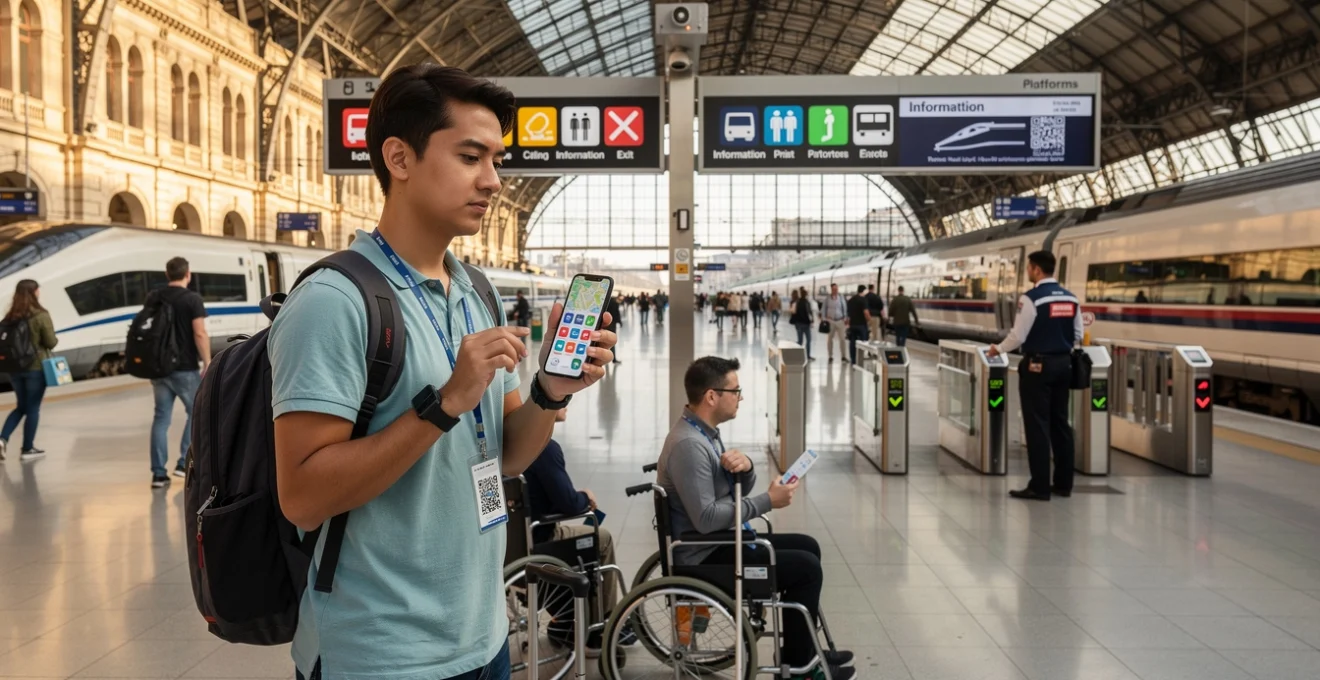
Railway travel offers an unparalleled opportunity to experience different cultures while moving efficiently between destinations. However, stepping into a bustling train station in an unfamiliar country can feel overwhelming, particularly when faced with foreign languages, unfamiliar layouts, and complex ticketing systems. Modern railway infrastructure has evolved dramatically, incorporating sophisticated digital wayfinding systems and international design standards that, once understood, make navigation considerably more straightforward than first appearances might suggest.
The key to confident railway station navigation lies in preparation, understanding universal design principles, and leveraging technology effectively. Whether you’re traversing the expansive terminals of Tokyo’s Shinkansen network or navigating the historic grandeur of European Hauptbahnhofs, certain fundamental patterns and digital tools can transform what appears chaotic into a manageable and even enjoyable travel experience.
Pre-departure digital navigation planning and mobile applications
Digital preparation forms the cornerstone of successful international railway travel. The proliferation of smartphone applications has revolutionised how travellers interact with foreign transportation networks, providing real-time information and navigation assistance that would have been unimaginable just a decade ago. Successful navigation begins long before you reach the station platform, starting with comprehensive digital reconnaissance of your intended journey.
Modern railway applications offer far more than simple timetabling. They provide detailed station maps, real-time platform changes, service disruptions, and increasingly sophisticated augmented reality features that overlay navigational information onto camera feeds. The integration of multiple data sources—from official railway operators to crowd-sourced information from fellow travellers—creates a comprehensive digital ecosystem that can guide you through even the most complex international terminals.
Citymapper integration for major european railway hubs
Citymapper has established itself as the premier application for navigating complex urban transportation networks across Europe’s major railway hubs. The application’s strength lies in its comprehensive integration of multiple transport modes, allowing seamless planning from your accommodation to final destination via train connections. In cities like London, Paris, Berlin, and Amsterdam, Citymapper provides detailed interior maps of major railway stations, including platform locations, facilities, and optimal walking routes.
The application’s real-time data integration proves particularly valuable during service disruptions. When delays or cancellations occur, Citymapper automatically recalculates alternative routes, often suggesting combinations of different transport modes that might prove faster than waiting for service restoration. This dynamic routing capability can save considerable time and reduce travel stress, particularly during peak commuting hours or adverse weather conditions.
Google translate camera function for Real-Time signage translation
Language barriers represent one of the most significant challenges when navigating foreign railway stations. Google Translate’s camera function has evolved into an indispensable tool for real-time signage interpretation, capable of translating text instantly through your smartphone camera. This technology proves particularly valuable in countries using non-Latin alphabets, where traditional phrase books offer limited assistance.
The application works effectively with various script types, from Cyrillic to Chinese characters, providing immediate translation overlays that maintain the original formatting and placement. For railway navigation, this means you can quickly understand platform directions, service announcements, and facility locations without relying on potentially unavailable multilingual staff. The offline translation capabilities ensure functionality even in areas with limited connectivity, though accuracy may vary depending on text complexity and lighting conditions.
Trainline app offline ticket storage and platform information
The Trainline application serves as a comprehensive booking and management platform for railway travel across Europe, offering significant advantages beyond simple ticket purchasing. The offline ticket storage capability ensures that connection issues won’t prevent you from accessing your booking details, while the integrated platform information provides real-time updates about departure gates and track changes.
Perhaps most valuable is the application’s integration with local railway operator systems, which enables automatic updates about service changes that might affect your journey. When delays occur, the application can suggest alternative connections and automatically calculate new arrival times. This proactive approach to journey management helps maintain schedule integrity even when individual services experience disruptions.
Local transit authority applications: SNCF connect, DB navigator, and trenitalia
National railway operators increasingly offer sophisticated mobile applications that provide advantages unavailable through third-party platforms. SNCF Connect for French railways, DB Navigator for German trains, and Trenitalia for Italian services each offer unique features tailored to their specific
operating environment. These official applications typically provide more granular data on rolling stock, carriage formation, and platform allocations, which can be critical when navigating large, multi-level stations. They also tend to push disruption alerts slightly faster than aggregators, making them indispensable for complex itineraries that rely on precise connections.
For example, DB Navigator allows you to see which section of a German platform corresponds to your carriage, reducing last‑minute sprints along the platform with luggage. SNCF Connect integrates with French regional transport, making it easier to understand whether your TGV ticket also covers local TER connections. Trenitalia’s app provides real-time composition information and alerts you to last‑minute platform changes—especially useful in busy hubs like Roma Termini or Milano Centrale.
Wherever possible, you should create accounts within these national apps before departure, add your payment details, and download any purchased tickets to your device. This pre‑configuration dramatically shortens on‑site decision time and allows you to move through stations with the same confidence as local commuters.
International railway terminal architecture and wayfinding systems
Understanding how international railway terminals are designed removes much of the anxiety associated with unfamiliar environments. Modern stations follow repeatable architectural logics: passenger flows are channelled along predictable paths from entrance to concourse, from concourse to platform, and from platform to exit. Once you recognise these patterns, even the largest station begins to feel like a scaled‑up version of one you already know.
Most long‑distance stations combine three structural elements: an arrivals level, a departures concourse, and platform access points. Retail zones, ticket offices, and information desks are strategically located at transition points between these elements, encouraging you to pass useful facilities en route to your train. By consciously noting these anchor points—information desk, main departure board, platform access—you create a mental map that remains valid across many different countries.
Central european station layout patterns: hauptbahnhof design principles
Central European Hauptbahnhofs (main stations) are among the most navigable once you understand their design principles. Whether you are in Berlin, Vienna, Zurich, or Munich, the core pattern is consistent: a central concourse aligned with a bank of numbered tracks, flanked by retail and service areas, with clear vertical circulation connecting underground, ground, and elevated levels. The main departure boards sit prominently above or within sight of this concourse, serving as your primary orientation tool.
Tracks are usually numbered sequentially, and pedestrian flow is organised via underpasses or overpasses that intersect all platforms at right angles. This means that if you know your track number—say, Gleis 8—you can generally follow signage to a single underpass, then locate the corresponding platform segment without detouring through the whole station. In many Hauptbahnhofs, regional and long‑distance services are grouped by track ranges, so becoming familiar with these ranges can further streamline your route.
Many German and Austrian stations also incorporate clearly marked “Reisezentrum” (travel centre) areas and distinct zones for local S‑Bahn services versus long‑distance ICE or EC trains. Think of these stations as three interlocking layers—local, regional, and long‑distance—stacked vertically or horizontally around a common concourse. Once you identify which layer your train belongs to, wayfinding becomes a matter of following a colour or icon family (S‑Bahn logo, ICE designation) rather than deciphering every individual sign.
Asian high-speed rail terminal navigation: shinkansen and CRH station configurations
In East Asia, high‑speed rail terminals such as Japan’s Shinkansen hubs and China’s CRH stations resemble airports more than traditional railways. They are designed around controlled access, security screening, and large pre‑boarding waiting areas. For travellers used to walking directly to a platform, this can initially feel counter‑intuitive—but the logic is highly consistent once understood.
Japanese Shinkansen stations typically separate conventional lines from high‑speed platforms via dedicated gates. After passing through the Shinkansen gates—often marked in green—you enter a controlled concourse where platforms are accessed via escalators and elevators. Overhead bilingual signage in Japanese and English indicates train numbers, departure times, and car positions, and car stop markers on the platform floor ensure orderly queuing. Because the trains stop with remarkable precision, standing at the correct marker places you directly at your reserved car door.
Chinese high‑speed rail stations, by contrast, are often built as vast, elevated halls with a “waiting room first, platform second” model. You typically clear security, enter a large waiting hall identified by gate numbers, and only proceed to the platform when your gate opens 10–20 minutes before departure. Train numbers (e.g. G102, D824) are your primary references on both digital boards and printed tickets. Think of each gate as an airport boarding gate that leads directly down to the correct platform; once you map the relationship between your train number and gate, the station becomes straightforward to navigate.
Universal pictogram recognition in multi-lingual environments
Because large stations serve international passengers, they increasingly rely on universal pictograms to convey essential information without text. Learning to recognise these icons—much like learning road signs—dramatically speeds up navigation in environments where you may not read the local script. You do not need to memorise hundreds of symbols; a core set of 15–20 icons will cover most needs.
Common pictograms include stylised trains for platforms, a suitcase for luggage services, a fork and knife for food, a bed for hotels, an escalator icon for vertical circulation, and a white “i” on a blue background for information desks. Accessibility icons (wheelchair, stroller, priority seat) and safety symbols (emergency exit running figure, fire extinguisher) also follow international standards derived from ISO norms. Over time, you will find yourself scanning for shapes and colours rather than reading full signboards—a bit like glancing at app icons instead of reading app names.
In multilingual environments such as Brussels, Zurich, or Hong Kong, pictograms are often paired with two or three languages. When the text feels overwhelming, use the icon as your anchor: locate the pictogram that matches your goal (toilet, taxi, ticket), then follow its directional arrows along corridors and staircases. This technique is particularly valuable in crowded stations where stopping to read every sign is impractical.
Platform numbering systems across different railway networks
Once inside a station, understanding how platforms are numbered can prevent last‑minute confusion. While each network has its quirks, most follow one of three schemes: simple sequential numbering, paired platform “islands”, or regional/long‑distance segregation. Recognising which scheme you are dealing with makes it much easier to move decisively through the concourse.
Sequential systems, common in the UK and parts of Western Europe, number platforms from one end of the station to the other (1, 2, 3, etc.). Island platforms—frequent in Germany, Switzerland, and the Netherlands—pair tracks on either side of a single platform surface, leading to labelling such as 3/4 or 5/6. In this configuration, you may see your train listed for “Gleis 4”, but physically stand on platform “3/4”; the train direction and platform edge determine which side you need.
Some networks also introduce letter suffixes (e.g. 2A, 2B) to distinguish short platforms or sub‑sections. In busy hubs like Paris Gare du Nord, London Waterloo, or Milano Centrale, understanding that 2A is not the same as 2B can save a last‑second sprint. As a rule of thumb, always cross‑check three elements on the departure board: train number, destination, and platform designation (including letters). If any one of these changes, follow the new platform number rather than clinging to the original ticket printout.
Ticket validation procedures and boarding protocols by region
Even seasoned travellers can be caught out by differing ticket validation rules, and fines for non‑compliance can be substantial. The challenge is that validation protocols vary not only by country but sometimes by region and train type. To navigate train stations confidently, you need a mental checklist: “Do I need to validate? Where? Before or after boarding?” Applying this checklist at each journey start dramatically reduces the risk of mistakes.
In much of continental Europe, paper tickets for regional trains must be validated in small machines before you reach the platform. In Italy and France, these devices are often yellow or green, mounted at eye level near station entries and platform access points. You insert the ticket briefly to stamp the date and time; failing to do so can render an otherwise valid ticket invalid if checked on board. By contrast, most long‑distance e‑tickets with QR codes are considered pre‑validated and only require scanning by conductors.
Germany and Switzerland rely heavily on proof‑of‑payment systems. You purchase a ticket (physical or digital), but there are no gates or validators at many stations. Instead, roving inspectors check tickets on board and can issue on‑the‑spot fines. Here, the key is ensuring your digital ticket is downloaded and that any required personal identification (e.g. the same credit card used to purchase) is available. In the UK, Japan, and large Chinese stations, automated gates read your ticket or transit card both when entering and leaving the platform area, effectively combining validation and access control.
Boarding protocols also differ. In Japan and Switzerland, orderly queues form at marked door positions, and boarding is rapid, quiet, and punctual. In parts of Southern Europe, boarding can feel more fluid, with passengers spreading along the platform and converging when the train arrives. To avoid stress, arrive at the platform a few minutes early, locate your carriage or class section using overhead signs or floor markings, and position yourself where doors are expected to stop. Think of this as aligning yourself with the “flow line” of boarding passengers, rather than trying to out‑run them once the train arrives.
Language barrier solutions and communication strategies
Language differences are often what make foreign train stations feel intimidating, yet modern tools and a few targeted phrases can bridge most gaps. The goal is not fluency but functional communication: being able to confirm platforms, ask for help, and respond in basic situations. When combined with digital translation tools and visual aids such as maps or screenshots, a small vocabulary goes a long way.
Effective communication in stations follows a simple structure: you identify your objective (confirm a platform, find a service, resolve a problem), prepare a concise phrase or keyword, and pair it with visual proof. Showing your ticket on your phone while saying the destination name, for example, is far more effective than a long monologue in your native language. Station staff and fellow passengers are accustomed to this hybrid of words and gestures and can usually respond with simple directions or by pointing to the correct sign.
Essential railway vocabulary in germanic, romance, and slavic languages
Memorising a small set of railway‑specific words in the local language transforms your interaction with signage and announcements. Rather than trying to decode every sentence, you listen and look for these anchor terms—“platform”, “departure”, “delay”, “exit”—as if you were scanning for landmarks on a map. Recognising just a few words can help you infer the rest from context.
In Germanic languages, key terms include Bahnhof (station), Gleis (track), Abfahrt (departure), Ankunft (arrival), and Verspätung (delay). In Romance languages, look for stazione or gare (station), binario or voie (platform/track), partenza/départ (departure), and ritardo/retard (delay). Slavic networks often use terms like vokzal or stanice (station), peron (platform), odjezd/otpravlenie (departure), and příjezd/pribytiye (arrival).
You do not need to pronounce everything perfectly; even a recognisable approximation will usually be understood, especially when paired with a printed destination name. Consider keeping a brief personal “railway phrase card” on your phone or on paper with these core terms for each region you visit. Over time, you will notice patterns—such as the similarity between peron in Polish and Croatian—that make new countries feel less foreign.
Staff identification protocols and multilingual assistance points
Knowing who to approach—and where to find them—saves time and reduces hesitation when you need help. In most major stations, staff uniforms, lanyards, and high‑visibility vests follow consistent branding, but when you are stressed it can be easy to overlook them in the crowd. Taking a moment upon arrival to spot the main information point and observe staff attire pays dividends later.
Many European stations operate central “Information” counters, marked with the familiar “i” symbol, where staff often speak at least one additional language beyond the local one—frequently English, sometimes French or German. In Japan and South Korea, look for “Tourist Information” desks that specialise in assisting foreign visitors and can provide printed English station maps. China’s larger stations increasingly feature bilingual help desks and “volunteer” stands where university students in red vests assist travellers.
Some staff carry language badges indicating which languages they speak, often as small flags on their lapel or name tag. If you see an employee with your language indicated, approach them even if their role is not explicitly customer service; they can usually direct you to the right place or colleague. As a practical tactic, approach staff in stationary positions (ticket counters, gates, information desks) rather than those moving quickly between tasks—they are more likely to have both the time and tools to help you.
Emergency communication phrases for critical situations
While most journeys proceed smoothly, it is wise to prepare for rare but critical situations—missed connections, medical issues, or safety concerns. In these moments, concise, high‑priority phrases can cut through language barriers far more effectively than complex explanations. Think of them as the verbal equivalent of an emergency exit sign: simple, universally understood, and immediately actionable.
Useful phrases include “I need help” (Ich brauche Hilfe / J’ai besoin d’aide / Mi serve aiuto), “Call an ambulance/police” and “I have lost my bag/passport”. Pair these with obvious gestures and, where possible, written translations pre‑saved in a note on your phone for quick access. Many translation apps now offer “favourites” lists; adding your emergency phrases to this list ensures they are available even offline.
In case of disruption—such as missing the last train of the night—simple questions like “When is the next train?”, “Where is the night bus?”, or “Is there a hotel near the station?” can be lifesavers. Deliver them calmly, show your ticket and destination, and be prepared to accept written notes or numbers in response. Writing down times or platform numbers reduces the chance of misunderstanding under stress.
Cultural transit etiquette and passenger flow management
Even the best digital tools cannot compensate for ignoring local etiquette. Understanding how passengers are expected to move and behave within a station helps you blend in and reduces friction with both staff and fellow travellers. In many ways, etiquette functions as an invisible traffic system: when everyone follows the rules, the entire environment feels calmer and more predictable.
At the most basic level, this means yielding space to alighting passengers before boarding, avoiding blocking stairways and escalators, and keeping noise at a reasonable level. In Japan and the UK, for example, there is a strong culture of standing on one side of escalators (often the left in London, the right in Osaka) to leave a passing lane free. In parts of continental Europe, standing side‑by‑side is more common, and “walking lanes” are not as strictly observed. Watching what locals do at the first escalator you encounter is often more informative than any sign.
Queueing behaviour also varies. In some Asian and Northern European countries, neat queues form automatically at marked points; cutting in line is frowned upon. In other places, passengers cluster loosely around the expected door area, and boarding is more of a “wave” than a line. Adapting to these norms not only shows respect but can also make your own experience smoother—fighting the prevailing pattern tends to create more stress than it saves.
Inside trains, cultural expectations around luggage, seating, and phone usage differ. On many European networks, placing large bags in dedicated racks and keeping aisles clear is standard; blocking seats with luggage is discouraged and can prompt staff intervention. In East Asia, phone calls are often discouraged in “quiet zones” or near priority seats, with passengers favouring messaging instead. When in doubt, mimic the behaviour of the majority and look for small etiquette pictograms in carriages—crossed‑out phones, feet off seats, or “no eating” signs provide quick guidance.
Technology-enhanced accessibility features in modern railway infrastructure
Modern railway stations increasingly embrace inclusive design, using technology to make navigation easier not only for passengers with disabilities but for everyone. Features originally developed as accessibility tools—tactile paving, audible announcements, high‑contrast signage—often become valuable aids for travellers dealing with language barriers, fatigue, or heavy luggage. Recognising and using these elements can significantly reduce cognitive load in complex terminals.
Many major stations now integrate real‑time accessibility information into their apps and displays. DB Navigator, for example, indicates which carriages offer step‑free boarding and where elevators are located along a platform. In Japan, Shinkansen stations provide detailed diagrams showing the exact position of accessible doors, multi‑purpose restrooms, and reserved seating, often duplicated in English. Tactile guidance strips on floors lead from entrances to key facilities and platforms, effectively acting as “rails for your feet” that you can follow when visual information becomes overwhelming.
Augmented reality (AR) navigation is also beginning to appear in selected hubs. Some operators are piloting apps that overlay directional arrows and facility labels onto your camera view, guiding you from your current location to a specific platform or exit. For travellers with hearing impairments—or simply those who struggle to follow fast‑spoken announcements—these visual overlays help compensate for missed audio information. Similarly, visual departure boards now often include icons indicating wheelchair access, bike storage, and quiet zones, letting you choose the carriage that best suits your needs.
From an accessibility perspective, lifts and ramps are only part of the story. Consistent lighting levels, clear contrast between floor and stair edges, and logical placement of handrails all contribute to safer, more intuitive movement. When you enter an unfamiliar station, take a few seconds to scan for this infrastructure: where are the elevators? Do tactile strips indicate a main circulation route? Are there induction loop symbols at information desks for hearing aids? Treating these features as part of your personal wayfinding toolkit turns what might seem like specialised elements into general navigation aids.
Ultimately, technology‑enhanced accessibility in railway stations reflects a broader trend: designing systems that work for edge cases tends to make them better for everyone. As a traveller, you benefit from this philosophy each time you follow a clear icon, rely on contrasting signage in low light, or use an app that points you to the nearest step‑free route. By learning to read and leverage these features, you transform unfamiliar stations from sources of anxiety into spaces you can move through with confidence and control.