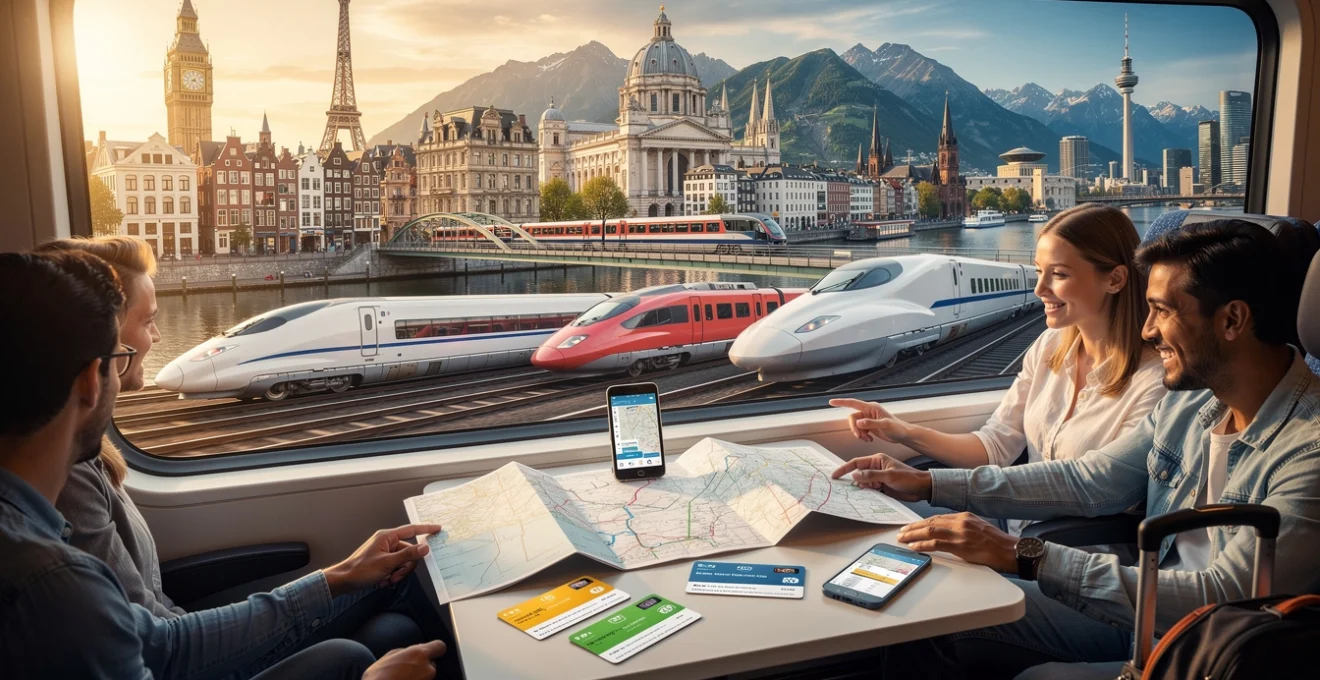
Multi-destination rail travel has transformed the way travellers explore continents, offering unprecedented freedom to discover multiple cities with a single ticket. Rail passes provide an elegant solution to the complex logistics of intercity transportation, eliminating the need to purchase individual tickets while opening up extensive networks of destinations. Whether you’re planning a grand European tour, exploring Japan’s diverse regions, or traversing Great Britain’s historic landscapes, the right rail pass can significantly enhance your journey’s convenience and value.
The strategic use of rail passes becomes particularly compelling when your itinerary includes multiple high-cost routes or frequent travel between major urban centres. Modern rail networks span vast geographical areas, with some passes covering over 30 countries and thousands of destinations. Understanding the nuances of different pass systems, reservation requirements, and regional coverage areas can mean the difference between a seamlessly orchestrated adventure and a logistically challenging experience.
European rail pass networks: eurail vs interrail coverage analysis
The European rail pass landscape centres around two primary systems that offer remarkably comprehensive coverage across the continent. Both passes provide access to the same extensive network, yet their eligibility requirements create distinct pathways for different traveller demographics. The fundamental distinction lies in residency status, with this simple criterion determining which pass system you can access.
European rail networks have evolved into one of the world’s most integrated transportation systems, with passes covering everything from high-speed international routes to regional scenic railways. The coordination between national rail operators ensures seamless border crossings and simplified booking procedures across diverse countries with varying languages and currencies.
Eurail pass validity across 33 european countries
The Eurail Pass system extends coverage to 33 European countries, making it the most comprehensive rail pass available for non-European residents. This extensive network includes major destinations like France, Germany, Italy, Spain, and the Netherlands, alongside smaller nations such as Luxembourg, Slovenia, and Montenegro. The pass validity extends beyond traditional Western European boundaries, encompassing Eastern European countries including Poland, Czech Republic, and Hungary.
Coverage includes access to national rail networks within each country, enabling travel on everything from local commuter services to premium intercity connections. The pass provides particular value on expensive international routes, where individual ticket prices can exceed €100 for popular connections like Paris to Barcelona or Amsterdam to Berlin. Most participating countries offer unlimited travel within their borders, though some impose restrictions on premium services or require advance reservations.
Interrail pass regional zones and Cross-Border connectivity
Interrail passes serve European residents with identical network coverage but often feature more flexible pricing structures and regional options. The system divides Europe into distinct zones, allowing travellers to purchase passes covering specific geographical areas rather than the entire continent. This zonal approach proves particularly cost-effective for focused regional exploration, such as Scandinavian countries or Mediterranean nations.
Cross-border connectivity remains seamless regardless of which zones you select, with many routes crossing multiple countries without additional fees. The Interrail system particularly excels in facilitating travel between neighbouring countries with strong rail connections, such as the Benelux region or the German-speaking countries of Central Europe. Regional passes often provide better value for concentrated itineraries covering 3-5 countries within a specific geographical area.
High-speed rail integration: TGV, ICE, and AVE reservations
European high-speed rail networks represent some of the world’s most advanced transportation technology, with services like France’s TGV, Germany’s ICE, and Spain’s AVE offering speeds exceeding 300 kilometres per hour. Rail pass holders enjoy access to these premium services, though mandatory seat reservations typically apply. The reservation system ensures guaranteed seating while managing capacity on popular routes during peak travel periods.
Reservation fees for high-speed trains vary significantly by country and service level, ranging from €4 for domestic German ICE services to €10-35 for international TGV connections. Some operators limit the number of seats available to pass holders, particularly during summer months and holiday periods. Advance booking becomes crucial for securing preferred travel times, with many high-speed services accepting reservations up to 90 days prior to departure.
Supplement fees for premium services and night trains
Night train services across Europe require additional supplements beyond basic pass validity, reflecting the premium accommodation and extended journey times these services provide. Sle
eper supplements typically cover sleeping compartments, couchettes, or upgraded seating, and can range from €10 for a simple couchette to over €100 for a private sleeper cabin on premium routes. These night trains can be an efficient way to combine transportation and accommodation, especially on longer cross-border journeys such as Paris–Munich or Vienna–Rome. However, availability can be limited during peak seasons, so you should consider booking as early as possible if an overnight segment is essential to your multi-city rail itinerary.
Premium day services such as panoramic trains, first-class lounges, or private rail operators may also charge additional supplements or require separate tickets even when you hold a Eurail or Interrail pass. For example, privately operated scenic trains in Switzerland, or premium business-class coaches on certain high-speed routes, often require mandatory seat reservations with an extra fee. When planning a rail pass route that includes several premium or overnight services, it is wise to budget a supplementary cost buffer of 10–20% on top of your base pass price.
Multi-city itinerary planning with rail pass optimisation
Designing a multi-city itinerary with a rail pass is a balance between freedom and structure. Rail passes are most cost-effective when you cluster longer journeys on your travel days, using shorter hops or local transit on non-travel days. Think of your pass as a flexible backbone connecting key hubs, with local networks, buses, and metro systems filling in the gaps.
When optimising a rail pass, start by mapping your must-see cities, then grouping them into logical clusters based on geography and available train connections. You can then assign rail pass days to the longer segments between these clusters, while leaving time for slower travel or day trips within each region. This strategic approach helps you avoid wasting expensive pass days on very short journeys that could be cheaper as point-to-point tickets.
Golden triangle routes: London-Paris-Amsterdam connectivity
The classic London–Paris–Amsterdam route, often called the “Golden Triangle”, is one of the most popular multi-city rail itineraries in Europe. High-speed trains connect these three cities in just a few hours each, with London–Paris and London–Amsterdam served by Eurostar, and Paris–Amsterdam covered by Thalys/Eurostar-branded high-speed services. Travel times are typically under four hours for each leg, making it easy to link all three cities within a single week.
From a rail pass perspective, this triangle requires careful analysis because Eurostar services between London and mainland Europe are not fully covered by many passes, or they require separate reservations and limited pass-holder quotas. If your main focus is on these three cities only, advance-purchase point-to-point tickets may rival or even outperform a global rail pass in terms of cost. However, if you plan to extend your journey to Brussels, Cologne, Bruges, or beyond, integrating a Eurail or Interrail pass can provide additional flexibility and savings.
One effective strategy is to treat London as a gateway rather than a central hub. You could start in London with a separate Eurostar ticket to Paris, then activate your Eurail or Interrail pass for the Paris–Amsterdam segment and any side trips, such as Paris–Lyon or Amsterdam–Rotterdam. By aligning your pass days with the longer continental segments, you preserve flexibility while keeping London-based costs predictable and easier to manage.
Grand tour circuit planning: Rome-Florence-Venice-Milan coordination
Italy’s classic “Grand Tour” circuit of Rome, Florence, Venice, and Milan showcases the benefits of rail passes for dense, high-value routes. High-speed Frecciarossa and Italo services link these cities in as little as 1.5–3 hours per leg, with frequent departures throughout the day. Because last-minute fares on these premium trains can be high, using a rail pass with reservations can deliver both savings and flexibility compared with fixed advance tickets.
For a typical 10–14 day itinerary, you might spend 2–3 nights in each city, using your pass days to cover the main intercity segments and any additional side trips. For example, you can easily add excursions to Pisa from Florence, or to Verona, Lake Garda, or Bologna from Venice and Milan. While many regional trains in Italy do not require reservations, high-speed services usually do, with modest reservation fees that you should factor into your budget.
To coordinate this Grand Tour efficiently, consider travelling northbound or southbound in a single arc rather than backtracking. Starting in Rome and finishing in Milan (or vice versa) allows for logical onward connections by rail to Switzerland, Austria, or France. If you already hold a wider Eurail or Interrail pass, this Italian segment slots neatly into a broader European route, effectively turning four major Italian cities into key anchor points of your multi-destination rail adventure.
Scandinavian capital connections: Stockholm-Oslo-Copenhagen links
The Scandinavian capitals of Stockholm, Oslo, and Copenhagen form a compelling triangle for travellers interested in modern design, nature, and vibrant urban culture. Rail connections between these cities are less dense than in Central Europe but still efficient and comfortable, with direct services linking Stockholm–Oslo and Copenhagen–Stockholm via high-speed or intercity trains. Journey times typically range between five and seven hours, making rail an attractive alternative to short-haul flights.
In this region, Eurail and Interrail passes can be particularly valuable because walk-up fares on Scandinavian routes are often high. A pass allows you to remain flexible with departure times, especially in shoulder seasons when timetable changes or weather conditions may affect services. In addition, longer-distance night trains within Sweden or to the Arctic Circle can be integrated into a wider pass-based itinerary, provided you account for supplement and reservation fees.
When planning a Scandinavian rail circuit, it can be helpful to visualise the network as a loop rather than a strict triangle. You might start in Copenhagen, travel to Stockholm via Malmo, then continue to Oslo and return to Copenhagen by way of Gothenburg. This loop structure maximises variety while minimising backtracking, and it aligns well with the flexible nature of multi-country rail passes.
Central european hub strategy: Vienna-Prague-Budapest-Munich
Central Europe offers one of the best value propositions for multi-city rail travel, particularly along the Vienna–Prague–Budapest–Munich corridor. These four cities function as rail hubs for Austria, the Czech Republic, Hungary, and southern Germany, with frequent direct trains linking each pair. Travel times typically range from four to seven hours, and the routes are scenic, crossing rivers, forests, and historical regions.
Using a Eurail or Interrail pass, you can stitch these hubs together into a flexible route that allows for spontaneous detours. For instance, between Vienna and Munich you could stop in Salzburg or Linz; between Prague and Budapest you might add Bratislava as a half-day or overnight stop. Because point-to-point fares are usually moderate but can add up over several legs, a rail pass becomes especially attractive once you exceed four or five long intercity journeys.
A practical hub strategy is to designate two or three of these cities as bases for day trips. From Vienna, you can reach Salzburg or Graz; from Munich, day trips to Nuremberg or Neuschwanstein (via Fussen) are common; from Budapest, smaller towns along the Danube are easily accessible. Using your pass for these side excursions stretches its value, turning each city into a launch pad for exploring the wider region without complex ticketing.
Cross-border route efficiency: Basel-Zurich-Salzburg-Innsbruck
For travellers interested in Alpine landscapes and cross-border efficiency, the Basel–Zurich–Salzburg–Innsbruck axis illustrates how rail passes simplify travel across Switzerland, Germany, and Austria. Basel serves as a major international gateway, with high-speed links to Paris and Frankfurt, while Zurich is a central Swiss hub. From Zurich, you can reach Salzburg and Innsbruck on direct Railjet or EuroCity trains that traverse some of Europe’s most picturesque terrain.
Because Switzerland is known for high point-to-point fares, incorporating Swiss routes into a multi-country rail pass can yield substantial savings, especially on longer legs such as Basel–Vienna or Zurich–Munich. However, Swiss domestic passes like the Swiss Travel Pass may sometimes be more advantageous if you are focusing heavily on Swiss scenic routes. As you evaluate your cross-border route, consider which country will host the majority of your travel days and compare regional passes with broader Eurail or Interrail options.
One of the key efficiency gains of this routing is the ability to transition smoothly between city sightseeing and Alpine excursions. For example, you could base yourself in Salzburg for cultural experiences and then continue to Innsbruck for mountain activities, all on the same flexible pass. By framing Basel and Zurich as access points and Salzburg and Innsbruck as scenic hubs, you create a rail itinerary that balances urban and outdoor experiences without the need for separate cross-border tickets.
Regional rail pass systems for multi-destination travel
Beyond continent-wide options like Eurail and Interrail, several countries offer dedicated regional rail passes designed for intensive exploration within their borders. These products are particularly attractive if your itinerary concentrates on one nation or a compact region with dense rail infrastructure. They often include additional benefits such as public transport integration, museum discounts, or free access to specific scenic lines.
When planning multi-destination travel within a single country, regional passes can sometimes outperform global passes both in cost and convenience. They may offer more granular duration choices, such as 2–15 consecutive days, or flexible passes valid for a set number of days within a longer window. Understanding how these regional products interact with national and international networks is essential for building an efficient and cost-effective rail-based trip.
JR pass coverage for Tokyo-Kyoto-Osaka-Hiroshima circuits
The Japan Rail (JR) Pass is one of the most renowned national rail passes, providing extensive coverage across the JR network throughout Japan. For travellers planning a classic Tokyo–Kyoto–Osaka–Hiroshima circuit, the JR Pass often delivers excellent value, particularly on the Shinkansen bullet trains. A Tokyo–Hiroshima round trip alone can approach the cost of a 7-day JR Pass, making the pass a strong contender for anyone covering several long-distance segments in a short period.
With a JR Pass, you can ride most Shinkansen services (excluding some premium categories like Nozomi and Mizuho on certain lines) as well as a wide range of limited express, rapid, and local trains. This means you can travel seamlessly from Tokyo to Kyoto and Osaka, continue onwards to Hiroshima, and still have capacity for side trips to places such as Nara, Himeji, or Miyajima (via JR ferry). The pass functions as a flexible backbone for your Japanese itinerary, allowing you to adapt plans according to weather, energy levels, or newly discovered destinations.
Regional JR passes, such as those covering only Kansai–Hiroshima or the Kansai–Hokuriku area, can sometimes be more economical if you are focusing on a smaller area rather than crossing the entire country. For example, if you arrive in Osaka and limit your travel to Kyoto, Nara, Hiroshima, and nearby cities, a regional pass may cost less while still unlocking unlimited travel within that zone. As with European passes, the key is to compare the total cost of anticipated point-to-point tickets with the price and flexibility of the JR product that best matches your route.
Swiss travel pass integration with scenic routes and cable cars
The Swiss Travel Pass stands out for its integration of trains, buses, boats, and many mountain transport systems under a single ticket. For travellers keen to explore multiple Swiss cities like Zurich, Lucerne, Interlaken, and Geneva, while also venturing onto iconic scenic routes, this pass offers substantial convenience. It provides unlimited travel on the national rail network and includes many lake boat services and urban public-transport systems in more than 90 towns and cities.
One of the Swiss Travel Pass’s defining advantages is access to world-famous panoramic trains such as the Glacier Express, Bernina Express, and GoldenPass Line. While seat reservations and small supplements may apply on these services, the base fare is covered, making it easy to incorporate them into a wider multi-destination itinerary. In many cases, the pass also provides substantial discounts (often 25–50%) on mountain railways and cable cars to destinations like Jungfraujoch or Mount Pilatus.
Because Swiss transport prices are relatively high compared with many other countries, the Swiss Travel Pass can quickly pay for itself if you plan to ride several scenic lines and visit multiple regions. It effectively transforms the entire country into an interconnected playground, where you can decide each morning whether to focus on city museums, lakeside walks, or high-altitude viewpoints. When combined with international rail passes or point-to-point tickets to and from Switzerland, it becomes a powerful tool for multi-country itineraries centred on the Alps.
Britrail pass network: London-Edinburgh-Cardiff-Manchester connections
The BritRail Pass is tailored specifically for visitors to Great Britain, offering unlimited travel on nearly all National Rail services across England, Scotland, and Wales. For a multi-city circuit that includes London, Edinburgh, Cardiff, and Manchester, this pass can significantly simplify logistics. Long-distance British train tickets purchased at the last minute are among the most expensive in Europe, so a pass that allows hop-on, hop-off flexibility on many routes can be a strong financial and practical advantage.
With a BritRail Pass, you can board high-speed services from London to Edinburgh, then continue west towards Glasgow or south towards Manchester and the north of England. From Manchester or London, trains to Cardiff and the rest of Wales are frequent, providing easy access to coastal areas and national parks. Major airport express services such as Gatwick Express and some Heathrow and Stansted services are also integrated into many BritRail products, turning your pass into a door-to-door mobility solution.
Various BritRail pass types exist, including consecutive-day passes and flexi-passes valid for a certain number of days within a set timeframe. If you plan a dense schedule of travel days clustered around city stays, flexi options can be very effective. By aligning travel-heavy days with your pass validity and using walking or local transport on non-travel days, you can see several major British cities and regional highlights without worrying about fluctuating advance-purchase fares or peak-time pricing.
German rail pass flexibility for Berlin-Hamburg-Munich-Cologne
The German Rail Pass covers Deutsche Bahn’s extensive network and is open to many non-European residents, making it a strong choice for travellers focusing on Germany’s major cities. A typical multi-city route might include Berlin, Hamburg, Munich, and Cologne, all connected by high-speed ICE trains running at up to 300 km/h. With frequent departures and relatively straightforward reservation policies (reservations are optional on most ICE services), the pass grants you the freedom to choose departure times on the day.
Because Germany’s advance-purchase fares can be competitive, the German Rail Pass tends to shine when you want flexibility rather than strict scheduling. It is particularly useful if you are unsure how long you will stay in each city or if you plan to weave in smaller towns such as Dresden, Nuremberg, or Freiburg along the way. The pass’s flexible versions, valid for a certain number of days within a month, let you concentrate travel on days when you cover the greatest distances.
Another advantage is the ability to use the German Rail Pass for some cross-border services into neighbouring countries, such as Salzburg, Basel, or some stations in the Netherlands, depending on the specific product conditions at the time of purchase. This makes it easier to integrate Germany into a wider Central European itinerary without needing separate tickets for every border crossing. As always, checking the latest validity rules before travel will ensure you maximise the value of your pass.
Reservation systems and seat allocation strategies
Reservation systems can initially seem complex, but with a bit of planning they become a powerful tool rather than a constraint. In many European countries, regional and slower intercity trains do not require reservations, allowing you to board freely with your pass. High-speed and long-distance services, however, often have mandatory or recommended reservations to manage demand and guarantee seating, especially on popular routes and during peak hours.
As a multi-city traveller, it helps to think of reservations like restaurant bookings: for busy times and top-rated venues, you secure a spot in advance, while for casual lunches you simply walk in. When you know you must arrive in a city by a certain time—for example, to catch a flight or join a guided tour—making a reservation on a specific train gives you peace of mind. On more flexible travel days, you can leave your schedule open and target non-reservation trains or times of day when seating pressure is lower.
Many rail operators now allow online reservations for pass holders, sometimes with dedicated portals or app-based systems. Others require reservations to be made at ticket counters or self-service machines at stations. To avoid queues, consider making reservations in batches: once you arrive in a new city, you might visit the station and book the next two or three long-distance segments in one go. This approach balances spontaneity with security, ensuring that your core connections are protected while leaving room for improvisation.
Cost-benefit analysis: pass pricing vs point-to-point tickets
Evaluating whether a rail pass is cheaper than point-to-point tickets is central to planning any multi-city rail journey. A practical method is to outline your intended routes, then look up approximate fares for each leg using national rail websites or timetable platforms. Once you have a rough total, you can compare it with the price of relevant passes, factoring in any reservation fees or supplements that would apply in either scenario.
In general, rail passes are most cost-effective when you take several long or cross-border journeys within a relatively short period. If you are only travelling between two or three cities and can commit to fixed dates, early-booked advance fares may beat a pass. However, passes provide a level of flexibility that advance tickets cannot match: you can change plans due to weather, events, or personal preference without incurring heavy change fees or losing non-refundable tickets.
For a more nuanced analysis, consider assigning a rough “flexibility value” to your time and options. How much is it worth to you to be able to leave later in the day, stay longer in a city, or divert to a newly recommended destination? While this value is subjective, many travellers find that paying a modest premium for a pass is justified by the reduced stress and increased spontaneity it affords. Ultimately, the best choice combines economic efficiency with the style of travel that suits you best.
Digital rail pass management and mobile integration platforms
The rise of digital rail passes and mobile ticketing platforms has significantly simplified multi-city train travel. Many Eurail, Interrail, and regional passes are now available in app form, allowing you to store your pass on a smartphone instead of carrying a paper booklet. Within these apps, you typically activate travel days, log journeys, and generate QR codes or digital tickets that conductors scan onboard.
Mobile integration also extends to journey planning and reservations. A single app or platform can provide live timetables, platform information, and reservation options across multiple countries or operators. This reduces the friction of navigating unfamiliar websites in foreign languages and allows you to adjust plans on the move. For example, if a connection is delayed, you can quickly check alternative routes and, where permitted, switch to a different train without visiting a ticket office.
To make the most of digital passes, it is wise to ensure that your phone is charged and that you have at least intermittent internet access for updates, even if the pass itself works offline. Many travellers carry a portable battery and download offline timetables or screenshots of key journeys as a backup. By combining a rail pass with robust digital tools, you gain not only cost and coverage advantages but also a high level of control over your multi-city rail adventure, turning complex routes into manageable, even enjoyable, planning exercises.