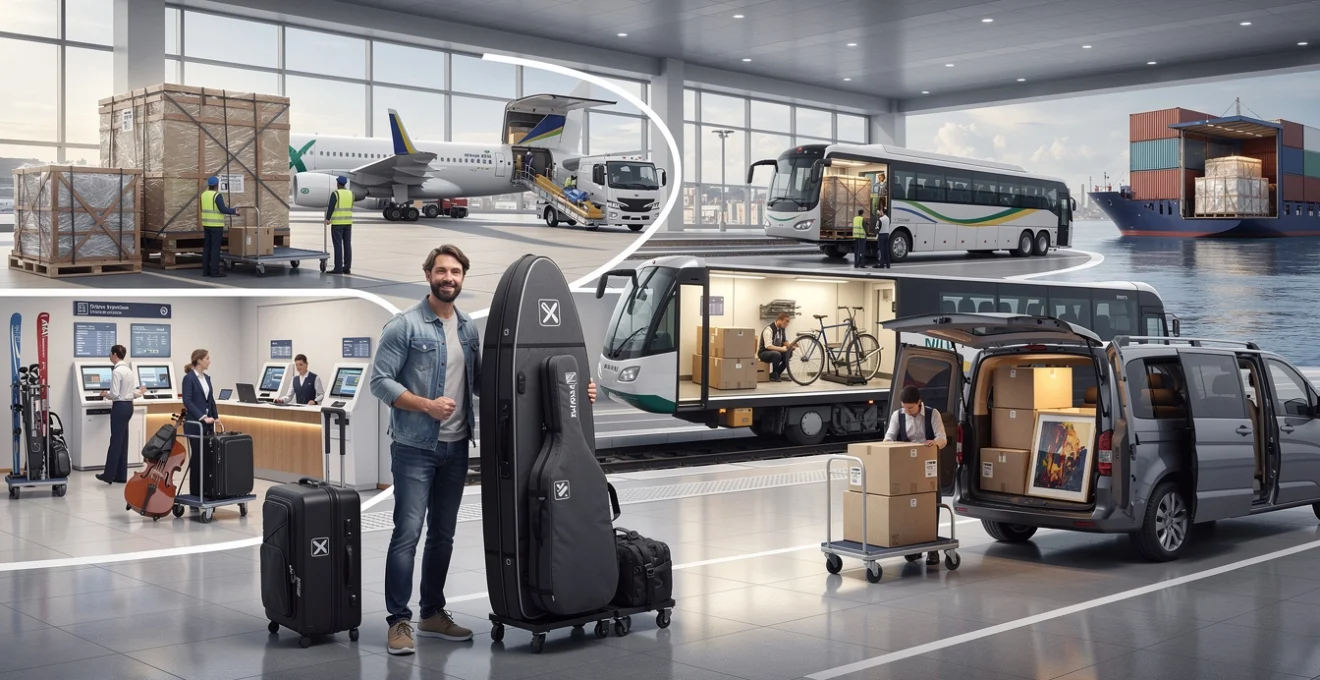
Navigating airports and transport hubs with oversized luggage presents unique challenges that extend far beyond the typical travel experience. Whether you’re relocating internationally, transporting sporting equipment, or carrying professional instruments, the logistics of moving bulky items require careful planning and specialised solutions. Traditional airline restrictions often make conventional travel impractical for oversized baggage, forcing travellers to explore alternative transportation methods that can accommodate their specific needs while maintaining cost-effectiveness and reliability.
The modern travel landscape offers numerous options for managing oversized luggage, from specialised freight services to dedicated courier networks. Understanding these alternatives becomes crucial when standard airline allowances fall short of your requirements. Each transportation method presents distinct advantages, limitations, and cost structures that must align with your timeline, budget, and destination requirements. The key lies in selecting the most appropriate solution based on your specific circumstances and the nature of your oversized items.
Airline baggage policies and dimensional restrictions for oversized luggage
Modern airline policies regarding oversized luggage reflect a complex balance between operational efficiency and passenger accommodation. The aviation industry has implemented increasingly stringent restrictions on baggage dimensions and weight limits, primarily driven by aircraft capacity constraints and fuel efficiency considerations. These limitations significantly impact travellers who need to transport items exceeding standard allowances, creating a need for comprehensive understanding of alternative solutions.
IATA standard baggage size classifications and weight limitations
The International Air Transport Association establishes global standards that influence baggage policies across member airlines. Standard checked baggage typically measures no more than 158 centimetres in linear dimensions (length + width + height), with weight restrictions commonly ranging from 20 to 32 kilograms depending on fare class and destination. Items exceeding these parameters fall into oversized categories, triggering additional fees that can often exceed the original ticket price. Understanding these baseline measurements helps determine when alternative transportation becomes more economical than airline excess baggage charges.
IATA classifications extend beyond simple dimensional restrictions to include specific categories for sporting equipment, musical instruments, and professional tools. Each category carries distinct handling requirements and associated costs. For instance, golf equipment may qualify for standard sporting goods rates, while professional sound equipment might require specialised freight handling due to fragility and value considerations.
British airways executive club and virgin atlantic flying club oversized baggage allowances
Premium airline loyalty programmes offer enhanced baggage allowances that can accommodate larger items within standard checked baggage services. British Airways Executive Club members benefit from increased weight allowances and priority handling, though dimensional restrictions remain largely unchanged. The programme’s tiered structure provides progressively better terms, with Gold and Silver members receiving additional baggage pieces rather than increased size allowances.
Virgin Atlantic Flying Club operates similarly, offering weight-based benefits while maintaining strict dimensional controls. Their Upper Class passengers can check bags up to 32 kilograms without additional charges, though items exceeding standard dimensions still incur oversized baggage fees. These programmes become particularly valuable for frequent travellers who consistently transport bulky items, as the accumulated savings can justify the membership investment over time.
Emirates skywards and qatar airways privilege club special equipment policies
Middle Eastern carriers often provide more accommodating policies for oversized items, reflecting their positioning as premium international operators. Emirates Skywards members enjoy generous sporting equipment allowances, including complimentary transportation for golf bags, ski equipment, and diving gear when properly packaged. Their aircraft fleet, dominated by wide-body jets, provides greater cargo capacity for oversized items compared to narrow-body domestic aircraft.
Qatar Airways Privilege Club extends similar benefits while emphasising their cargo expertise for particularly challenging items. Their specialised handling facilities in Doha accommodate everything from racing bicycles to professional filming equipment. The airline’s cargo division works closely with passenger services to provide seamless solutions for items that exceed standard passenger baggage capabilities, though advance notice remains essential for proper coordination.
Budget carrier restrictions: ryanair, EasyJet, and wizz air dimensional constraints
European low-cost carriers maintain the strictest baggage policies in the industry, with minimal accommodation for oversized items. Ryanair’s policy essentially prohibits oversized checked baggage beyond standard dimensions, forcing passengers to seek alternative shipping methods for bulky items. Their operational model prioritises quick turnarounds and standardised handling procedures that cannot accommodate
their quick aircraft turnaround times or irregularly shaped cargo. EasyJet and Wizz Air apply similarly rigid dimensional and weight limits, with oversized luggage either refused or charged at premium excess baggage rates that can quickly exceed the value of your ticket. For travellers carrying oversized sports equipment or professional gear, this often means that low-cost carriers are only viable when combined with separate luggage shipping services.
When flying with budget airlines, careful pre-trip planning becomes essential. You should measure every item against the airline’s published maximum dimensions and explore pre-booked “sports equipment” or “large item” options where available, as on-the-day fees are significantly higher. In many cases, the most efficient strategy involves booking a cheaper seat-only fare and using a dedicated luggage courier for oversized baggage. This separation allows you to enjoy the savings of budget flights while avoiding the stress and unpredictability of trying to check in non-standard items at the airport.
Specialised freight and cargo services for bulky item transportation
When airline baggage systems reach their limits, specialised freight and cargo services step in to handle oversized luggage and bulky items. These providers operate on commercial logistics networks that are designed to move irregular, heavy, or voluminous shipments across borders in a controlled and traceable manner. While the process can seem more complex than simply checking a bag, the trade-off is greater reliability, better tracking, and tailored solutions for fragile or high-value pieces.
Choosing a freight or cargo option becomes particularly attractive when the total weight or size of your oversized luggage pushes airline fees into four-figure territory. By comparing transit times, pick-up and delivery options, and handling protocols, you can often secure a door-to-door service that is both cost-effective and significantly less stressful. Think of it as upgrading from the limitations of a suitcase carousel to the flexibility of a global logistics network.
Fedex international priority freight and UPS worldwide express freight solutions
FedEx International Priority Freight and UPS Worldwide Express Freight sit at the premium end of time-definite freight transport, ideal when oversized luggage must arrive within a narrow window. Both services are well suited to items such as trade show equipment, large musical instruments in flight cases, or multiple heavy cartons that exceed airline baggage limits. Shipments are typically moved via air freight with strict cut-off times and guaranteed delivery dates, which can be essential if you are coordinating with events, performances, or project deadlines.
From a practical standpoint, you will need to provide precise dimensions, weight, and contents descriptions for each piece of oversized luggage. FedEx and UPS can arrange collection from your home, office, or studio, and many locations offer professional packing support for fragile or high-value items. While these express freight options are not the cheapest route for bulky items, they deliver strong value when you factor in reliability, tracking visibility, and the reduction in risk compared with attempting to check oversized items onto multiple connecting flights.
DHL same day and TNT direct distribution door-to-door services
DHL Same Day and TNT Direct Distribution specialise in urgent, door-to-door deliveries, often within 24–48 hours across major global routes. For oversized luggage, this can include items like camera rigs, sports equipment, or engineering tools that must reach a site or venue without delay. Unlike standard courier services that operate on fixed schedules, these time-critical networks are built around rapid collection, dedicated routing, and bespoke handling instructions.
In practice, using DHL Same Day or TNT Direct for oversized luggage feels closer to chartering a solution than simply sending a parcel. You can request tailored packaging, specify delivery windows, and receive real-time updates throughout the journey. This level of service is particularly attractive if you are transporting equipment that is both bulky and business-critical—such as exhibition stands or AV systems—where a missed flight connection could jeopardise an entire event. The cost premium is offset by reduced downtime and the reassurance that specialists are monitoring your shipment from pick-up to delivery.
Palletised freight forwarding through expeditors international and kuehne + nagel
When oversized luggage turns into multiple large pieces or a full household move, palletised freight forwarding through companies such as Expeditors International and Kuehne + Nagel becomes an efficient option. Instead of treating each item as a separate piece of baggage, your belongings are consolidated onto pallets or into crates, then shipped via air, road, or sea as freight. This method scales well: the more you ship, the more cost-effective it tends to become per kilogram.
Freight forwarders handle much of the complexity that individual travellers often find overwhelming. They can advise on customs documentation, coordinate pick-up and delivery, and provide warehousing or temporary storage if your arrival date does not match your shipment’s timeline. For relocations, academic sabbaticals, or long-term overseas projects, palletised freight offers a structured way to move everything from bicycles and studio equipment to boxed household goods in a single, organised consignment.
Temperature-controlled logistics for musical instruments and artwork via DB schenker
Some oversized items are not just bulky—they are also highly sensitive to temperature and humidity. Fine musical instruments, original artworks, and conservation-grade artefacts fall into this category, requiring far more than standard bubble wrap and cardboard. DB Schenker’s temperature-controlled logistics provide climate-stable environments throughout the journey, from specialised packaging and insulated containers to monitored storage and transport units.
If you are touring with valuable instruments or sending large artworks to an exhibition, this type of service helps prevent warping, cracking, or finish damage caused by extreme temperatures or rapid changes in climate. It is similar to placing your item in a travelling museum vault rather than a standard cargo hold. While temperature-controlled logistics come at a premium, they are often far less costly than restoration work or the potential loss of a one-of-a-kind piece.
Ground transportation networks for oversized luggage management
Not every journey involves flying. In many cases, ground transportation networks provide flexible, cost-effective solutions for managing oversized luggage across regions or within a single country. Coaches, trains, and rental vehicles each offer distinct advantages, especially when airline baggage restrictions would otherwise complicate your plans. The key is understanding how each mode handles large items and what preparation is required before you travel.
Ground options are particularly appealing for multi-stop itineraries, domestic relocations, or trips involving bulky sports gear like bicycles and skis. You avoid airport security queues and baggage carousels while retaining direct control over how your oversized luggage is stowed and handled. By aligning your route with bus, rail, or road networks that explicitly permit large items, you can create a travel experience that feels more like a tailored logistics plan than a series of compromises.
National express coach services and megabus luggage storage compartments
National Express and Megabus both operate extensive coach networks with underfloor luggage compartments that can accommodate items far larger than typical cabin suitcases. For travellers within the UK or across parts of Europe, these spacious holds make it feasible to carry oversized luggage such as large suitcases, boxed equipment, or even folded pushchairs without incurring the kind of penalties common on airlines. However, each operator enforces weight and size guidelines, so checking their latest conditions of carriage before booking is essential.
From a practical perspective, you should label every piece of oversized luggage clearly and arrive at the coach stand early enough to coordinate loading with the driver. While staff are generally helpful, they may refuse items that cannot be lifted safely or that obstruct access to other passengers’ baggage. If you are transporting especially bulky pieces, contacting customer services in advance can help you gauge feasibility and explore options such as additional seat bookings or split loads across multiple departures.
Virgin trains west coast and CrossCountry rail bicycle and equipment storage
Rail travel offers another viable route for oversized luggage, particularly when you are moving between major cities or commuting with regular equipment like bicycles. Virgin Trains West Coast (now operating under the Avanti West Coast brand) and CrossCountry services both provide dedicated spaces for cycles and larger items, though capacity is limited and advance reservations are often mandatory. Treat these reservations as seriously as you would a seat booking; without them, you may be refused boarding with your oversized items.
For non-bicycle oversized luggage—such as large musical instrument cases or display stands—options vary by train type and route. Many long-distance services offer luggage racks at carriage ends or adjacent to doors, which can handle taller or bulkier pieces than standard overhead shelves. When planning a journey with significant oversized luggage, consider travelling outside peak hours, boarding early where possible, and positioning yourself close to the relevant storage area to monitor your items throughout the trip.
Enterprise Rent-A-Car commercial vehicle fleet and europcar van rental solutions
When flexibility and control are paramount, renting a vehicle specifically suited to oversized luggage can be the most straightforward solution. Enterprise Rent-A-Car and Europcar both maintain commercial vehicle and van fleets that range from compact vans to long-wheelbase panel vehicles, perfect for transporting everything from exhibition materials to multiple bicycles and suitcases. With this approach, you are essentially acting as your own freight forwarder—deciding when to load, where to stop, and how to secure your items.
Before committing to a rental, it is crucial to match the internal dimensions and payload capacity of the vehicle to your oversized luggage. Measuring your items and comparing them with vehicle specifications can prevent uncomfortable surprises on collection day. Think of it as checking whether furniture will fit through a doorway before moving house. Simple additions like ratchet straps, moving blankets, and load bars can transform a basic van into a secure, travel-ready solution for even the most awkwardly shaped pieces.
Maritime shipping options for international oversized item transport
For truly large or heavy oversized luggage—such as furniture, workshop machinery, or entire studio setups—maritime shipping often emerges as the most economical international option. Sea freight operates on a different cost structure from air travel, favouring volume and weight at the expense of speed. If your timeline spans weeks rather than days, shipping by sea can reduce costs dramatically while offering flexible options for both partial and full container loads.
Less-than-container load (LCL) services allow you to share container space with other shippers, paying only for the cubic metres you use. This model suits travellers who have more than airline baggage will allow but less than a full household move. For larger relocations, a full container load (FCL) provides greater control and security, as your belongings remain sealed from origin to destination. Freight forwarders and specialist relocation companies can coordinate door-to-door moves, including packing, port handling, customs clearance, and final delivery to your new residence abroad.
However, maritime shipping requires a more strategic mindset than standard travel. You must consider transit times, potential port delays, and destination customs procedures, all of which can add complexity if you have a fixed arrival date. Insurance for sea freight is also essential, given the longer journey and greater number of handling points. If you plan ahead and work with reputable providers, though, maritime transport can turn the challenge of moving oversized luggage across continents into a predictable, budget-friendly process.
Packaging standards and protection protocols for fragile oversized items
No matter which transport option you choose, the safety of your oversized luggage ultimately depends on how well it is packed. Packaging is your first and most important line of defence against drops, vibration, and environmental changes. Think of robust packing as designing a personal safety harness for your belongings: even if the journey gets rough, everything stays secure and intact.
For fragile oversized items—such as large TVs, framed art, or delicate instruments—double-boxing techniques and rigid outer shells are strongly recommended. You should allow for at least 5–10 centimetres of impact-absorbing material (such as foam, corrugated inserts, or bubble wrap) on all sides, not just the corners. Avoid leaving empty spaces; if you shake the box and hear movement, additional padding is required. Clear labelling with “Fragile” and “This Way Up” instructions helps, but you should always pack as though those labels might be ignored.
When using freight or courier services, check their published packaging standards and any requirements for insurance coverage. Some providers insist on specific crate types, pallet configurations, or reinforced corners before they will accept high-value or delicate oversized luggage. For very sensitive items, professional packing services can build custom crates or flight cases designed to withstand repeated handling. It is similar to commissioning a tailored suit: an upfront investment that ensures a better fit and long-term durability.
Cost analysis and insurance coverage for high-value oversized luggage transportation
Transporting oversized luggage is not just a logistical exercise—it is also a financial calculation. Airline excess baggage fees, courier charges, freight rates, and vehicle rentals all contribute to the total cost of moving your items from A to B. Comparing these options side by side helps you identify when it is more economical to ship oversized items separately rather than struggle to fit everything into standard baggage allowances.
A useful approach is to build a simple cost matrix that factors in ticket class, oversize and overweight charges, separate courier quotes, and any additional expenses such as airport transfers or storage. You may find that a lower-cost flight combined with a dedicated luggage shipping service undercuts the price of a premium ticket with higher baggage allowances. Time is part of this equation too: how much are you willing to pay to have your oversized luggage arrive on the same day versus several days earlier or later?
Insurance is the second pillar of sound planning for high-value oversized luggage. Most carriers and freight companies include only minimal liability by default, often based on weight rather than actual item value. To protect items such as professional instruments, camera gear, or artwork, you will usually need to purchase enhanced liability coverage or a specialist travel and transit insurance policy. Always read the fine print: some policies exclude certain categories (like antiques or prototypes) or require proof of professional packaging before they will honour a claim.
In practice, you should document the condition and value of your items before handing them over—photographs, serial numbers, and purchase receipts all strengthen your position if you need to file a claim. Ask yourself: if this item were delayed, damaged, or lost, could I replace it quickly, and at what cost? Your answer will help you determine an appropriate level of cover. By aligning transport mode, packaging quality, and insurance protection, you create a coherent strategy that makes travelling with oversized luggage far more predictable and far less stressful.