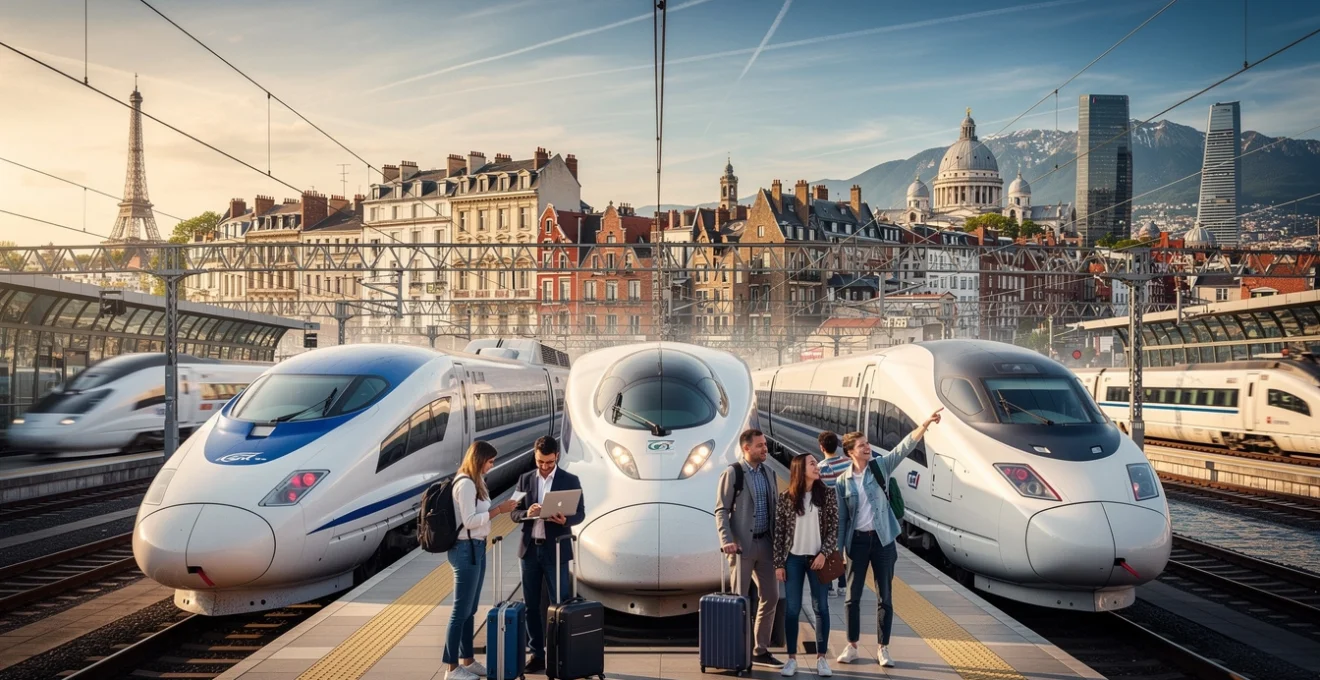
The era of high-speed rail has transformed continental travel from a logistical challenge into an elegant, efficient experience. Travellers crossing Europe, Japan, and other well-connected regions now enjoy rapid transit between major metropolitan areas, eliminating the stress of airport security queues, baggage restrictions, and lengthy transfers from distant terminals. High-speed trains have become more than mere transportation—they represent a sophisticated approach to urban exploration that prioritizes convenience, environmental responsibility, and genuine comfort. Unlike conventional travel methods that treat the journey as an obstacle to overcome, rail networks position transit as an integral part of the travel experience itself.
Modern rail infrastructure connects city centres directly, delivering passengers from urban core to urban core without the peripheral airport commutes that consume valuable hours. This fundamental advantage becomes particularly pronounced when considering total journey times: whilst a flight might appear faster on paper, the complete door-to-door experience often favours the train. For travellers planning multi-city itineraries, this efficiency multiplies across each leg of the journey, transforming previously exhausting schedules into manageable, even enjoyable, sequences of exploration.
High-speed rail infrastructure: comparing TGV, shinkansen, and eurostar networks
The world’s premier high-speed rail systems demonstrate remarkable engineering achievements, each adapted to their geographic and cultural contexts. These networks have fundamentally altered regional connectivity, making same-day multi-city exploration not merely feasible but practical for both business travellers and tourists. Understanding the distinct characteristics of each system helps you appreciate the sophistication behind your seamless journey from one urban centre to another.
France’s TGV system: paris to lyon in two hours at 320 km/h
The Train à Grande Vitesse pioneered European high-speed rail when it launched in 1981, establishing France as a continental leader in rapid transit infrastructure. Today’s TGV network spans over 2,800 kilometres of dedicated high-speed lines, with trains routinely reaching operational speeds of 320 km/h on certain routes. The Paris-Lyon corridor, one of the system’s original routes, exemplifies this efficiency by covering 465 kilometres in approximately two hours—a journey that would require at least five hours by conventional rail.
What distinguishes the TGV system is its hub-and-spoke configuration centred on Paris, radiating outward to Bordeaux, Marseille, Strasbourg, and numerous other destinations. The recent extension to Bordeaux reduced journey times from over three hours to just over two, opening southwestern France to Parisian day-trippers and business travellers alike. This expansion demonstrates France’s continuing investment in rail infrastructure, with SNCF consistently upgrading both rolling stock and track technology to maintain competitive advantages over short-haul aviation.
Japan’s shinkansen tokaido line: tokyo to osaka connectivity
The Shinkansen established the global template for high-speed rail when it debuted in 1964, coinciding with the Tokyo Olympics. The Tokaido Line connecting Tokyo and Osaka remains the world’s busiest high-speed rail corridor, transporting over 150 million passengers annually along its 515-kilometre route. Trains depart every few minutes during peak periods, offering you remarkable scheduling flexibility unmatched by any aviation service on this route.
Japanese engineering excellence manifests in the Shinkansen’s legendary punctuality—average delays measure in seconds rather than minutes—and its impeccable safety record spanning six decades without a single passenger fatality from accidents. The newest N700S series trains feature advanced tilting mechanisms that maintain passenger comfort whilst navigating curves at speeds approaching 300 km/h. This combination of frequency, reliability, and comfort has made the Shinkansen an indispensable component of Japanese infrastructure, handling the equivalent of an entire domestic airline’s annual capacity every few weeks.
Eurostar channel tunnel services: london to paris direct routes
Eurostar’s Channel Tunnel service represents one of modern engineering’s most audacious achievements: boring 50 kilometres beneath the English Channel to create a fixed link between Britain and continental Europe. Since 1994, Eurostar trains have connected London St Pancras with Paris Gare du Nord in just 2 hours 15 minutes, fundamentally altering cross-Channel travel
for both leisure and business travellers. When you factor in the time required to reach airports on either side, clear security, and wait at the gate, the rail journey often becomes the faster option door to door. Eurostar also streamlines the experience by integrating check-in, security, and exit checks within the station environment, typically requiring you to arrive just 60-90 minutes before departure rather than several hours in advance. Onboard, you have space to work, dine, or simply relax as the English countryside and northern France glide past your window.
Eurostar’s network now extends beyond its core London–Paris and London–Brussels routes to reach Amsterdam, Lille, and seasonal destinations in the Alps and southern France. This expansion transforms London into a practical starting point for multi-city itineraries across Western Europe, allowing you to combine capital cities in a single week without setting foot in an airport. As night trains and regional services continue to integrate timetables with Eurostar, the Channel Tunnel is increasingly just the first leg of a joined-up rail journey stretching from the UK to the Mediterranean and beyond.
Spain’s AVE network: madrid-barcelona corridor performance
Spain’s AVE (Alta Velocidad Española) network is one of the fastest-growing high-speed rail systems in the world, and its flagship Madrid–Barcelona corridor showcases what modern rail can achieve. Covering roughly 620 kilometres in as little as 2 hours 30 minutes, AVE trains routinely cruise at 300 km/h, turning what used to be an all-day overland journey into a convenient city-to-city hop. For many travellers, the high-speed train beats flying not only in comfort but also in total door-to-door time.
The Madrid–Barcelona line highlights how high-speed rail can reshape national travel habits. Since its full opening in 2008, the route has captured the majority of market share from airlines, in some years reaching over 60% of total passenger traffic between the two cities. Competition from new low-cost operators such as Ouigo España and Iryo has introduced more frequent departures and aggressively priced tickets, making it easier for you to include both cities in a single itinerary. With AVE and its competitors also linking Madrid to Seville, Málaga, Valencia, and Alicante, you can now explore multiple Spanish regions in a single week without enduring a single domestic flight.
Multi-city itinerary efficiency: journey time analysis across european routes
When planning a multi-city trip, the true advantage of fast trains becomes clear not on a single route, but across an entire itinerary. Instead of losing half a day every time you change cities by air, high-speed rail allows you to treat travel as part of the experience and often to move between destinations in the morning or evening without sacrificing sightseeing time. Door-to-door journey analysis—including transfers, waiting times, and check-in procedures—consistently shows that trains can rival or outperform flights on routes up to 800–1,000 kilometres.
This efficiency compounds when you stitch together several segments. Imagine starting your day in Paris, having lunch in Brussels, and reaching Amsterdam for dinner—all possible thanks to fast, frequent rail connections. Because major stations sit at the heart of historic centres, you step off the train and are immediately immersed in the city, rather than spending precious hours navigating suburban ring roads or airport shuttles. Over a week or two, that time saved can equate to an extra day of exploration, a crucial difference when you want to see as much as possible.
Central station locations: proximity to historical city centres
One of the least appreciated yet most powerful advantages of high-speed rail is the location of major terminals. Stations such as Paris Gare de Lyon, Roma Termini, München Hbf, and Kyoto Station are embedded directly in the urban fabric, often within walking distance of historic quarters, museums, and key landmarks. This central positioning eliminates the long, expensive transfers typical of airports, which are often 20–40 kilometres from the city core.
For multi-city travellers, this proximity translates into immediate access. You can arrive in Florence and be looking up at the Duomo within minutes, or step off the train in Lyon Part-Dieu and transfer onto a short tram or metro ride to the Old Town. Think of high-speed stations as both arrival points and local transport hubs: they connect seamlessly with metro lines, trams, buses, taxis, and increasingly, bike- and scooter-sharing schemes. The result is a continuous travel flow—from your hotel in one city to your next hotel in another—without the disjointed feeling that often accompanies airport transfers.
Frequency and scheduling: deutsche bahn ICE timetable flexibility
Germany’s ICE (InterCityExpress) network provides a prime example of how frequency and flexible scheduling enhance multi-city rail travel. On core routes such as Frankfurt–Cologne, Munich–Berlin, or Hamburg–Berlin, ICE trains often depart every hour or even every 30 minutes at peak times. This density of service gives you far more control over your schedule than most short-haul flights, which might run only a few times per day on equivalent routes.
High-frequency departures mean you can treat long-distance trains almost like metro services: miss one and another will follow shortly. For business travellers, this flexibility allows last-minute changes without the penalties common in airline fare structures. For leisure travellers, it becomes easier to adjust your plans based on the weather, your energy levels, or a spontaneous decision to spend a few more hours exploring a museum. In practice, this timetable flexibility reduces planning stress while maximising how many cities you can comfortably include in a European itinerary.
Seamless connections: thalys network integration in belgium and netherlands
Before its integration into the Eurostar brand, the Thalys network set the standard for seamless cross-border connectivity between France, Belgium, Germany, and the Netherlands. High-speed services linked Paris to Brussels in around 1 hour 20 minutes, continuing on to cities like Amsterdam and Cologne with minimal dwell times at intermediate stations. Even as branding evolves, the underlying network remains a backbone for multi-country itineraries in northwestern Europe.
What makes this corridor so valuable for travellers is not only speed but also the quality of connections. In Brussels, you can change from a high-speed service to domestic trains heading to Bruges, Ghent, or Antwerp with minimal walking and short transfer times. Amsterdam Centraal offers similar integration, allowing easy onward travel to Rotterdam, The Hague, or smaller Dutch towns. The effect is like travelling along a well-oiled conveyor belt of connectivity: you glide from one historic centre to another with minimal friction, making it realistic to visit several countries in a single week without feeling rushed.
Same-day multi-destination feasibility: rome-florence-venice rail triangle
Italy’s high-speed backbone—linking Rome, Florence, Bologna, Milan, and Venice—illustrates how fast trains transform the feasibility of same-day multi-destination travel. Routes such as Rome–Florence (around 1 hour 30 minutes) and Florence–Venice (roughly 2 hours) mean you could, in theory, have breakfast near the Colosseum, lunch by the Arno, and dinner on the Grand Canal. While you may not choose to do all three in a single day, knowing that these options exist gives you enormous flexibility when designing your itinerary.
More realistically, travellers use this triangle to base themselves in one city and take strategic day trips to others. Staying in Florence, for example, you can dip down to Rome for a day of ancient history or up to Venice for canals and palazzi, returning to the same hotel each night. Because services are offered by both Trenitalia’s Frecciarossa and the private Italo operator, competition has helped keep prices reasonable and frequencies high. The result is an Italian itinerary that feels more like commuting between neighbourhoods than crossing hundreds of kilometres.
Carbon footprint reduction: railway electrification and environmental impact data
Beyond convenience and comfort, high-speed rail offers a compelling environmental argument, particularly if you want to reduce the carbon footprint of your multi-city travel. Electrified rail networks powered increasingly by renewable energy can emit as little as 10–25 grams of CO₂ per passenger-kilometre, compared with 150–250 grams for short-haul flights. On busy corridors where trains replace planes, the cumulative reduction in emissions is substantial, helping countries meet climate targets without curbing mobility.
Studies from the European Environment Agency and the International Energy Agency consistently show that shifting journeys from air and car to rail is one of the most effective ways to decarbonise transport. Many high-speed lines, from France’s TGV to Spain’s AVE and Japan’s Shinkansen, already run on heavily decarbonised grids, magnifying their environmental advantage. It’s helpful to picture the difference like this: one full high-speed train can remove the equivalent of several hundred cars or multiple short-haul flights from the skies. For travellers planning multi-city trips, choosing rail over air is one of the most straightforward sustainability decisions you can make.
Railway electrification also reduces local air pollution and noise, particularly important as high-speed lines often approach or enter dense urban areas. Unlike jet aircraft, which concentrate emissions during take-off and landing near airports, electric trains operate quietly and cleanly along their entire route. Many operators now publish carbon calculators on their websites, allowing you to compare emissions for different modes before booking. As governments introduce incentives for low-carbon travel, we can expect further improvements in rail energy efficiency and an even stronger case for choosing trains for multi-city exploration.
Passenger comfort and onboard productivity during inter-city transit
Comfort is not a luxury but a critical factor when you are stringing together several cities in a single trip. High-speed trains offer a fundamentally different onboard experience from economy-class flights: wider seats, generous legroom, the ability to stand up and walk around, and large windows framing ever-changing landscapes. Even in standard class, you’ll typically find more space than on most budget airlines, along with power outlets, luggage racks, and access to café-bars or trolley services.
For many travellers, trains double as mobile offices or living rooms. Reliable Wi-Fi is increasingly standard on services like Eurostar, ICE, TGV, and Shinkansen, allowing you to catch up on emails, plan your next day’s sightseeing, or stream entertainment. The atmosphere is generally calmer than airports and planes, with fewer intrusive announcements and no seatbelt signs interrupting your work or rest. If you think of your travel time not as dead time but as productive or restorative time, the advantage of rail for multi-city itineraries becomes obvious.
Another understated benefit is the psychological ease of train travel. You keep your belongings close, move freely between cars, and avoid the claustrophobic feeling some experience on aircraft. Families appreciate the ability for children to walk the aisles, while older travellers value the absence of steep boarding stairs and the smoother ride profile. For long-distance routes, first- and business-class cabins often provide quieter environments, larger seats, and sometimes at-seat dining—ideal if you need to arrive in the next city ready for a meeting or an evening out.
Cost-effectiveness: rail pass systems versus budget airlines for continental travel
At first glance, budget airlines can appear cheaper than trains, particularly when you see promotional fares advertised at ultra-low prices. However, once you factor in baggage fees, airport transfers, seat selection, and the cost of lost time, rail begins to look far more competitive—especially if you’re visiting multiple cities in quick succession. Rail pass systems amplify this value, offering flexible, multi-day or multi-country travel for a fixed price that can dramatically reduce per-journey costs.
When comparing rail passes to budget airlines, it’s important to look beyond headline prices and consider the total travel experience. How much is your time worth? How many early-morning departures or late-night arrivals are you willing to tolerate to save a few euros? Fast trains departing from city centres at civilised hours, with generous baggage allowances and no hidden fees, can quickly become the more economical choice in both financial and personal terms. This is particularly true if you plan to make three or more long-distance journeys in a single trip.
Eurail global pass: unlimited travel across 33 countries
The Eurail Global Pass (for non-European residents) is one of the most flexible tools for exploring multiple cities by train across Europe. Covering 33 countries and thousands of destinations, it offers you a set number of travel days to use within a larger time window—for instance, 10 travel days in 2 months. On each of those days, you can board as many participating trains as you like, hopping from capital cities to smaller regional towns without buying individual long-distance tickets.
Value increases the more you move. If you’re planning a dense itinerary—Paris to Amsterdam, on to Berlin, then Prague, Vienna, Venice, and Rome in two weeks—a Eurail Global Pass can reduce your average cost per high-speed journey significantly below standard fares. Reservations are still required on many high-speed and night trains, sometimes incurring modest fees, but these usually compare favourably with airline surcharges and checked-luggage costs. Because you retain the freedom to change your route on the fly, the pass also protects you from price spikes that can occur when booking point-to-point tickets at the last minute.
Interrail pricing tiers: youth, adult, and senior pass comparison
For European residents, the Interrail Pass offers a similar concept with tailored pricing tiers for different age groups. Youth travellers (typically aged 12–27) enjoy some of the most attractive discounts, often paying around 20–25% less than standard adult prices for the same flexibility. Seniors (usually 60+) also benefit from reduced rates, acknowledging that they may travel more slowly but still value the ability to visit numerous cities without the stress of air travel.
These tiered options make rail passes especially compelling for families or mixed-age groups planning multi-city journeys. A family of four, for example, can roam across several countries with predictable, upfront costs for their long-distance travel, while taking advantage of local transit cards in each city. When you compare this to buying separate airline tickets—each with its own baggage rules, fees, and timing constraints—the simplicity and security of a single Interrail purchase can be a major advantage. The combination of age-based discounts and seasonal promotions can sometimes bring the cost per travel day to well under the price of a typical budget flight.
Regional rail passes: swiss travel pass and JR pass value analysis
Regional rail passes focus your value on specific, high-cost networks where point-to-point fares can add up quickly. The Swiss Travel Pass is a classic example: Switzerland’s trains, boats, and mountain railways are renowned for their punctuality and scenic routes, but individual tickets can be expensive. With a pass, you gain unlimited travel on most national services, plus free or discounted access to many mountain excursions and museums, turning ambitious multi-city or multi-resort itineraries into a cost-effective reality.
In Japan, the Japan Rail (JR) Pass historically offered exceptional value for travellers planning to cover long distances on the Shinkansen and JR local lines. Although recent price adjustments have narrowed the gap somewhat, the pass can still be economical if you intend to travel between major cities like Tokyo, Kyoto, Osaka, Hiroshima, and Fukuoka within a limited timeframe. Think of these regional passes as all-you-can-eat buffets for transport: if you are committed to exploring extensively within a country, they quickly pay for themselves while granting you the freedom to make spontaneous side trips without worrying about individual ticket prices.
Luggage flexibility and border control streamlining on cross-border services
High-speed trains also excel in one of the most practical aspects of multi-city travel: how you handle your luggage. Unlike budget airlines that rigorously enforce strict cabin baggage dimensions and charge for every extra kilogram, most European and Japanese trains allow you to bring multiple bags on board at no additional cost, provided you can manage them yourself. Overhead racks, end-of-car luggage spaces, and sometimes dedicated baggage areas make it easy to keep your belongings close without wrestling with check-in counters or conveyor belts.
This flexibility is particularly valuable if your itinerary involves varied activities—say, combining business meetings with hiking in the Alps or shopping in Milan. You can carry specialised gear or extra outfits without incurring punitive fees or worrying about whether your bag will fit into a metal sizer. Because you load and unload your luggage directly, the risk of lost bags is also dramatically lower than with air travel. For travellers who like to bring home wine, regional foods, or fragile souvenirs, the smoother handling and shorter transfer distances at stations can be a significant relief.
Border control procedures on cross-border rail services have also become more streamlined, especially within the Schengen Area. Many routes operate with no routine passport checks at internal borders, allowing you to move between countries as easily as between regions. Where formal controls remain—on services like Eurostar or routes entering and leaving Schengen—they are typically conducted at the station before boarding, consolidating security, check-in, and immigration into a single, predictable process. Instead of queuing at multiple counters in sprawling airport terminals, you move through a compact, clearly signposted sequence and walk directly onto your train.
Onboard, there is rarely any interruption for border formalities, so you can continue working, reading, or simply watching the landscape roll by. This continuity of experience is one of the subtle reasons high-speed trains feel so civilised compared with flying. When you add up the advantages—flexible luggage policies, lower risk of loss, and simplified border checks—it becomes clear why fast trains are often the smartest choice for exploring multiple cities across borders in a single, coherent journey.