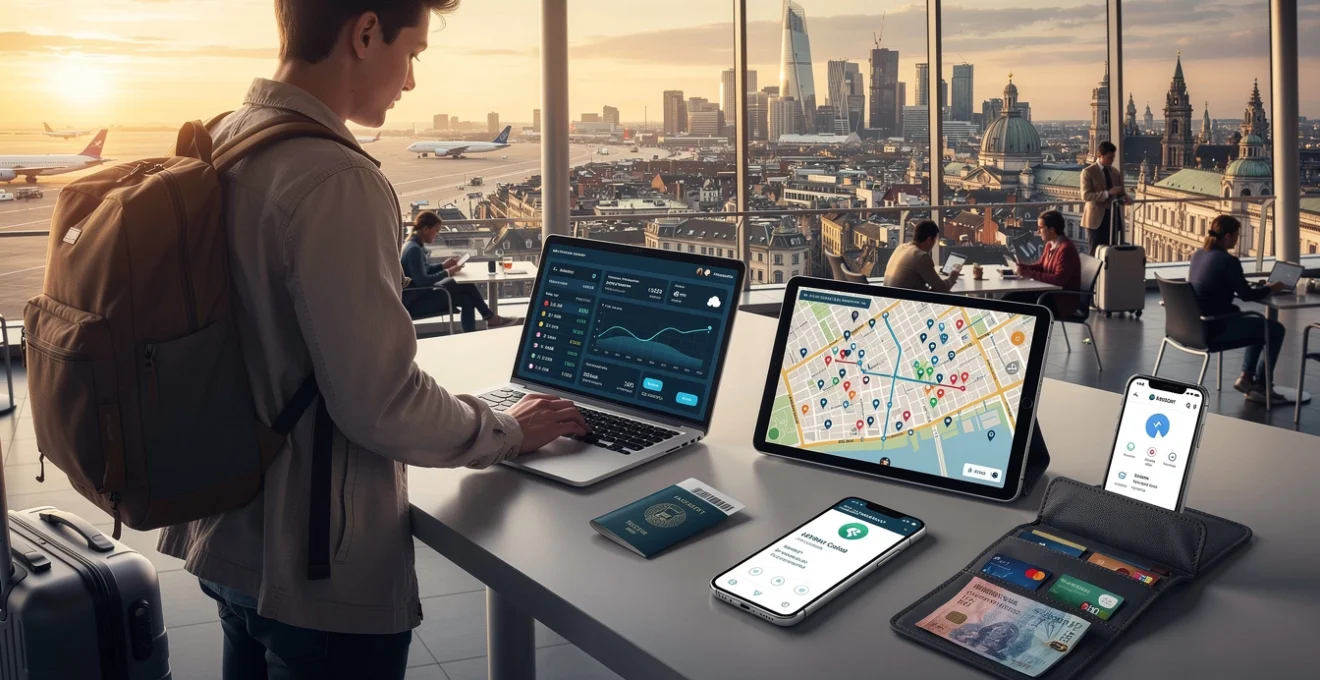
Modern travellers face an unprecedented challenge: maximising precious time whilst navigating increasingly complex travel ecosystems. Whether you’re embarking on a weekend city break or an extended international expedition, every moment counts when exploring new destinations. The difference between a mediocre trip and an extraordinary adventure often lies not in the budget or destination choice, but in the strategic implementation of time-saving techniques that seasoned travellers have refined over years of experience.
Technology has revolutionised how we plan, book, and execute our journeys, yet many travellers remain unaware of the sophisticated tools and methodologies available to streamline their experiences. From advanced booking algorithms that can save hours of research time to digital infrastructure solutions that ensure seamless connectivity across borders, the modern travel landscape offers unprecedented opportunities for efficiency optimisation.
Strategic Pre-Departure planning techniques for optimal itinerary efficiency
The foundation of any time-efficient journey begins months before departure, with strategic planning that leverages sophisticated digital tools and market intelligence. Effective pre-departure preparation can eliminate countless hours of on-ground confusion and decision paralysis that plague unprepared travellers. Research indicates that travellers who invest just three hours in comprehensive pre-planning save an average of 8-12 hours during their actual trip duration.
Multi-platform booking aggregation using kayak, skyscanner, and google flights
Flight comparison platforms have evolved far beyond simple price comparisons, now offering sophisticated analytics that can identify patterns invisible to casual browsers. Kayak's Price Forecast feature utilises machine learning algorithms to predict whether prices will rise or fall, enabling strategic booking decisions. Meanwhile, Skyscanner’s “Whole Month” view reveals pricing trends across extended periods, whilst Google Flights provides real-time inventory updates that reflect actual availability rather than cached results.
The most effective approach involves cross-referencing results across all three platforms, as each maintains different airline partnerships and inventory access. Professional travel consultants recommend setting up price alerts on multiple platforms simultaneously, as algorithms can vary significantly in their tracking accuracy. This triangulated approach has proven to identify savings opportunities that single-platform searches miss entirely.
Dynamic pricing algorithms and tuesday 3PM booking window optimisation
Airline pricing algorithms adjust thousands of times daily based on demand forecasting, competitor analysis, and inventory management protocols. Industry data suggests that booking flights on Tuesday afternoons between 15:00-17:00 GMT offers optimal pricing windows, as airlines typically release their weekly inventory adjustments during this period. However, this timing strategy should be combined with broader market analysis rather than relied upon exclusively.
Advanced travellers monitor pricing patterns for specific routes over 6-8 week periods, identifying recurring cycles that reflect airline revenue management strategies. Dynamic pricing responsiveness varies significantly between airlines, with budget carriers typically showing more volatile patterns than legacy airlines with established pricing structures.
Geolocation-based accommodation clustering via booking.com heat maps
Accommodation selection transcends simple price comparison when time efficiency becomes the primary objective. Booking.com’s heat map functionality reveals neighbourhood pricing density, enabling strategic location selection that minimises transport time whilst maximising exploration opportunities. Properties clustered within 800-metre radii of major attractions typically offer 40-60% time savings compared to suburban alternatives, despite premium pricing.
Heat map analysis should incorporate public transport accessibility, pedestrian infrastructure quality, and proximity to multiple point-of-interest categories. Properties positioned at transport hub intersections often provide exponentially greater exploration potential than those offering marginal cost savings in peripheral locations.
Transit route optimisation through rome2rio and citymapper integration
Multi-modal transport planning requires sophisticated route analysis that accounts for real-time conditions, seasonal variations, and alternative pathway options. Rome2rio excels at international and intercity route planning, whilst Citymapper dominates urban navigation with hyperlocal transit intelligence. Professional travel efficiency demands integration of both platforms for comprehensive journey mapping.
Route optimisation extends beyond simple time calculations to include reliability factors, weather contingencies, and alternative pathway availability.
Efficient travellers always maintain backup route strategies, as transport disruptions can cascade into significant time losses without proper contingency planning.
<h
Digital infrastructure deployment for seamless connectivity management
Once strategic planning is complete, the next time-saving priority is building a robust digital infrastructure that keeps you online and operational with minimal friction. Losing connectivity abroad can cost you hours in missed directions, failed bookings, and administrative headaches. By pre-configuring your connectivity stack before departure, you transform your phone into a resilient command centre that continues working even when networks are patchy or systems go down.
Esim configuration protocols for airalo and holafly network coverage
Physical SIM swaps at foreign airports are one of the most avoidable time sinks in modern travel. eSIM technology from providers such as Airalo and Holafly allows you to land with data already active, bypassing queues, language barriers, and manual configuration. The most efficient workflow is to purchase and install your eSIM profile 24–48 hours before departure, then schedule activation for your arrival date so that your device transitions automatically when it detects the new network.
Before purchase, verify country-specific coverage maps, fair-use limits, and whether tethering is allowed, as some “unlimited” plans throttle aggressively after a threshold. On dual-SIM phones, maintain your home number on the physical SIM for banking OTPs while routing data and most calls through the eSIM. Power users also configure a secondary back-up eSIM with a small data package in case their primary provider experiences outages, ensuring that navigation and essential apps remain online.
VPN tunnel establishment using NordVPN and ExpressVPN geo-restrictions bypass
Public Wi‑Fi networks in airports, cafés, and hotels are notorious for weak security and inconsistent access to services. A well-configured VPN such as NordVPN or ExpressVPN protects your data and helps you bypass geo-restrictions that can otherwise derail bookings or banking tasks. Create and test your VPN profiles at home first, ensuring that your credentials work across desktop, tablet, and mobile so you are not troubleshooting logins on an unfamiliar network.
For time-saving efficiency, set up at least two server “favourites”: one in your home country (to access banking and streaming) and one close to your current region for optimal speed. Many secure websites flag logins from unusual locations; by routing through a familiar country, you reduce the risk of automated security holds. Remember that some airport and hotel portals require you to authenticate before enabling VPN traffic, so always connect to Wi‑Fi normally first, complete any splash-page steps, and then initiate your VPN tunnel.
Offline navigation cache management via google maps and maps.me
Relying solely on live data for navigation is one of the most common causes of lost time abroad. Both Google Maps and Maps.me allow you to cache entire city or regional maps for offline use, turning your phone into a dedicated GPS device even when you have no signal. The most efficient strategy is to download offline areas for every destination city, plus a wider regional map to cover day trips and airport transfers.
Google Maps excels in real-time public transport data and business listings, while Maps.me often provides superior detail for hiking trails and rural paths. Experienced travellers therefore maintain parallel offline coverage on both apps: Google Maps for urban navigation and restaurant searches, Maps.me for off-the-beaten-path excursions. Update your offline maps the day before departure and again whenever you detect a strong Wi‑Fi connection on the road, so you always have current street changes and new POIs at your fingertips.
Cloud storage synchronisation through google drive and dropbox redundancy systems
Document loss or device failure can instantly derail a trip, especially when critical records are stored only on a single phone or laptop. Implementing a dual-cloud redundancy system using Google Drive and Dropbox ensures that essential files remain accessible from any internet-connected device. Before departure, create a clearly labelled folder structure (for example: /Trips/Year_Country/) and upload scans of passports, visas, insurance policies, accommodation confirmations, and transport tickets.
To maximise resilience, enable offline access for your highest-priority files on at least one device per traveller, and share a read-only folder with your travel companion or trusted contact at home. In the event of theft or hardware failure, you can restore your entire travel admin system in minutes from any borrowed device. This approach mirrors professional disaster-recovery protocols: if one platform experiences issues, the other remains available, dramatically reducing downtime and stress.
Streamlined documentation digitisation and security protocols
Administrative bottlenecks at borders, check‑in counters, and hotel receptions can easily consume hours over the course of a trip. Digitising your documentation and applying basic security protocols transforms these interactions into rapid, low-friction processes. Instead of rifling through paper folders, you become the traveller who produces exactly the right document in seconds, even under pressure.
Start by creating high‑resolution scans or photos of your passport, driver’s licence, visas, vaccination records, travel insurance, and key bookings. Store these in a dedicated “Travel Docs” folder within your chosen cloud system, and mirror the folder locally on your phone for offline access. For extra resilience, export critical items like your passport and main tickets as a single, small .pdf that can be shared quickly with airlines, embassies, or medical staff when needed.
Security is non‑negotiable when carrying this level of sensitive information. Use a reputable password manager to store logins, policy numbers, and emergency contact details, protecting the vault with a strong master password and two‑factor authentication. On your phone, enable biometric access and full‑disk encryption; on laptops, configure automatic locking after a short period of inactivity. These measures mirror corporate security best practice but are surprisingly simple to implement, and they can be the difference between a minor inconvenience and full identity theft.
At the operational level, keep a concise “border packet” on your device: a single note containing your first-night address, onward travel details, and proof of funds or return flights. Many immigration forms and officers ask for the same core data; by having it pre‑organised, you reduce form-filling time and avoid fumbling for information under scrutiny. As a final safeguard, leave a copy of your essential documents with a trusted person at home who can email or message them if you are locked out of your accounts abroad.
Micro-location strategy implementation for urban navigation efficiency
Macro‑level planning gets you to the right city; micro‑location strategy ensures you use your limited hours within that city to maximum effect. Instead of zig‑zagging across town multiple times a day, you can structure your movements in logical clusters that minimise transit and maximise experiences. Think of it as designing “micro‑zones” for each day, where everything you want to see is within a compact walking radius.
Begin by pinning every key attraction, café, and restaurant you’re interested in onto a single map layer in Google Maps or Maps.me. Clear patterns will emerge: you might see three museums, a park, and several eateries all within one neighbourhood, while another area is surprisingly sparse. Group your days by these natural clusters, visiting each area once rather than repeatedly crossing the city. This alone can reclaim two to three hours per day that would otherwise be wasted in transit.
Within each micro‑zone, apply a simple route-optimisation mindset: start at the point furthest from your accommodation and work your way back, or begin with the attraction that has the most limited opening hours and build around it. Many travellers intuitively do the opposite, beginning with what is closest and gradually drifting further away, only to face a long, tiring return trip at the end of the day. By inverting this logic, you front‑load transit when you are fresh and finish close to “home base” when you are tired.
Time-of-day considerations further refine your micro‑location strategy. Popular viewpoints and old towns are best visited early, before day‑tripper buses arrive; indoor museums can be reserved for midday heat or unexpected rain. Ask yourself: “Where will crowds be in three hours?” and adjust accordingly. Combining neighbourhood clustering with these timing tactics allows you to experience iconic sites with fewer people, less queuing, and better photos, all while keeping your walking distances efficient and manageable.
Advanced currency exchange arbitrage and fee minimisation tactics
Foreign currency management is not only about saving a few percentage points in fees; done poorly, it can also cost you time through repeated ATM visits, declined cards, and unnecessary bank calls. A lean, well‑designed currency strategy eliminates these frictions while keeping more of your budget available for actual experiences. In many cases, optimising your money management can fund an extra day or two abroad over the course of a single trip.
Start by using a travel‑optimised debit or credit card with no foreign transaction fees and competitive interbank exchange rates. Many modern fintech providers offer multi‑currency wallets that let you preload funds in destination currencies when rates are favourable, then spend locally as if using a domestic card. This approach not only minimises costs but also reduces the need to hunt for currency exchange booths or carry large amounts of cash, both of which are time‑consuming and potentially risky.
At ATMs, always decline “dynamic currency conversion” (DCC) offers that allow you to be charged in your home currency. While they appear convenient, these conversions often bake in mark‑ups of 4–8%, effectively taxing every withdrawal. Choose to be charged in the local currency instead and allow your bank or card network to perform the conversion at a more transparent rate. Withdraw larger, less frequent sums to minimise fixed ATM fees, but balance this with safety considerations and your accommodation’s security features.
For travellers passing through multiple countries, currency arbitrage can help avoid ending each leg with pockets full of unusable coins and small notes. Prioritise card payments in your final days in a currency zone and pay cash only for small, fixed‑price items that conveniently deplete your remaining notes. If you do end up with leftover bills, larger denominations of widely used currencies (such as euros or US dollars) can be held for future trips, while obscure currencies are best exchanged back before you leave the country to avoid poor rates at home.
Finally, keep a concise record of your spending in a simple app or spreadsheet. This is not about micro‑budgeting every coffee; it is about spotting patterns that allow you to adjust on the fly. Are ATM fees higher than expected? Switch to card more aggressively. Are you consistently under‑withdrawing and revisiting machines? Increase your average withdrawal and free up that time for something more memorable than standing in another queue.
Real-time language processing tools and cultural context automation
Communication barriers are among the most underestimated sources of time loss abroad. Misunderstood directions, confused orders, or incomplete explanations at ticket counters can create long chains of minor delays. Modern real‑time language tools dramatically reduce these frictions, but their true power emerges when combined with a basic awareness of cultural context and local etiquette.
Apps such as Google Translate and DeepL now offer near‑instant voice and camera translation, turning menus, signs, and short conversations into manageable tasks rather than puzzles. Before departure, download offline language packs for your key destinations so that translation remains available regardless of connectivity. Practise using the conversation mode and photo translation features at home; fumbling with a new interface in front of an impatient waiter or taxi driver wastes both time and social capital.
However, language tools are most effective when you do not need to rely on them for every interaction. Learning 15–20 high‑frequency phrases in the local language—covering greetings, directions, numbers, and polite questions—acts as a force multiplier. It speeds up small transactions, reduces the risk of miscommunication, and signals respect, which often leads to better service and more generous assistance when something goes wrong. Think of these phrases as “keyboard shortcuts” for real‑world interactions.
Cultural context automation takes this one step further. By spending even 30 minutes researching tipping norms, queueing etiquette, typical dining hours, and common scams, you can avoid time‑consuming misunderstandings and uncomfortable situations. For example, knowing that many Southern European restaurants close between lunch and dinner will prevent wasted walks to shuttered doors, while understanding that “no problem” may sometimes be used to avoid open disagreement can prompt you to double‑check important arrangements.
Ultimately, the goal is not to speak every language fluently but to remove communication as a bottleneck in your travel experience. With a lightweight toolkit of translation apps, offline phrase lists, and cultural notes stored on your phone, you can move through airports, train stations, markets, and museums with far fewer delays. The result is more time spent experiencing the destination and less time untangling preventable misunderstandings.