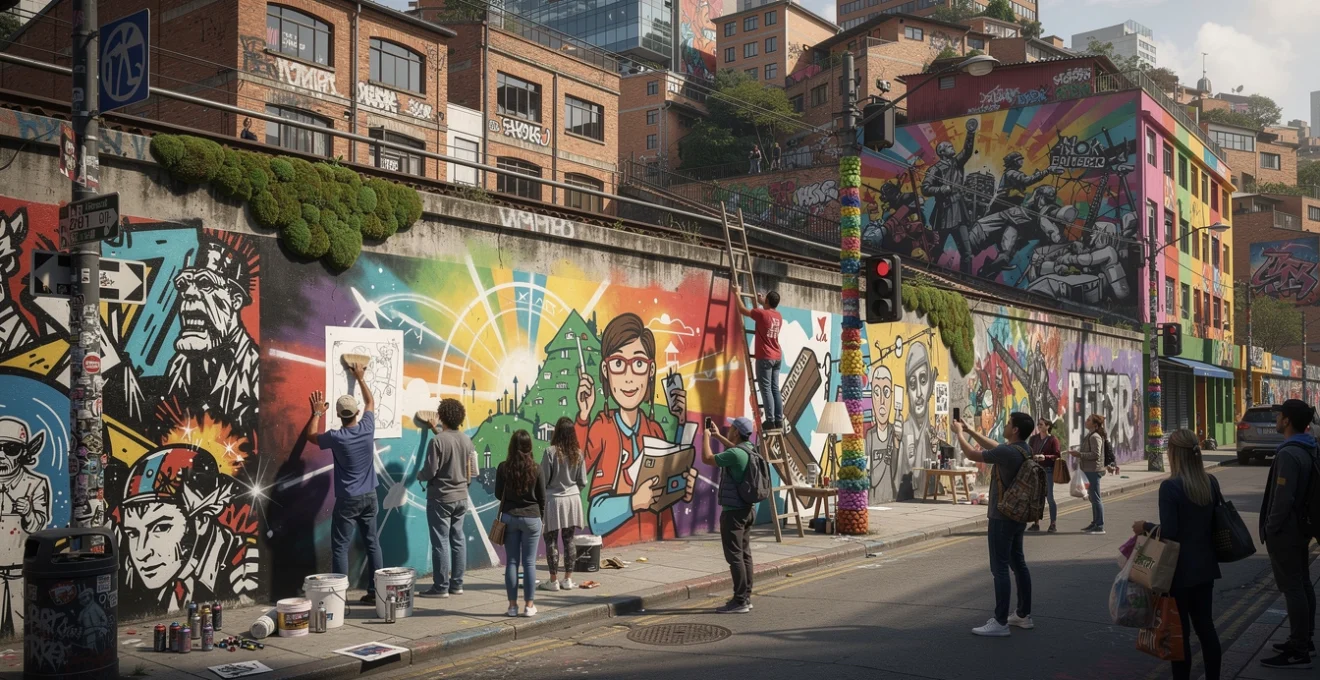
Urban landscapes have transformed into vast canvases where artistic expression meets civic identity. The murals adorning building facades, the stencilled imagery on brick walls, and the elaborate spray-painted compositions in forgotten alleyways collectively form what researchers now term the “linguistic landscape” of contemporary cities. Far from mere decoration or vandalism, these visual interventions reshape how residents perceive their environment, encoding historical narratives, political dissent, and cultural pride into the very architecture of urban space. Recent studies from institutions like Kaunas University of Technology reveal that multilingual murals function as powerful tools for community reflection, turning public spaces into living archives of collective memory. Street art doesn’t simply beautify—it brands, protests, commemorates, and ultimately defines what a city means to those who inhabit it.
The relationship between cities and their street art operates bidirectionally: artists respond to urban conditions whilst simultaneously creating new meanings within those spaces. When you walk through neighbourhoods transformed by aerosol art or wheat-paste installations, you’re experiencing a city’s creative pulse made visible. This phenomenon has gained such significance that municipalities worldwide now grapple with whether to criminalise, tolerate, or actively commission these interventions. The answer reveals much about a city’s cultural priorities and its willingness to embrace grassroots creativity as part of its official identity.
Urban canvas: how muralism and graffiti transform architectural facades into cultural narratives
The transformation of building exteriors into narrative surfaces represents one of the most striking developments in contemporary urbanism. What began as transgressive acts of territorial marking has evolved into sophisticated visual storytelling that commands international attention. Cities recognising this potential have witnessed remarkable shifts in how their communities engage with public space, turning previously overlooked structures into landmarks worthy of pilgrimage.
The evolution from subway tags to commissioned civic murals
The journey from illicit subway scrawls to government-sanctioned murals spans five decades of cultural negotiation. New York City’s late 1960s subway system became the proving ground where young artists from marginalised communities developed distinctive typographic styles, colour theories, and hierarchical systems that still influence street art today. Those early practitioners, working under cover of darkness with stolen spray paint, established fundamental principles: visibility equals legitimacy, style demonstrates skill, and placement signifies ambition.
Contemporary civic mural programmes bear little surface resemblance to furtive nocturnal sessions, yet they inherit crucial DNA from that era. The bold colour palettes, layering techniques, and command of large-scale composition all trace lineage to graffiti’s formative period. However, the intent has fundamentally shifted. Whilst original graffiti writers sought peer recognition within subcultural networks, commissioned muralists now address the broader contemporary art world with civic-focused messaging. This transition hasn’t occurred without tension—many graffiti purists view commissioned work as compromised, arguing that removing illegality strips the medium of its authentic rebellious character.
Bristol’s banksy legacy: subversive stencilling as destination tourism
Bristol’s transformation into a street art destination owes much to its most famous son, whose anonymity only amplifies his influence. The stencil technique—creating reproducible imagery by cutting designs into cardboard or metal templates—allows rapid deployment and sharp visual impact. This methodology proved particularly effective for political messaging, enabling artists to execute complex compositions in minutes rather than hours, reducing arrest risk whilst maximising distribution.
The city’s relationship with unsanctioned street art has evolved considerably. Local authorities initially treated such works as vandalism requiring immediate removal, yet public outcry over attempts to erase certain pieces forced policy reconsideration. Bristol now attracts thousands of visitors specifically to view street art, generating substantial tourism revenue whilst fostering vibrant creative industries. This economic dimension complicates simple narratives about authenticity—when subversive art becomes profitable, does it retain its critical edge? The question remains contested, yet Bristol’s experience demonstrates how cities can leverage grassroots creativity for placemaking without entirely domesticating it.
Philadelphia’s mural arts program: Community-Driven Place-Making through Large-Scale installations
Launched in 1984 as an anti-graffiti initiative, Philadelphia’s Mural Arts Program exemplifies how cities can channel aerosol energy into sanctioned expression. The programme has since produced over
4,000 murals, engaging over 15,000 residents each year in design and painting processes. What began as a pragmatic response to unchecked tagging has evolved into one of the world’s largest public art programmes, positioning street art as a catalyst for dialogue rather than conflict. Neighbourhoods once defined by blight and vacancy now host monumental works co-designed with local communities, addressing themes from mass incarceration to environmental justice.
The programme’s collaborative methodology is key to its impact. Artists conduct workshops, gather oral histories, and invite residents to help paint large-scale “parachute cloth” panels later installed on walls. This participatory approach turns mural-making into civic education and reconciliation, particularly in areas with histories of racial tension or economic neglect. For visitors, Philadelphia’s murals function as an open-air museum of urban narratives; for locals, they operate as mirrors reflecting struggles, aspirations, and collective resilience.
Melbourne’s hosier lane: permissioned graffiti zones as living galleries
Melbourne’s Hosier Lane demonstrates what happens when a city designates specific areas as legal or semi-legal canvases for graffiti and street art. Rather than freezing artworks in time, these zones embrace constant change: pieces are layered, buffed, and replaced in rapid succession, turning alleyways into dynamic, ever-evolving galleries. The result is an urban environment where experimentation is encouraged and emerging artists can develop their style without the immediate risk of prosecution.
From a creative identity perspective, Hosier Lane and nearby laneways like AC/DC Lane function as barometers of Melbourne’s cultural mood. Political slogans, pop culture references, and intricate characters appear almost overnight in response to current events, acting like a visual Twitter feed etched onto brick and bluestone. For tourists, curated street art walks through these spaces have become must-do experiences, contributing to Melbourne’s reputation as one of the world’s leading street art capitals and reinforcing the idea that a city’s walls can serve as open, democratic exhibition spaces.
Tactical urbanism: street art as socio-political commentary and neighbourhood branding
Beyond aesthetics, street art operates as a form of tactical urbanism—small-scale, often temporary interventions that collectively influence how cities function and feel. Murals, stencils, and paste-ups can reframe neglected areas as creative districts, signal political resistance, or help communities assert control over contested spaces. When viewed this way, street art becomes both a tool for socio-political commentary and a strategic asset in neighbourhood branding, shaping how insiders and outsiders alike read the urban landscape.
Berlin’s east side gallery: post-wall iconography and historical memory preservation
The East Side Gallery in Berlin, a 1.3-kilometre stretch of the former Berlin Wall painted by over 100 artists in 1990, stands as a textbook example of street art as historical memory. What was once a brutal barrier now operates as a monumental mural corridor, its images documenting hopes, fears, and sharp critiques of post-Cold War politics. Iconic works such as Dmitri Vrubel’s My God, Help Me to Survive This Deadly Love—depicting the fraternal kiss between Brezhnev and Honecker—have become visual shorthand for the contradictions of authoritarian regimes.
Yet the East Side Gallery is not a frozen relic. Ongoing debates about preservation versus redevelopment reveal tensions between economic interests and memory politics. Sections threatened by luxury construction have sparked protests, reminding us that public art can anchor collective identity even as property values rise around it. When you walk along the Gallery today, you’re not only viewing paintings; you’re traversing a contested memorial space where graffiti, tags, and restoration work all testify to ongoing negotiations over what history should look like in the present.
Wynwood walls, miami: curated street art districts and creative placemaking economics
Miami’s Wynwood Walls illustrate how curated street art districts can transform industrial zones into global creative destinations. Initiated in 2009, the project invited renowned muralists and graffiti writers to paint former warehouse facades, turning blank concrete into monumental artworks. The aesthetic impact was immediate, but the longer-term effects have been economic: Wynwood evolved into a key node of Miami’s cultural tourism, attracting galleries, cafes, and tech startups.
This model of creative placemaking reveals both opportunities and dilemmas. On one hand, Wynwood demonstrates how strategic investment in public art can accelerate neighbourhood revitalisation, reduce vacancy rates, and create jobs in the cultural and hospitality sectors. On the other, rising rents and rapid gentrification have pushed out some of the very communities whose edgy reputation made the area attractive. The district raises a critical question for urban planners and artists alike: how can cities harness the branding power of street art tourism without hollowing out the social fabric that gave rise to that creativity in the first place?
Bogotá’s comuna 13 transformation: graffiti tourism and urban regeneration strategies
On the hillsides of Bogotá and in Medellín’s Comuna 13, vivid murals spill across stairways, retaining walls, and funicular stations, narrating a recent history marked by violence, displacement, and resilience. Once synonymous with cartel warfare and state repression, these neighbourhoods now attract international visitors for guided graffiti tours that explain the icons, slogans, and portraits covering the walls. Street art in this context functions as both testimony and strategy—a way for residents to reclaim narratives long dominated by external media.
The integration of murals with new physical infrastructures, such as outdoor escalators and improved lighting, exemplifies how creative expression can complement more traditional forms of urban regeneration. Local artists lead tours, sell prints, and collaborate on community projects, ensuring that tourism revenue circulates within the neighbourhood. While challenges remain—including the risk of commodifying trauma or sanitising complex histories for visitors—the Comuna 13 model suggests that graffiti can help reposition stigmatised districts as places of cultural innovation rather than danger.
Protest stencils and wheatpasting: ephemeral activism in hong kong and santiago
Not all street art as socio-political commentary is monumental or permanent. In cities like Hong Kong and Santiago, protest movements have turned to stencils, posters, and wheatpasted graphics to rapidly disseminate dissenting messages. These techniques offer low-cost, low-barrier entry points for citizens who may not consider themselves artists but recognise the power of visual communication in contested streets. A single image—a gas-masked figure, a slogan in multiple languages, a symbol of resistance—can be reproduced hundreds of times overnight, transforming city centres into visual battlegrounds.
The ephemerality of these works is part of their strength. Authorities may buff walls or tear down posters, but digital documentation ensures that the imagery continues to circulate online, often reaching global audiences within hours. In this sense, protest street art functions like a flash mob: highly coordinated yet decentralised, appearing suddenly and disappearing quickly while leaving behind a powerful imprint on both physical and digital memory. For urban observers, reading these fleeting interventions provides insight into a city’s political temperature at a given moment.
Material techniques and artistic methodologies defining contemporary street art aesthetics
The creative identity of a city is also shaped by the technical choices its artists make. From high-pressure aerosol cans to biodegradable moss mixtures, the material toolkit of street art directly influences what appears on walls—and how long it lasts. Understanding these methodologies helps you read the urban canvas more precisely, distinguishing quick tags from carefully layered murals and spontaneous interventions from meticulously planned installations.
Aerosol art technologies: cap selection, spray control, and layering techniques
Modern aerosol art is far from crude spraying; it relies on a sophisticated understanding of pressure, nozzle types, and surface behaviour. Artists select specific caps—fat caps for broad fills, skinny caps for fine outlines, specialized calligraphy caps for dynamic flares—to control line width and texture. Combined with low-pressure cans and high-pigment paints, these tools allow for gradients, shadows, and photorealistic details that rival studio work. The result is a mural language where style, precision, and technical mastery communicate status within the graffiti community.
Layering is equally crucial. Many large-scale pieces begin with a primed base coat, followed by blocked-in colours, mid-tone modelling, and finally sharp outlines and highlights. This sequence, often executed over several days in permissioned contexts, produces the depth and vibrancy that make certain walls feel almost cinematic. For city officials and property owners considering commissioning work, understanding these technical demands—ventilation, scaffold access, curing times—can mean the difference between a mural that fades quickly and one that anchors a neighbourhood’s visual identity for a decade or more.
Paste-up installations and sticker bombing: low-barrier entry points for urban intervention
While aerosol work often requires practice, equipment, and time, paste-ups and stickers offer more accessible ways to intervene in public space. Artists design and print images or hand-draw on paper, then use wheatpaste or commercial adhesives to affix them to walls, signposts, and street furniture. This technique allows for detailed illustration, collage, or even photographic work that might be difficult to execute directly on rough surfaces. It also enables artists to produce multiples, effectively “broadcasting” their visual identity across a city overnight.
Sticker bombing, where small adhesive graphics accumulate on poles and street signs, can feel like visual noise, but it serves important subcultural functions. Each sticker represents a tag, crew, brand, or message staking a micro-claim to visibility. For emerging artists, these methods act as stepping stones into the broader street art ecosystem. For urban strategists, they offer clues about creative networks operating beneath the radar and provide indicators of where more structured cultural support—such as legal walls or micro-grant programmes—might find fertile ground.
Yarn bombing and moss graffiti: eco-conscious street art alternatives
As environmental awareness grows, some artists are experimenting with softer, more sustainable interventions such as yarn bombing and moss graffiti. Yarn bombing involves wrapping trees, benches, lampposts, and railings in knitted or crocheted coverings, transforming hard urban edges into tactile, colourful surfaces. These installations often read as playful rather than confrontational, inviting passers-by to touch, photograph, and share, and they foreground questions about care, domestic labour, and the feminisation of public space.
Moss graffiti and other “living” artworks push the eco-conscious approach further by using organic materials instead of paint. Recipes combining moss, yoghurt, and water are applied to walls, encouraging growth in specific patterns over time. While results vary depending on climate and maintenance, the intention is clear: to literally green the city while delivering messages about sustainability and urban ecology. For municipalities seeking to support creative identity without increasing chemical footprints or visual clutter, these approaches suggest alternative pathways where street art and environmental design converge.
Digital documentation and geo-tagging: how instagram and street art apps amplify urban identity
The meaning of street art no longer resides solely on the wall. Platforms like Instagram, TikTok, and dedicated street art apps have turned murals and graffiti into globally circulating images, allowing a piece painted in a back alley to be seen by millions within days. Geo-tagging functions as a bridge between digital and physical space, enabling visitors to locate specific works, follow self-guided tours, and contribute their own documentation to an ever-growing archive. In effect, every post becomes another thread in the narrative of how a city presents its creative self to the world.
This digital amplification has tangible consequences for urban identity. Neighbourhoods once known only to locals can become international attractions after a mural goes viral. Artists gain careers through online visibility, while brands and tourism boards increasingly commission “Instagrammable” facades as part of marketing strategies. Yet reliance on social media metrics also poses risks: will cities start to favour easily shareable imagery over complex, challenging works that are harder to digest at a glance? Navigating this tension between attention economy and authentic expression is now part of the strategic landscape for both artists and city-makers.
Legal frameworks and policy responses: navigating anti-graffiti ordinances versus public art commissions
Beneath the visual vibrancy of street art lies a complex web of legal frameworks that can either stifle or support creative expression. Many cities maintain strict anti-graffiti ordinances, imposing fines, community service, or even jail time for unauthorised markings. At the same time, those same municipalities may invest in public art commissions, mural festivals, and cultural branding campaigns that explicitly leverage street art aesthetics. This apparent contradiction reveals deeper questions about who is allowed to mark the city, under what conditions, and to whose benefit.
Forward-thinking policy approaches tend to balance enforcement with opportunity. Some cities create legal or semi-legal walls, streamline permit processes for community-led murals, or offer diversion programmes that channel young graffiti writers into structured workshops rather than the criminal justice system. Others partner with business improvement districts to commission facade works that reflect local history and diversity. For planners and cultural managers, the key is to recognise that heavy-handed eradication strategies rarely succeed; instead, policies that differentiate between destructive vandalism and context-sensitive street art can help nurture a city’s creative identity while still addressing legitimate concerns about property rights and maintenance costs.
Economic impact: street art tourism and the commodification of alternative urban aesthetics
As we’ve seen in Bristol, Wynwood, Berlin, and beyond, street art can significantly influence a city’s economic trajectory. Murals and graffiti trails draw tourists who book guided tours, stay in local hotels, and patronise nearby cafes and shops. In some cities, street art festivals generate tens of millions in economic activity over a single weekend, while year-round mural districts boost foot traffic for small businesses that might otherwise struggle. When you see street art on a visitor bureau’s promotional materials, you’re witnessing the commodification of what began as alternative urban aesthetics.
This monetisation brings both benefits and challenges. On the positive side, it can provide income streams for artists, fund maintenance and restoration, and support ancillary industries such as printmaking, merchandise, and cultural programming. However, as neighbourhoods gain cachet as “edgy” or “authentic,” property values often rise, risking displacement of long-term residents and the gradual replacement of independent venues with chain stores. Cities seeking to leverage street art for economic development must therefore think carefully about inclusive strategies—such as rent controls, community land trusts, or profit-sharing models—that ensure the communities who lived with these walls before they were fashionable also share in the rewards.