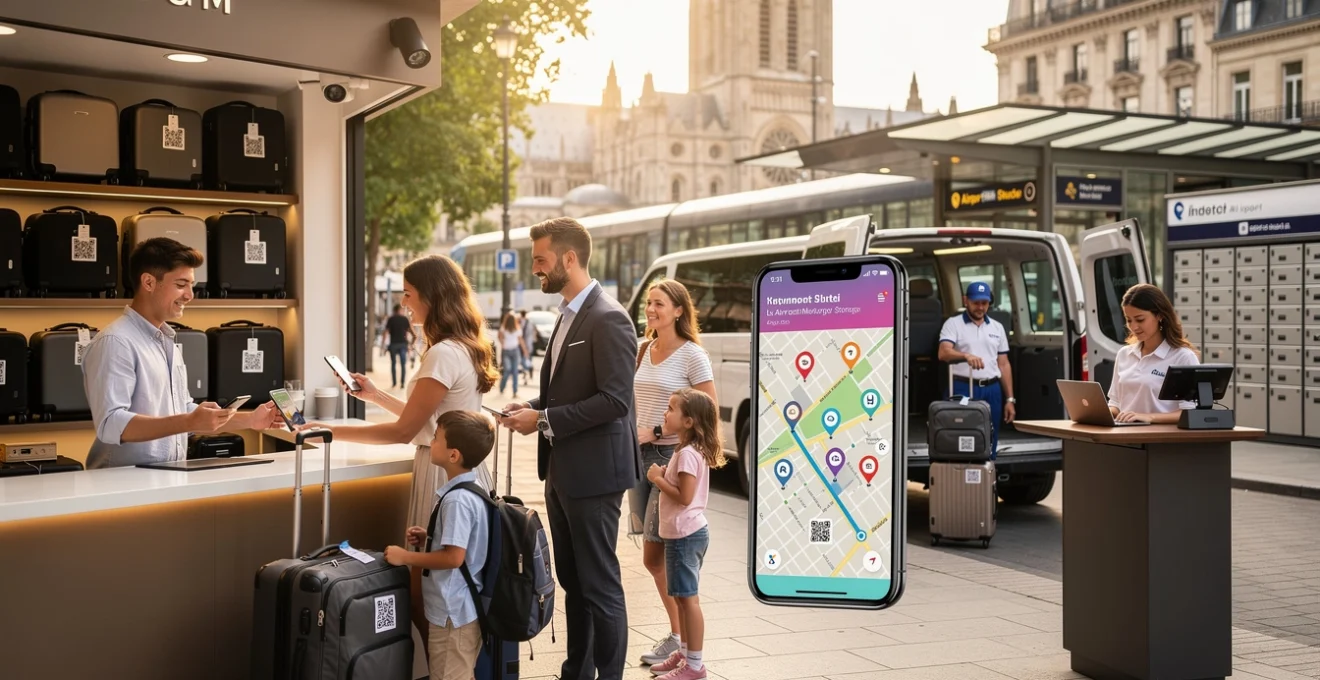
Dragging heavy suitcases through crowded city streets, wrestling with bags on public transport, or arriving hours before hotel check-in can transform what should be an exciting travel day into an exhausting ordeal. Modern urban tourism increasingly demands flexibility—travellers want to maximise every moment in a destination without being tethered to their luggage. Fortunately, the travel industry has responded with innovative solutions that separate you from your bags precisely when you need freedom most. From on-demand storage networks spread across thousands of retail locations to dedicated courier services that shuttle belongings between airports and accommodations, these services have fundamentally changed how millions of tourists experience cities. The question is no longer whether such services exist, but rather which option best suits your specific itinerary, budget, and security requirements.
The luggage logistics sector has expanded dramatically over the past decade, driven by technological advancements, changing travel patterns, and the rise of short-term accommodation platforms. What was once limited to traditional left luggage counters at major railway stations has evolved into a sophisticated ecosystem of peer-to-peer storage networks, same-day courier services, and integrated booking platforms. Understanding how these systems work—and how to leverage them strategically—can add hours of productive sightseeing time to your trip whilst eliminating physical strain and logistical headaches.
How luggage storage networks like bounce and LuggageHero transform urban tourism
The emergence of distributed storage networks represents perhaps the most significant innovation in urban luggage management. Rather than relying solely on centralised facilities at transport hubs, companies like Bounce, LuggageHero, and Stasher have created extensive networks of partner locations scattered throughout city centres. This geographical distribution means you can often find a storage point within a few hundred metres of your current location, whether you’re near a museum, shopping district, or restaurant quarter. The convenience factor cannot be overstated—instead of backtracking to a train station locker, you simply locate the nearest partner venue via a mobile application and drop off your bags whilst continuing your planned route.
Peer-to-peer storage models: partnering with cafés, hotels, and retail shops
The operational model underpinning these networks relies on partnerships with existing businesses that have spare storage capacity. Independent cafés, boutique hotels, souvenir shops, and retail outlets agree to allocate secure space for temporary bag storage in exchange for a revenue share and potential customer foot traffic. From the business owner’s perspective, this arrangement requires minimal operational overhead—they simply receive bags, apply security seals, and store them in a designated area until collection. For travellers, this creates an unexpectedly vast network of options. In central London alone, LuggageHero operates over 300 partner locations, whilst Bounce maintains similar coverage across major European and North American cities.
The vetting process for partner locations typically involves on-site inspections by company representatives who assess security measures, storage space adequacy, and operational reliability. Businesses must demonstrate they can maintain consistent opening hours, provide secure storage areas away from public access, and train staff on proper bag handling procedures. This quality control mechanism helps maintain service standards across the network, though individual experiences can still vary depending on the specific venue. Some locations offer climate-controlled storage rooms, whilst others might designate a corner of a stockroom—both technically meeting minimum requirements but offering different levels of protection for your belongings.
Geolocation integration: finding nearest Drop-Off points via mobile applications
The technological backbone of modern storage networks centres on sophisticated geolocation systems integrated into mobile applications. When you open an app like Bounce or LuggageHero, GPS functionality automatically identifies your current position and displays nearby storage points on an interactive map. Filtering options allow you to refine results based on opening hours, available capacity, user ratings, and proximity to specific landmarks or addresses. This real-time availability data prevents the frustration of arriving at a location only to discover it’s fully booked or temporarily closed.
The booking interface typically requires you to specify your drop-off date, estimated collection time, and number of bags. Advanced systems employ predictive algorithms that account for seasonal demand patterns—suggesting alternative locations during peak tourist periods when popular venues might reach capacity. Once you’ve selected a location, the application generates a unique booking reference and provides turn-by-turn navigation to the storage point. This seamless digital experience
continues at the physical counter, where staff confirm your booking, scan a QR code, and take custody of your bags. Compared with traditional left luggage, this combination of instant discovery, digital payment, and secure documentation removes much of the friction from a typical sightseeing day, especially if you are moving between several neighbourhoods.
Dynamic pricing algorithms: hourly vs daily rate structures across major cities
One of the most practical advantages of modern luggage storage networks is flexible pricing. Rather than paying a flat day rate regardless of how long you store your bags, platforms like LuggageHero and Bounce use dynamic pricing models that offer both hourly and daily caps. If you only need to store a backpack for two hours while you visit a single museum, you avoid overpaying; if you are out from morning until late evening, the system automatically applies the daily maximum.
In many major cities, hourly rates start from the equivalent of €1–€2 per bag, with daily caps typically around €5–€10 depending on the destination and local costs. Algorithms factor in demand patterns, location popularity, and seasonal fluctuations—so storage near a central station in Paris in July may cost more than a neighbourhood café in February. This model is similar to ride-hailing surge pricing but usually operates within tighter, more predictable bands to avoid shocking travellers with unexpected costs.
For you as a traveller, the key is understanding how these rate structures map onto your itinerary. If you are planning a full-day city tour before a late flight, it usually makes sense to store early and keep the bags in one place all day at a daily rate. If you are hopping between districts and only need short-term relief at specific points, strategically using hourly storage near must-see attractions can be more economical. Taking a moment to compare hourly versus day pricing before confirming a booking can save a surprising amount over a multi-city trip.
Insurance coverage standards: liability protection from €1,000 to €3,000 per bag
Beyond convenience and price, insurance coverage is a critical factor when choosing a luggage storage provider. Most established networks include baseline liability protection, often around €500–€1,000 per bag, with the option to purchase additional premium coverage up to €2,500–€3,000. This coverage typically protects against theft, loss, or damage while your luggage is in the custody of the storage partner, provided you have followed the platform’s booking and payment rules.
Policy details do vary, and this is where many travellers overlook important fine print. For example, some services require all payments to be made through the official app or website—if you pay cash directly at the shop, you may void insurance protection altogether. High-value items such as professional camera equipment, jewellery, or large sums of cash are often excluded or subject to lower caps, much like airline baggage policies. Thinking of the insurance as similar to a hotel safe policy can help frame your expectations: it offers meaningful protection, but not for every conceivable item.
Before finalising a booking, it is worth checking the stated coverage limits and exclusions, especially if you are carrying laptops or specialist gear. If your belongings exceed the standard policy value, consider spreading them across two bags or adding optional premium insurance where available. It is a small additional cost compared with the potential disruption of replacing lost essentials mid-trip. When used thoughtfully, insured luggage storage lets you explore with much greater peace of mind, knowing there is a formal safety net in place.
Baggage transfer services between airports and accommodation providers
While on-demand storage networks are ideal for short-term stops, luggage transfer services solve a different problem: moving your bags between points while you move independently. Instead of storing and later collecting your suitcase, you hand it over at one location and find it waiting at your next hotel or rental. This approach is particularly valuable on arrival or departure days, when flight times often clash with hotel check-in and check-out windows, and you want to use the “dead time” productively rather than guarding your belongings.
Same-day courier solutions: AirPortr and nannybag direct delivery systems
Same-day luggage courier services such as AirPortr in London or Nannybag’s transfer offerings in select cities specialise in airport-to-door and door-to-airport deliveries. The process usually starts with an online booking, where you specify your flight details, pick-up address, and delivery destination. A uniformed driver then meets you at your home, hotel, or designated airport meeting point, scans and seals your bags, and transports them directly to their destination—often within a defined time window on the same day.
Imagine landing at Heathrow early in the morning with an evening check-in at a central London apartment. Instead of hauling heavy cases on the Tube or in a crowded taxi, you can hand them over at the terminal, head into the city with just a daypack, and receive a notification when your luggage is delivered. AirPortr, for example, integrates with certain airlines to check your bags in for the flight itself, meaning you do not even see them until the baggage carousel at your destination. It is essentially applying the principles of parcel logistics to travel, turning your suitcase into a trackable shipment.
Of course, this level of convenience comes with a higher price tag than simple storage, usually calculated per bag and per route. However, when you compare the fee to the cost of airport taxis, time lost, and physical effort—especially for families or older travellers—the value proposition can be strong. As with storage networks, insurance coverage, cut-off times, and identification requirements are important to review carefully, as missed pick-ups or incomplete paperwork can delay delivery.
Railway station locker alternatives: left luggage facilities at king’s cross and gare du nord
In many European cities, traditional station lockers have been supplemented—or replaced—by manned left luggage counters and third-party providers operating within or near major rail hubs. At London King’s Cross or Paddington, for instance, you will find staffed Left Luggage facilities where bags are tagged, weighed, scanned, and stored in secure back-of-house areas rather than self-service cabinets. Similar services exist at Paris Gare du Nord, Milan Centrale, and other high-traffic stations, often with extended opening hours to match train schedules.
These facilities offer a hybrid experience: they maintain the centralised convenience of station storage while incorporating more advanced security screening and inventory management. Bags may pass through X-ray scanners, and staff will check identification or boarding passes before accepting or releasing luggage. This resembles airport-style security in miniature, designed to mitigate risks associated with unattended baggage in crowded public spaces. For travellers, the process is still straightforward—queue, register your bag, receive a claim ticket or QR code, and return later to collect.
That said, station-based left luggage can become crowded at peak times, and pricing is often fixed per calendar day rather than hourly, making short stops less economical. There is also the issue of location: while perfect if your itinerary naturally begins and ends at the station, it may require time-consuming detours if your accommodation is elsewhere. As a result, many travellers now combine station facilities with app-based networks, choosing the option that best aligns with each journey segment.
Hotel concierge partnerships: pre-arrival and post-checkout storage coordination
For travellers staying in hotels, the most discreet luggage storage and transfer option often comes through the concierge desk. Many mid-range and upscale properties will store your bags before check-in or after check-out at no extra charge, allowing you to explore the city freely. Increasingly, hotels are also partnering with specialist luggage transfer companies, enabling services such as airport pick-up, inter-hotel transfer, or same-day courier to a different city, all coordinated through a single point of contact at reception.
This integration works particularly well when your itinerary involves multiple properties within one brand or group. You might, for instance, check out of a London hotel in the morning, travel by train to Edinburgh luggage-free, and find your bags already delivered to your new room by evening. From your perspective, the logistics disappear into the background, managed by the hotel and its partner carrier. It can feel similar to a cruise line handling your suitcase from one port to the next.
If you value this type of hands-off experience, it is worth asking potential hotels in advance what luggage services they offer. Some will facilitate third-party transfers and add the fee to your room bill, whereas others may only offer on-site storage. Clarifying responsibilities—who is liable at each handover point, and how delays are communicated—helps avoid misunderstandings. When executed well, concierge-enabled luggage transfers allow you to treat a multi-stop journey as a seamless, continuous stay.
Inter-city transfer logistics: moving luggage from london to edinburgh via dedicated carriers
When your trip spans several cities, inter-city luggage transfer services function like a dedicated courier for your personal belongings. Companies operating on popular leisure routes—for example, between London and Edinburgh, or along famous hiking trails—collect your bags from one accommodation and deliver them to the next, often overnight. You travel by train, car, or even on foot with only a light daypack, while your heavier gear follows by road with the carrier.
The operational model is similar to that of regional parcel networks. Drivers follow planned routes, visiting multiple hotels, guesthouses, and B&Bs each morning to pick up labelled bags and then distributing them at the next set of stops later in the day. Many services ask that luggage be ready by 9:00 a.m. and guarantee delivery by late afternoon, giving you a clear window in which to plan your movements. Weight limits—commonly around 20 kg per bag—help protect staff from injury and keep vehicles within safe load limits.
For walking or cycling holidays, this type of luggage transfer can be transformative. Instead of loading your pack with everything for a week on the trail, you carry only what you need for each day: water, snacks, layers, and essentials. Your main suitcase, with spare clothes and non-urgent items, awaits at each night’s accommodation. It is rather like having a support vehicle following you at a distance, but without the environmental or visual impact of a convoy. If you are planning a route-heavy trip, researching these regional carriers in advance can open up itineraries that might otherwise feel too demanding.
Technology infrastructure powering on-demand baggage solutions
Behind the scenes, modern luggage storage and transfer services rely on a sophisticated technology stack that would look familiar in e-commerce or last-mile delivery. Booking engines, QR codes, GPS tracking, and APIs all play their part in moving physical bags as predictably as digital data. Understanding these components not only demystifies the process but also helps you evaluate which providers have the most robust systems—an important consideration when you are entrusting them with everything you packed for your trip.
QR code check-in systems and tamper-proof sealing mechanisms
Most leading luggage services now anchor their check-in and check-out processes around unique digital identifiers, typically QR codes or barcodes. When you complete an online booking, the system generates a code linked to your reservation details: drop-off location, number of bags, insurance terms, and scheduled pick-up or delivery. At the storage point or during collection, staff scan this code, associating your physical luggage with the digital record and reducing the risk of manual errors such as mislabelling or duplicate tags.
Once your bag is accepted, it is usually fitted with a tamper-evident seal—a numbered cable tie, adhesive strip, or security tag—that would clearly show if someone attempted to open it. In some systems, the seal number is also recorded in the app or on your digital receipt, allowing you to verify that the same seal is intact upon collection. Think of it as a low-tech lock paired with high-tech documentation: the combination does not make theft impossible, but it makes interference far more visible and traceable.
For you, this means that any storage or transfer transaction should leave a clear digital trail. If a provider still relies solely on handwritten receipts and loose tags, it may be a sign that their processes have not kept pace with current best practices. Prioritising services that use QR code check-ins and documented seal numbers offers an extra layer of accountability and can be invaluable if you ever need to file a claim or query a discrepancy.
Real-time tracking dashboards: GPS-enabled bag monitoring platforms
For door-to-door luggage transfers, particularly airport-to-hotel or inter-city services, GPS tracking has become a key differentiator. Rather than waiting passively and hoping your bag arrives, you can follow its journey on a real-time map or status dashboard, similar to monitoring a food delivery or ride-hailing driver. The system updates as your bag is scanned at pick-up, loaded into a vehicle, approaches the destination, and is finally delivered and signed for.
In practice, the level of granularity varies by provider. Some offer continuous live tracking of the vehicle carrying your luggage; others update status at key milestones—collected, in transit, delivered. Either way, you gain transparency, which reduces anxiety and allows you to plan your day more confidently. If you can see that your suitcase has been dropped at your hotel while you are still at a museum, you know you can head straight to dinner afterward without detouring to check on it.
However, GPS tracking is not a guarantee against delays or disruptions. Traffic jams, unexpected security checks, or access issues at your accommodation can still slow things down. The value lies in visibility: you and the provider can see where the system is breaking down and respond proactively, whether by adjusting a delivery time, contacting a hotel, or rerouting the driver. In that sense, real-time dashboards act like an air traffic control screen for your luggage, turning what would otherwise be guesswork into manageable information.
API integration with booking engines: expedia and airbnb embedded services
As luggage services mature, they are increasingly integrated directly into the travel platforms you already use to book flights and accommodation. Through application programming interfaces (APIs), companies can plug their storage or transfer options into sites like Expedia, Booking.com, or Airbnb, presenting you with luggage solutions at precisely the moment you are defining your itinerary. This is similar to how travel insurance or airport transfers appear as add-ons during a flight booking process.
Imagine booking an apartment with an 4 p.m. check-in time and a flight arriving at 9 a.m. If the platform is connected to a luggage network, it might automatically surface a nearby storage point or same-day courier option during checkout, complete with pricing and time windows. Some partnerships go further, letting you manage the entire luggage workflow from your booking dashboard—modifying pick-up times, adding bags, or updating delivery addresses without visiting a separate website. For frequent travellers, this level of integration can feel like having an invisible travel assistant coordinating in the background.
For providers, API integration also enables more intelligent routing and capacity planning. By accessing anonymised booking data (subject to privacy rules), they can anticipate demand surges around major events or popular check-in days and adjust staffing or pricing accordingly. For you, the benefit is twofold: better availability when you need it and fewer manual steps between planning a trip and executing it. Over time, as more platforms adopt these integrations, we can expect luggage logistics to become as tightly woven into travel planning as seat selection or airport transfers.
Security protocols and compliance standards for temporary storage facilities
Entrusting your luggage to a third party naturally raises questions about security and regulatory compliance. Reputable storage and transfer providers address these concerns through a combination of physical safeguards, staff training, and adherence to local and international regulations. While individual implementations differ, several core principles are common across the industry and can serve as a checklist when you are evaluating options.
First, there is physical security. Bags should be stored in non-public areas—stockrooms, locked cupboards, or dedicated storage rooms—rather than within reach of casual customers. Access to these areas is often restricted to authorised staff, with CCTV coverage and, in some cases, alarm systems outside of opening hours. In high-traffic facilities like major railway stations, luggage may also be scanned using X-ray machines to comply with anti-terrorism regulations, mirroring requirements found in airports.
Second, identity verification and record-keeping play a major role. Many providers require some form of ID or proof of booking at drop-off and collection, ensuring that staff only release bags to the rightful owner. Digital logs record who accepted the bag, at what time, and under which reservation number, creating an audit trail. From a compliance perspective, this helps satisfy obligations related to anti-money laundering and counter-terrorism legislation, which often require companies to know who is using their services and for what purpose.
Data protection is the third pillar. Because these systems handle personal information—names, contact details, sometimes passport numbers—they must comply with frameworks such as the EU’s GDPR or equivalent national laws. This generally means encrypting data in transit and at rest, limiting who within the company can access sensitive records, and providing clear privacy policies that explain how your data is used and for how long it is stored. While you may not read every clause, choosing providers that explicitly reference these standards is a good sign that they take both security and privacy seriously.
Finally, staff training and incident response procedures complete the picture. Even the best systems are only as secure as the people operating them. Well-run services educate partner venues on how to handle suspicious items, what to do if a bag is left uncollected, and how to respond in the rare event of loss or theft. Clear escalation paths and published complaint procedures give you somewhere to turn if something goes wrong. In effect, you are looking for evidence that security is treated as an ongoing process rather than a one-time checkbox.
Cost-benefit analysis: comparing traditional left luggage vs modern storage apps
With so many options available, how do you decide between a classic left luggage counter and a modern storage app? The answer depends on the specifics of your trip: where you are staying, how long you need to store your bags, your budget, and your comfort with digital tools. Comparing the two approaches side by side can help clarify which is better suited to each scenario.
Traditional left luggage facilities, typically found at airports and major train stations, offer predictable pricing, strong security infrastructure, and long opening hours aligned with transport schedules. They are ideal if your route already passes through the station or terminal and you are comfortable doing a small detour at the start and end of your sightseeing day. However, they often charge per 24-hour period, making short stops relatively expensive, and they concentrate all storage in one location, which may not be convenient if your activities are spread across the city.
Modern storage apps, by contrast, trade centralisation for flexibility. By partnering with neighbourhood businesses and using hourly or capped daily pricing, they bring luggage storage closer to the places you actually visit and align costs more tightly with how long you need the service. The digital booking process—with instant maps, reviews, and insurance information—also makes it easier to compare options on the fly. The trade-off is that quality can vary between individual partner locations, and you rely on both the platform and the shop adhering to agreed standards.
To visualise the differences, it helps to think of traditional left luggage as a central bus station and app-based networks as rideshare vehicles dispersed throughout the city. The former offers stability and scale from a single hub; the latter offers proximity and flexibility wherever you happen to be. In practice, many travellers use both over the course of a trip: a station facility on inter-city travel days and nearby app locations for in-city sightseeing. Running a quick mental cost-benefit calculation—considering detour time, opening hours, and total duration of storage—before each leg of your journey will usually point to the most efficient choice.
Strategic usage scenarios for maximising sightseeing efficiency in tourist hubs
Knowing that luggage storage and transfer services exist is one thing; using them strategically to design smoother sightseeing days is another. By thinking of your bags as assets that can move independently of you, you can structure itineraries that maximise your time on the ground, particularly in dense tourist hubs like London, Paris, Barcelona, or New York. The aim is to reduce “dead luggage time”—those hours when you are physically present in a destination but tethered to your bags and unable to explore freely.
Consider an early-morning arrival with late-afternoon hotel check-in. Instead of heading straight to your accommodation only to leave your bags in a lobby corner, you might book a storage spot near your first attraction or neighbourhood of interest. You drop your suitcases within minutes of stepping out of the station, enjoy a full day of museums and cafés, and then collect your luggage on the way to your hotel in the evening. This simple shift can turn what would have been a half-wasted day into a fully productive one.
On multi-city trips, you can take the concept further by combining storage and transfer. For example, you might check out of a Rome hotel in the morning, have your luggage couriered directly to your Florence accommodation, and spend the intervening hours exploring a hill town en route with only a small backpack. For hikers or cyclists following long-distance routes, pre-arranging daily bag transfers means each stage feels like a light day trip rather than an expedition, allowing you to cover more ground with less fatigue. In both cases, luggage becomes a background process, not a central constraint.
Even within a single city, strategic storage can help you stitch together activities that would otherwise be awkward. Have an evening theatre performance after checking out from a rental with a strict noon departure? Store your bags near the theatre district, enjoy a museum, a long lunch, and a walk in the park, then collect your suitcase just before the show or right afterward. Travelling with children or older relatives? Using storage points to break up heavy carrying duties can preserve energy and patience, making the entire trip more enjoyable.
The key is to ask, at each stage of planning: “Where will my luggage be while I am doing this?” If the honest answer is “with me, slowing me down,” then exploring storage or transfer options is worthwhile. With thoughtful use of these services, you can redesign your travel days around experiences rather than around bags—turning tight connections, awkward check-in times, and long layovers into opportunities rather than obstacles.