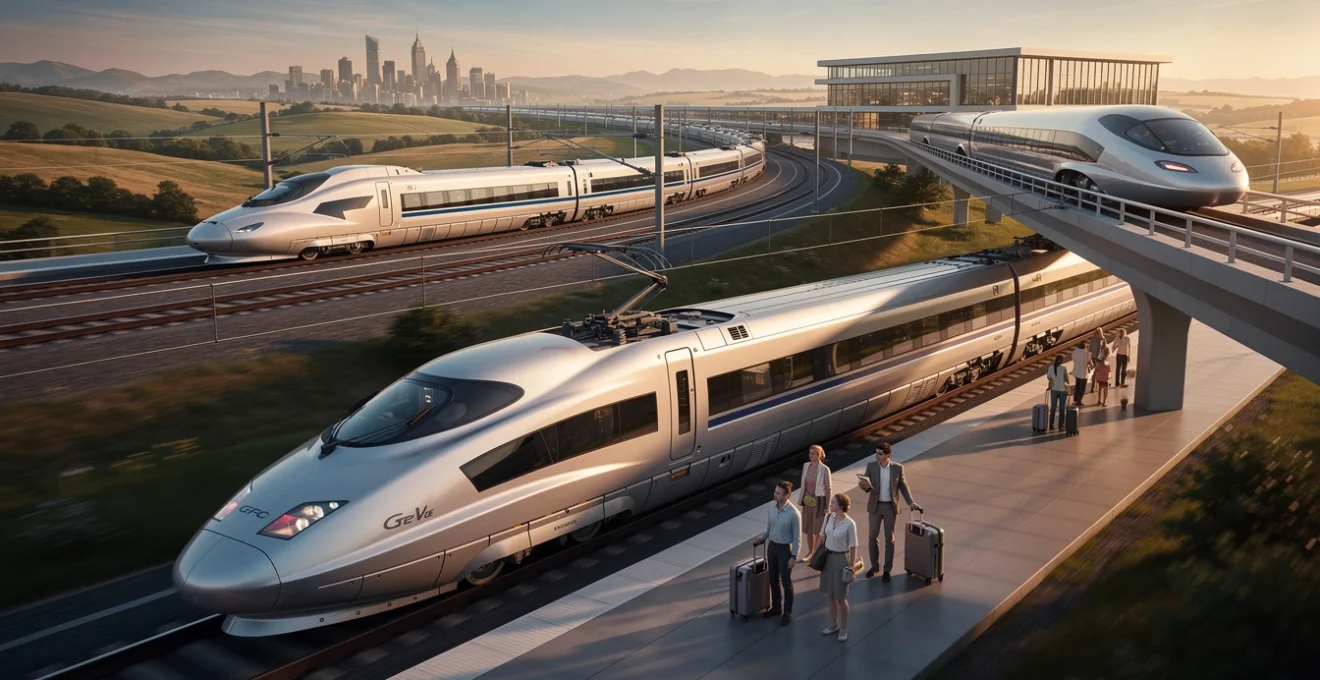
The ability to traverse vast distances in remarkably short timeframes has fundamentally transformed how societies approach inter-city connectivity. High-speed rail technology represents one of humanity’s most significant transportation achievements, combining engineering precision with operational efficiency to deliver journey times that rival air travel for medium-distance routes. Modern high-speed trains routinely operate at speeds exceeding 300 km/h, with some experimental services pushing beyond 400 km/h, effectively shrinking geographical barriers and redefining what travellers consider accessible within a day’s journey. This transportation revolution hasn’t happened overnight; it’s the result of decades of incremental improvements in materials science, aerodynamics, track engineering, and power systems. As urban populations continue to concentrate in major metropolitan areas, the demand for rapid, reliable, and environmentally sustainable transport solutions has never been more pressing, positioning high-speed rail as a cornerstone of 21st-century mobility infrastructure.
Evolution of High-Speed rail technology: from shinkansen to maglev systems
The journey from conventional rail services to today’s ultra-fast trains encompasses numerous technological breakthroughs that have progressively increased operational speeds whilst maintaining passenger safety and comfort. Understanding this evolution provides valuable context for appreciating the sophisticated engineering that enables modern high-speed rail networks to function with such remarkable precision.
Japan’s shinkansen: pioneering bullet train engineering since 1964
When the first Tōkaidō Shinkansen line opened between Tokyo and Osaka in October 1964, it inaugurated an entirely new era in railway transport. Operating at speeds of 210 km/h—unprecedented for scheduled passenger services at that time—the original Series 0 trains demonstrated that high-speed rail could be both commercially viable and extraordinarily safe. The Shinkansen concept introduced several revolutionary features: dedicated tracks exclusively for high-speed services, advanced signalling systems that prevented human error, and streamlined trainsets designed specifically for sustained high-velocity operation. Perhaps most remarkably, the Shinkansen has maintained an impeccable safety record throughout its six decades of operation, with zero passenger fatalities due to derailments or collisions during commercial service. This safety achievement stems from rigorous maintenance protocols, comprehensive earthquake detection systems that automatically halt trains when seismic activity is detected, and conservative operational practices that prioritise reliability over absolute speed records. The network has expanded considerably since 1964, now comprising multiple lines that connect Japan’s major cities with services operating at speeds up to 320 km/h on newer routes.
France’s TGV network and articulated trainset design innovations
France’s Train à Grande Vitesse (TGV) brought distinctive engineering approaches to high-speed rail when commercial services commenced in 1981. The TGV’s most significant innovation was its articulated trainset configuration, where adjacent carriages share a common bogie rather than each carriage having two independent bogies. This articulated architecture reduces the total number of bogies required, consequently decreasing the train’s overall weight and minimising track wear. Fewer bogies translate directly into lower energy consumption—a crucial consideration for operating economics—whilst also reducing maintenance requirements and costs. The lighter weight enables more efficient acceleration and deceleration, improving journey times on routes with multiple intermediate stops. TGV trains have consistently pushed speed boundaries, with specially configured trainsets achieving the world record for conventional rail at 574.8 km/h in 2007, though commercial services typically operate at 300-320 km/h. The extensive French high-speed network now radiates from Paris to virtually every corner of the country, with international services extending into Belgium, the Netherlands, Germany, Switzerland, Italy, and Spain, demonstrating how high-speed rail can create genuinely integrated cross-border transport corridors.
Magnetic levitation technology in shanghai transrapid and JR-Maglev
Magnetic levitation represents a fundamentally different approach to high-speed ground transport, eliminating the wheel-rail interface entirely. The Shanghai Maglev, using German Transrapid technology, has operated commercially since 2004, connecting Pudong International Airport to the city’s metro network across a 30-kilometre route. During regular service, the train reaches 431 km/h, making it the fastest commercial train service globally, with the journey taking just over seven minutes. The absence of physical contact
between train and guideway significantly reduces mechanical friction and vibration, allowing for smoother rides at very high speeds. Japan’s JR-Maglev, developed for the Chūō Shinkansen line between Tokyo and Nagoya, has demonstrated test speeds exceeding 600 km/h on dedicated tracks. Instead of relying on conventional electric motors, both systems use linear motors embedded in the guideway to propel the train, effectively turning the track into a long, straight motor. While magnetic levitation trains showcase what is technically possible when it comes to ultra high-speed rail, their high infrastructure costs and lack of compatibility with existing rail networks mean they are currently deployed only on a few showcase routes rather than as widespread inter-city solutions.
Aerodynamic nose cone design and pressure wave mitigation
As high-speed trains push beyond 300 km/h, aerodynamics becomes just as critical as traction power in determining overall performance. One of the most visible manifestations of this focus is the elongated nose cone seen on modern high-speed trainsets such as Japan’s N700S Shinkansen, France’s Avelia Horizon, and Germany’s latest ICE generations. These nose shapes are carefully optimised using computational fluid dynamics (CFD) and wind-tunnel testing to reduce aerodynamic drag, which rises roughly with the square of speed. By smoothing airflow over the train body and minimising turbulent wake, designers can cut energy consumption, reduce noise, and improve stability at speed.
A particular challenge arises when high-speed trains enter tunnels, where they generate pressure waves that can cause loud “tunnel boom” effects at the exit and discomfort for passengers due to rapid pressure changes. To mitigate this, engineers design nose cones that gradually compress the air column in front of the train, much like the tapered front of an aircraft reduces shock waves at transonic speeds. Some Shinkansen models feature exceptionally long, beak-like noses exceeding 15 metres for this reason. Additional measures, such as tunnel entrance hoods, perforated tunnel walls, and carefully shaped train cross-sections, work together to smooth pressure transitions. The result is that, even at 300 km/h or more, you can sit by the window, feel only a gentle pressure in your ears, and continue reading or working almost undisturbed.
Tilting train mechanisms in pendolino and talgo systems
While dedicated high-speed lines are built with generous curve radii, many countries also want to reduce journey times on legacy routes that weave through mountains, valleys, and historic corridors. This is where tilting trains such as Alstom’s Pendolino family and Talgo’s tilting trainsets come into play. The basic idea is simple: by tilting the car body into a curve, much like a motorbike leans when cornering, the lateral forces passengers feel are reduced, allowing the train to take curves at higher speeds without causing discomfort. In practice, achieving this smooth tilt requires a complex interplay of sensors, hydraulic or electric actuators, and real-time control systems.
The Pendolino uses active tilting technology that predicts upcoming curves using lineside beacons and onboard sensors, then gently tilts the car bodies up to about 8 degrees. Talgo employs a more passive, naturally guided system in some of its designs, where the articulated, low-floor coach arrangement and clever suspension geometry allow the cars to lean without heavy tilting equipment. Both approaches aim to balance speed with comfort, but as early experiments showed, overcompensating for lateral forces can induce motion sickness if what passengers feel does not match what they see outside the window. Modern tilting trains therefore intentionally leave a portion of lateral acceleration uncompensated, giving travellers enough physical cues to align their senses while still shaving crucial minutes off existing routes.
Infrastructure requirements for sustained velocities above 300 km/h
Achieving and maintaining speeds above 300 km/h over long distances is not just a question of powerful trains; it depends equally on the underlying infrastructure. Track geometry, signalling, power supply, and structural design all have to be engineered to much tighter tolerances than conventional rail. This is why many of the world’s flagship high-speed rail networks rely on dedicated corridors built from the ground up rather than attempting to repurpose existing mixed-traffic lines. Understanding these infrastructure demands helps explain why high-speed rail projects are capital-intensive but also why, once built, they can deliver consistent, airline-competitive journey times.
Dedicated High-Speed rail corridors and track gauge standardisation
Dedicated high-speed rail corridors minimise conflicts between fast passenger services and slower freight or regional trains, enabling timetable stability and high average speeds. Networks such as Japan’s Shinkansen, France’s LGV (Lignes à Grande Vitesse), and Spain’s AVE lines are prime examples of this strategy. By separating traffic types, operators can run high-frequency, high-speed services with fewer delays caused by overtaking manoeuvres or congested junctions. For passengers, this translates into predictable journey times and reliable connections, which are essential for high-speed rail to compete with short-haul flights.
Track gauge standardisation further enhances interoperability and network efficiency, particularly in regions with cross-border services. Most European high-speed lines use the 1,435 mm standard gauge, allowing rolling stock such as TGV, ICE, and Eurostar trainsets to operate across multiple countries with minimal modification. Spain, historically using a wider Iberian gauge on conventional lines, chose standard gauge for its AVE high-speed network to align with the broader European system. This decision facilitates through-running international services and reduces the need for complex gauge-changing technologies. For planners considering new corridors, aligning gauge choices with neighbouring networks can avoid costly compatibility issues and unlock wider economic benefits.
Continuous welded rail and ballastless slab track systems
At high speeds, even small irregularities in the track can translate into noticeable vibrations and increased maintenance. To address this, high-speed lines typically use continuous welded rail (CWR), where individual rail segments are thermally welded into long, seamless stretches. This eliminates the familiar “clickety-clack” of traditional jointed track, reducing noise and providing a smoother ride. CWR also distributes thermal stresses more evenly, which is crucial when trains travel at 300 km/h or more and dynamic loads are magnified. The result is improved passenger comfort and lower wear on both wheels and rails.
Many modern high-speed railways also deploy ballastless slab track systems, particularly in tunnels, viaducts, and sections requiring high stability. Instead of resting on a bed of crushed stone ballast, the rails are fixed to precast concrete slabs or in-situ concrete foundations. This structure maintains alignment over longer periods, supports higher axle loads, and reduces the risk of track deformation. While slab track can be more expensive to install initially, it typically offers lower lifecycle costs due to reduced maintenance and longer service intervals. For operators, this means less downtime for track work and higher availability of corridor capacity, which is critical for meeting growing travel demand.
Catenary wire design for pantograph current collection at speed
Powering high-speed trains requires an overhead contact system capable of delivering large amounts of electricity smoothly, even as pantographs sweep beneath at hundreds of kilometres per hour. The catenary wires above high-speed tracks are therefore engineered with precise tensioning, stagger, and support spacing to maintain consistent contact. At 300 km/h, any irregularity can cause arcing or momentary loss of power, leading to wear, noise, and potential damage to both wire and pantograph. To mitigate this, engineers design the contact wire profile and support geometry so that the pantograph head experiences minimal vertical oscillation and maintains steady pressure.
Advanced high-speed catenary systems often use auto-tensioning devices that compensate for thermal expansion and contraction, keeping wire tension within optimal limits across temperature variations. Some networks, such as Germany’s ICE corridors and Spain’s AVE lines, incorporate aerodynamic shields and optimised mast spacing to reduce wind-induced movement. From a passenger’s perspective, these technical details may be invisible, but they are essential to ensure that lights, air conditioning, and traction motors function without interruption. Reliable current collection also supports energy-efficient practices like regenerative braking, feeding electricity back into the grid without destabilising voltage levels.
Superelevation calculations and minimum curve radius engineering
High-speed trains can only maintain their impressive velocities if horizontal curves are engineered with appropriate radii and track cant, known as superelevation. Superelevation is the practice of raising the outer rail relative to the inner rail in a curve, allowing the train to bank slightly and counteract lateral forces. Engineers use detailed calculations that account for design speed, curve radius, and expected traffic mix to determine the optimal cant value. Too little superelevation and passengers experience uncomfortable side forces; too much, and slower trains may feel as if they are tipping inward, compromising safety and comfort.
For sustained speeds above 300 km/h, minimum curve radii typically extend to several kilometres, which is why high-speed corridors tend to follow straighter alignments even if that means constructing tunnels and viaducts. Where geography or urban constraints limit curve size, a combination of moderate tilting technology and carefully designed superelevation can help preserve higher speeds. However, there is always a trade-off between design flexibility, construction cost, and operational performance. Understanding these geometric constraints explains why some routes can support headline-grabbing maximum speeds, while others focus on boosting average speeds through targeted improvements to the most restrictive sections.
Operational efficiency: how trains like ICE, AVE, and frecciarossa optimise journey times
Beyond engineering and infrastructure, the art of covering long distances quickly depends on how high-speed rail systems are operated day-to-day. European flagships such as Germany’s ICE, Spain’s AVE, and Italy’s Frecciarossa demonstrate that optimised timetables, smart energy management, and well-disciplined station operations can make the difference between impressive top speeds on paper and genuinely competitive end-to-end journey times. For passengers comparing options with air travel or driving, what ultimately matters is how long it takes from departure city to destination city, including transfers, stops, and potential delays.
Regenerative braking systems and energy recovery mechanisms
One of the most powerful tools high-speed trains use to enhance both efficiency and sustainability is regenerative braking. Instead of dissipating kinetic energy as heat through friction brakes, modern electric multiple units like the ICE 3, AVE S-103, and Frecciarossa 1000 convert some of that energy back into electrical power during deceleration. This recovered energy can be fed into the overhead line to power nearby trains or, depending on the grid configuration, returned to the wider electricity network. In effect, the high-speed rail system behaves a bit like a distributed energy storage network, smoothing peaks in demand.
From an operational perspective, regenerative braking allows operators to design timetables that maintain high average speeds without excessively penalising energy consumption. Drivers (or automated driving systems) can employ “eco-driving” strategies, coasting where possible and maximising energy recovery on approach to stations and speed restrictions. When combined with modern substation equipment and smart grid integration, some networks report energy savings of 10–20% compared with older rolling stock that lacked these capabilities. For you as a passenger, these systems work silently in the background, but they play a significant role in reducing the carbon footprint of high-speed rail journeys.
ETCS level 2 signalling and moving block train control
Keeping multiple trains running safely at high speeds on the same corridor requires sophisticated signalling and train control systems. The European Train Control System (ETCS) Level 2, deployed on many ICE, AVE, and Frecciarossa routes, replaces traditional lineside signals with continuous communication between trains and a central radio block centre. Movement authorities, speed limits, and braking curves are transmitted directly to the driver’s cab, where onboard computers supervise compliance and can automatically intervene if a train exceeds its permitted envelope. This not only enhances safety but also allows trains to run closer together, increasing line capacity without compromising separation.
While ETCS Level 2 still relies on fixed blocks defined by trackside equipment, it paves the way toward more dynamic “moving block” concepts, where safe separation distances are calculated in real time based on each train’s speed and braking performance. Such systems, already tested in some high-density corridors, can significantly increase the number of train paths per hour. For passengers, this translates into more frequent services and greater flexibility in departure times. It also makes the network more resilient to minor disruptions, as controllers can adjust train spacing and speeds dynamically to recover the timetable more quickly.
Dynamic route scheduling and platform turnaround protocols
Even with cutting-edge trains and infrastructure, poor operational practices can erode the time savings high-speed rail promises. This is why operators invest heavily in dynamic route scheduling tools and disciplined platform turnaround protocols. Advanced software analyses historical data, real-time performance, and passenger demand to optimise train paths, dwell times, and connections. For example, if an incoming ICE or AVE service is running slightly late, traffic management systems can adjust crossing priorities or platform assignments to minimise knock-on delays. In busy hubs, these adjustments happen minute by minute, much like air traffic control, but within the constraints of rails and fixed routes.
Efficient platform turnaround is equally crucial. High-speed trains often arrive, unload, undergo basic checks, and depart again within 20–40 minutes. Standardised procedures for cleaning, catering resupply, crew changes, and minor inspections help ensure that tight schedules are met. Some operators use predictive maintenance and remote diagnostics to flag potential issues before a train even reaches the station, allowing technical teams to prepare in advance. The net effect is that trains spend more time moving and less time idle, improving asset utilisation and giving you more options for fast, convenient departures throughout the day.
Passenger capacity optimisation in Double-Decker TGV duplex configurations
Maximising capacity without compromising comfort is another lever for improving high-speed rail efficiency, and double-decker designs such as the TGV Duplex provide a compelling solution. By adding an extra level of seating within the same train length and using articulated bogies between cars, these trainsets significantly increase the number of passengers carried per path on the line. This reduces the cost per seat-kilometre and helps operators offer competitive fares while maintaining profitability. For busy corridors like Paris–Lyon or Paris–Marseille, the ability to transport more people per train is essential to meet demand without saturating the timetable.
Interior layouts in these double-decker units are carefully planned to balance capacity and comfort: wide doors and generous vestibules reduce boarding times, while staircases are optimised for safe, rapid passenger flows between decks. Designers also pay close attention to luggage space, seat pitch, and noise insulation, ensuring that the added capacity does not feel cramped. From your perspective as a traveller, this means you can benefit from frequent, high-capacity services during peak holiday or business travel periods without the experience degrading into an overcrowded commute. For network planners, double-decker high-speed trains are a strategic tool to absorb long-term growth in demand on key axes.
Comparative performance: global High-Speed rail networks and speed records
Looking across the globe, high-speed rail networks vary widely in design philosophy, maximum speed, and operational priorities. Japan emphasises punctuality and safety, achieving average delays measured in seconds on the Shinkansen even with dense traffic. France and Spain combine high-speed trunk lines with extensive regional connections, enabling city-centre to city-centre journeys that often rival or beat air travel for total door-to-door time. China, meanwhile, has built the world’s largest high-speed network in just over a decade, with more than 40,000 kilometres of dedicated lines linking major cities and secondary hubs at speeds typically between 250 and 350 km/h.
When it comes to absolute speed records, France’s modified TGV set the benchmark for conventional wheel-on-rail trains at 574.8 km/h in 2007, while Japan’s JR-Maglev has reached 603 km/h in testing. However, these headline speeds are not representative of everyday operations, where considerations such as energy efficiency, maintenance costs, and passenger comfort lead operators to cap services at lower values. For instance, most European and Asian high-speed services settle around 300–320 km/h as a sweet spot between speed and sustainability. What truly distinguishes networks, therefore, is not just their maximum speed but their average speed and reliability over entire routes, including intermediate stops and potential bottlenecks.
For passengers comparing global high-speed rail options, real-world performance metrics such as on-time arrival rates, average journey times between key city pairs, and service frequency are more informative than speed records alone. A network that consistently delivers three-hour trips between major metropolitan regions, with departures every 30 minutes and minimal delays, can transform business practices and tourism flows. In this sense, high-speed rail is less about isolated feats of engineering and more about the everyday art of making long-distance travel fast, predictable, and comfortable.
Economic viability and route planning for Inter-City connectivity
Designing economically viable high-speed rail lines requires much more than simply drawing straight lines between cities on a map. Planners must analyse current and projected travel demand, existing transport alternatives, regional development goals, and construction costs to determine where high-speed corridors make sense. Routes connecting city pairs roughly 200–1,000 kilometres apart tend to offer the strongest business cases, as they are long enough for high speed to matter but short enough that high-speed rail can compete directly with air travel on total journey time. Examples include Madrid–Barcelona, Milan–Rome, and London–Paris, all of which have seen significant modal shift from air to rail after the introduction of competitive high-speed services.
Economic models for high-speed rail also factor in broader societal benefits that do not appear directly on an operator’s balance sheet. These include reduced congestion on roads and at airports, lower greenhouse gas emissions compared with car and plane travel, and regional development impacts such as increased investment and job creation around new stations. Studies in countries like France, Spain, and China have shown that intermediate cities connected to high-speed lines often experience boosts in tourism and business activity. However, benefits are not automatic; they depend on integrating stations with local public transport, urban planning, and complementary economic policies.
Another key consideration is phasing and scalability. Many successful networks started with a single high-demand corridor that could justify the initial capital expenditure and build public support. Subsequent extensions then leveraged the operational experience and institutional knowledge gained from the first line. This step-by-step approach helps manage risk, refine standards, and adapt to evolving technologies. For decision-makers weighing whether to invest in high-speed rail, transparent cost–benefit analyses, realistic demand forecasts, and robust governance frameworks are essential to ensure projects deliver on their promises rather than becoming costly white elephants.
Future trajectories: hyperloop concepts and Next-Generation rail technologies
Looking ahead, the future of covering long distances quickly is likely to involve both incremental improvements to existing high-speed rail and more radical concepts such as Hyperloop. Hyperloop proposals envision pressurised capsules travelling through low-pressure or near-vacuum tubes at speeds potentially exceeding 900 km/h, dramatically reducing aerodynamic drag. Several companies and research consortia have built test tracks and demonstrated small-scale prototypes, but substantial technical, regulatory, and economic challenges remain. Questions about emergency evacuation, system redundancy, land acquisition, and long-term maintenance costs will need convincing answers before large-scale deployment can occur.
In parallel, next-generation rail technologies are evolving along more evolutionary paths. These include lighter, stronger materials for car bodies; more efficient traction systems using silicon carbide power electronics; and advanced digital twins that simulate train and infrastructure performance over their entire lifecycle. Automation and artificial intelligence are already influencing predictive maintenance, timetable optimisation, and even semi-autonomous driving functions. Battery-assisted or hydrogen-powered high-speed trains are being explored for sections where continuous electrification is difficult, potentially extending the reach of fast, low-carbon transport to new regions.
Ultimately, whether we are discussing Hyperloop-style systems or refined high-speed rail, the core challenge remains the same: how can we move more people, more quickly, with less environmental impact and greater comfort? High-speed rail has already proven that, for many inter-city journeys, the combination of speed, reliability, and city-centre accessibility is hard to beat. As technologies mature and networks expand, we can expect the threshold of what counts as a “day trip” to keep stretching outward. For travellers, that means more opportunities to live, work, and explore across wider geographies—while still arriving with enough energy to enjoy what awaits at the other end of the line.