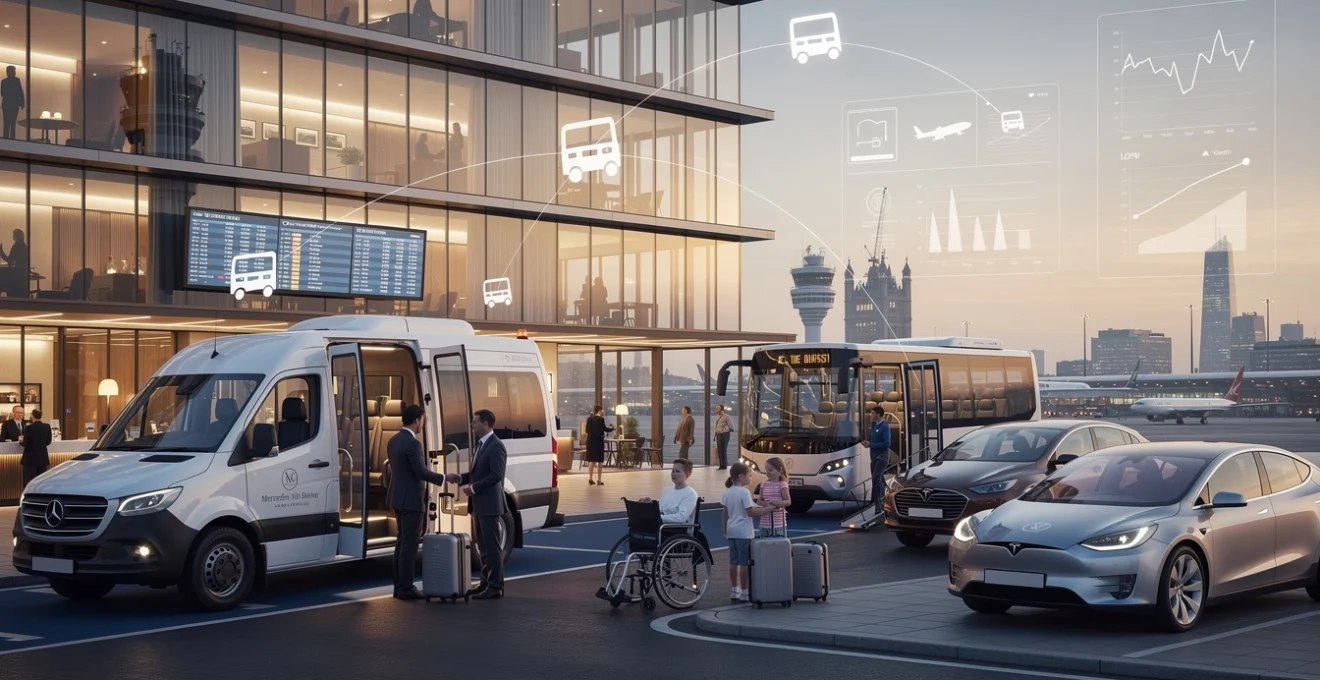
The hotel shuttle bus represents one of the most significant operational decisions you’ll face when managing guest transport logistics. With ground transportation costs continuing to rise across the UK—taxi fares from London Heathrow to nearby hotels now routinely exceed £25-30—the question of whether to operate your own shuttle service or rely on third-party alternatives has never been more critical. Recent industry data shows that 68% of airport hotel guests cite complimentary shuttle services as a key factor in their booking decision, yet many properties struggle to determine when the investment genuinely enhances their competitive position versus when it becomes an unsustainable cost burden.
The landscape of hotel shuttle operations has evolved considerably since the pandemic, with contactless booking systems, electric vehicle adoption, and enhanced sanitisation protocols reshaping guest expectations. What was once a simple courtesy van service has transformed into a sophisticated logistics operation requiring careful strategic planning, regulatory compliance, and technology integration. Understanding when shuttle services deliver genuine value—and when alternative transportation solutions better serve both your guests and your bottom line—requires examining the operational frameworks, cost structures, and specific use cases that determine success.
Operational framework of hotel shuttle bus services
The foundation of any successful shuttle operation rests on a well-structured operational framework that balances guest convenience with operational efficiency. Modern hotel shuttle systems function as mini-transport networks, requiring the same level of planning and coordination you’d expect from commercial bus operators. The complexity varies significantly depending on whether you’re running fixed-route scheduled services or operating on-demand request-based systems, with each approach presenting distinct advantages and challenges.
Fixed-route scheduling systems for airport and city centre transfers
Fixed-route scheduling represents the most common operational model for airport hotel shuttles, particularly for properties within 3-5 miles of major airports like Heathrow, Gatwick, or Manchester. This approach establishes predetermined departure times from both the hotel and airport terminals, typically operating at 30-minute or hourly intervals during peak travel periods. The Heathrow Hotel Hoppa service, despite its monopolistic pricing structure and notorious inefficiency, demonstrates the fixed-route model at scale—though not necessarily at its best.
The primary advantage of fixed-route systems lies in their predictability for both operations teams and guests. You can accurately forecast fuel costs, driver scheduling requirements, and vehicle utilisation rates. Guests appreciate knowing that a shuttle departs at specific times, allowing them to plan their airport arrival or hotel check-in accordingly. However, the inflexibility inherent in fixed schedules often results in half-empty vehicles during off-peak periods and frustrated guests who’ve just missed a departure by minutes.
Optimal fixed-route scheduling requires careful analysis of your guest arrival patterns. Properties serving primarily business travellers with flights concentrated around 7-9am and 6-8pm departures benefit from increased frequency during these windows, whilst reducing service during midday lulls. Leisure-focused hotels near airports often see more distributed arrival times throughout the day, necessitating consistent hourly service from early morning until late evening.
On-demand request protocols and guest communication platforms
On-demand shuttle services offer greater flexibility but demand more sophisticated coordination systems. Rather than adhering to fixed timetables, vehicles operate in response to guest requests, typically received through phone calls, text messages, or increasingly through dedicated mobile applications. This model works particularly well for properties with moderate guest volumes where fixed schedules would result in excessive empty running or where service areas extend beyond simple airport-to-hotel routes.
The challenge with on-demand operations centres on response time management. Industry benchmarks suggest that shuttle pick-up times should not exceed 15 minutes for airport requests, yet achieving this consistently requires careful positioning of vehicles and sophisticated dispatch protocols. Many properties now employ real-time tracking systems that allow guests to monitor shuttle locations via smartphone apps, significantly reducing the anxiety associated with waiting for on-demand services.
Successful on-demand shuttle operations require at least two vehicles for properties with 150+ rooms to maintain acceptable response times during peak periods whilst accommodating vehicle maintenance and cleaning schedules.
Communication platforms have become essential infrastructure for on-demand services. Basic operations might rely on simple phone calls to reception, but more advanced systems integrate with property management systems (PMS) to automatically alert guests when their requested shuttle is en route. Wh
p>hen you connect these tools with automated SMS or WhatsApp alerts, you dramatically reduce no‑shows at the curb and repetitive calls to reception. You can also push clear instructions on where to meet the shuttle (for example, “follow signs to Bus Bay 18, look for the blue Mercedes‑Benz Sprinter branded with our logo”). This level of clarity is particularly important at large, complex hubs such as London Heathrow, where guests can easily end up at the wrong bus stand.
From an operational perspective, a robust guest communication platform also creates a valuable data trail. You can measure average wait times, peak request periods, cancellation rates and common pain points in real time. Over a few months, this data becomes the equivalent of a “black box” for your hotel shuttle bus service, helping you fine‑tune routes, adjust staffing and decide whether you need to add or rotate vehicles on specific days of the week.
Fleet management software integration with property management systems
Integrating fleet management software with your property management system (PMS) is where a hotel shuttle operation starts to feel more like an airline than a simple courtesy van. Instead of dispatching vehicles based on guesswork or manual notes at the front desk, you can link live reservation data with real‑time vehicle tracking and driver schedules. When done well, this integration allows you to anticipate shuttle demand before guests even arrive at the airport, rather than merely reacting to phone calls.
Most modern fleet tools provide GPS tracking, telematics, fuel consumption data and driver behaviour metrics. When these systems talk directly to your PMS, you can, for example, flag all arrivals on an evening bank of flights into Heathrow Terminal 5 and pre‑allocate shuttle capacity. For group bookings and airline crew contracts, you can assign specific vehicles and time slots in advance, with automated reminders pushed to both drivers and guests. This reduces idle time, avoids last‑minute scrambling and helps you keep your hotel shuttle bus utilisation rate within target thresholds.
From a financial perspective, integrated fleet management makes it much easier to calculate the true operating cost of each route or time band. You can attribute fuel, labour and maintenance costs to specific patterns of guest activity and then compare those costs to the room revenue those guests generate. If you discover that your late‑night double‑runs to the airport are consistently carrying fewer than three guests per trip, you have data‑driven grounds to reduce frequency or shift those runs to a shared ride‑hailing partnership instead. In short, the PMS and fleet tools together give you the dashboard you need to treat the shuttle as a strategic asset, not just a fixed cost.
Driver training standards and guest service excellence protocols
Even the most sophisticated shuttle scheduling system will fail if the human element is neglected. Your shuttle drivers are often the first and last point of in‑person contact guests have with your brand, so their training should go well beyond basic vehicle handling. Leading airport hotels treat shuttle drivers as mobile concierges, equipping them with local knowledge, clear service standards and the soft skills needed to manage stressed, jet‑lagged passengers.
At a minimum, driver training programmes should cover safety procedures, luggage handling protocols, accessibility assistance and clear communication techniques. Many UK properties now align their shuttle training with Welcome Host or similar customer service frameworks, ensuring a consistent tone of voice and approach across all touchpoints. Investing in periodic refresher training, mystery‑guest audits and passenger feedback surveys pays off quickly, as small improvements in courtesy and efficiency translate directly into higher online review scores and repeat bookings.
Think of your hotel shuttle bus as a rolling extension of your lobby. Would you tolerate a surly receptionist or a cluttered, poorly signposted check‑in area? The same standards should apply to the shuttle. Simple protocols—such as drivers introducing themselves, confirming the destination, offering assistance with bags and providing an estimated journey time—go a long way towards dispelling anxiety, especially for first‑time visitors to large airports like Heathrow or Manchester. In competitive markets where many hotels sit within a few hundred metres of each other, that extra level of shuttle hospitality can be a genuine differentiator.
Cost-benefit analysis: hotel shuttles versus alternative ground transportation
Once the operational framework is clear, the next question is starkly financial: when does a hotel shuttle bus make economic sense compared to taxis, ride‑sharing and public transport? It is tempting to badge the service as “complimentary” and hope it pays for itself through higher occupancy, but experienced operators look closely at per‑guest transport costs, competitor pricing and the impact on average daily rate (ADR). Without this analysis, what seems like a guest‑friendly perk can quickly become a margin‑eroding obligation.
Per-guest transportation cost calculations for shuttle operations
To understand the real cost of running a hotel shuttle bus, you need to move beyond fuel receipts and driver wages. A thorough cost model will factor in depreciation or leasing costs, insurance, routine maintenance, tyres, cleaning, software subscriptions and even the opportunity cost of parking space used for the fleet. When you spread these expenses across the total number of passengers carried over a month, you arrive at a realistic per‑guest transport cost rather than an optimistic headline figure.
For many UK airport hotels running a single 12–16‑seat minibus, we frequently see fully loaded costs in the range of £35–£55 per operational hour, depending on vehicle type and wage levels. If your shuttle averages eight passengers per trip and completes two round‑trips per hour, your effective cost per guest journey may sit around £3–£5. That can be very competitive against local taxis, especially in heavily regulated markets like Heathrow where short‑hop fares quickly exceed £25. However, if load factors fall to two or three guests per journey, that same shuttle becomes substantially more expensive on a per‑guest basis.
One useful tactic is to track a rolling three‑month average of passengers per trip and passengers per operating hour. Whenever those averages slip below your break‑even threshold, it is a signal to revisit your timetables or consider shifting some runs to an on‑demand model. The goal is not simply to fill every seat, but to ensure that the total cost of your hotel shuttle bus service aligns with the incremental room revenue it generates and the level of guest satisfaction it delivers.
Comparative pricing models against taxi services and ride-sharing platforms
When guests compare your shuttle with taxis or ride‑sharing apps, they are not just looking at absolute price; they also weigh convenience, perceived safety, flexibility and travel time. A taxi from London Heathrow to a nearby Bath Road hotel may cost £25–£30 for a five‑minute journey, while a Hotel Hoppa ticket or local bus fare is much lower but may involve multiple stops and longer waits. In this context, a free or low‑cost hotel shuttle that runs reliably every 20–30 minutes can be extremely appealing, especially to cost‑conscious travellers or families.
However, ride‑sharing platforms such as Uber and Bolt complicate the equation. In off‑peak periods, a ride‑share trip to a nearby hotel might cost as little as £12–£15, with a door‑to‑door experience that feels personalised. One approach that many hotels adopt is a hybrid model: running a baseline shuttle service during peak check‑in and check‑out windows while partnering with taxi or ride‑sharing providers for off‑peak demand. You can then position the shuttle as the default option for most guests, while still offering an app‑based or concierge‑booked alternative for those willing to pay for immediate departure.
From a marketing standpoint, it is also worth considering how you present your shuttle compared to these alternatives. Do you emphasise the predictable fixed cost versus the surge‑pricing risk of ride‑sharing? Do you highlight sustainability benefits when using electric or Euro 6‑compliant vehicles? Clear comparison messaging on your website and pre‑arrival emails helps set expectations and reduces friction at the front desk when guests are choosing how to travel. In many cases, simply explaining that taxis at Heathrow may be reluctant to accept very short fares can nudge guests towards your more reliable shuttle option.
Revenue impact on average daily rate and total revenue per available room
One of the most under‑appreciated aspects of hotel shuttle bus strategy is its impact on pricing power. A well‑run complimentary shuttle can justify a higher ADR, particularly for airport hotels where transfer convenience is a primary booking factor. If your competitors charge for their transport or rely entirely on expensive third‑party services, you have room to position your property as “hassle‑free” and price accordingly. Even a modest £4–£6 uplift in ADR, multiplied across high occupancy and a large room inventory, can more than offset shuttle operating costs.
To quantify this, you can run A/B tests over defined periods, comparing booking pace and conversion when shuttle messaging is prominent versus when it is less emphasised. You may find that corporate accounts and airline crew contracts specifically value inclusive transfers, enabling you to negotiate higher net rates in exchange for guaranteed availability. On the leisure side, packages that bundle “room, breakfast and airport shuttle” can boost total revenue per available room (TRevPAR) by driving incremental spend on food and beverage, as guests are more inclined to dine on‑site when they see the overall offer as good value.
Of course, the reverse can also be true: if shuttle costs spiral without a corresponding ADR benefit, you risk eroding margins. This is particularly common when hotels promise 24/7 on‑demand service but only have sufficient volume during a few daily peaks. Regularly reviewing the relationship between shuttle usage, ADR and TRevPAR ensures that your transport strategy remains a revenue driver rather than a silent drain. Ask yourself: if we switched our shuttle from complimentary to chargeable tomorrow, how much would we need to increase ADR to compensate for the likely dip in demand?
Capital expenditure requirements for vehicle acquisition and maintenance
Deciding whether to buy, lease or outsource your hotel shuttle bus fleet is a classic capital expenditure dilemma. Purchasing vehicles outright locks in a significant upfront cost but can be economically attractive over a five‑ to seven‑year horizon if utilisation is high and maintenance is well controlled. Leasing spreads costs more evenly and may include maintenance packages, making it easier to align expenses with revenue, but total lifetime costs can be higher. Outsourcing to a local coach company or specialist airport transfer provider, meanwhile, converts a large chunk of fixed capex into variable operating expenditure.
When evaluating these options, consider not only sticker prices but also lifecycle factors such as residual value, expected mileage, local emission regulations and potential shifts to low‑emission zones. Electric shuttle buses and plug‑in hybrids typically involve higher initial costs but benefit from lower fuel spend and, in some cases, government incentives or tax advantages. Properties near London, where Ultra Low Emission Zone (ULEZ) policies are tightening, may find that investing in compliant vehicles is less about guest perception and more about avoiding penalties and restrictions that could disrupt shuttle operations.
Maintenance planning is equally important. A single unexpected breakdown on a busy morning bank of departures can cascade into missed flights, complaint vouchers and negative online reviews. Building a maintenance schedule that anticipates wear patterns, rotating vehicles to balance mileage and holding buffer capacity (either an extra vehicle or a standby contract with a local partner) can prevent these costly disruptions. Ultimately, your capital decisions should support a level of reliability that matches your brand promise: there is little value in marketing a premium, seamless transfer experience if your fleet is constantly off the road.
Strategic use cases for hotel shuttle implementation
Not every property needs a hotel shuttle bus, and not every shuttle needs to serve only the airport. The most successful implementations map specific guest journeys and identify pain points that a dedicated vehicle can solve more efficiently than taxis or public transport. By thinking in terms of “use cases” rather than generic coverage, you can design a shuttle strategy that is tightly aligned with your positioning—whether that is airport convenience, urban exploration or access to local attractions and business parks.
For example, a limited‑service airport hotel may focus exclusively on reliable terminal transfers, while a full‑service city‑centre property might operate a fixed‑route loop connecting the hotel with the main train station, convention centre and key tourist sites. Some resort hotels in peripheral locations use shuttles to link guests with beach clubs, golf courses or nearby villages, effectively extending the perceived footprint of the property. In each scenario, the shuttle is a tool to close a specific gap in connectivity, rather than an end in itself.
It is also important to consider the competitive landscape. If neighbouring hotels already operate frequent, well‑reviewed shuttles, remaining “off the grid” may put you at a disadvantage. Conversely, if public transport is excellent and taxis are plentiful, adding a shuttle simply because “guests expect one” can be an unnecessary expense. Asking targeted questions—who are our primary guests, where are they coming from, and what obstacles do they face in reaching us?—helps you decide whether a hotel shuttle bus is the best solution or whether information, signage and partnerships might achieve the same aim at lower cost.
Airport transfer scenarios: distance thresholds and guest demographics
Airport hotels are where the shuttle debate becomes most acute. Distances may be short—often under five miles—but the practical difficulty of reaching the property can be high due to one‑way systems, tunnel access rules and restrictions on hotel‑operated vehicles, as seen at Heathrow. To determine when an airport shuttle is the best option, you need to balance distance, travel time, guest profile and the quality of alternatives such as local buses, regional trains and taxis.
As a rough rule of thumb, the case for a dedicated hotel shuttle bus strengthens when public transport requires more than one connection, when taxis are disproportionately expensive for the distance travelled, or when your primary guest segments value predictability over absolute speed. Business travellers facing tight schedules, families managing multiple suitcases and elderly guests unfamiliar with the area are all far more likely to appreciate a direct, branded vehicle waiting where and when you say it will. The next step is to translate these general principles into concrete thresholds for specific airports.
Optimal distance parameters for london heathrow and manchester airport routes
London Heathrow presents a unique challenge because hotels are not permitted to operate their own shuttle vehicles to the terminals, leading to the dominance of the paid “Hotel Hoppa” services and, increasingly, reliance on local buses. For hotels on Bath Road or around Hatton Cross, the physical distance to the terminals may be as little as 1–3 miles, yet the combination of tunnels, security restrictions and traffic can turn this into a 20‑minute journey at busy times. In this context, the “distance threshold” for considering a shuttle is less about miles and more about door‑to‑door friction and regulatory constraints.
Where direct operation is allowed—such as between hotels and nearby business parks or off‑airport car parks—many Heathrow‑area properties find that shuttles are most efficient within a 5‑mile radius. Within this zone, you can typically complete a round trip in under 40 minutes even during peak periods, enabling a single vehicle to maintain a half‑hourly service. Beyond 7–8 miles, journey times lengthen to the point where you either need additional vehicles or you risk unacceptable gaps between departures.
Manchester Airport, by contrast, offers a more straightforward environment for hotel shuttles. Many properties sit within 2–4 miles of the terminals and face fewer restrictions on curbside access. Here, a simple rule often applies: if guests can realistically walk to the terminal in under 15 minutes with luggage, a shuttle may be a “nice to have” rather than essential. For hotels beyond that walking radius but within a 6‑mile drive, running a free shuttle at 20–30‑minute intervals during flight peaks is usually attractive, especially for mid‑scale and limited‑service brands that compete heavily on convenience.
Business traveller preferences for complimentary airport shuttles
Business travellers tend to prioritise three things in airport transfers: reliability, speed and the ability to predict their total travel time. Many will expense taxis or ride‑shares without hesitation, but even for this segment a well‑executed complimentary shuttle can be highly persuasive. Why? Because it removes decision‑making friction. When your confirmation email states, “Our shuttle runs every 20 minutes from 05:00–23:00; travel time is 8–10 minutes,” the guest no longer needs to compare apps, estimate queues or worry about surge pricing.
Corporate travel buyers also look favourably on inclusive shuttle offerings, as they simplify policy compliance and budget forecasting. A contract that bundles room, breakfast, Wi‑Fi and airport transfers at a fixed nightly rate helps companies avoid unpredictable ground transport expenses, particularly in cities where short taxi rides are disproportionately costly. For hotels targeting airline crew, the shuttle is almost non‑negotiable: punctual, dedicated transfers from terminal to hotel and back are a core part of most crew agreements.
That said, business travellers are also particularly sensitive to poor execution. A shuttle that runs late, is overcrowded or fails to appear will quickly push them back towards ride‑sharing apps, sometimes permanently. For this segment, it can be better to operate a slightly more limited but highly reliable service than to promise 24/7 coverage that you struggle to deliver. Clear communication—both digitally and at the airport curb—about first and last departures, typical journey times and any planned service interruptions is essential to maintain trust.
Leisure guest family requirements and luggage capacity considerations
Leisure guests, especially families, often have very different priorities. Cost and luggage capacity usually top their list, followed closely by ease of navigation through an unfamiliar airport. Parents travelling with children, pushchairs and multiple suitcases are unlikely to relish the idea of changing buses or trains, even if the total journey time is modest. For them, a direct hotel shuttle bus that can accommodate all their belongings in one go is immensely attractive, even if it is slightly slower than a taxi.
When designing a shuttle service for this demographic, vehicle layout and baggage space become critical. Many 9–12‑seat minibuses struggle to handle six or seven large suitcases plus hand luggage without compromising passenger comfort or safety. For family‑heavy properties near Heathrow or Manchester, considering 16‑seat configurations with dedicated luggage racks or trailers can make transfers more seamless. This is particularly important during school holidays, when both occupancy and baggage volumes spike.
Families are also more sensitive to perceived fairness in pricing. A per‑person hotel shuttle bus fee can quickly add up for a group of four or five, at which point a taxi or ride‑share may look more appealing. To counter this, some hotels introduce family caps or “kids go free” policies on shuttle tickets, or simply absorb the cost and advertise transfers as complimentary. The latter approach not only simplifies decision‑making but also enhances the sense of value, which can influence online reviews and word‑of‑mouth recommendations long after the stay has ended.
Vehicle specifications and fleet composition for different property types
Choosing the right vehicles for your shuttle fleet is as strategic as deciding whether to run a shuttle at all. Different property types—budget airport hotels, upscale business properties, luxury brands and extended‑stay aparthotels—have distinct passenger profiles and branding requirements. A no‑frills 15‑seat diesel minibus might be perfect for a budget hotel focused on function and price, but it could send the wrong message for a five‑star property promising a premium, sustainable experience.
When planning fleet composition, it helps to think in layers: core high‑capacity vehicles for predictable peaks, supplemented by smaller or more premium vehicles for VIPs and off‑peak demand. You may also decide to phase in electric vehicles for shorter runs while retaining a conventional diesel or hybrid model for longer regional transfers. The right mix balances capacity, comfort, environmental performance and total cost of ownership, all while reflecting your brand’s positioning.
Mercedes-benz sprinter and ford transit shuttle bus configurations
For most UK hotels, the workhorses of a shuttle fleet are still the Mercedes‑Benz Sprinter and Ford Transit platforms. These vehicles offer flexible seating configurations—from 9‑seat executive layouts to 17‑seat high‑capacity models—along with proven reliability and widespread availability of parts and servicing. In practice, this means less downtime, easier driver familiarisation and the ability to scale capacity up or down without reinventing your operating model.
Interior configuration is where you can make a real difference to guest comfort. Rather than simply maxing out the seat count, many hotels now opt for a slightly lower capacity to allow for wider aisles, dedicated luggage zones and improved legroom. High, easy‑access sliding doors, grab rails and low steps are particularly important when serving a mix of business and leisure guests, some of whom may have mobility challenges or bulky hand luggage. Upgraded lighting, USB charging points and climate control further reinforce the perception that your shuttle is an extension of the hotel, not an afterthought.
Both Sprinter and Transit platforms are available in diesel, mild‑hybrid and, increasingly, fully electric or plug‑in hybrid variants. If your hotel operates predominantly short, repetitive airport loops—say, between a Heathrow‑area property and a nearby business park—electric configurations can be attractive. They offer lower running costs and quieter journeys, aligning well with sustainability commitments and noise‑sensitive local communities. The main considerations are charging infrastructure, daily range requirements and the need for contingency vehicles during longer maintenance windows.
Luxury hotel requirements: tesla model X and BMW electric vehicle options
Luxury and upper‑upscale properties often view their transfer experience as part of the brand theatre. Instead of a standard minibus, they may deploy premium SUVs or saloons such as the Tesla Model X, BMW iX or Mercedes‑Benz EQV to handle VIP guests, suites and loyalty elites. These vehicles provide a markedly different experience from a shared shuttle: private, quiet, technology‑rich and visually aligned with a high‑end brand promise.
From an operational standpoint, these premium electric vehicles are rarely used as mass‑market shuttles; rather, they complement a core fleet. You might, for instance, operate a standard Sprinter for regular airport runs while offering pre‑booked Tesla transfers for top‑tier loyalty members or chargeable chauffeur services. This layered approach allows you to align service levels with guest value, all while showcasing your sustainability credentials through visible use of zero‑emission vehicles.
The main challenges for deploying premium EVs are capital cost and utilisation. A Tesla Model X or BMW iX represents a substantial investment, so you’ll want to ensure it is either generating incremental revenue—through paid transfers and upsells—or driving measurable marketing value in the form of higher ADR and guest satisfaction among key segments. Careful scheduling is essential to avoid long idle periods, especially when balancing charging cycles with peak arrival waves. In some cases, partnering with specialist chauffeur companies that provide branded vehicles can deliver the same effect with less capex exposure.
Accessibility compliance standards under the equality act 2010
Regardless of star rating or guest mix, all UK hotels operating shuttles must consider accessibility under the Equality Act 2010. The Act requires service providers to make reasonable adjustments so that disabled guests are not placed at a substantial disadvantage compared to non‑disabled guests. In practical terms, this means your shuttle service must be planned and equipped to accommodate wheelchair users, guests with limited mobility, and those with sensory impairments.
At a minimum, at least one vehicle in your fleet should offer wheelchair access via a ramp or lift, with clearly designated securement points and trained drivers who understand how to operate the equipment safely and respectfully. Step heights, handrails, seatbelt design and signage should all be reviewed through an accessibility lens. Audio and, where possible, visual announcements of stops can make a significant difference for guests with sight or hearing impairments, particularly on shared routes with multiple hotels or terminals.
Accessibility is not just a legal obligation; it is also a reputational issue. Guests who encounter barriers in using your shuttle—perhaps because they are told to arrange and pay for their own accessible taxi instead—are likely to rate their stay poorly and share their experience widely. By contrast, hotels that actively promote accessible shuttle features on their websites and booking channels can attract a loyal, often under‑served segment of travellers. When you consider that an accessible hotel shuttle bus can serve guests, staff and local community groups, the business case for getting this right becomes even stronger.
Regulatory compliance and licensing requirements for hotel shuttle operations
Operating a hotel shuttle bus in the UK is not simply a matter of buying a vehicle and printing your logo on the side. Depending on the size of the vehicle, the nature of the journeys and whether you charge a fare, you may need an operator’s licence, specific insurance coverage and compliance with public service vehicle (PSV) regulations. The complexity can feel daunting, but failing to address it exposes your property to significant risk, including fines, invalidated insurance and reputational damage in the event of an accident.
For most hotels running larger minibuses (nine seats or more, including the driver) on a regular schedule, a PSV operator’s licence from the Office of the Traffic Commissioner will be required. This entails proving that you are of good repute, financially fit and capable of maintaining your vehicles safely. Drivers may need a category D1 or D licence, along with periodic Driver Certificate of Professional Competence (CPC) training. Smaller vehicles, such as eight‑seat people carriers, are subject to different rules but still require appropriate hire‑and‑reward insurance and adherence to road traffic law.
You will also need to navigate airport‑specific rules. Heathrow, for example, restricts hotel‑operated shuttles to certain zones and encourages use of common services like Hotel Hoppa or local buses for terminal access. Other airports may require permits or fees for curbside pick‑up and drop‑off, along with adherence to security protocols and time limits at the stand. Regularly reviewing airport authority guidance and maintaining open communication with ground transport teams helps you stay compliant as rules evolve, particularly around emissions and congestion management.
Insurance is another critical pillar. Standard motor policies are unlikely to provide adequate cover for a vehicle transporting fee‑paying or complimentary guests as part of a commercial operation. You should work with a broker experienced in passenger transport to ensure that your hotel shuttle bus fleet is appropriately insured for public liability, employer’s liability (for drivers and loading staff), and business interruption if a major incident temporarily halts your service. In a worst‑case scenario, being under‑insured can be more damaging than being unlicensed.
Finally, document everything. Maintenance logs, driver training records, incident reports and risk assessments all form part of a robust compliance framework. Treat your shuttle operation with the same rigour as food safety or fire regulations, and you will be well‑placed to offer a reliable, legally compliant service that genuinely enhances your guest experience. After all, the goal is not just to move people from A to B, but to do so in a way that is safe, sustainable and fully aligned with the standards your guests—and regulators—now expect.