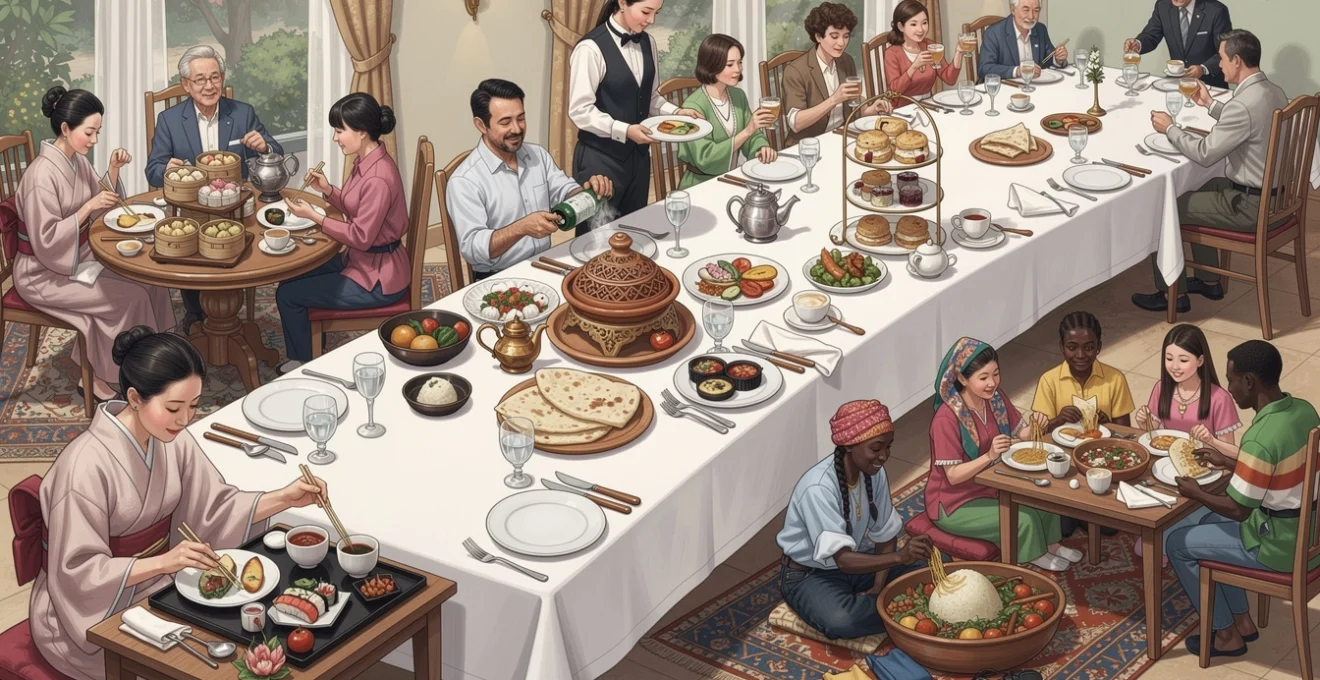
# A Beginner’s Guide to Food Etiquette Around the World
Navigating a business dinner in Tokyo, attending a wedding feast in Morocco, or simply sharing a meal with locals during your travels can quickly transform from delightful to daunting if you’re unfamiliar with regional dining customs. Food etiquette isn’t merely about using the correct fork or knowing when to start eating—it represents centuries of cultural values, social hierarchies, and deeply held beliefs about hospitality and respect. With globalisation connecting our world more intimately than ever, understanding these nuanced dining protocols has become essential for travellers, expatriates, and anyone engaging in international business or cultural exchange. What’s considered polite in London might be offensive in Seoul, and gestures of appreciation in Mumbai could cause confusion in Paris. This comprehensive guide demystifies the complex landscape of global food etiquette, equipping you with the knowledge to dine confidently across continents.
Understanding cultural dining protocols and table manners across continents
The foundation of food etiquette rests on a fundamental principle: dining customs reflect core cultural values. In many Western societies, individual plates and personal space at the table mirror values of independence and personal boundaries. Conversely, communal dining practices prevalent across Africa, the Middle East, and parts of Asia emphasise collectivism and shared community bonds. These aren’t arbitrary rules—they’re expressions of how societies view relationships, hierarchy, and social cohesion.
Timing represents another crucial dimension of global dining etiquette that catches many travellers off guard. Spaniards typically eat dinner around 10 PM, whilst in Finland, families gather for their evening meal between 5 and 6 PM. Showing up to a dinner party exactly on time might be expected in Germany but considered slightly rude in Argentina, where arriving 30 minutes late demonstrates respect for the host’s preparation time. Understanding these temporal expectations prevents awkward situations and shows cultural sensitivity.
The concept of hospitality varies dramatically across cultures, influencing everything from portion sizes to refusal protocols. In many Middle Eastern countries, the practice of ta’arof involves hosts insisting multiple times that guests take more food, with guests expected to refuse politely at least twice before accepting. Meanwhile, finishing everything on your plate in China suggests the host didn’t provide enough food, whereas leaving food uneaten in many Western countries might imply you didn’t enjoy the meal. These contradictory expectations demonstrate why cultural context matters immensely when dining internationally.
Religious and philosophical beliefs profoundly shape dining etiquette worldwide. Islamic dietary laws influence eating customs across Muslim-majority nations, where only the right hand is used for eating since the left is reserved for personal hygiene. Hindu customs in India often emphasise vegetarianism and specific food combinations considered spiritually harmonious. Buddhist principles in Thailand promote mindfulness during meals, discouraging conversation that might distract from appreciating the food. Recognising these deeper cultural and spiritual foundations helps you approach unfamiliar dining situations with appropriate respect and understanding.
East asian food etiquette: chopstick rules and communal dining customs
East Asian dining etiquette presents some of the most intricate protocols in global gastronomy, with chopstick usage serving as the cornerstone of proper table manners. These paired utensils aren’t merely eating tools—they’re extensions of cultural philosophy, requiring years of practice to master fully. The way you hold, position, and use chopsticks communicates your cultural literacy and respect for tradition. Beyond chopsticks, East Asian dining emphasises communal sharing, hierarchical seating arrangements, and elaborate serving rituals that transform meals into sophisticated social ceremonies.
Japanese kaiseki protocol: itadakimasu rituals and sushi consumption techniques
Japanese dining etiquette represents perhaps the most formalised system of table manners globally, with kaiseki—the traditional multi-course meal—epitomising these refined customs. Before eating, diners say « itadakimasu » (literally « I humbly receive »), expressing gratitude not just to the chef but to all elements that contributed to the meal, from farmers to the ingredients themselves. This brief ritual establishes mindfulness and appreciation as foundational to the dining experience. Upon finishing, « gochisousama deshita »
(“thank you for the feast”) closes the experience and signals appreciation to the host and chef. Skipping these phrases won’t offend anyone, but using them shows cultural awareness and instantly creates goodwill.
When eating sushi in Japan, technique matters. Nigiri (fish atop rice) is traditionally eaten in one or two bites, with the fish side—rather than the rice—lightly dipped into soy sauce to avoid overpowering the flavour and causing the rice to disintegrate. Many sushi chefs will brush seasoning or sauce directly onto the piece, meaning extra soy sauce or wasabi is unnecessary. Ginger is used as a palate cleanser between bites, not piled on top of the sushi itself. If you’re seated at the counter, you’re interacting with a craftsman; polite questions and visible enjoyment are welcome, but long phone calls or strong perfume are not.
Table manners in a kaiseki meal are even more structured. Dishes are served in a precise order to highlight seasonality and texture—from delicate appetisers to simmered courses, grilled items, and a rice finale. You generally start with the course placed nearest you and avoid rearranging plates unless guided. Handles of lidded bowls should face to the right so they’re easy to open without reaching across others. As with many forms of Japanese food etiquette, slowing down, observing others, and treating each dish as a small work of art will help you navigate even the most elaborate kaiseki with confidence.
Chinese lazy susan dynamics and tea pouring hierarchy at dim sum tables
In Chinese dining culture, especially at banquets and dim sum restaurants, the large round table and rotating Lazy Susan reflect a core value: food is to be shared. Dishes are placed in the centre and rotated so everyone can access them, but it is considered bad manners to spin the Lazy Susan while someone is serving themselves. Instead, wait until chopsticks are lifted away before gently turning it clockwise. You should also take modest portions at first, leaving enough for all guests before returning for seconds.
Hierarchy plays a visible role in Chinese food etiquette. Senior guests, honoured visitors, or the eldest person at the table are usually seated facing the entrance or in the “best” seat, and dishes such as fish or premium meats may be oriented so the head or main piece faces them. At dim sum, it’s polite to pour tea for others before refilling your own cup, starting with elders and guests of honour. In southern China and Hong Kong, those being served often tap two fingers on the table as a silent “thank you”—a discreet gesture rooted in an old imperial legend about a disguised emperor serving tea.
Teapots and tea cups carry additional unspoken rules. You rarely pour the last drop of tea into your own cup; instead, you offer it to someone else and then request a fresh pot. Leaving the teapot lid ajar is a subtle sign to the staff that a refill is needed. If you’re sharing a pot at a busy dim sum hall, resist the temptation to hug it close or monopolise it—think of the tea as collective property, much like the shared dishes circulating on the Lazy Susan.
Korean banchan sharing practices and soju drinking etiquette
Korean meals are famously generous, with small side dishes known as banchan covering the table. These are meant for everyone, not just the person sitting closest. You typically take small amounts with your chopsticks and return the dish to the shared centre, avoiding “claiming” any single banchan as yours. It’s courteous to ensure others have tried a dish before finishing it and to keep an eye on plates that might need replenishing, especially if you’re the host or senior person at the table.
Drinking etiquette in Korea, particularly around soju and beer, is highly codified and closely tied to respect. You almost never pour your own drink; instead, you pour for others, who will then reciprocate. When a senior person pours you soju, you accept the glass with both hands and turn your head slightly away from them as you drink, shielding the act as a sign of deference. Keeping your glass empty can signal that you’re ready for more, so if you’ve reached your limit, leave it partially full or cover it lightly with your hand when someone offers to pour.
Refusing alcohol can be sensitive in some business contexts, but modern norms are gradually becoming more flexible. If you don’t drink, you can still participate in the ritual using water or soft drinks, following the same rules of pouring and acceptance. As a guest, you’ll make a strong impression by remembering simple gestures: receive and pour with two hands, wait for the eldest person to start drinking before you do, and avoid placing your chopsticks upright in rice, which carries a negative connotation across much of East Asia.
Chopstick taboos: avoiding vertical placement and food passing between utensils
Because chopsticks are such a visible part of East Asian food etiquette, misusing them can stand out immediately. One of the most important chopstick rules across Japan, China, and Korea is never to stick them vertically into a bowl of rice. This resembles incense sticks used in funeral rituals and is seen as extremely inauspicious. Instead, place chopsticks horizontally on a rest, on the paper sleeve, or neatly across your bowl when pausing.
Another major taboo is passing food from one pair of chopsticks directly to another. In Japanese funeral customs, bone fragments are passed between chopsticks, so mimicking this at the table is considered deeply inappropriate. If you want to share food, lift it from the communal plate and place it on the person’s small plate instead, ideally using the serving end of your chopsticks or dedicated serving utensils if provided. Stabbing food, pointing at people, or waving chopsticks in the air can also be read as childish or disrespectful.
A helpful way to remember chopstick etiquette is to think of them as pens in a formal meeting: you wouldn’t point them at colleagues, drum on the table, or leave them stuck into important documents. In the same way, you treat chopsticks with quiet respect, using them purposefully rather than playfully. If you’re unsure, watch what locals do, mirror their pace and gestures, and don’t hesitate to ask a friendly host for guidance—most will happily demonstrate proper chopstick use if you show genuine interest.
Middle eastern and north african dining customs: right-hand rules and bread significance
Across much of the Middle East and North Africa, food etiquette is inseparable from concepts of hospitality and faith. In many Muslim-majority countries, using the right hand for eating is a long-standing rule, grounded both in religious tradition and hygiene. The left hand is historically associated with personal cleansing, so bringing it to shared food can be seen as unclean. Even when cutlery is used, you’ll notice people favouring their right hand for passing dishes, breaking bread, and accepting drinks.
Bread occupies a particularly sacred place in Middle Eastern and North African food culture. Flatbreads such as khobz, pita, or msemen are more than accompaniments; they often act as edible utensils, used to scoop stews, tagines, and dips. Wasting bread can be considered disrespectful, with some families even kissing dropped pieces before placing them aside rather than discarding them. For visitors, treating bread with care—never using it as a napkin or toy, for instance—is a simple but powerful way to show cultural respect.
Moroccan tagine consumption: communal dish navigation and bread as utensil
If you’re invited to a Moroccan home or traditional restaurant, you’ll likely encounter a fragrant tagine served in its distinctive conical pot. In many households, everyone eats from the same large dish rather than having individual plates. The general rule is to “eat from your side”: imagine a slice of the circular tagine directly in front of you and focus on that section, rather than stirring or searching through the entire dish for favourite pieces. This keeps the communal food neat and respectful for all.
Bread is your primary utensil when eating tagine. You tear off small pieces with your right hand and use them to pinch or scoop bites, combining morsels of meat, vegetables, and sauce. Because the meal is shared, you avoid dipping bread that has already been bitten back into the communal sauce. If utensils are provided, they’re usually intended to help portion the food at first, after which you can continue with your hands and bread—a style of eating that many travellers find surprisingly satisfying and tactile.
Hosts in Morocco are typically generous and may repeatedly encourage you to eat more, especially prized cuts of meat or eggs placed near the centre of the tagine. Accepting at least a little more, if you’re able, shows appreciation for their effort. When you’re truly full, a gentle hand over the dish and a phrase such as “shukran, ana kenyen” (“thank you, I’m full”) is generally understood and respected. Above all, eating calmly, avoiding rushing, and engaging in conversation around the table are key parts of Moroccan dining etiquette.
Arabic coffee ceremony protocols and finjan cup handling in gulf states
In the Gulf states and parts of the Levant, Arabic coffee—often spiced with cardamom—is more than a drink; it’s a social ritual that signals welcome and respect. Coffee is typically served in small handleless cups called finjan, poured by a host from a long-spouted pot known as a dallah. The host usually stands and moves clockwise around the room, serving elders and honoured guests first. You hold your cup in your right hand and extend it slightly toward the server as they approach.
Refills are part of the ritual, and it’s common for the host to top up your cup several times. If you’ve had enough, there is a specific gesture to avoid endless refills: you gently shake your cup from side to side before handing it back, signalling that you are finished. Saying a polite “shukran” (thank you) reinforces the message. Leaving without this gesture may lead your host to assume you’re still interested in more coffee, as refusing hospitality outright can be interpreted as impolite.
Because Arabic coffee ceremonies often accompany important discussions, from business negotiations to family events, your behaviour during the ritual matters. Speaking respectfully, avoiding interrupting elders, and keeping your phone away all demonstrate that you understand the occasion’s significance. Think of the coffee as a warm prelude to the conversation: by accepting it graciously and following finjan etiquette, you’re opening the door to deeper connection.
Turkish mezesequencing and raki toasting traditions
In Turkey, long evenings of eating and conversation often revolve around meze—a series of small dishes served with bread, salads, grilled seafood, and sometimes the anise-flavoured spirit raki. Unlike a Western appetiser course that quickly gives way to a main dish, meze is both the beginning and the backbone of the meal. Cold dishes arrive first—such as hummus, ezme, and stuffed vine leaves—followed by hot meze like fried calamari or grilled cheese. You take modest portions of each dish, allowing everyone around the table to sample and share.
Raki drinking follows a set of unwritten rules. It is traditionally diluted with water, turning it a cloudy white, and sipped slowly throughout the meal rather than consumed as a shot. Toasts are frequent, and clinking glasses involves a small hierarchy: you often hold your glass slightly lower than that of an elder or honoured guest as a nod of respect. It’s also common to maintain brief eye contact during a toast, echoing similar customs found in parts of Europe and Scandinavia.
As in many communal dining cultures, leaving the table for extended periods or rushing through your food runs counter to the spirit of Turkish hospitality. Meals can stretch for hours, with music, conversation, and shared plates circulating constantly. If you’re unsure when to start or which dish to try first, watch the host; they’ll often guide the pace, suggesting combinations or offering particular meze to you as a sign of welcome.
Persian sofreh etiquette: floor dining posture and ta’arof refusal customs
Traditional Iranian meals are often served on a beautifully arranged spread called a sofreh, laid on the floor or a low surface and covered with rice dishes, stews, herbs, bread, and pickles. Sitting cross-legged or with legs neatly folded to one side is standard; stretching your feet toward the sofreh or other diners can be considered impolite. As in many parts of the region, the right hand is preferred for eating and passing dishes, even when spoons or forks are used for rice and stews.
The social code of ta’arof deeply shapes Persian dining etiquette. Hosts will often insist repeatedly that you eat more or take the last piece of a dish, while you, as the guest, are expected to decline politely once or twice before eventually accepting. This ritualised back-and-forth isn’t meant to be deceptive; rather, it demonstrates generosity on the host’s side and humility on the guest’s. If you accept too quickly, it can seem eager; if you refuse too firmly, you might inadvertently reject their hospitality.
Navigating ta’arof can feel like learning a delicate dance. A practical approach is to start with small portions, leaving room to graciously accept seconds after a round or two of gentle insistence. When you’re truly finished, firm but warm language—such as “dastetun dard nakone, kheili khoshmazeh bood” (“may your hands not hurt, it was very delicious”)—signals sincere appreciation and helps close the ritual on a positive note. Over time, you’ll find that understanding ta’arof unlocks a richer experience of Iranian culture far beyond the dinner table.
European fine dining conventions: continental vs british cutlery positioning
European dining etiquette can appear intimidating at first glance, with multiple forks, knives, and glasses laid out in precise order. Yet the underlying logic is straightforward: you work your way from the outside in as each course arrives. Two main styles dominate formal meals—the Continental (or European) style and the British (or “zigzag”) style—each with its own rules for how you hold and rest your cutlery. Both are accepted across Europe, but they send slightly different signals about your familiarity with local table manners.
In the Continental style, common in France, Germany, and much of mainland Europe, you hold the fork in your left hand, tines facing down, and the knife in your right. You cut a piece of food and bring it directly to your mouth with the fork still in your left hand, without switching. In British style, you may cut with knife in right and fork in left, then place the knife on the plate and transfer the fork to your right hand to eat. Today, many people blend these approaches, but in more formal settings, sticking to one consistent style looks more polished.
French service à la russe: course progression and couverts placement standards
In France, traditional fine dining often follows service à la Russe, a course-by-course style of service that replaced the earlier custom of placing all dishes on the table at once. Meals can include an aperitif, starter, fish course, meat course, cheese, dessert, and coffee, each arriving in a carefully choreographed sequence. Portions are typically moderate, designed so that you can enjoy multiple courses without feeling overwhelmed. Rushing ahead, asking for several items at once, or requesting substitutions in a formal restaurant can disrupt this rhythm and may be frowned upon.
Cutlery and glassware placement—collectively known as the couverts—follow clear rules that help both diners and staff. Your knife and fork start on the outside and move inward with each course; dessert cutlery is often set above the plate or brought later. When you pause eating, you rest your fork and knife in an inverted “V” shape on the plate, tines down, knife blade facing inwards. When you are finished, you place them parallel, typically at the 4 o’clock position. This silent language tells servers whether to clear your plate without interrupting conversation.
Wine etiquette also carries weight in French dining culture. The host or sommelier usually proposes pairings, and constantly topping up your own glass may be seen as a bit over-eager. Instead, allow your glass to be refilled when appropriate or ask discreetly. Above all, French fine dining is about pleasure and pacing: enjoying each course fully, engaging in conversation, and treating the table as a space for both gastronomy and social connection.
Italian pasta consumption rules: spoon prohibition and cappuccino timing restrictions
Italian food etiquette is less about rigid formality and more about protecting culinary traditions. Perhaps the most famous rule concerns pasta and spoons. Outside of settings with very young children, twirling long pasta such as spaghetti on a spoon is generally considered unnecessary, even clumsy. Instead, you use only your fork, gathering a few strands against the side of the plate and twirling them into a manageable bite. Cutting pasta with a knife is another faux pas, as it suggests the dish was prepared incorrectly or that you’re unfamiliar with how it’s meant to be eaten.
Coffee culture in Italy has its own distinct timetable. Milky drinks such as cappuccino, caffè latte, or latte macchiato are traditionally reserved for breakfast and usually not consumed after about 11 a.m. The belief—whether scientific or not—is that milk is too heavy to follow a substantial meal. After lunch or dinner, Italians typically order an espresso or macchiato, sometimes standing at the bar for a quick shot rather than lingering at the table. Ordering a cappuccino after dinner won’t cause a scandal, but it will immediately mark you as a visitor rather than a local.
Other small gestures reinforce respect for Italian dining culture: wait for everyone to be served before starting, avoid asking for extra cheese on seafood pasta (where it’s rarely considered appropriate), and don’t expect elaborate menu substitutions in traditional trattorie. If you approach the meal with curiosity and a willingness to follow local rhythms, you’ll find that Italians are usually delighted to explain the “why” behind their rules—turning a simple plate of pasta into a cultural lesson.
British afternoon tea ceremony: scone splitting methodology and milk-first debates
Afternoon tea in Britain is both a treat and a ritual, with its own subtle etiquette. A classic tea stand arrives stacked with finger sandwiches, scones, and small cakes, typically enjoyed in that order—from savoury to sweet. You don’t pile your plate high; instead, you take one or two items at a time, returning for more as the meal progresses. Tea is served in a pot, and refilling your cup or those of your companions should be done calmly and neatly, avoiding overfilling.
The humble scone is at the centre of one of Britain’s most enduring etiquette debates: cream then jam (the Devon way) or jam then cream (the Cornish way)? While both methods are accepted, consistency and neatness matter more than the order itself. Scones are not eaten like sandwiches; you gently break them in half with your hands, rather than cutting them, then apply clotted cream and jam to each half separately. Eating them in two or three bites per half, without crumbs scattered across the table, reflects well on your table manners.
Another widely discussed point is when to add milk to your tea. “Milk first” or “tea first” has historically signalled class and china quality, but in modern etiquette either is acceptable, depending on preference and type of tea. The key is to add milk sparingly and stir quietly, moving your spoon back and forth without clinking it against the cup. Holding the cup by its handle, without raising your little finger, and engaging in relaxed conversation are the final touches that transform afternoon tea from a simple snack into a refined social ritual.
Sub-saharan african communal eating traditions: ugali hand techniques and sharing bowl etiquette
From West Africa to East and Southern Africa, many meals centre around shared bowls and staple starches such as ugali, fufu, or injera. These foods act as the foundation for richly flavoured stews, sauces, and vegetables, and eating with your hands is common and culturally meaningful. As in other regions, the right hand is usually preferred for eating, with the left kept away from communal dishes. Before and after the meal, handwashing—sometimes with water poured from a jug over a basin—is an important ritual of cleanliness and respect.
Ugali, known by various names across East Africa, is a dense maize porridge that you mould into small portions with your fingers. The technique is to pinch off a piece with your right hand, roll it into a small ball, and gently press your thumb to create a dip. You then use that indentation to scoop up stew or vegetables from the shared bowl. Taking only what you can comfortably eat in one or two bites helps keep the meal tidy and ensures there is enough for everyone.
Sharing bowls require a heightened sense of awareness and courtesy. You avoid letting your fingers touch your mouth directly while reaching back into the communal dish; instead, bring food first to your personal space before eating. Eating noisily or very quickly may be associated with greed, especially when food is carefully prepared and meant to be enjoyed together. Conversation often flows more slowly than in Western dining, with comfortable silences accepted as people focus on their food—a reminder that in many African cultures, eating together is an act of community as much as nourishment.
Latin american dining social dynamics: sobremesa culture and meal timing expectations
In many Latin American countries, meal times are flexible and social, with lunch often being the largest and most important meal of the day. In places like Mexico, Colombia, and Argentina, lunch can start as late as 2 or 3 p.m. and stretch over several courses. Dinner, when taken, might be a lighter affair, eaten later in the evening. Arriving exactly on time for a social meal can sometimes be less important than arriving in good spirits; in some cultures, showing up 15–30 minutes after the stated time is perfectly acceptable.
A defining feature of Latin dining etiquette is the concept of sobremesa—literally “over the table”—the lingering conversation that happens after the plates have been cleared. Rather than rushing off as soon as dessert is finished, guests stay to talk, drink coffee or digestifs, and deepen social bonds. Leaving immediately after eating can seem abrupt, especially at family gatherings or festive occasions. If you need to depart early, a brief explanation and warm thanks to the host help maintain the expected convivial tone.
Mexican tortilla usage as edible utensil and taco consumption orientation
In Mexico, tortillas are as essential to the table as cutlery is in much of Europe. They often serve as edible utensils, used to scoop up beans, sauces, and stews or to wrap grilled meats and vegetables into tacos. When presented with a basket of warm tortillas, you’re encouraged to use them freely, but taking only one or two at a time avoids waste and allows for fresh ones to be brought as needed. Using a knife and fork for everything, especially street tacos, can look overly formal and may mark you as unfamiliar with local customs.
The way you eat a taco also carries its own unspoken rules. You typically hold it with one hand or both, tilting your head slightly rather than tilting the taco, to keep fillings from falling out. Hard-shell tacos are more of a Tex-Mex invention; in Mexico, soft corn tortillas dominate, and piling them too high with ingredients makes them difficult to eat gracefully. Condiments such as salsa and lime are added sparingly at first—you can always add more, but over-saucing can cause the tortilla to break and the contents to spill onto the table.
Street food culture in Mexico is vibrant but organised. It’s customary to pay after eating at many stalls, keeping track mentally of what you’ve consumed. Standing at high tables, sharing space with strangers, and ordering a second or third taco over time are all normal. By observing how locals handle their tortillas and interact with vendors, you can quickly learn the subtle etiquette that keeps this fast-paced yet friendly environment running smoothly.
Brazilian churrascaria signalling systems and rodízio service interactions
Brazilian churrascarias—barbecue restaurants—offer a unique all-you-can-eat style called rodízio, where servers circulate with skewers of different meats and carve them directly onto your plate. To manage the flow of food, many restaurants use a simple but effective signalling system: a small card or token placed on your table that is green on one side and red on the other. When you want more meat, you turn the card to green; when you need a pause or are finished, you flip it to red. Ignoring this signal and verbally calling servers repeatedly can disrupt the rhythm and is generally unnecessary.
Because the variety of meats is extensive, from picanha (top sirloin cap) to chicken hearts, pacing yourself is crucial. Start with small slices and avoid filling up on the generous salad and side bars if your goal is to sample multiple cuts. It’s courteous to accept at least a small portion when a skewer is offered, especially at the beginning of service, but you’re not obliged to try everything. A simple “não, obrigado/obrigada” with a friendly gesture toward the red side of your card is a polite way to refuse.
Rodízio service is designed to feel festive rather than formal, yet basic table manners still apply. Using the provided tongs to assist as meat is sliced, keeping your plate reasonably tidy, and avoiding loud conversations on your phone show appreciation for the experience. As with many Latin American dining traditions, lingering for a while after the meal—perhaps with a coffee or caipirinha—and chatting with your companions is very much in keeping with local expectations.
Argentine asado protocols: meat refusal etiquette and fernet sharing customs
In Argentina, the asado (barbecue) is both a cooking method and a social institution, often stretching over an entire afternoon or evening. The asador—the person in charge of the grill—holds a position of honour, carefully tending different cuts of beef, sausages, and offal over wood or charcoal. Meat is usually served in stages, with sausages and offal first, followed by larger cuts. Starting to eat before others are served or criticising the doneness of the meat can be taken as disrespectful to the asador’s skills.
Refusing meat at an asado needs a bit of tact, especially if you don’t eat beef or have dietary restrictions. A good strategy is to explain your limitations early, perhaps offering to bring a side dish or salad to share, which aligns with the communal ethos of the event. When offered meat you can’t or don’t wish to eat, a warm smile and a clear but gentle “muchas gracias, pero no puedo” usually suffices. Taking a very small portion, when possible, is often seen as more polite than outright refusal, as it acknowledges the effort and generosity involved.
Another distinctive element of Argentine social drinking is the popularity of Fernet, a bitter herbal liqueur most often mixed with cola. Like the national drink mate, Fernet-cola is sometimes shared informally within a small group, with one person preparing and topping up glasses. Accepting at least a sip when it’s offered is a friendly gesture, even if the flavour is an acquired taste. As with other Latin American customs, what matters most at an asado isn’t rigid etiquette but your willingness to relax, share, and participate in the slow, convivial rhythm of the gathering.