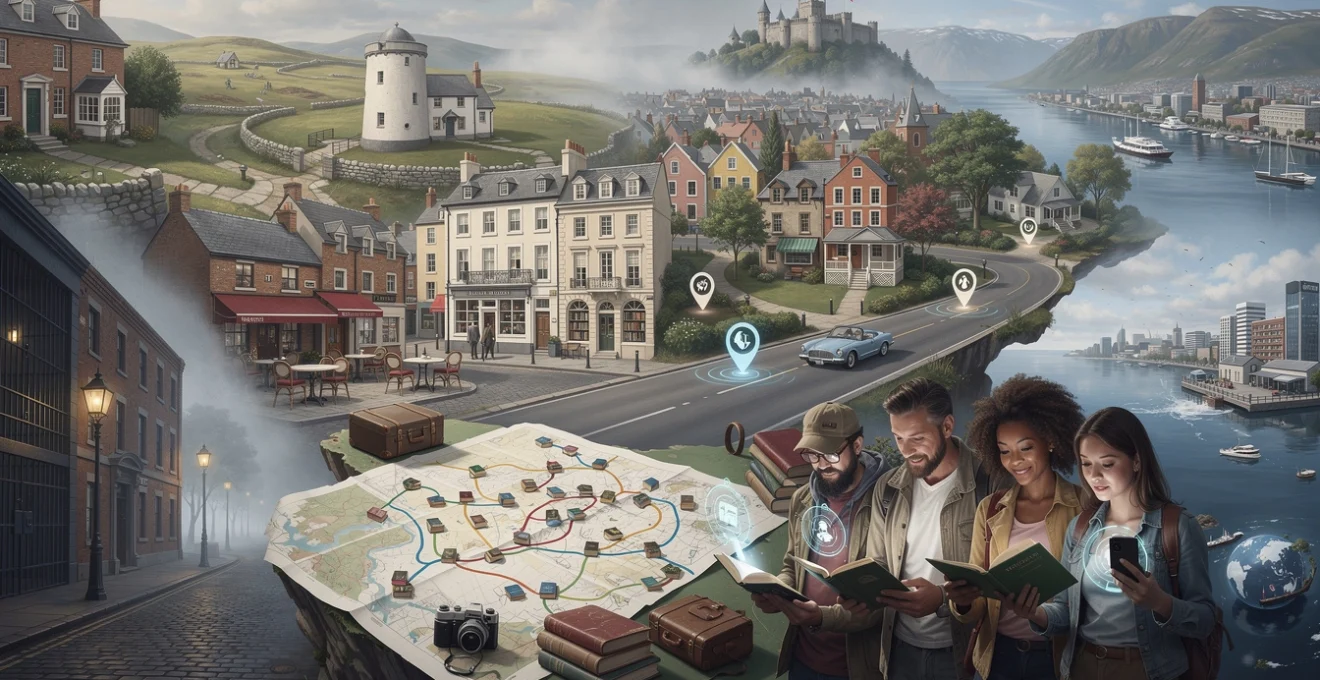
The intersection of literature and travel creates some of the most enriching experiences available to cultural enthusiasts. Literary tourism has evolved from simple author house visits to comprehensive thematic journeys that allow travellers to walk in the footsteps of beloved characters and witness the landscapes that shaped literary masterpieces. From Victorian London’s fog-shrouded streets to modernist Paris cafés, these carefully curated routes transform reading into immersive geographical adventures. The growing popularity of literary pilgrimages reflects our deep desire to connect with stories on a physical level, bridging the gap between imagination and reality through purposeful travel.
Victorian literary landscapes: dickens’ london and brontë country walking trails
Victorian literature offers some of the most geographically rich narratives in English literature, with authors drawing extensively from their immediate surroundings to create vivid, authentic settings. The industrial transformation of 19th-century Britain provided writers with dramatic urban and rural landscapes that became integral to their storytelling. These literary landscapes remain remarkably preserved, allowing modern travellers to experience Victorian England much as the original authors and their characters would have encountered it.
Charles dickens’ marshalsea prison route through borough and southwark
The Borough and Southwark districts of London preserve the gritty atmospheric essence of Dickens’ social commentary novels. This route begins at the site of the former Marshalsea Prison, where Dickens’ father was imprisoned for debt and which features prominently in Little Dorrit. The walking trail continues through Borough Market, virtually unchanged since Victorian times, where the sights, sounds, and aromas provide authentic sensory connections to Dickens’ detailed descriptions of London’s working-class neighbourhoods.
Visitors can explore the George Inn on Borough High Street, one of London’s last surviving galleried coaching inns, which Dickens frequented and featured in Little Dorrit. The route extends to Winchester Palace ruins and the Golden Hind replica, offering glimpses into the maritime history that influenced many of Dickens’ Thames-side scenes. St. George’s Cathedral and the surrounding medieval streets maintain their Victorian character, providing authentic backdrops for scenes from Oliver Twist and Our Mutual Friend.
Jane austen’s hampshire heritage trail: chawton cottage to winchester cathedral
Hampshire’s rolling countryside and market towns provided Jane Austen with the genteel settings that became synonymous with Regency romance. The heritage trail connects key locations from Austen’s life and novels, beginning at Chawton Cottage, where she wrote and revised her most famous works. The 17th-century cottage, now a museum, contains original manuscripts, personal belongings, and the small writing table where Pride and Prejudice and Emma were perfected.
The route continues through Alton’s Georgian market square to Winchester, where Austen spent her final days. Winchester Cathedral houses her grave and a memorial window, while the surrounding medieval streets echo the social hierarchies and marriage markets central to her novels. The trail includes visits to Steventon, where Austen was born, and Bath, the fashionable spa town featured prominently in Northanger Abbey and Persuasion.
Thomas hardy’s wessex circuit: dorchester to casterbridge archaeological sites
Thomas Hardy’s fictional Wessex corresponds closely to the real Dorset landscape, creating opportunities for literary travellers to experience the rural England that shaped his tragic narratives. The circuit begins in Dorchester, Hardy’s birthplace and the model for Casterbridge in The Mayor of Casterbridge. The town’s Roman walls, ancient amphitheatre, and market square provide authentic settings for Hardy’s exploration of rural social dynamics and economic change.
The route extends through the Dorset countryside to Higher Bockhampton, where Hardy’s birthplace cottage is preserved as a National Trust property. Visitors can walk the heathlands that inspired The Return of the Native and visit St. Michael’s Church in Stinsford, where Hardy’s heart is buried. The circuit includes Puddletown, the model for Weatherbury in
Puddletown, the model for Weatherbury in Far from the Madding Crowd, and the prehistoric landscape of Maiden Castle, which looms over the town, complete the circuit. Together, these archaeological sites and rural villages reveal how Hardy blended real topography with fictionalised place names to create Wessex. For a more immersive literary travel route, you can follow signed walking paths between villages, many of which still resemble the agricultural communities Hardy depicted. Seasonal events, such as local fairs and church festivals, echo the communal gatherings in his novels and offer contemporary insight into rural traditions. This Wessex circuit allows readers to see how geology, history, and social change intertwine in Hardy’s distinctive narrative world.
Brontë parsonage museum haworth moor literary pilgrimage
Brontë Country in West Yorkshire provides one of the most atmospheric literary landscapes in Britain. The Brontë Parsonage Museum in Haworth serves as the starting point for a walking pilgrimage across the moors that inspired Wuthering Heights and Jane Eyre. The preserved parsonage, with its period interiors and original manuscripts, offers a rare window into the domestic circumstances under which Charlotte, Emily, and Anne Brontë produced their novels. Exhibition rooms highlight how the surrounding moorland shaped their imaginative geographies, from isolated manor houses to windswept hilltops.
From the parsonage, waymarked routes lead out onto Haworth Moor, where you can walk to Top Withens, widely believed to be the model for the Earnshaw home in Wuthering Heights. The stark, open landscape, punctuated by drystone walls and heather, closely matches Emily Brontë’s descriptions of elemental forces and emotional turbulence. Further along the trail, you’ll encounter Brontë Waterfall and the stone bridge celebrated in the sisters’ juvenilia, allowing you to connect specific natural features with their early experiments in world-building. As you navigate the moors, it becomes clear why this region is considered a pilgrimage site for readers seeking an authentic Victorian literary travel experience.
Modernist writers’ european cultural corridors and urban exploration routes
The early 20th century saw writers breaking with tradition and using cities as experimental laboratories for new narrative forms. Modernist authors turned urban spaces into complex texts, mapping psychological journeys onto real streets, cafés, and riverbanks. Today, these modernist literary travel routes invite you to experience European cities not just as tourists, but as readers moving through layered cultural corridors. By tracing these routes on foot or via public transport, you can witness how historical upheavals, artistic circles, and everyday street life shaped some of the most influential works of modern literature.
James joyce’s dublin bloomsday literary walking tour: martello tower to davy byrne’s pub
Few literary travel routes are as carefully documented as the one charted in James Joyce’s Ulysses. The Bloomsday walking tour follows the path of Leopold Bloom and Stephen Dedalus through Dublin on 16 June 1904, now celebrated annually by readers worldwide. The route typically begins at the Martello Tower in Sandycove, where the novel’s opening chapter is set and where Joyce himself once stayed. The tower has been converted into the James Joyce Tower and Museum, displaying first editions, letters, and period artefacts that bring early 20th-century Dublin to life.
From Sandycove, the route threads its way into the city centre, passing key locations such as Sandymount Strand, Westland Row, and Sweny’s Pharmacy, which still sells lemon soap as a nod to Bloom’s purchase in the novel. Literary travellers often pause at Davy Byrne’s Pub on Duke Street, where Bloom famously orders a gorgonzola sandwich and a glass of burgundy. On Bloomsday itself, you can join costumed readings, musical performances, and guided walks that transform Dublin into a living stage set for Joyce’s experimental narrative. For the rest of the year, self-guided maps and audio tours allow you to explore at your own pace, comparing Joyce’s dense interior monologues with the very real streets and river crossings they describe.
Ernest hemingway’s paris left bank literary quarter: shakespeare and company to café de flore
Paris’s Left Bank is synonymous with modernist experimentation, and few writers are more closely associated with this quarter than Ernest Hemingway. A classic literary travel route begins at Shakespeare and Company, the English-language bookshop that first published Joyce’s Ulysses and served as a hub for expatriate writers in the 1920s. While the original location has changed, today’s bookshop near Notre-Dame maintains the bohemian spirit of the “Lost Generation” with readings, writing workshops, and shelves packed with classic and contemporary literature.
From there, you can follow the Seine westward to the Latin Quarter, where Hemingway and his contemporaries rented modest apartments and wrote in unheated rooms. Key stops include the cafés of Boulevard Saint-Germain, particularly Les Deux Magots and Café de Flore, where Hemingway, Sartre, and Simone de Beauvoir discussed politics, art, and the craft of writing. This Left Bank literary trail mirrors the scenes depicted in A Moveable Feast, allowing you to sit where Hemingway drafted early stories or edited manuscripts between coffees. As you wander these streets, you’ll notice how the compact geography of the district encouraged constant encounters and cross-pollination between writers, painters, and musicians.
Franz kafka’s prague castle district and golden lane literary trail
Prague’s Old Town and Castle District form the core of a distinctly Central European modernist landscape. Franz Kafka’s uneasy, dreamlike depictions of bureaucracy and alienation draw heavily on the city’s narrow streets, looming facades, and labyrinthine alleyways. A typical Kafka literary trail starts at the Kafka Museum on the bank of the Vltava, which uses multimedia installations to evoke the fragmented reality of his fiction. From there, you can cross the Charles Bridge and climb to the Castle District, where Kafka worked at the Workers’ Accident Insurance Institute.
Within the castle complex, Golden Lane is a highlight for literary travellers. Kafka rented a small house here (No. 22) for a brief period, seeking peace and anonymity to write. Although the interiors have been reconstructed, the cramped scale and thick stone walls convey the sense of enclosure that pervades his stories. As you explore the surrounding courtyards, stairways, and government buildings, it’s easy to see how this architecture informed works like The Trial and The Castle. Night-time walking tours, when the streets are quieter and shadows lengthen, are particularly effective for readers wanting to experience a “Kafkaesque” atmosphere first-hand.
Virginia woolf’s bloomsbury london: russell square to tavistock square memorial route
Virginia Woolf and the Bloomsbury Group transformed early 20th-century London into a nexus of artistic and intellectual innovation. A Bloomsbury literary walking route typically begins at Russell Square, close to the former homes of Woolf, E.M. Forster, and economist John Maynard Keynes. Though many of the original interiors have changed, blue plaques mark key addresses, allowing you to reconstruct the group’s dense social network within just a few streets. Walking between these buildings underlines how Woolf’s “stream of consciousness” style mirrors the overlapping conversations and shifting allegiances of her circle.
The route continues to Gordon Square and then to Tavistock Square, where Woolf lived at No. 52 before the house was destroyed in the Second World War. In Tavistock Square Gardens you’ll find a bust of Woolf, a focal point for readers paying their respects and reflecting on her contribution to feminist and modernist literature. From here, you can extend the walk south to the British Museum, which appears in Mrs Dalloway, or north to Regent’s Park, both used as settings for Woolf’s exploration of urban motion and interior life. Travelling these streets on foot reinforces one of her core insights: the city itself is a living, shifting text, best read at walking pace.
American literary road trip itineraries: from beat generation to southern gothic
In the United States, the road trip is almost a literary genre in its own right. From the restless wanderings of the Beat Generation to the haunted landscapes of Southern Gothic fiction, American authors have used highways and backroads to explore identity, freedom, and social conflict. Designing an American literary road trip itinerary allows you to connect far-flung locations into a single narrative journey, much like a novel structured around multiple settings. You can move from jazz-era New Orleans to desert motels in the Southwest, or from New England mill towns to Californian coastlines, tracing how place shapes character and plot.
One classic route follows the path of Jack Kerouac’s On the Road, beginning in New York City, passing through Denver, and ending in San Francisco. This cross-country journey highlights the changing textures of American life, from industrial cities to open plains, and remains a popular long-distance driving itinerary. Another powerful route focuses on Southern Gothic authors such as William Faulkner, Flannery O’Connor, and Tennessee Williams, linking Oxford, Mississippi, with Savannah, Georgia, and New Orleans, Louisiana. Along the way, visitors encounter decaying mansions, small-town courthouses, and humid city streets where issues of race, class, and memory play out in stark relief.
For a more contemporary road trip inspired by literature, you might combine Cormac McCarthy’s border novels with Louise Erdrich’s depictions of the Upper Midwest, stopping at national parks, border towns, and reservation communities. These itineraries demand thoughtful planning: distances can be vast, and rural infrastructure may be limited. However, that very sense of scale and occasional isolation mirrors themes found throughout American writing. With careful research, flexible scheduling, and regular pauses for local bookshops and independent cinemas, you can transform a standard holiday drive into a multi-state literary exploration.
Contemporary crime fiction detective trails across nordic countries
Nordic noir has turned the landscapes of Scandinavia into global crime-fiction destinations. Readers drawn to the stark moral questions and meticulous police work of authors like Stieg Larsson, Jo Nesbø, and Henning Mankell increasingly seek out the real locations behind the investigations. These detective trails thread through compact, walkable city centres and remote coastal settlements, inviting you to experience both the polished surfaces and hidden tensions that characterise contemporary Nordic society. The contrast between picturesque scenery and dark narratives makes these literary travel routes particularly compelling.
In Sweden, many travellers start in Stockholm with a route based on Larsson’s Millennium trilogy. Guided walking tours lead you through Södermalm, where journalist Mikael Blomkvist and hacker Lisbeth Salander live and work. Stops include cafés, newspaper offices, and apartment buildings referenced in the novels, alongside waterfront views that appear in key scenes. Further south, Ystad on the Baltic coast is the home of Inspector Kurt Wallander, Mankell’s melancholic detective. The town has embraced its literary fame, offering maps of Wallander’s favourite haunts and bus tours that connect filming locations from the television adaptations.
Norway’s capital, Oslo, provides another rich setting for crime-fiction tourism. Jo Nesbø’s Harry Hole series takes full advantage of the city’s changing districts, from historic Gamlebyen to the regenerated Barcode Project on the waterfront. Self-guided routes allow you to trace Harry’s movements between his apartment near Sofienberg Park, his preferred bars, and the police headquarters. Beyond the cities, Icelandic crime fiction has put Reykjavik and the surrounding countryside on the map for readers seeking remote, weather-beaten environments where small communities guard big secrets. As you follow these detective trails, you’ll notice how long winter nights, modern design, and generous welfare systems all feed into narratives grappling with crime, ethics, and social responsibility.
Post-colonial literature geographic narratives: commonwealth writers’ international routes
Post-colonial literature often weaves together multiple geographies, reflecting histories of migration, displacement, and cultural hybridity. Commonwealth writers from regions such as the Caribbean, South Asia, and West Africa have used cities, villages, and coastlines as stages on which to examine the long aftershocks of empire. Designing literary travel routes around these narratives means thinking in networks rather than single destinations. Instead of a simple “from A to B” itinerary, you’re tracing overlapping routes of labour, education, and exile, much as the novels and memoirs themselves do.
Consider, for example, a route inspired by the works of Salman Rushdie, which might link Mumbai with London and New York, mirroring the transnational journeys of his characters. In India, you can visit Mumbai neighbourhoods evoked in Midnight’s Children, exploring colonial-era architecture, crowded markets, and coastal promenades. In the UK, a complementary trail could focus on writers such as Zadie Smith and Andrea Levy, following their depictions of North London estates, post-war immigrant communities, and university campuses. Together, these locations reveal how post-colonial literature maps identities that are simultaneously local and global.
The Caribbean offers another powerful set of literary travel routes, connecting islands like Jamaica, Trinidad, and Barbados through the works of authors including Derek Walcott, Jamaica Kincaid, and V.S. Naipaul. Visitors can explore plantation ruins, port cities, and capital suburbs that surface repeatedly in novels and poetry, each site layered with histories of enslavement, indenture, and cultural resistance. In West Africa, routes based on Chinua Achebe and Chimamanda Ngozi Adichie might connect rural villages with rapidly modernising cities such as Lagos or Abuja, underlining the tension between tradition and globalisation. As you plan these journeys, it’s worth engaging with local guides, independent bookshops, and community archives to gain perspectives that go beyond the canonical texts and reflect contemporary debates about heritage and representation.
Digital literary tourism platform integration and augmented reality heritage applications
The rise of digital tools has transformed how we experience literary tourism. Instead of relying solely on printed guidebooks, travellers can now use mobile apps, interactive maps, and augmented reality (AR) experiences to navigate literary travel routes with real-time context. Many cultural organisations report increased engagement when they integrate digital storytelling into heritage sites, particularly among younger visitors who expect multimedia content. This shift doesn’t replace traditional walking tours but rather adds an extra interpretive layer, much like a critical introduction enhances a classic novel.
Augmented reality heritage applications are particularly effective for reconstructing lost or altered literary environments. Imagine holding up your smartphone outside a demolished Victorian lodging house and seeing a 3D reconstruction overlaid on the present-day street view, accompanied by excerpts from Dickens or Gaskell. Similar AR experiences can project period-appropriate interiors onto modern cafés where modernist writers once gathered, or display character routes as coloured lines along the pavement. For remote destinations or readers unable to travel, virtual tours and 360-degree video walks offer an accessible alternative, allowing global audiences to “walk” through places like Joyce’s Dublin or Brontë Country from home.
For travellers, integrating digital platforms into your literary itinerary has practical benefits as well. GPS-enabled apps can prevent you from getting lost on complex city routes, while push notifications highlight nearby points of interest you might otherwise miss. Some platforms even gamify the experience, awarding badges for visiting specific locations or completing themed quests, which can be especially engaging for families or school groups. As with any technology, there are considerations: battery life, data access, and screen fatigue can all affect your experience. The most rewarding approach often combines digital guidance with moments of device-free exploration, letting you absorb the atmosphere of a place without constant mediation. In this way, digital literary tourism tools function like a good editor—supporting your journey, clarifying context, but ultimately letting the original text of the landscape speak for itself.