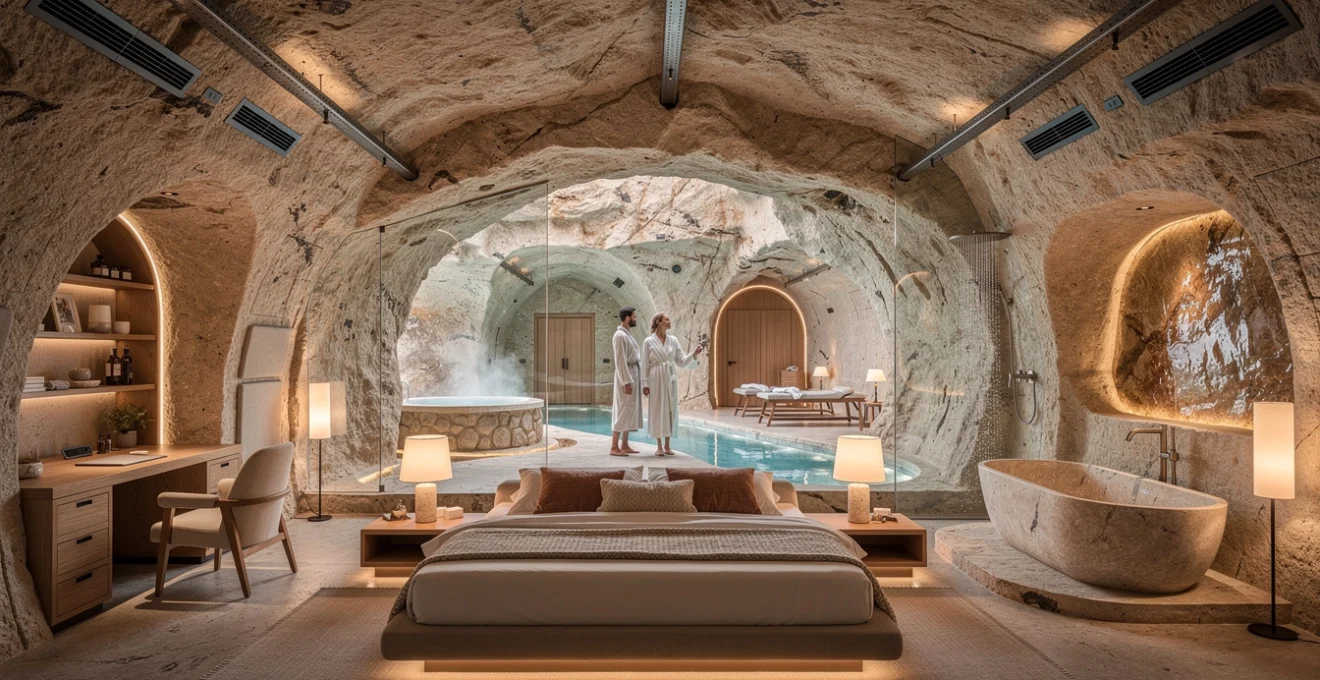
The hospitality industry has witnessed a remarkable transformation in recent years, with travellers increasingly seeking accommodations that offer authentic experiences beyond conventional luxury. Cave hotels represent one of the most fascinating developments in this evolution, seamlessly blending ancient geological formations with contemporary comfort to create truly extraordinary lodging experiences. These subterranean sanctuaries have captured the imagination of discerning travellers who crave unique environments that connect them with both history and nature.
From the volcanic landscapes of Cappadocia to the dramatic cliffs of Santorini, cave hotels demonstrate how innovative architecture can transform natural rock formations into sophisticated hospitality venues. The engineering challenges involved in creating these underground retreats are considerable, requiring expertise in structural engineering, climate control, and sustainable design. Yet the results speak for themselves: accommodations that provide unparalleled comfort whilst maintaining the raw beauty and character of their geological origins.
The appeal of cave hotels extends far beyond their novelty factor. These establishments offer natural temperature regulation, acoustic insulation, and an intimate connection with the earth that conventional hotels simply cannot replicate. The experience of sleeping within ancient rock formations creates a profound sense of place that resonates with guests long after their stay concludes.
Architectural engineering principles behind cave hotel construction
The construction of cave hotels requires a sophisticated understanding of geological engineering principles that differ substantially from conventional building projects. Engineers must work with existing rock formations rather than imposing external structures, demanding creative solutions that respect the natural integrity of the cave environment whilst ensuring guest safety and comfort.
Geological assessment and rock formation analysis for hospitality development
Before any construction begins, comprehensive geological assessments determine the suitability of rock formations for hospitality development. Engineers conduct detailed studies of rock composition, stability, and porosity to identify potential structural weaknesses or water infiltration points. Volcanic tuff, commonly found in Cappadocia’s cave hotels, presents unique challenges due to its soft, porous nature that allows for relatively easy excavation but requires careful reinforcement strategies.
Ground-penetrating radar and seismic testing reveal hidden cavities or unstable zones within the rock matrix. These assessments inform architects about load-bearing capacities and help identify areas where additional structural support becomes necessary. The geological survey process can take several months, but this thorough preparation prevents costly modifications during construction and ensures long-term structural integrity.
Structural integrity solutions for underground accommodation spaces
Maintaining structural stability in cave hotels requires innovative reinforcement techniques that preserve the natural appearance of rock surfaces whilst providing adequate support for guest accommodations. Steel reinforcement systems, typically concealed within the rock matrix, distribute loads evenly across cave walls and ceilings. These frameworks must accommodate natural rock expansion and contraction cycles caused by temperature fluctuations.
Modern cave hotels often employ shotcrete applications – a method of spraying concrete onto rock surfaces – to stabilise loose or fractured areas without altering the visual character of the cave environment. Advanced anchoring systems secure these reinforcements deep within solid rock, creating invisible support networks that maintain the authentic cave experience whilst meeting contemporary safety standards.
Natural ventilation systems and air circulation in subterranean hotels
Effective air circulation presents one of the most significant challenges in cave hotel design, as natural ventilation systems must overcome the inherent limitations of underground spaces. Engineers design sophisticated airflow networks that utilise thermal stack effects and pressure differentials to maintain fresh air circulation throughout guest accommodations. These systems often incorporate multiple air shafts strategically positioned to create cross-ventilation patterns.
Smart ventilation controls monitor air quality parameters including humidity, carbon dioxide levels, and temperature, automatically adjusting airflow rates to maintain optimal conditions. Some cave hotels integrate geothermal ventilation systems that leverage the earth’s natural temperature stability to pre-condition incoming air, reducing energy consumption whilst maintaining guest comfort.
Waterproofing technologies for Cave-Based hospitality infrastructure
Water management in cave hotels requires advanced waterproofing solutions that prevent moisture infiltration whilst allowing the rock to breathe naturally. Traditional waterproofing membranes can trap moisture within rock formations, leading to structural damage and air quality issues. Instead, cave hotels employ breathable waterproofing systems that include crystalline waterproofing admixtures and penetrating
sealers that react with mineral components inside the stone to form a water-resistant barrier. These systems reduce capillary absorption while still permitting vapour diffusion, which is crucial for maintaining healthy humidity levels inside cave rooms. In high-risk zones, engineers combine drainage channels, perimeter French drains, and sump pumps to redirect groundwater away from guest areas, especially during seasonal rainfall or snowmelt.
Surface treatments on exposed rock often include lime-based plasters and mineral paints that are compatible with the substrate and allow it to “breathe.” In addition, carefully graded floor slopes and concealed gutter systems ensure that any incidental water – from condensation, cleaning, or guest use – is directed towards drains rather than pooling near walls. When you stay in a cave hotel that feels dry and comfortable year-round, those invisible waterproofing layers and drainage strategies are quietly doing their work in the background.
Global cave hotel destinations leading luxury troglodyte tourism
While cave hotels were once seen as niche curiosities, they now sit at the forefront of luxury hospitality in several destinations worldwide. Pioneering properties in Turkey, Greece, Jordan, and the United States have proven that “troglodyte tourism” can be both exclusive and environmentally sensitive. Each region interprets the cave hotel concept through its own geology, culture, and design traditions, creating highly distinctive experiences that still share the same core idea: using the earth itself as architecture.
As you compare cave hotels across continents, you begin to see recurring themes. The most successful properties balance authentic rock-cut spaces with generous natural light, advanced ventilation, and thoughtful interior design. They also act as gateways to their landscapes, offering guided hikes, balloon flights, desert walks, or archaeological tours that deepen your connection to place. In this sense, cave hotels are not just somewhere to sleep; they are curated introductions to some of the world’s most striking environments.
Cappadocia’s museum hotel and argos in cappadocia underground suites
Cappadocia in central Turkey remains the benchmark destination for luxury cave hotels, and two properties often cited as best-in-class are Museum Hotel and Argos in Cappadocia. Both are built into volcanic tuff plateaus and former monastic complexes, where centuries of human habitation have already carved a labyrinth of tunnels, cellars, and rock-hewn rooms. Rather than erase that history, these hotels restore and reinterpret it, allowing you to sleep in spaces that once stored wine, grain, or religious manuscripts.
Museum Hotel takes its name literally, displaying hundreds of registered archaeological artefacts throughout its suites and common areas. Many rooms feature original stone arches, fireplaces carved into the rock, and terraces opening to panoramic views of the fairy chimneys and Uçhisar Castle. Argos in Cappadocia, by contrast, is famous for its network of underground corridors and its atmospheric wine cellar, where local Cappadocian wines age in the same cool conditions used for centuries. In both cases, the cave architecture is not a gimmick; it defines the entire guest journey, from the sound-dampened sleep to the thermal stability that keeps interiors pleasantly cool in summer and warm in winter.
Santorini’s mystique and katikies cliffside cave accommodations
On Santorini, the idea of cave living takes on a more maritime character. Properties like Mystique and Katikies carve suites directly into the island’s volcanic caldera cliffs, combining Cycladic whitewashed façades with vaulted cave interiors. Here, the “cave hotel” is less about deep subterranean immersion and more about using the cliff as a structural shell: bedrooms and bathrooms cut into rock, opening onto terraces that float above the Aegean Sea.
Mystique’s suites typically feature organic, flowing forms, with niches and alcoves shaped by the rock itself. Katikies is renowned for its multi-level infinity pools and cascading terraces, which appear to dissolve into the sea and sky. Both hotels show how cave architecture can be seamlessly integrated with high-end amenities: plunge pools carved partly into rock, spa treatment rooms tucked into quiet grottoes, and restaurants that occupy sheltered, barrel-vaulted spaces. The result is a type of cave hotel experience where you feel cocooned by the cliff, yet constantly drawn outward to the expansive caldera views.
Jordan’s feynan ecolodge desert cave integration
In Jordan’s Dana Biosphere Reserve, Feynan Ecolodge takes a different approach, prioritising environmental stewardship and community engagement over overt luxury. While not a pure cave hotel in the Cappadocian sense, Feynan integrates cave-like design principles to moderate the harsh desert climate. Thick earthen walls, recessed courtyards, and semi-subterranean spaces create thermal mass that smooths out temperature extremes, much like traditional troglodyte dwellings in the region.
Guest rooms feature minimal, earth-toned interiors with small, strategically placed windows that frame desert and mountain views. At night, the lodge relies on candlelight rather than bright artificial illumination, reinforcing the feeling of shelter and intimacy. What makes Feynan particularly compelling as a case study is its holistic approach: renewable energy systems, water conservation measures, and local Bedouin employment are woven into the guest experience. If you are interested in cave hotels that embody sustainable tourism principles, Feynan demonstrates how “living with the land” can guide both architecture and operations.
New mexico’s kokopelli cave bed and breakfast sandstone chambers
In the United States, one of the most iconic cave accommodations is the Kokopelli Cave Bed and Breakfast near Farmington, New Mexico. Blasted into a sandstone cliff 70 metres above the La Plata River valley, this single, expansive suite offers a very different interpretation of troglodyte tourism. Accessed via a steep trail and carved entrance, it feels more like a secluded hideaway than a conventional hotel, appealing to travellers seeking solitude and a close relationship with the desert landscape.
Inside, Kokopelli Cave features exposed sandstone walls, a rock-hewn shower, and a balcony terrace cut directly into the cliff face. The surrounding geology dictates room layout and furniture placement, while the thick stone envelope provides natural insulation from the intense New Mexican sun. It’s a compelling example of how even small-scale cave accommodations must respect geological conditions – from monitoring rock stability to ensuring adequate ventilation – while still offering modern comforts such as running water, electricity, and well-appointed living areas.
Advanced climate control systems for subterranean guest accommodation
One of the key advantages of cave hotels is their natural temperature stability. In many regions, underground spaces maintain a near-constant temperature year-round, typically between 12°C and 18°C depending on depth and geology. However, transforming raw caves into luxury accommodation still requires advanced climate control systems to fine-tune comfort. After all, guests expect not just “pleasantly cool,” but precisely controlled sleeping, bathing, and spa environments.
To achieve this, engineers often combine passive techniques with high-efficiency mechanical systems. Geothermal heat pumps, for example, use the earth’s stable subsurface temperature as a heat source in winter and a heat sink in summer. When paired with radiant floor heating, low-temperature radiators, or discreet fan coil units, these systems maintain ideal indoor climates with far less energy than conventional HVAC. Energy recovery ventilators further enhance efficiency by transferring heat and humidity between outgoing and incoming air streams, ensuring that improved air quality does not come at the cost of increased energy use.
Humidity management is another crucial factor in subterranean hospitality. Too little humidity and the air feels dry and irritating; too much and you risk condensation, mould, or damage to finishes and furnishings. Modern cave hotels deploy smart building management systems that continuously monitor relative humidity, temperature, and CO2 levels. These systems adjust dehumidifiers, ventilation rates, and sometimes even underfloor heating output to keep conditions within a narrow comfort band. You can think of it like a “cruise control” for indoor climate: subtle, automatic adjustments maintain a smooth journey without the guest ever noticing the fine-tuning taking place.
Luxury amenities integration within natural rock formations
Integrating luxury amenities into cave hotels is a delicate balancing act. On one hand, guests expect spa facilities, fine dining, and high-spec bathrooms that match or surpass those of top-tier surface hotels. On the other, the inherent charm of cave accommodation lies in its raw rock surfaces, irregular geometry, and sense of timelessness. The challenge is to provide five-star comfort without erasing the cave’s character or overloading the rock structure with incompatible materials and loads.
Design teams typically start by mapping the cave’s strengths and constraints: ceiling heights, natural alcoves, existing niches, and access to daylight or external terraces. From there, they identify where to insert pools, treatment rooms, kitchens, and lounges in ways that respect the structural integrity of the rock. Often, the most successful solutions feel almost inevitable, as if the cave had been waiting centuries to become a hammam or a vaulted dining room. When you walk into such a space, you sense that the amenities are an extension of the geology rather than an imposition on it.
Spa and wellness facilities in cave hotel environments
Cave hotels are particularly well-suited to spa and wellness concepts, because their intrinsic qualities – quietness, stable temperatures, and low light levels – support relaxation. Many properties dedicate entire subterranean wings to wellness, carving out treatment cabins, saunas, hammams, and meditation rooms. In Cappadocia and Santorini, it’s common to find plunge pools and steam rooms tucked into former storage cellars or monastic chambers, their stone walls now illuminated by soft, indirect lighting.
From an engineering perspective, spa facilities demand careful planning to manage humidity and heat loads. Steam rooms and hot pools can produce large quantities of moisture, which must be safely extracted without driving damp into surrounding rock. Designers often use independent ventilation and dehumidification systems for spa zones, along with specialised waterproof plasters and membranes that remain vapour-permeable where possible. When done correctly, the result is powerful: you move from a cool, dim cave corridor into a warm, aromatic hammam carved from stone, experiencing a sensory contrast that feels almost ritualistic.
Fine dining restaurant design for underground hospitality venues
Fine dining in a cave hotel offers a theatrical setting that conventional restaurants struggle to match. Barrel-vaulted ceilings, rock-cut niches, and filtered shafts of daylight all contribute to an atmosphere that is at once intimate and dramatic. In properties like Museum Hotel or Argos in Cappadocia, dining rooms often occupy former monasteries, stables, or wine cellars, with original stone details left visible alongside contemporary furniture and tableware.
However, designing a restaurant in a subterranean setting goes beyond aesthetics. Chefs and operators must consider air supply for kitchens, odour control, and fire safety in spaces with limited natural ventilation. Advanced extraction hoods, fire-rated ductwork, and dedicated emergency exits are non-negotiable, even when they must be discreetly integrated behind stone walls. Acoustics also play a key role: untreated rock can cause echoes that overwhelm conversation, so designers often incorporate sound-absorbing materials in seating, textiles, and ceiling baffles. When you sit down to dinner in a cave restaurant and notice you can hear your companions clearly despite the lively atmosphere, you are experiencing the benefits of this careful acoustic planning.
Swimming pool construction techniques in cave hotel settings
Swimming pools in cave hotels range from small plunge pools carved into natural alcoves to dramatic, partially enclosed infinity pools that spill out from the rock face. Building any pool adjacent to or inside a cave demands meticulous structural and waterproofing strategies. The weight of the water – one cubic metre equals roughly one tonne – must be safely transferred to competent rock or supporting structures without overstressing the cave shell.
Engineers typically design reinforced concrete shells that sit either fully within excavated voids or partially cantilever out from the rock face. Multiple waterproofing layers, including flexible membranes, bentonite mats, and protective screeds, guard against leaks that could undermine the rock or cause damp in lower levels. In cliffside locations such as Santorini, infinity pools are often anchored deeply into the volcanic substrate with rock bolts and anchors, distributing loads into the strongest geological strata. For guests, the technical complexity disappears behind smooth stone edges and tranquil water; all that remains is the surreal sensation of floating at the intersection of rock, sky, and – in coastal destinations – open sea.
High-end bathroom fixtures and plumbing in rock-cut spaces
Bathrooms are among the most technically demanding components of any cave hotel, combining water supply, drainage, ventilation, and electrical services in confined, irregular spaces. High-end cave suites now commonly feature freestanding stone bathtubs, walk-in rain showers framed by rough-hewn walls, and underfloor heating that takes the chill off stone tiles. Integrating these luxuries requires routing plumbing lines through or around rock without compromising structural stability or visual authenticity.
To achieve this, designers often build service cavities behind partial-height partition walls or raised floors, creating concealed zones where pipes, traps, and inspection points can be accessed. Drainage gradients must be carefully calculated, especially in suites that step down into the rock, to avoid backflow or stagnant water. Corrosion-resistant materials such as PEX piping and stainless steel fittings help ensure long-term reliability in slightly humid environments. When everything is properly designed, you can enjoy a rainfall shower under a vaulted stone ceiling or soak in a tub carved from local rock, never suspecting the complex web of services hidden just out of sight.
Sustainable tourism practices in cave hotel operations
Cave hotels are often perceived as inherently sustainable thanks to their use of existing rock formations, natural insulation, and small surface footprint. While this is partially true, responsible operators go far beyond the structural advantages of underground architecture to embed sustainability into daily operations. In an era when travellers increasingly ask how their stay impacts local communities and ecosystems, these practices are becoming a key differentiator between truly eco-conscious cave hotels and those that simply trade on aesthetics.
Energy efficiency is a natural starting point. Many leading cave hotels deploy solar thermal panels for hot water, photovoltaic arrays for electricity, and high-efficiency heat pumps to complement the thermal mass of their walls. Water conservation is equally important, particularly in arid or semi-arid regions such as Cappadocia, Santorini, and Jordan. Low-flow fixtures, greywater reuse for irrigation, and rainwater harvesting systems reduce the strain on local resources. Some properties even monitor per-guest water and energy consumption and use that data to refine housekeeping schedules or encourage more mindful use without compromising comfort.
Social sustainability is just as critical. Because many cave hotels occupy historic neighbourhoods or cultural landscapes, they have a responsibility to engage with local communities rather than displace them. The most progressive properties partner with local artisans for furniture, textiles, and crafts; employ residents in roles from guiding to management; and contribute to heritage preservation initiatives. You might find that the rug in your suite was woven in a nearby village, or that your guide to the valley’s rock churches grew up exploring the same trails. In this way, cave hotels can act as catalysts for sustainable tourism that supports – rather than exploits – the places that make them possible.
Interior design methodologies for cave hotel guest rooms
Designing interiors for cave hotel guest rooms is fundamentally different from fitting out a conventional, rectilinear space. Instead of starting with a clean box, designers begin with undulating walls, uneven floors, and irregular niches. The goal is not to fight these imperfections but to choreograph them, turning constraints into character. When done well, a cave room feels both deeply rooted in its geology and effortlessly comfortable – a balance that requires careful planning and a nuanced understanding of how people perceive space.
Successful cave hotel interiors usually embrace three guiding principles. First, they preserve as much visible rock as possible, using it as the primary “finish” rather than hiding it behind plasterboard. Second, they layer tactile materials – wood, wool, linen, and stone – to soften acoustics and introduce warmth. Third, they use lighting and furniture placement to create clear spatial zones: sleeping, sitting, bathing, and storage areas that feel intuitive even when the room’s geometry is unconventional. If you have ever walked into a cave suite and instinctively known where to sit, where to rest, and where to store your belongings, you have experienced this invisible design choreography at work.
Lighting design solutions for natural stone accommodation spaces
Lighting is arguably the most transformative tool in cave hotel design. Because many cave rooms have limited or small openings to the outside, artificial lighting must simultaneously provide sufficient illumination and preserve the moody, cocoon-like quality that guests expect. The solution is rarely a single central fixture. Instead, designers rely on layered lighting schemes that combine ambient, task, and accent sources to model the stone surfaces and guide movement.
Recessed LED strips tucked into ceiling coves or floor-level channels can wash rock walls with soft light, revealing their texture without creating harsh glare. Adjustable spotlights highlight artworks, alcoves, or key architectural details, while warm-toned bedside lamps and reading lights support nighttime routines. Colour temperature is especially important underground: warmer whites (around 2700K–3000K) tend to feel more inviting and less clinical, mimicking the glow of firelight or candles that historically illuminated caves. By varying brightness levels and allowing guests to control zones independently, cave hotels let you tune the atmosphere from bright and practical to intimate and theatrical with a few simple adjustments.
Furniture selection and custom millwork for irregular cave dimensions
Standard furniture often struggles in cave rooms, where curved walls, tapered ceilings, and sloping floors can make off-the-shelf pieces look awkward or ill-fitting. As a result, many cave hotels invest in custom millwork and built-in furnishings tailored to specific rooms. Beds may be nestled into rock niches or framed by timber platforms that compensate for uneven floors. Wardrobes and shelving units are frequently curved or faceted to follow the contours of the walls, with integrated lighting and concealed hardware that keep visual clutter to a minimum.
This bespoke approach serves both aesthetics and practicality. Built-in benches, window seats, and writing desks maximise usable space without crowding circulation paths, an important consideration in smaller or more irregular suites. Durable, locally sourced woods such as walnut, oak, or cedar are common choices, providing a warm counterpoint to cool stone and supporting regional craftsmanship. When you sit on a bench that follows the exact radius of a cave wall, you are experiencing the benefits of this custom design work – a reminder that furniture in such settings is not just placed, but purposefully grown out of the room’s geometry.
Textile and fabric choices for humid subterranean environments
Textiles play a critical role in making cave hotel rooms feel cosy and inviting, but they must be selected with care. Subterranean environments can have slightly higher baseline humidity than typical above-ground rooms, especially in older caves or regions with significant seasonal rainfall. Fabrics that are prone to mould, mustiness, or rapid wear in damp conditions are therefore avoided in favour of breathable, natural fibres and performance blends.
Cotton, linen, and wool are popular choices for bedding, curtains, and upholstery, often combined with moisture-resistant underlayers or removable covers that can be laundered frequently. Many cave hotels in Cappadocia and Matera take advantage of local weaving traditions, using hand-knotted rugs and kilims that not only add colour and pattern but also help regulate acoustics by absorbing sound. Window treatments tend to be layered – perhaps a sheer curtain for privacy paired with a heavier drape for light control and insulation – giving you flexibility to adapt the space to your preferences. By favouring breathable, easy-to-clean materials, operators ensure that rooms stay fresh and comfortable even when the weather outside shifts.
Acoustic treatment strategies for cave hotel sound management
At first glance, you might expect caves to be naturally quiet – and in many cases they are, thanks to thick rock walls that block external noise. However, the hard, reflective surfaces inside a cave can create echoes and reverberation that make conversations or background music sound muddled. Left untreated, a beautiful stone chamber can feel more like a cathedral than a bedroom. Acoustic treatment strategies therefore focus on taming reflections without undermining the visual impact of the rock.
Rather than covering walls with obvious panels, designers tend to hide sound-absorbing materials in plain sight. Upholstered headboards, fabric wall hangings, thick rugs, and padded seating all serve double duty as design elements and acoustic dampers. Ceilings may incorporate discreet baffles or perforated panels backed with insulation, particularly in restaurants and lounges where multiple conversations happen simultaneously. In some high-end properties, acoustic consultants use simulation software to predict how sound will behave in each room, adjusting materials and layouts before construction begins. The result for you as a guest is subtle but significant: you enjoy the serene quiet and intimacy that people associate with caves, without the distracting echoes that raw stone alone might produce.