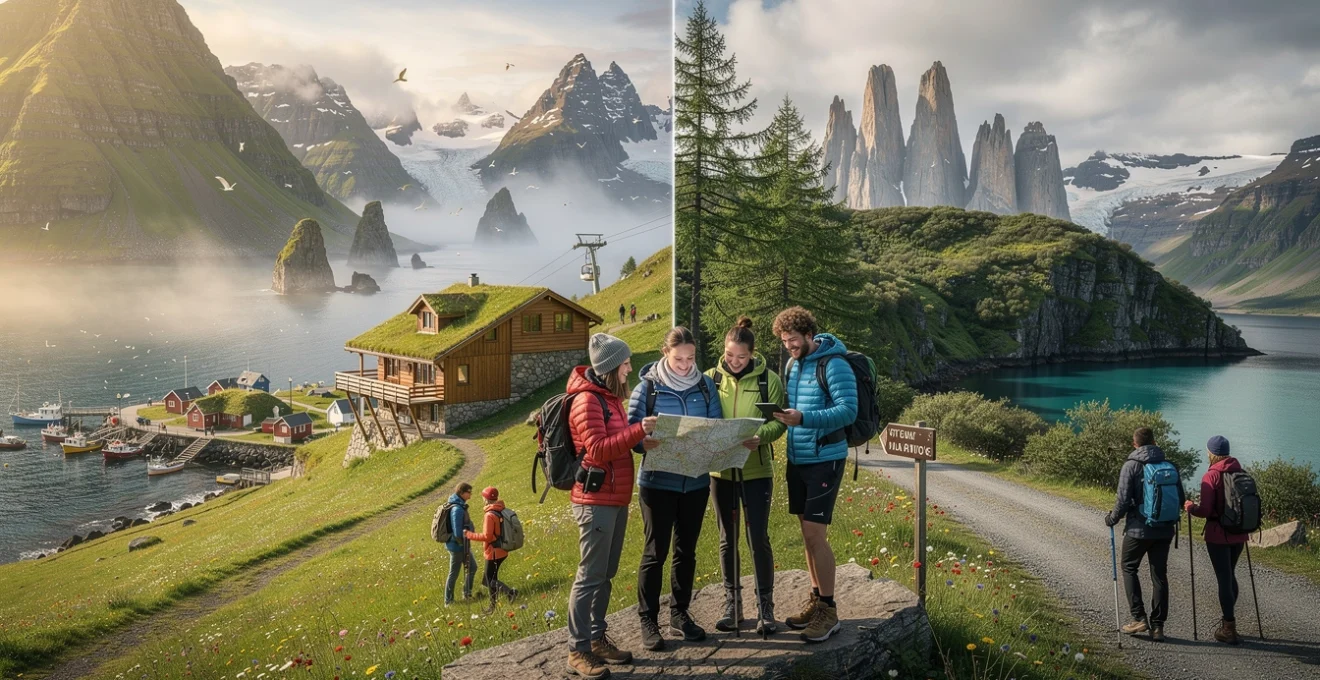
As global temperatures continue to rise and traditional summer destinations experience unprecedented heatwaves, travellers are increasingly seeking refuge in cooler climates during the warmest months. The phenomenon known as « coolcations » has emerged as a significant trend, with searches for cool weather destinations increasing by 300% year-on-year according to recent travel analytics. Rather than enduring sweltering temperatures that can reach above 40°C in Mediterranean hotspots, discerning travellers are discovering the unique pleasures of destinations where summer temperatures rarely exceed 20°C, offering comfortable conditions for outdoor exploration and cultural immersion.
These cooler destinations provide not only respite from oppressive heat but also opportunities to experience dramatic landscapes, witness natural phenomena like the midnight sun, and enjoy outdoor activities without the risk of heat exhaustion. From the rugged coastlines of Nordic islands to the snow-capped peaks of alpine retreats, cool weather destinations offer a refreshing alternative to conventional beach holidays whilst delivering equally memorable experiences.
Nordic coastal destinations with Sub-15°C summer temperatures
The Nordic coastal regions represent some of the most compelling cool weather destinations for summer travel, where maritime influences create consistently moderate temperatures even during peak season. These destinations combine dramatic natural beauty with comfortable climates that rarely exceed 15°C, making them ideal for travellers seeking active holidays without heat-related discomfort.
Faroe islands: maritime climate analysis and seasonal temperature patterns
Located strategically between Iceland and Norway, the Faroe Islands experience a distinctly maritime climate characterised by remarkably stable temperatures throughout the summer months. With average highs of just 13°C during July and August, these 18 interconnected islands offer one of Europe’s most consistently cool summer climates. The Gulf Stream’s moderating influence ensures that temperature variations remain minimal, creating ideal conditions for hiking between dramatic cliffs and exploring traditional fishing villages.
The islands’ unique topography, featuring steep mountains rising directly from the Atlantic Ocean, creates numerous microclimates within short distances. Visitors can experience morning temperatures of 8°C in sheltered valleys whilst coastal areas reach comfortable highs of 14°C by afternoon. This temperature gradient provides excellent opportunities for diverse outdoor activities, from sea cliff hiking to visits to traditional grass-roof villages that have remained virtually unchanged for centuries.
Iceland’s westfjords: microclimate variations and cooling ocean currents
Iceland’s remote Westfjords peninsula offers some of the country’s most spectacular scenery alongside consistently cool summer temperatures. The region’s complex fjord system creates numerous microclimates, with the Greenland Sea’s cold currents maintaining average summer temperatures between 10-13°C. Unlike Iceland’s more popular southern regions, the Westfjords experience minimal tourist crowds whilst offering dramatic bird cliffs, pristine beaches, and authentic fishing communities.
The peninsula’s geographical isolation results in weather patterns distinct from the rest of Iceland, with frequent Atlantic weather systems contributing to the region’s notably cool summer climate. Temperature variations within the Westfjords can be significant, with inland areas experiencing lows of 6°C whilst coastal regions reach maximums of 15°C. This creates perfect conditions for wildlife observation, particularly the massive bird colonies at Látrabjarg cliffs, Europe’s westernmost point.
Northern norway’s lofoten islands: midnight sun with cool air masses
The Lofoten archipelago represents perhaps the most dramatic combination of spectacular scenery and cool summer temperatures found anywhere in Europe. Positioned above the Arctic Circle, these islands experience the midnight sun phenomenon from May through July, providing 24-hour daylight whilst maintaining refreshingly cool temperatures averaging 12-15°C throughout summer.
The islands’ unique geography creates fascinating weather patterns where Arctic air masses interact with the warming influence of the Gulf Stream.
The result is a climate that feels almost air-conditioned, with constant ocean breezes moderating temperatures and creating perfect conditions for hiking dramatic peaks that rise directly from pristine beaches.
Traditional fishermen’s cabins, known as rorbuer, provide authentic accommodation options that allow visitors to experience the islands’ maritime heritage whilst enjoying comfortable temperatures that rarely require more than light layers.
Shetland islands: atlantic weather
Shetland islands: atlantic weather systems and temperature moderation
Positioned where the North Sea meets the Atlantic, the Shetland Islands sit directly in the path of shifting oceanic air masses. This exposed location might suggest harsh conditions, yet the surrounding seas act as an enormous heat sink, ensuring that summer temperatures remain remarkably stable. Typical July and August highs sit around 13-15°C, with many days hovering closer to 10-12°C, even under bright sunshine. For travellers used to 30°C city heat, walking along Shetland’s cliffs can feel like stepping into natural air conditioning.
Atlantic low-pressure systems frequently sweep across the archipelago, bringing fast-changing but generally moderate weather. You might experience mist, sunshine and a brief shower all within an afternoon stroll, yet the thermometer rarely spikes. These maritime influences make Shetland ideal for multi-hour coastal hikes, seabird watching at sites like Sumburgh Head and boat trips to remote isles, all without the risk of overheating. Pack a windproof layer rather than sandals, and you can comfortably enjoy full days outside in peak European summer.
Greenland’s coastal settlements: arctic circle climate zones
Greenland’s coastal towns and villages offer some of the coolest summer conditions accessible to leisure travellers, with many communities sitting either on or north of the Arctic Circle. In places such as Ilulissat and Sisimiut, average July temperatures typically range between 5-10°C, with frequent days remaining below this threshold when cold air flows off the ice sheet. The combination of low humidity and crisp, clear light creates an environment that feels invigorating rather than extreme during the short Arctic summer.
Despite Greenland’s reputation for deep cold, coastal summer conditions are surprisingly manageable for prepared visitors. The surrounding ocean and extensive fjord systems help buffer temperature extremes, especially in western settlements, so that you are more likely to encounter cool drizzle and low cloud than blizzards.
Think of Greenland’s summer as an extended early spring: you will need a warm jacket and hat, but you can comfortably cruise among icebergs, kayak in sheltered fjords and hike tundra paths without facing winter-level hazards.
For travellers seeking a truly cool weather summer vacation, Greenland delivers some of the lowest reliable temperatures available without committing to a full polar expedition.
High-altitude alpine retreats exceeding 2000 metres elevation
While many European lowland regions now see sustained summer heatwaves, the continent’s major mountain ranges still provide reliable cool weather escapes. Thanks to the lapse rate – the rate at which air temperature decreases with altitude – temperatures typically drop around 0.6°C for every 100 metres of elevation gained. In practical terms, this means that resorts above 2000 metres can enjoy daytime highs of 15-20°C even when nearby cities are sweltering at 35°C or more.
These high-altitude alpine destinations offer a distinctive combination of clean air, low humidity and strong sunshine, making them ideal for active travellers. You can hike, mountain bike, climb or simply stroll between alpine villages in comfort, provided you pack layers and sun protection. Curious how it feels? Standing on a sunny terrace at 2200 metres can be compared to a bright autumn afternoon in the lowlands – warm in the sun, refreshingly cool in the shade, and blissfully free from oppressive humidity.
Swiss alps: zermatt and verbier summer temperature gradients
In the Swiss Alps, resorts such as Zermatt and Verbier illustrate perfectly how altitude can shape summer climate. While valley towns at 1000 metres may see occasional highs above 25°C, villages and mid-mountain stations between 1500-2200 metres usually remain in the 15-20°C range in July and August. Above 2500 metres, daytime temperatures often hover around 10-15°C, dropping close to freezing at night, which is ideal for travellers who struggle to sleep in warm conditions.
This pronounced vertical temperature gradient allows you to choose your preferred level of cool simply by selecting the altitude of your accommodation or daily excursions. Spending the morning hiking to a 2500-metre viewpoint might involve a light fleece and hat, while an afternoon on a 1600-metre terrace could be comfortable in a T-shirt. For cool-weather seekers, Zermatt’s car-free village and Verbier’s extensive lift network make it straightforward to access fresh mountain air and panoramic trails without enduring intense heat.
Austrian tyrol: innsbruck region altitudinal climate zones
The Innsbruck region in Austria’s Tyrol demonstrates how quickly climate can change within short horizontal distances when elevation varies. Innsbruck city itself, sitting around 575 metres, can experience occasional warm spells above 28°C in mid-summer. Yet within 30-45 minutes by cable car or mountain road, villages such as Kühtai (over 2000 metres) and high alpine pastures around Nordkette see daytime highs closer to 15-18°C, even on the hottest regional days.
These altitudinal climate zones give travellers flexibility to tailor each day to their comfort level. If lower valleys feel too warm, you can simply “trade altitude for degrees” by heading higher into the mountains, where forests, meadows and glacial vistas await. For those unaccustomed to elevation, starting with mid-altitude hikes around 1500-1800 metres and gradually progressing upward helps your body adapt to thinner air while you enjoy consistently cool weather summers.
French alps: chamonix valley orographic cooling effects
Chamonix, framed by Mont Blanc and its satellite peaks, benefits from powerful orographic effects that keep summer temperatures significantly cooler than many French lowland destinations. Orographic lifting forces moist air to rise as it encounters steep mountain walls, leading to cloud formation and localised cooling. As a result, July and August highs in Chamonix (around 1000 metres) often stay in the low to mid-20s°C, while mid-stations and hiking routes above 2000 metres tend to remain below 18°C.
For travellers escaping urban heat, this means you can spend full days on trails such as the Grand Balcon Nord or Lac Blanc without overheating, provided you manage strong UV exposure at altitude. Think of the Chamonix valley as a natural amphitheatre of cool air, sheltered by ice-capped peaks that act like giant reflectors, bouncing sunlight but moderating ambient temperatures. With cable cars and cog railways whisking you quickly above 2000 metres, it is easy to plan a truly cool weather summer itinerary centred on hiking, trail running or glacier viewpoints.
Carpathian mountains: brasov and poiana brasov elevation analysis
In Eastern Europe, Romania’s Carpathian Mountains offer a lesser-known but highly effective cool summer alternative. The historic city of Brașov, located at around 600 metres, already enjoys milder summers than much of southern Europe, with typical July highs of 24-26°C and cooler nights. Just a short drive away, the resort of Poiana Brașov sits close to 1000 metres, where daytime temperatures usually remain 3-5°C lower than in the city.
Higher-altitude hiking routes in the nearby Piatra Craiului and Bucegi ranges often stay in the mid-teens Celsius during summer afternoons, with fresh breezes along ridgelines and shaded forest trails. For travellers seeking cool weather summers on a moderate budget, this region combines affordable accommodation with reliably lower temperatures than many Western European resorts. The Carpathians also tend to see less crowding than the Alps, giving you space to enjoy the fresh air without congested paths or overbooked mountain huts.
Southern hemisphere winter escape destinations during european summer
When Europe and North America move into peak summer, many destinations in the Southern Hemisphere are entering their coolest season. For travellers who truly dislike heat or who want to combine long-haul travel with guaranteed mild conditions, planning a trip between June and August to the opposite side of the equator can be highly effective. You are, in effect, swapping a northern heatwave for a southern late autumn or winter, often with clear skies and comfortable daytime temperatures.
Countries such as Chile, Argentina, South Africa, New Zealand and parts of Australia offer diverse landscapes and cool weather summers from a northern traveller’s perspective. Daytime temperatures in many of these regions hover between 8-18°C, depending on altitude and latitude, making them perfectly suited to activities like hiking, wine touring or wildlife watching. Have you ever imagined combining your “summer holiday” with snow-capped mountains, crisp mornings and cosy evenings by a fireplace? In the Southern Hemisphere, that scenario is entirely realistic between June and August.
Patagonian climate zones and sub-antarctic weather patterns
Patagonia, stretching across southern Chile and Argentina, is one of the most fascinating regions for climate-conscious travellers. Influenced by the Southern Ocean, the Andes and proximity to the Antarctic Circumpolar Current, it experiences highly dynamic but generally cool conditions throughout much of the year. While January and February (Southern Hemisphere summer) bring the mildest weather, even then many Patagonian destinations record average highs of only 12-18°C, with powerful winds adding an extra cooling effect.
The region can be roughly divided into western (Chilean) maritime zones, central Andean areas and eastern (Argentine) steppe. Each has distinct temperature and wind patterns, yet all share a common trait: Patagonia almost never feels hot. For travellers planning a cool weather summer vacation from Europe or North America, visiting between November and March usually offers the best balance of daylight, trail accessibility and reliably mild temperatures.
Chilean patagonia: torres del paine seasonal wind systems
Torres del Paine National Park, perhaps the best-known part of Chilean Patagonia, is shaped by powerful westerly winds that sweep across the Southern Ocean before colliding with the Andes. These “Roaring Forties” and “Furious Fifties” wind belts ensure that even during the warmest months, perceived temperatures often remain in the single digits Celsius, particularly along exposed ridgelines and lake shores. Average summer highs in Puerto Natales, the gateway town, sit around 15-17°C, but strong winds can make it feel several degrees cooler.
Seasonal variations in wind strength mean that shoulder months such as November and March sometimes offer slightly calmer conditions while retaining pleasantly cool temperatures. Visitors should prepare with layered clothing systems and windproof outer shells rather than relying solely on insulation. The reward? You can trek the classic W or O circuits, kayak near icebergs on Grey Lake or watch guanacos grazing against granite towers, all without the fatigue and health risks associated with high heat and humidity.
Argentine patagonia: ushuaia and tierra del fuego climate data
Ushuaia, often described as the world’s southernmost city, lies on the island of Tierra del Fuego at a latitude comparable to Iceland in the Northern Hemisphere. Its climate, however, is even cooler in summer: January highs average around 14°C, with many days staying between 8-12°C and frequent cold fronts bringing showers or drizzle. Night-time temperatures can drop close to 5°C even in midsummer, making a warm layer and hat essential items for evening walks along the Beagle Channel.
Inland areas of Tierra del Fuego and nearby Andean valleys exhibit similar patterns, with low summer humidity, strong winds and rapid weather changes.
If you think of Ushuaia’s climate as a perpetual early spring with occasional winter flashbacks, you will pack correctly and avoid surprises.
For northern travellers seeking a genuinely cool weather summer destination, few places offer a more reliable escape from heat than this southern tip of South America, where even peak-season cruises to Antarctic waters depart under bracing, jacket-worthy conditions.
Falkland islands: sub-antarctic maritime influence on temperature
The Falkland Islands sit squarely within the cool embrace of the South Atlantic, influenced by the cold Falkland Current and persistent westerly winds. This sub-Antarctic maritime environment keeps summer temperatures remarkably subdued: average highs in January and February rarely exceed 14°C, while nights frequently fall below 8°C. Heatwaves, in the sense familiar to European or North American travellers, are virtually unknown here.
For visitors, this means that multi-hour wildlife excursions – whether to penguin colonies, albatross nesting sites or remote beaches – remain physically comfortable even under full sunlight. The trade-off is the need for robust wind and rain protection, as weather systems can shift quickly across the islands’ open landscapes. If your ideal cool weather summer involves watching king penguins on white-sand beaches in a fleece jacket rather than competing for shade on a crowded Mediterranean shore, the Falklands deliver a unique sub-Antarctic experience.
Chilean lake district: andean foothills cooling mechanisms
Further north in Chile, the Lake District marks a transitional zone where temperate rainforests, deep glacial lakes and the lower Andes create a climate markedly cooler than the country’s central valleys. Towns such as Puerto Varas and Pucón typically see summer highs of 20-24°C, but evenings cool quickly to 10-12°C thanks to cold air drainage from surrounding mountains and extensive forest cover. The large lakes themselves act as thermal moderators, absorbing heat during the day and releasing it slowly at night.
For travellers who find 30°C coastal resorts uncomfortable but do not necessarily want near-Arctic conditions, the Lake District offers a balanced alternative. You can hike to volcanic viewpoints, kayak on mirror-still lakes or soak in natural hot springs under clear skies, all while enjoying air temperatures that feel more like a mild late spring than high summer. The combination of mountain breezes, frequent cloud cover and lush vegetation provides a natural “air conditioning” effect that many visitors find noticeably refreshing.
Pacific northwest coastal climate and marine layer phenomena
Along the Pacific Northwest coast of North America, from northern California through Oregon and Washington into British Columbia, cool ocean currents and frequent marine layers shape one of the continent’s most temperate summer climates. The California Current carries cold water southward from higher latitudes, chilling the air just above the sea surface. When this cool, moist air moves inland beneath warmer air aloft, it forms a marine inversion layer often experienced as fog or low stratus clouds.
For travellers, this marine layer acts like a natural sunshade, keeping daytime temperatures along the immediate coast in the 15-20°C range even when inland cities soar above 30°C. Locations such as San Francisco, coastal Oregon towns like Newport, and Washington’s Olympic Peninsula frequently wake to cool, misty mornings that gradually clear into mild, sunlit afternoons. Have you ever noticed how stepping a few kilometres inland from the coast can feel like changing seasons? That’s the marine layer at work, dissipating as inland heating intensifies.
British Columbia’s coastline, including Vancouver Island and the Gulf Islands, experiences similar moderating effects, though with slightly warmer summer averages. Sea breezes driven by temperature contrasts between land and ocean further enhance cooling during the afternoon and early evening. For those planning a cool weather summer road trip, structuring your route to follow the Pacific coast rather than cutting inland can dramatically reduce your exposure to high temperatures, while offering access to rugged shorelines, temperate rainforests and consistently comfortable hiking conditions.
Monsoon-influenced highland destinations with natural air conditioning
In parts of Asia and East Africa, highland regions influenced by monsoon systems offer another category of cool weather summer destinations. These areas combine elevated altitudes with seasonal cloud cover and rainfall, resulting in “natural air conditioning” even when surrounding lowlands are hot and humid. Cities such as Shimla and Darjeeling in India, the Cameron Highlands in Malaysia, central Kenya’s highlands around Nairobi and Ethiopia’s plateau all provide markedly cooler climates than nearby coastal or lowland regions.
Typical summer temperatures in these highland zones often range from 18-24°C during the day and 10-16°C at night, with frequent afternoon showers or thunderstorms adding further cooling. While monsoon rains can occasionally disrupt travel, they also sustain lush vegetation, tea plantations and terraced farms that give these regions their distinctive character. Think of these destinations as elevated verandas overlooking the tropics: you feel close to the equatorial sun, yet the air around you remains pleasantly mild.
Planning a cool weather summer trip to monsoon-influenced highlands does require a little extra preparation. Waterproof footwear, quick-drying clothing and flexibility in your daily schedule will help you adapt to passing showers or cloudy spells. In return, you gain access to comfortable hiking conditions, rich cultural experiences and landscapes that are at their greenest and most photogenic during the rainy season. For travellers seeking to avoid both extreme heat and the crowds of conventional summer hotspots, these elevated monsoon retreats can be a rewarding and climatically gentle alternative.