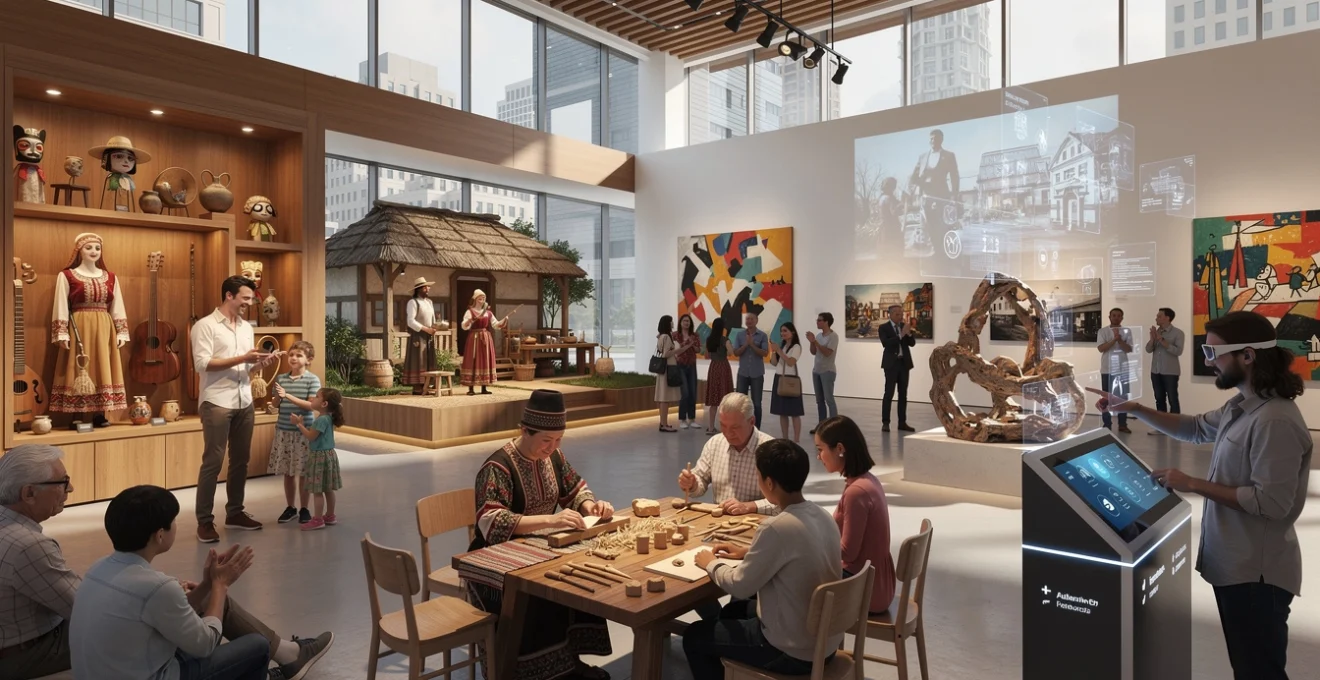
Cultural centres have emerged as vital bridges between communities and their heritage, transforming from simple exhibition spaces into dynamic platforms for cultural exchange and understanding. These institutions play an increasingly important role in helping visitors connect with local identity through immersive experiences, authentic storytelling, and meaningful engagement with regional traditions. Modern cultural centres recognise that heritage is not merely historical artefacts displayed behind glass, but living traditions that continue to shape contemporary communities and their sense of place.
The evolution of cultural interpretation has shifted dramatically towards participatory approaches that emphasise community collaboration and inclusive narratives. Visitor centres and museums are growing into civic laboratories that honour diversity whilst weaving together living heritage and scientific knowledge. This transformation reflects a broader understanding that effective cultural centres must serve as mediators between heritage, communities, and territories, creating spaces where both local residents and international visitors can engage meaningfully with regional identity.
Anthropological museums as custodians of regional heritage and folklore
Anthropological museums represent some of the most sophisticated approaches to preserving and interpreting regional heritage. These institutions have evolved beyond traditional display methods to become active custodians of living culture, employing innovative interpretation strategies that bring folklore and traditional practices into dialogue with contemporary life. The most effective anthropological museums recognise that culture is not static but continues to develop through ongoing community practices and intergenerational knowledge transfer.
Modern anthropological museums increasingly focus on collaborative curation, working directly with community members to ensure authentic representation of their cultural heritage. This approach challenges historical museum practices that often presented cultures through external academic perspectives rather than community voices. Today’s anthropological museums prioritise community-led narratives that allow local people to tell their own stories whilst providing contextual frameworks that help visitors understand the broader significance of regional traditions.
Living history exhibitions at skansen Open-Air museum stockholm
Skansen Open-Air Museum pioneered the concept of living history exhibitions, creating immersive environments where visitors can experience traditional Swedish life through active demonstration and participation. The museum’s approach involves historically accurate reconstructions of buildings, crafts, and daily activities from different periods of Swedish history. Professional interpreters, often dressed in period costume, demonstrate traditional skills such as glassblowing, textile production, and agricultural practices using authentic historical methods.
The success of Skansen’s model lies in its commitment to authenticity combined with accessibility for contemporary audiences. Visitors can observe traditional bread baking in historical ovens, witness seasonal celebrations rooted in Swedish folklore, and engage with craftspeople who maintain traditional skills passed down through generations. This hands-on approach to heritage interpretation creates memorable experiences that help visitors understand how historical practices continue to influence modern Swedish identity.
Interactive ethnographic displays at museum of welsh life st fagans
St Fagans National Museum of History represents a groundbreaking approach to ethnographic display through its integration of historic buildings with interactive cultural programming. The museum has relocated over forty original buildings from across Wales, creating an authentic landscape where visitors can explore centuries of Welsh life. Each building serves as a stage for demonstrating traditional Welsh crafts, customs, and daily practices through expert interpretation and community participation.
The museum’s ethnographic displays excel in their ability to contextualise objects within broader cultural narratives. Rather than presenting artefacts as isolated specimens, St Fagans situates historical objects within reconstructed environments where their original functions and cultural significance become apparent. This approach helps visitors understand how material culture reflects deeper aspects of Welsh identity, from religious practices to social hierarchies and economic relationships that have shaped regional development over centuries.
Traditional craft demonstrations at beamish living museum county durham
Beamish Museum has established itself as a leader in traditional craft demonstration through its comprehensive approach to skills preservation and public engagement. The museum employs master craftspeople who not only demonstrate historical techniques but also train new generations in traditional skills such as blacksmithing, pottery, and woodworking. These demonstrations occur within authentic historical settings, including a working Victorian town, Edwardian farm, and early twentieth-century colliery village.
The craft demonstration programme at Beamish extends beyond simple performance to include educational workshops where visitors can learn basic traditional skills. This participatory approach helps people understand the physical demands and technical expertise required for traditional crafts whilst developing appreciation for the ingenuity of historical communities. The museum’s commitment
to supporting sustainable local economies is evident in its partnerships with regional suppliers and training programmes for apprentices. By positioning traditional craft as both a heritage asset and a viable contemporary livelihood, Beamish helps visitors see how regional identity is continually reshaped through work, skills, and everyday creativity rather than preserved only in static displays.
Indigenous cultural preservation at te papa tongarewa wellington
Te Papa Tongarewa, the national museum of New Zealand, offers a powerful example of how cultural centres can support indigenous cultural preservation while engaging diverse audiences. Its approach to Māori and Pacific heritage foregrounds co-curation, with iwi (tribal) representatives directly involved in decision-making about how taonga (treasures) are cared for, interpreted, and displayed. This shared authority model moves beyond consultation and recognises communities as knowledge holders and partners rather than subjects of study.
The museum’s long-term exhibitions, such as those dedicated to Māori meeting houses and carving traditions, integrate language, oral histories, and performance into their interpretation. Visitors encounter live demonstrations, guided waiata (song) sessions, and storytelling that explain not only what objects are but why they matter within Māori cosmology and community life. In this way, Te Papa functions as both a guardian of material culture and a living platform where indigenous knowledge systems are performed, transmitted, and adapted for future generations.
Te Papa’s approach highlights an important lesson for any cultural centre seeking to help visitors understand local identity: representation must be grounded in relationships. By building long-term partnerships with Māori communities and ensuring that exhibitions respond to changing priorities, the museum demonstrates how cultural institutions can support indigenous sovereignty while still welcoming international visitors. For you as a visitor, this means you do not simply learn about Māori culture from a distance; you are invited into an ongoing conversation about land, language, and identity that continues well beyond the gallery walls.
Contemporary art galleries reflecting modern local narratives
While anthropological museums often focus on historical traditions, contemporary art galleries provide insight into how local identity is experienced in the present. Through commissioned works, community projects, and experimental exhibitions, these institutions offer a space where artists respond to rapid social, economic, and environmental change. Instead of presenting regional culture as something fixed, contemporary art spaces reveal it as a set of evolving narratives shaped by migration, urbanisation, and global connections.
For visitors trying to understand a city or region, contemporary art can act like a sensitive seismograph, registering subtle social tensions and emerging ideas before they appear in mainstream discourse. Whether exploring questions of belonging, climate justice, or digital life, artists often give form to issues residents are struggling to articulate. Cultural centres that foreground these works thus become crucial forums where local communities can see their realities reflected and where outsiders can gain a more nuanced understanding of place than tourism marketing usually offers.
Urban identity expression at tate modern bankside london
Tate Modern, located on London’s South Bank, exemplifies how a major gallery can reflect and shape urban identity. Housed in a former power station, the building itself tells a story of industrial heritage repurposed for cultural life, mirroring the wider regeneration of the surrounding Bankside area. Inside, curated displays of international modern and contemporary art are frequently framed through themes that resonate with Londoners’ lived experience, from migration and protest to architecture and the cityscape.
The Turbine Hall commissions, in particular, offer a stage for large-scale installations that invite public interaction and debate. These works often address questions such as: who has the right to the city, and how can public space remain open and inclusive? By encouraging visitors to walk through, lie on, or contribute to installations, Tate Modern turns abstract conversations about urban identity into embodied experiences. This participatory approach helps you feel how art can reshape your sense of belonging to a complex metropolis.
Beyond the galleries, Tate engages with London’s diverse communities through outreach projects, youth programmes, and collaborations with grassroots organisations. Such initiatives ensure that the narratives on display are informed by multiple voices rather than a single institutional perspective. For cultural centres in other cities, Tate Modern’s evolution suggests that reflecting local identity is not only about exhibiting local artists, but also about asking how the institution itself participates in the life, debates, and inequalities of its urban environment.
Regional artist collectives at baltic centre for contemporary art gateshead
Baltic Centre for Contemporary Art in Gateshead demonstrates how a gallery can anchor itself in regional identity while maintaining an international outlook. Located on the south bank of the River Tyne, Baltic has cultivated strong relationships with communities across North East England, positioning itself as a “good neighbour” as much as a major arts venue. Its programmes frequently feature regional artist collectives whose work grapples with the area’s industrial past, social change, and contemporary cultural diversity.
Community-focused initiatives, such as long-term projects in neighbourhood settings, invite residents to co-create artworks, explore local stories, and reflect on what it means to live in the region today. Baltic’s Neighbourly programme, for example, supports people with experience of migration and displacement through language-learning support, shared meals, and collaborative making sessions. These activities do not simply “add” inclusion onto existing exhibitions; they actively shape the centre’s understanding of North East identity as multilingual, mobile, and interconnected.
The gallery also plays a key role in the Sanctuary and Culture Network, which brings together cultural workers, refugee-led organisations, and volunteers to make the North East a more welcoming place for people seeking sanctuary. By embedding itself in wider regional efforts around social justice and cultural access, Baltic shows how contemporary art can contribute to a more equitable cultural future. Visitors encounter exhibitions that are enriched by these relationships, gaining deeper insight into how communities in the region are redefining belonging, resilience, and solidarity in the twenty-first century.
Community-driven installations at centro de arte reina sofía madrid
Madrid’s Museo Nacional Centro de Arte Reina Sofía is internationally renowned for masterpieces such as Picasso’s Guernica, yet its identity is equally shaped by community-driven installations and socially engaged projects. The museum’s programming often asks how art can respond to Spain’s complex political history and the everyday realities of its urban residents. Through collaborations with neighbourhood associations, activist groups, and independent cultural spaces, Reina Sofía becomes less a static museum and more a civic forum for dialogue.
Community-driven installations frequently address themes such as housing rights, labour struggles, and migration, inviting participants not only as audiences but as co-creators. This could involve workshops where local residents contribute archival materials, oral histories, or creative responses that become part of the exhibition. Such practices help break down the traditional hierarchy between artist, institution, and public, reflecting a more horizontal vision of cultural production aligned with the lived identities of Madrid’s communities.
For visitors, these projects provide an entry point into contemporary Spanish debates that might otherwise remain invisible during a short stay. Instead of encountering only canonical artworks, you engage with installations that speak directly to the city’s ongoing transformations and tensions. Other cultural centres can take inspiration from Reina Sofía’s example by asking: how might our exhibitions change if we treated our neighbours not only as visitors, but as partners in thinking about what our region is and could become?
Digital art interpretations at zkm centre for art and media karlsruhe
The ZKM Centre for Art and Media in Karlsruhe is widely recognised as a pioneer in digital and media art, but it also offers a distinctive model for expressing local identity in a highly networked world. Situated in a former munitions factory, ZKM’s focus on technology, interactivity, and experimentation resonates with the region’s engineering traditions and contemporary innovation ecosystems. Exhibitions explore how digital tools reshape perception, memory, and community, encouraging visitors to reflect on their own mediated experience of place.
Interactive installations often require active participation, from motion-tracking environments to generative soundscapes that respond to visitor movement. This transforms spectators into co-authors of the artwork, mirroring how digital culture allows users to constantly remix and reinterpret local narratives online. The centre’s research labs and residencies further strengthen ties between artists, technologists, and citizens, ensuring that projects are informed by both critical theory and everyday digital practices.
ZKM’s approach suggests that understanding local identity today means acknowledging its entanglement with global networks of data, images, and platforms. For many younger visitors, a sense of “home” is already hybrid—shaped as much by online communities as by physical neighbourhoods. By treating digital art as a serious tool for cultural interpretation rather than a novelty, ZKM offers cultural centres worldwide a blueprint for engaging audiences who increasingly navigate their heritage through screens as well as streets.
Performance venues showcasing authentic regional traditions
Performance venues—from theatres and concert halls to community stages and outdoor amphitheatres—provide some of the most immediate ways for visitors to encounter local identity. Through music, dance, storytelling, and ritual, these spaces present living traditions in real time, allowing audiences to feel the rhythms, accents, and emotional textures that define a region. Unlike static displays, performances unfold in the moment, shaped by the interaction between artists and spectators.
Many cultural centres now integrate performance into their core programming, collaborating with local ensembles, folk groups, and independent artists to curate seasons that reflect both continuity and change. A traditional song reinterpreted with contemporary instrumentation, or a folk dance performed alongside spoken word, can illuminate how communities negotiate between heritage and innovation. For visitors, attending such events offers a kind of “shortcut” to understanding regional identity, much as tasting local cuisine does for culinary culture.
Of course, presenting authentic traditions raises important questions: who decides what counts as “authentic,” and how can institutions avoid turning living practices into staged spectacles? Leading venues address these challenges by involving practitioners in curatorial decisions, providing detailed contextual information, and ensuring that performances remain rooted in community needs rather than solely in tourist demand. When done well, performance programming becomes a powerful, ethical tool for cultural immersion that benefits both local participants and international audiences.
Educational workshop programmes for cultural immersion
Educational workshop programmes are among the most effective strategies cultural centres use to help visitors move from passive observation to active engagement. Rather than simply looking at exhibitions or attending performances, participants learn by doing—trying out traditional crafts, participating in storytelling circles, or taking part in community research projects. This experiential learning deepens understanding because it connects intellectual information with bodily experience and personal reflection.
Workshops can range from short introductory sessions for tourists to long-term courses designed for local residents and schools. Many institutions now prioritise co-designed programmes, inviting community members, educators, and artists to shape content so that it reflects both local priorities and visitors’ curiosity. For example, a museum might work with elders and youth to develop intergenerational workshops on regional folklore, combining archival materials with contemporary digital storytelling tools.
Research on museum education increasingly shows that such immersive programmes can support wellbeing, social cohesion, and a stronger sense of belonging. When you make something with your hands, share a meal, or co-create a mural, you are not just “learning about” a culture—you are temporarily stepping inside its practices and values. For cultural centres, the challenge is to design workshops that are accessible, respectful of participants’ different backgrounds, and flexible enough to accommodate multiple ways of knowing, from academic analysis to oral tradition.
Multilingual interpretation technologies for international visitors
As cultural tourism grows, cultural centres face the challenge of making complex local identities understandable to visitors who may not share the language or cultural references of the host community. Multilingual interpretation technologies have become vital tools in meeting this challenge, allowing institutions to provide tailored content without diluting nuance. When thoughtfully implemented, these technologies act like skilled interpreters at a conversation: they do not simply translate words, but help bridge worldviews.
However, technology alone cannot solve issues of accessibility and representation. Decisions about which languages to include, what stories to prioritise, and how much context to provide all reflect underlying values. If we treat multilingual interpretation as a form of cultural diplomacy, it becomes clear why careful content curation and community involvement are essential. The most successful systems combine technical innovation with human-centred design, ensuring that visitors feel both informed and welcomed rather than overwhelmed by information.
Augmented reality cultural navigation systems
Augmented reality (AR) has emerged as a powerful tool for guiding visitors through cultural centres and heritage sites while layering additional narratives onto physical spaces. By using smartphones or dedicated devices, visitors can see historical reconstructions, animated artefacts, or personal testimonies overlaid on the real environment. This can be particularly effective for illustrating lost buildings, past landscapes, or invisible stories—such as the lives of women, migrants, or workers who left few physical traces.
AR-based cultural navigation systems also allow for highly personalised experiences. Different “tracks” can be offered for families, school groups, or specialist audiences, each highlighting particular themes in multiple languages. Imagine walking through a historic district while hearing local residents’ memories, seeing archival photos pop up in situ, and receiving prompts that encourage you to notice architectural details you might otherwise overlook. In this way, AR turns visitors from passive map-followers into active explorers of layered urban and regional identities.
Yet AR is not a magic solution; it must be used carefully to avoid distracting from direct engagement with sites and communities. Successful cultural centres treat AR as a complement to, not a replacement for, human guides, tactile exhibits, and real-world encounters. When technology is aligned with clear interpretive goals—such as amplifying underrepresented voices or making complex histories easier to grasp—it can significantly enhance both accessibility and emotional connection.
Audio guide multilingual content curation strategies
Audio guides remain one of the most widely used interpretation tools, and advances in mobile technology have made them more flexible than ever. Institutions can now offer app-based guides that support dozens of languages, variable tour lengths, and thematic routes tailored to different interests. The key challenge is not the hardware, but the content strategy: how do you ensure that translations retain nuance, humour, and cultural specificity rather than producing bland, generic explanations?
Leading cultural centres approach audio guide production almost like editing a radio documentary. They script narratives that weave together expert commentary, community voices, and ambient sound to create an immersive auditory landscape. Long-form explanations are balanced with short, evocative stories, allowing visitors to choose their level of depth. For international audiences, glossaries of key local terms or short language learning segments can transform the guide into a mini cultural immersion experience, not just an information delivery device.
From an operational perspective, involving native speakers and cultural mediators in content development and review is non-negotiable. Automated translation can be a useful starting point, but without human oversight it risks introducing errors or cultural misreadings that erode trust. Investing in high-quality, community-informed audio content may seem resource-intensive, yet it pays off in deeper visitor engagement, positive word-of-mouth, and a stronger reputation for thoughtful, inclusive interpretation.
Interactive digital touchscreen information kiosks
Interactive touchscreen kiosks have become ubiquitous in cultural centres, providing flexible platforms for multilingual information, maps, and thematic explorations. When designed with user experience in mind, these kiosks offer visitors an intuitive way to navigate complex buildings, access background materials, and discover lesser-known stories at their own pace. They can present layered content—from concise summaries to in-depth essays—without overwhelming physical wall space.
For international visitors, the ability to switch languages with a single tap and adjust font sizes or contrast levels significantly improves accessibility. Kiosks can also incorporate multimedia elements such as video interviews, digitised archives, and interactive timelines, allowing users to follow their curiosity. One effective analogy is to think of these systems as “cultural search engines” embedded in the building: they help you query the institution’s knowledge base in ways that feel natural and responsive.
However, as with any digital tool, thoughtful content governance is crucial. Without regular updates and community input, kiosks risk becoming static or reflecting only a narrow slice of local identity. Best practice involves establishing clear guidelines for content review, inviting feedback from visitors, and ensuring that underrepresented communities can contribute materials and stories. In doing so, cultural centres can transform what might otherwise be a cold piece of hardware into a dynamic, shared resource for learning and dialogue.
Community collaboration models in cultural centre programming
Across all the examples discussed, one thread remains constant: cultural centres are most effective in helping visitors understand local identity when they are deeply embedded in community life. This requires moving beyond consultation towards genuine collaboration, in which residents, artists, activists, and local organisations participate in shaping programming and decision-making. In practice, this often means rethinking institutional structures, timelines, and measures of success.
Community collaboration models can take many forms, from advisory councils and co-designed exhibitions to long-term partnerships with schools, migrant associations, or elders’ groups. What unites these approaches is a commitment to shared ownership of cultural narratives. When we treat local communities as co-authors rather than audiences, we open up richer, more complex understandings of regional identity—understandings that visitors can then encounter in exhibitions, performances, and digital experiences.
Local stakeholder engagement frameworks
Effective stakeholder engagement begins with mapping who “the community” actually is—a task that quickly reveals how diverse and sometimes divided local populations can be. Rather than relying on a few well-connected voices, cultural centres increasingly adopt structured frameworks that ensure a broad range of stakeholders are involved. This might include rotating advisory panels, open calls for participation, or targeted outreach to groups historically excluded from cultural decision-making.
Many institutions now use tools borrowed from urban planning and participatory research, such as community listening sessions, focus groups, and co-design workshops. These methods not only generate ideas for programming but also surface underlying concerns, from affordability and accessibility to representation and trust. Addressing such issues may not be as visible as a new exhibition, yet it lays the groundwork for more meaningful, sustainable engagement.
To make these frameworks more than symbolic, cultural centres often commit to transparent reporting and feedback loops. For example, they may publish summaries of community input and explain which suggestions were adopted, adapted, or postponed—and why. This level of openness invites ongoing dialogue rather than one-off consultation, helping stakeholders feel that their time and knowledge are valued rather than extracted.
Resident artist programme integration methods
Artist-in-residence programmes can serve as powerful engines for community collaboration when they are integrated into local life rather than operating as isolated studio opportunities. Instead of focusing solely on individual artistic production, many cultural centres now design residencies that include community workshops, collaborative projects, or public research processes. Artists become facilitators and listeners as well as creators, helping surface local stories and perspectives.
Integration methods might involve pairing resident artists with local organisations—such as youth clubs, heritage groups, or refugee support networks—or inviting them to respond to community-defined themes. Clear frameworks, including shared expectations and timelines, help balance artistic freedom with social responsibility. For visitors, the outputs of such residencies often appear as exhibitions, performances, or interventions in public space that carry the imprint of both the artist’s vision and community voices.
One helpful way to think about these programmes is as “temporary laboratories” for reimagining regional identity. Instead of treating local culture as a finished product to be preserved, residencies encourage experimentation and dialogue. When institutions document and share these processes—through talks, publications, or digital platforms—they not only enrich local cultural life but also offer other regions replicable models for collaborative practice.
Intergenerational knowledge transfer workshops
Intergenerational workshops are a particularly impactful form of community collaboration, creating spaces where elders, adults, and young people can learn from one another. In many regions, older generations hold crucial knowledge about dialects, rituals, and everyday practices that may not be recorded in archives. Cultural centres can act as facilitators, inviting elders to share stories, songs, and skills while supporting younger participants in interpreting and re-presenting this knowledge through contemporary media.
These workshops often blend traditional activities—such as cooking, craft, or storytelling—with digital tools like podcasting, video, or interactive mapping. The result is not just preservation, but translation across generations: younger participants reinterpret heritage in ways that speak to their realities, while elders see their experiences valued and carried forward. For visitors, outputs such as community-curated displays or audio installations offer intimate, multi-voiced perspectives on local identity that standard labels rarely convey.
From a social perspective, intergenerational initiatives also combat isolation and age-segregation, strengthening the fabric of community life. The analogy of a “living library” is useful here: each person, regardless of age, is treated as a unique book whose stories enrich the collective understanding of place. Cultural centres that invest in these programmes thus support not only heritage transmission but also empathy, mutual respect, and shared responsibility for the region’s future.
Cross-cultural dialogue facilitation techniques
In increasingly diverse societies, helping visitors understand local identity also means acknowledging that “local” is rarely homogeneous. Cross-cultural dialogue programmes create structured opportunities for people from different backgrounds—long-term residents, newcomers, tourists—to share experiences and perspectives. Cultural centres often host these conversations in the form of moderated discussions, storytelling circles, or collaborative art-making sessions that use creative tasks to lower barriers and build trust.
Effective facilitation techniques emphasise active listening, clear ground rules, and the use of prompts or objects to spark conversation. For example, participants might bring an item that represents “home” to them, then explain its significance to the group. Such exercises highlight both differences and unexpected connections, making visible how multiple identities coexist within the same neighbourhood or region. Skilled facilitators are crucial, as they help navigate sensitive topics such as discrimination, memory, and belonging without shutting down dialogue.
For visitors, participating in or observing cross-cultural programmes can offer insights that no guidebook can match. Instead of receiving a single, official version of local identity, you encounter a mosaic of voices negotiating what that identity means in practice. When cultural centres document these processes and translate their lessons into exhibition content, interpretation strategies, or policy recommendations, they contribute not only to cultural understanding but also to more inclusive public discourse.