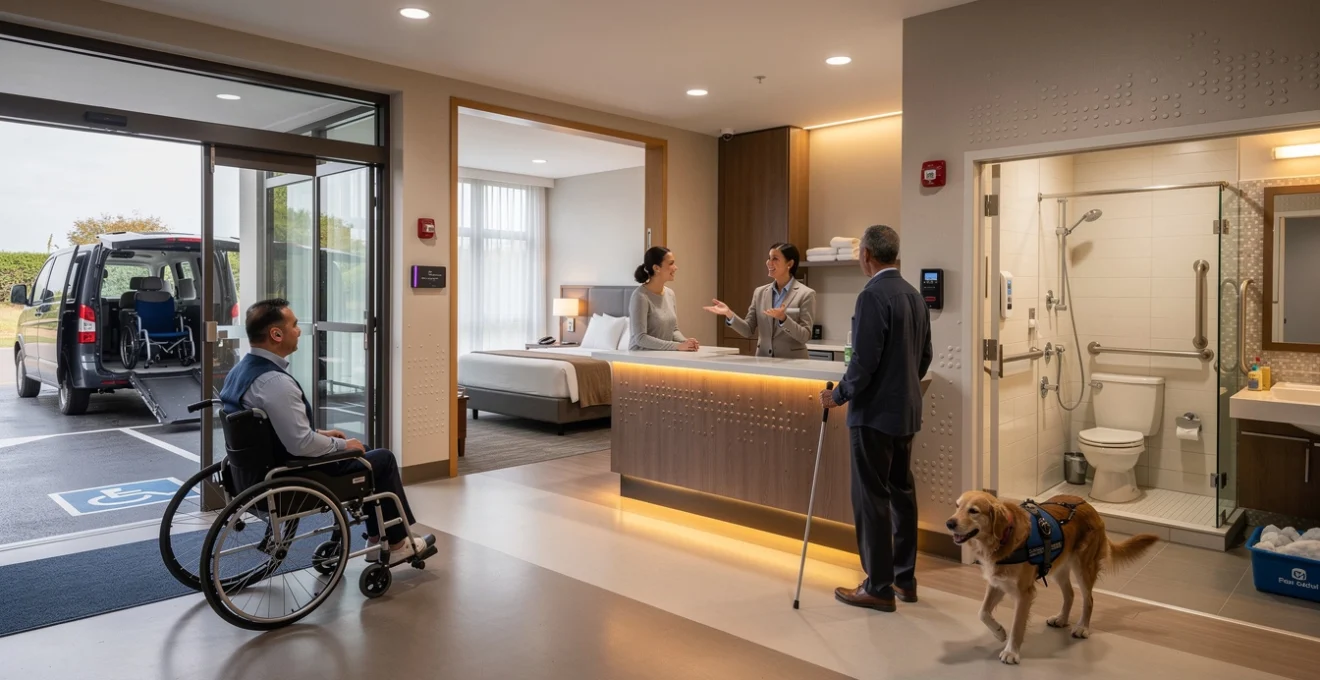
When planning your next getaway, the excitement of discovering new destinations can sometimes overshadow the critical importance of ensuring your accommodation meets essential accessibility standards. With over one billion people worldwide living with disabilities and an increasingly ageing global population, the demand for truly accessible hotel rooms has never been more pressing. Yet despite international regulations and growing awareness, many travellers still encounter significant challenges when attempting to secure appropriate lodging that genuinely meets their needs.
The statistics paint a concerning picture: 96% of travellers requiring accessible rooms have experienced issues with their accommodation upon arrival. This sobering reality highlights the gap between advertised accessibility features and the practical requirements of guests with diverse needs. The accessible tourism market represents not only a moral imperative but also a substantial economic opportunity, with disabled travellers and their companions contributing billions to the global travel economy annually.
Understanding what constitutes genuine accessibility goes far beyond basic compliance with disability legislation. It requires a comprehensive evaluation of mobility features, sensory accommodations, communication systems, and digital accessibility standards. Whether you’re travelling with mobility equipment, managing visual or hearing impairments, or supporting someone with cognitive differences, knowing which features to prioritise can transform your travel experience from potentially frustrating to genuinely enjoyable.
Mobility accessibility standards: ADA compliance and international guidelines
The foundation of accessible lodging begins with robust mobility accessibility standards that extend far beyond basic wheelchair access. International guidelines such as the Americans with Disabilities Act (ADA) in the United States, the Equality Act in the UK, and the European Accessibility Act establish minimum requirements that properties must meet. However, understanding these standards empowers you to evaluate whether a hotel truly accommodates your specific mobility needs or merely meets legal minimums.
Modern accessibility compliance requires hotels to provide a specific percentage of accessible rooms distributed across multiple floors and room categories. In the United States, properties with 50 rooms must offer at least two accessible units, whilst larger establishments must provide accessible options representing 4% of their total inventory. European standards vary by country but generally follow similar proportional requirements, ensuring guests with disabilities enjoy the same variety of accommodation choices as other travellers.
Wheelchair-accessible room dimensions and manoeuvring space requirements
Effective wheelchair accessibility demands precise spatial considerations that go beyond simply widening doorways. Standard accessible rooms must provide clear floor space measuring at least 150cm by 150cm to accommodate wheelchair turning circles. Additionally, corridors within rooms should maintain a minimum width of 90cm, allowing comfortable navigation between furniture and fixtures without the risk of becoming trapped or requiring assistance.
The positioning of furniture plays a crucial role in creating genuinely accessible spaces. Beds should offer clear access on both sides, with at least 90cm of maneuvering space alongside and at the foot of the bed. This configuration enables independent transfers from wheelchairs whilst providing adequate room for caregivers to assist when necessary. Adjustable bed heights represent the gold standard, allowing customisation for different transfer preferences and mobility equipment requirements.
Roll-in shower specifications and grab bar installation standards
Bathroom accessibility often determines the success or failure of an accessible accommodation experience. Roll-in showers must feature zero-threshold entry with appropriate floor drainage to prevent water accumulation outside the shower area. The shower space itself should measure at least 90cm by 150cm to accommodate wheelchairs comfortably, with reinforced walls capable of supporting grab bars rated for at least 135kg of force.
Grab bar placement follows specific protocols designed to maximise safety and independence. Horizontal bars should be installed 85cm from the floor, whilst vertical bars are positioned 180cm above the floor on the side wall. Shower seats, whether fold-down or removable, must support at least 115kg and be positioned at a height of 43cm to 48cm from the floor. Handheld showerheads with flexible hoses provide essential flexibility for users with varying reach capabilities.
Accessible parking proximity and surface material considerations
The accessibility journey begins before you even enter the hotel, making parking provisions critically important. Designated accessible parking spaces should be located as close as possible to accessible entrances, ideally within 60 metres of the main lobby. These spaces must measure at least 350cm wide with an additional
cross-hatched access aisle of at least 150cm. Surface materials should be firm, stable and slip-resistant, avoiding loose gravel, uneven cobblestones or steep cambers that make wheelchair propulsion unsafe or exhausting. Where possible, covered parking or sheltered drop-off zones protect guests from rain while transferring mobility equipment or loading luggage, which can be particularly important for travellers who need extra time to get in and out of vehicles.
When assessing accessible parking before you book, check whether the hotel provides a step-free route from the parking bay to the main entrance and whether kerbs are ramped at logical crossing points. Photos on the hotel’s website – or those uploaded by previous guests – can help you verify that the accessible parking spaces are not routinely blocked, used for storage or located on a steep slope. If you rely on a wheelchair-accessible vehicle, it’s also worth confirming that there is enough vertical clearance for roof boxes, hoists or rear-entry ramps.
Lift and elevator capacity for mobility equipment transport
Elevator access can make or break a stay for guests using wheelchairs, scooters or other mobility aids. Modern accessibility guidelines recommend lift cars at least 110cm deep and 140cm wide, with doors that clear a minimum of 90cm, allowing safe entry and exit without complex manoeuvring. The lift’s weight capacity should comfortably accommodate a powered wheelchair and at least one accompanying person, typically 630kg or more in larger hotels and resorts.
Control panels should be placed between 90cm and 120cm from the floor and set back from corners so that guests can reach them from a seated position. Tactile buttons, clear labelling and audible floor indicators further support both mobility and sensory accessibility. Before you book, ask whether all guest floors – including restaurants, gyms and pool areas – are served by at least one accessible lift, and whether there is a contingency plan if that lift goes out of service, such as alternative routes or priority repair contracts.
Visual impairment accommodation features in hotel properties
For travellers who are blind or have low vision, an accessible hotel stay depends on more than just step-free access. Visual impairment accommodation features help guests orient themselves, move confidently through corridors and use in-room amenities without constant assistance. When browsing options, it’s worth looking beyond generic claims of “visually impaired friendly” to identify concrete features that support safe and independent navigation.
Think of these measures as a guidance system layered over the physical building: tactile cues, clear audio information and high-contrast design all work together so that you do not have to rely solely on sight. By checking for specific visual accessibility features before booking, you minimise guesswork and reduce the risk of arriving at a property that feels confusing, disorienting or unsafe.
Braille signage and tactile wayfinding systems implementation
Braille signage and tactile wayfinding systems act like a map under your fingertips, helping you navigate unfamiliar spaces with confidence. In well-designed properties, room numbers, lift controls, floor directories and emergency exits are all marked in both raised print and Braille, placed consistently at about 140cm from the floor on the latch side of doors. Corridors may also feature tactile markers, such as textured floor strips at junctions or raised symbols on handrails, indicating changes in direction or the location of facilities like lounges and restrooms.
When researching hotels, check photos for close-ups of door signage and lift buttons, or email the property to ask whether Braille and raised-letter signs are installed throughout, not just in the lobby. Some newer hotels complement tactile signs with audio wayfinding apps or beacon-based systems that provide step-by-step spoken directions via your smartphone. If you rely heavily on tactile information, asking whether guest directories, menus and safety instructions are available in Braille or embossed large print can make a big difference to your experience.
Audio-visual fire alarm integration and emergency notification protocols
Emergency notifications must reach every guest, regardless of their level of vision. For travellers with visual impairments, integrated audio-visual fire alarm systems, combined with clear staff protocols, provide essential reassurance. In guest rooms and corridors, alarms should emit distinct, high-contrast sounds that cut through ambient noise, supported by spoken announcements where local regulations allow. In some properties, vibrating pillow pads or bed shakers can be paired with the alarm system to provide an additional tactile alert during the night.
Ask hotels how they ensure guests with visual impairments receive timely information during evacuations. Do staff receive specific training on guiding blind or low-vision guests along safe routes? Are stairwells equipped with handrails on both sides and non-slip, high-contrast nosings on each step? Well-prepared hotels will be able to explain their emergency notification protocols clearly and may even note that they log your accessibility needs in the booking so night staff know who might require assistance.
Guide dog accommodation policies and service animal relief areas
For many travellers, guide dogs and other service animals are essential mobility aids, not optional companions. Most major hotel brands now have service animal-friendly policies, but the clarity and consistency of those policies can vary. When you book, confirm in writing that recognised service animals are welcome in all public areas, including restaurants and lounges, and that no additional cleaning or pet fees will be charged for their stay.
A truly accessible property will also provide practical facilities such as a safe, well-lit relief area close to an accessible entrance, ideally with grass or another comfortable surface and a waste bin nearby. Some hotels go further by offering water bowls at reception or providing a small welcome mat and space for the dog’s bed in the room. Because misunderstandings do still occur, especially in smaller or independent properties, keeping a copy of local service animal legislation on your phone and asking the hotel to note your guide dog in the reservation can help prevent awkward check-in conversations.
High-contrast design elements and low-vision support features
High-contrast design helps guests with low vision distinguish edges, objects and pathways much more easily, in the same way that bold print makes a document easier to read. Look for hotels that use contrasting colours between floors and walls, door frames and doors, and furniture and surrounding surfaces. For example, dark handrails against light walls or a darker bedspread against lighter sheets make key features easier to locate without straining.
Supportive lighting is equally important. Adjustable bedside lamps, bright but glare-free corridor lighting and illuminated switches allow you to tailor the environment to your vision needs. In guest rooms, large-print information folders, TV remotes with clear, high-contrast buttons and thermostats with big, legible numbers make independent use simpler. If online photos show dim, atmospheric lighting everywhere, it may be worth asking whether brighter lighting options are available in rooms on request.
Hearing accessibility technology and communication support systems
For guests who are deaf or hard of hearing, hotel accessibility hinges on visual communication and vibration-based alerts rather than sound. While many properties now advertise “hearing-accessible rooms”, the actual equipment provided can vary from a single visual fire alarm to a comprehensive communication kit. Knowing which hearing accessibility technology to look for helps you separate marketing language from meaningful support.
Hearing-friendly hotel features serve more than a legal function; they reduce anxiety about missing important information, from fire alarms to room service knocks. Much like subtitles make a film accessible to a wider audience, visual and tactile alerts make the entire lodging experience clearer and more inclusive for everyone, including guests who sleep heavily or remove hearing aids at night.
TTY phone equipment and video relay service connectivity
Text telephones (TTY) and access to video relay services (VRS) remain important tools for many deaf and hard-of-hearing travellers, especially when dealing with complex issues such as billing questions or local travel arrangements. Some hotels provide in-room TTY devices on request, either as standalone units or as part of a portable hearing accessibility kit. Others ensure that front-desk lines can be reached via national relay services, allowing you to communicate in real time with staff through a qualified interpreter.
Before your stay, ask whether the hotel can supply a TTY phone or support communication through your preferred relay platform. Increasingly, properties are adopting web-based chat tools and messaging apps that allow you to bypass the phone entirely, which can be particularly useful if you prefer to communicate in writing. If you use sign language, check whether the hotel has any arrangements with remote interpreting services, so staff can quickly connect to a video interpreter if needed.
Assistive listening device compatibility in conference facilities
If you are attending a conference, wedding or meeting, the accessibility of the hotel’s event spaces matters just as much as your room. Assistive listening systems, such as induction loops, FM systems or infrared transmitters, amplify speech and reduce background noise for guests using hearing aids or cochlear implants. Well-equipped venues will have fixed loops at reception desks and portable systems available for meeting rooms or ballrooms.
When evaluating a property for events, ask whether their conference facilities are compatible with telecoil-enabled hearing aids and whether staff know how to operate the equipment. It can help to request photos of microphones, receivers and any signage indicating loop zones, as these details often reveal how frequently the system is used. If you’re organising a group booking, including assistive listening requirements in your event contract ensures the hotel understands that these features are not optional extras.
Visual alert systems for door notifications and emergency signals
Visual alert systems replace or supplement traditional auditory cues with lights and vibrations so that guests don’t miss key signals when they remove hearing devices. In a well-designed hearing-accessible hotel room, you will typically find flashing light indicators linked to the doorbell or door knock, visual fire alarms with strobe lights, and in some cases, vibrating bed shakers that activate during emergencies. These systems ensure that you can sleep or shower without worrying that you might miss an urgent announcement.
If the hotel lists “hearing-accessible rooms”, ask for a breakdown of what that actually includes. Are there separate indicators for door knocks and fire alarms? Is the alarm strobe bright enough to wake someone in a dark room? Because standards can differ widely, looking for guest-uploaded photos of alarm units or accessibility kits can provide extra reassurance that the room offers the full range of visual alert systems you need.
Staff BSL training programmes and deaf culture awareness
Technology alone cannot guarantee a smooth experience if staff lack basic Deaf awareness. Some hotels invest in British Sign Language (BSL) or local sign language training programmes, ensuring that at least a few team members can handle simple check-in conversations, directions and emergency explanations without relying entirely on written notes. Even when staff are not fluent signers, short training courses on Deaf culture awareness can transform everyday interactions.
You can often gauge a property’s commitment by the way they describe their training on their website or in accessibility statements. Do they mention ongoing Deaf awareness workshops, or simply a one-off session? Are front-desk and security teams included? Before you book, don’t hesitate to ask how the hotel usually communicates with Deaf guests and whether they can provide written materials, SMS updates or on-demand interpreting if needed. Clear, respectful communication makes it far easier to resolve any issues that arise during your stay.
Cognitive and neurological accessibility accommodations
Guests with cognitive or neurological differences – such as autism, ADHD, dementia or brain injuries – may experience hotels very differently from how designers imagine them. Busy lobbies, complex floor plans and flashing signage can quickly become overwhelming. Cognitive accessibility focuses on making spaces easier to understand, predict and navigate, reducing stress and sensory overload for travellers who process information in diverse ways.
When you are comparing accommodation options, consider how straightforward the guest journey appears. Are directions clear and consistent, or do they rely on abstract artwork and themed signage? Are check-in procedures simple, with the option to complete forms in advance? Properties that publish detailed, plain-language accessibility guides, including photos of key spaces, often signal a stronger understanding of neurodivergent guests’ needs.
Sensory-friendly features can be particularly valuable, such as quieter rooms away from lifts and bars, blackout curtains, and the option to reduce housekeeping visits to avoid unexpected knocks. Some hotels now offer “calm kits” with items like ear defenders, weighted blankets or fidget tools, recognising that managing sensory input is as important as physical access. If you or someone you travel with is sensitive to noise or light, asking for a room facing away from traffic or entertainment areas can significantly improve sleep and overall comfort.
Clear information design is another key element of cognitive accessibility. Simple, step-by-step instructions for using room controls, clear pictograms on signage and uncluttered décor help reduce cognitive load, much like a well-organised desktop helps you focus at work. When hotels provide pre-arrival information with photos of the lobby, lifts and breakfast area, it allows guests to rehearse the space mentally in advance, which can ease anxiety and make the first day of the trip feel much less overwhelming.
Accessible bathroom design: universal features and adaptive equipment
Accessible bathroom design often determines whether a hotel stay feels liberating or limiting. For travellers with mobility, sensory or cognitive needs, bathrooms must combine robust safety features with intuitive layouts. Universal design principles aim to create spaces that work for as many people as possible, whether that means a wheelchair user transferring to a shower seat or an older guest who simply finds standing for long periods difficult.
Key universal features include level-access, roll-in showers with non-slip flooring, grab bars positioned near toilets and within showers, and thermostatic controls that prevent sudden temperature changes. Controls and fixtures should be easy to operate with one hand and minimal grip strength – think lever handles instead of round knobs, and mixer taps instead of separate hot and cold. Adequate turning space, usually at least 150cm in diameter, allows wheelchair users to manoeuvre without risky three-point turns.
Adaptive equipment can further tailor accessible bathrooms to individual needs. This might include height-adjustable or wall-mounted shower seats, removable shower chairs, raised toilet seats, or portable hoists where ceiling tracks are not available. Some hotels keep a small inventory of such equipment that can be delivered to different rooms on request, rather than limiting all features to a single “accessible” room type. When you book, asking whether they have photos and measurements of the bathroom, including the distance between fixtures, helps you decide if your own equipment will fit.
Lighting, contrast and acoustics also play important roles in bathroom accessibility. Bright, even lighting reduces shadows that can confuse depth perception, while contrasting colours between walls, floors and fixtures make toilets, grab rails and basins easier to identify for guests with low vision. Quiet extractor fans and soft-close toilet seats help create a calmer environment for people who are sensitive to sudden noises. Ultimately, an accessible bathroom should feel like a safe, predictable space where you can manage basic routines without fear of slipping, tripping or needing unplanned assistance.
Digital accessibility: website compliance and booking platform usability
The accessibility journey now begins long before you roll through the lobby doors. For many travellers, the hotel website or booking platform is the first real test of how seriously a property takes inclusive design. If you struggle to navigate cluttered pages, inaccessible booking forms or vague room descriptions, it’s a warning sign that physical accessibility may not be much better. Digital accessibility ensures that guests using screen readers, keyboard navigation or other assistive technologies can research and reserve rooms with the same independence as anyone else.
Look for websites that follow recognised standards such as the Web Content Accessibility Guidelines (WCAG) 2.1, which cover everything from colour contrast and font size to alternative text for images and consistent heading structures. A genuinely accessible booking experience will let you filter for specific features – like roll-in showers, hearing-accessible rooms or step-free entrances – rather than relying on a single generic “accessible” label. Clear, detailed descriptions and up-to-date photos of accessible rooms, bathrooms and entrances are especially valuable when you are comparing properties in a new city.
Usable booking platforms also minimise cognitive overload by keeping forms simple, breaking long processes into clear steps and offering multiple ways to contact the property for clarification, such as live chat, email and phone. Some hotel groups now integrate accessibility questionnaires into the booking flow, allowing you to specify needs such as bed height preferences, proximity to lifts or fridge access for medication storage. This approach turns the booking process into a dialogue rather than a guessing game.
If you encounter a website that seems difficult to navigate with assistive technology, consider sending constructive feedback or asking whether there is an alternative accessible booking route. Many hotels are still on a learning curve with digital accessibility, and guest feedback can accelerate improvements. By choosing to support properties that invest in both physical and digital accessibility, you not only secure a smoother stay for yourself but also help push the industry toward more inclusive standards for every traveller.