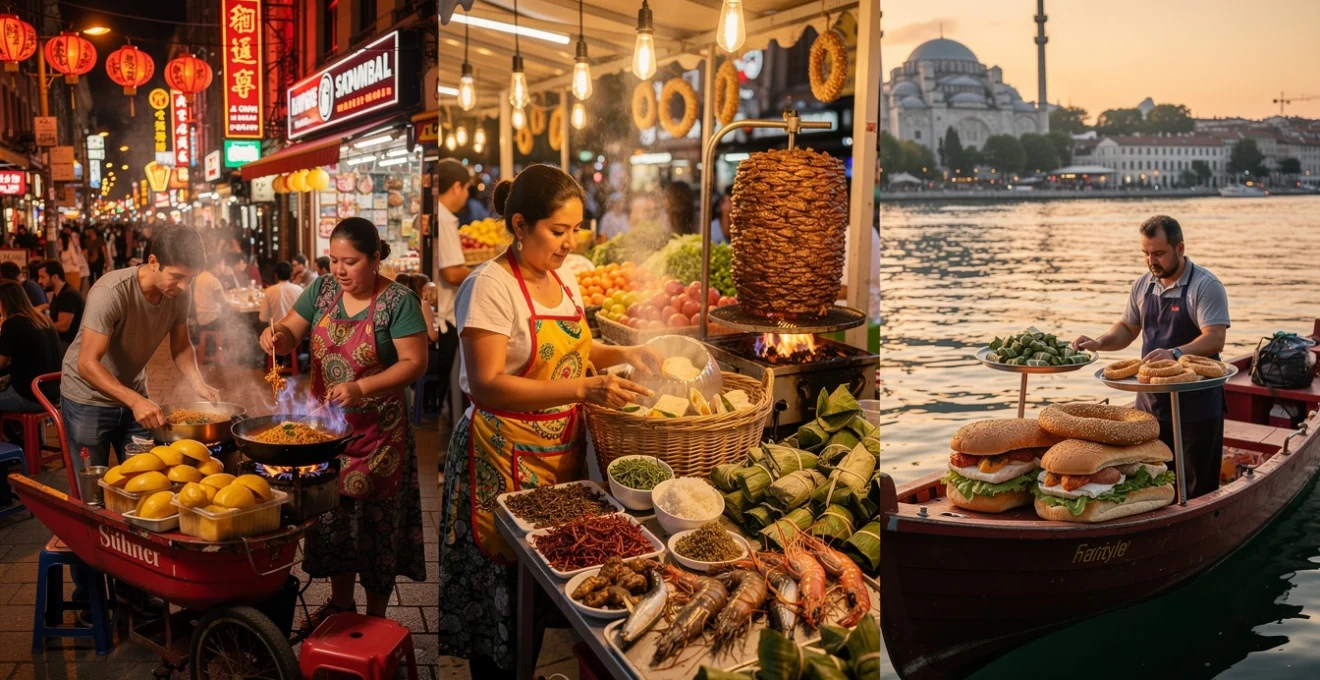
Street food represents one of the most authentic and immediate ways to understand a city’s culture, history, and daily rhythms. Unlike restaurants that cater to tourist expectations or fine dining establishments that reinterpret tradition through a chef’s vision, street food vendors operate within tight constraints of space, equipment, and economics that demand both technical mastery and absolute consistency. The result is often food that tastes exactly as it should—prepared with methods refined across generations, using ingredients sourced from the same suppliers for decades, and served to customers who return not because of novelty but because of familiarity. For travelers willing to eat where locals eat, street food offers a window into how a place truly lives, one meal at a time.
What distinguishes the world’s great street food cities is not merely the availability of inexpensive meals on sidewalks or in markets. It is the depth of culinary knowledge embedded in every transaction, the pride vendors take in their craft, and the social infrastructure that supports outdoor eating as a cultural norm rather than a convenience. In these cities, street food is not a compromise or a quick option before returning to “real” restaurants—it is the main event, the place where you will find the most honest expression of regional cuisine, and often the most memorable meals of your journey.
Bangkok’s yaowarat road: navigating thailand’s legendary chinatown night market
Bangkok’s Yaowarat Road transforms each evening into one of the most concentrated street food experiences on earth. As daylight fades, vendors roll out carts, fire up woks, and begin preparations that will continue until dawn. The district’s Chinese-Thai heritage creates a culinary landscape distinct from other Bangkok neighborhoods, with Cantonese techniques meeting Thai ingredients in dishes that exist nowhere else. Navigation requires patience—streets are narrow, crowds are dense, and the most acclaimed vendors often have no signage beyond a faded umbrella or a cluster of plastic stools.
Understanding Yaowarat’s layout improves the experience considerably. The main thoroughfare runs roughly east-west, with the highest concentration of vendors between Odeon Circle and the intersection with Charoen Krung Road. Side streets like Plaeng Nam Road and Soi Texas host specialized vendors focusing on specific dishes. Arriving before 7 PM allows you to secure seating before peak crowds arrive, though some of the most interesting vendors only begin operations after 9 PM when the dinner rush subsides and late-night workers emerge.
Guay teow reua: sourcing authentic boat noodles from lek & rut vendors
Boat noodles derive their name from the floating vendors who once sold them from small boats along Bangkok’s canals. The modern street version maintains the traditional small serving size—originally designed to be consumed quickly while standing—and the distinctively dark, concentrated broth. What makes a bowl authentic is not merely the ingredients but the ratios: blood (usually pork blood, though some vendors use beef) thickens the broth and provides an iron-rich depth, while palm sugar balances the fermented bean paste and fish sauce that form the flavor foundation.
At established Yaowarat vendors like Lek and Rut, you will notice customers ordering multiple bowls at once. This practice stems from the original serving size, which was intentionally small to keep prices low and allow customers to try variations. A single bowl contains perhaps six spoonfuls of broth and a handful of noodles. Serious eaters order four or five bowls, mixing beef and pork options, adding varying amounts of the condiment tray offerings—dried chili, sugar, fish sauce, and vinegar with chilies. The customization is part of the ritual, and watching how locals adjust their bowls provides insight into regional taste preferences.
Pad thai pratu phi: mastering the ghost gate’s Century-Old wok techniques
The vendors near Pratu Phi, or Ghost Gate, represent some of Bangkok’s oldest continuously operating pad thai stands. What distinguishes their versions from tourist-oriented pad thai elsewhere in the city is the wok technique and the quality of tamarind paste. Authentic pad thai requires a specific sequence of ingredient addition and precise heat control to achieve the characteristic slightly charred flavor without burning the sauce. The tamarind paste
paste used by these stalls is notably more concentrated than in many modern interpretations, which allows the noodles to be fried over fierce heat without the sugar burning.
Watching the wok station at Pad Thai Pratu Phi is like observing a tightly choreographed dance. Oil goes in first, followed by shallots and dried shrimp, then tofu and preserved radish, with the cook constantly adjusting the pan’s position over the charcoal or gas flame. Eggs are cracked directly into the wok and briefly scrambled before the soaked rice noodles are added and tossed to coat. Only once the noodles have absorbed some heat does the cook add the tamarind-based sauce and a splash of stock, allowing the liquid to caramelize around the strands rather than pooling in the bottom. Peanuts, bean sprouts, garlic chives, and lime are added off-heat, ensuring they retain texture and freshness.
For travelers keen to understand why some pad thai tastes flat while other versions sing, paying attention to these micro-steps is instructive. A well-seasoned carbon-steel wok, high BTU output, and the willingness to discard any portion that overcooks are non-negotiable. You will often see the cook tasting the sauce directly from a ladle and tweaking the balance of tamarind, fish sauce, and palm sugar throughout the night as temperature and evaporation change the reduction. If you arrive during the quieter pre-dinner window, you may even be able to stand close enough to feel the heat from the wok and appreciate just how much control is required to turn out hundreds of plates with identical char and chew.
Mango sticky rice at mae varee: understanding khao niao mamuang’s seasonal variations
Mango sticky rice, or khao niao mamuang, is deceptively simple: glutinous rice, coconut milk, sugar, salt, and ripe mango. At Mae Varee in Thonglor, arguably Bangkok’s most famous mango sticky rice shop, the difference lies in the rice texture and the vendor’s nuanced understanding of mango seasonality. Thailand produces several dessert mango varieties, including Nam Dok Mai and Ok Rong, and Mae Varee adjusts its sourcing throughout the year to maintain a consistent level of sweetness and perfume. This is why the quality of mango sticky rice can vary dramatically between monsoon and dry seasons if vendors do not adapt.
The sticky rice itself is soaked for hours, then steamed rather than boiled, which preserves individual grain integrity while allowing full absorption of the coconut syrup. Mae Varee’s coconut mixture is heated only until just below a simmer to prevent the fat from separating, then poured over the hot rice and left to rest so the starch can swell and trap the flavor. A pinch of salt is crucial, balancing the sweetness in the same way a good ceviche relies on salt to sharpen citrus. When you receive your portion, notice how the rice holds its shape yet yields easily to the spoon—this balance is the hallmark of a well-controlled steaming and soaking process.
If you visit multiple times across the year, you can track subtle shifts in flavor profile as different mango varieties come into peak season. Early-season fruits might be firmer with a tangier edge, while late-season Nam Dok Mai can taste almost like floral honey. Asking which farm the mangoes are from is not a faux pas; vendors are often proud of longstanding supplier relationships and will happily explain why a particular batch is considered special. For travelers, this attention to fruit provenance is a reminder that even the most iconic Thai street desserts are deeply tied to agricultural calendars.
T&K seafood’s grilled river prawns: sustainable chao phraya sourcing methods
Seafood in Bangkok can be a fraught topic, with concerns about freshness, sourcing, and sustainability often overshadowed by the spectacle of overflowing platters. On Yaowarat Road, T&K Seafood has built a reputation not just for generous portions of grilled river prawns and shellfish, but also for relatively transparent sourcing practices. River prawns, once abundant in the Chao Phraya and its tributaries, are now increasingly farmed in controlled ponds to reduce pressure on wild stocks. T&K works with suppliers in central Thailand who rotate ponds and monitor water quality, an approach that, while not perfect, represents a step away from indiscriminate trawling.
When ordering grilled river prawns, pay attention to size and shell condition. Large prawns with intact, glossy shells and firm heads are a sign of rapid processing from farm to grill. The cooking technique is straightforward but unforgiving: prawns are split along the back, brushed with a neutral oil, and set over charcoal so that the shell conducts heat while the flesh steams in its own juices. Overcooking turns the prized head fat grainy and dry; experienced grillers at T&K will line prawns along cooler edges of the grate, rotating frequently to ensure even heat distribution.
From a responsible travel perspective, it is worth asking about the origin of seafood when you sit down, particularly with high-demand items like squid, crab, and prawns. While not every vendor will have detailed answers, the very act of asking signals that visitors care about sustainable seafood. You can also prioritize lower-trophic species—such as mussels and small clams—which have a lighter environmental footprint compared to larger predatory fish. In a city where seafood is central to the street food experience, small individual choices like these help support vendors who are trying to balance tradition with modern environmental realities.
Mexico city’s mercado de san juan: gourmet street cuisine beyond conventional taquerías
In Mexico City, street food extends far beyond late-night tacos and sidewalk quesadillas. Mercado de San Juan, located a short walk from the historic center, has evolved from a traditional produce market into a hub for gourmet street cuisine and rare ingredients. Chefs from some of the city’s most celebrated restaurants shop here alongside home cooks and curious travelers, sourcing everything from wild mushrooms and game meats to imported cheeses. Unlike more chaotic markets, San Juan is compact and relatively organized, which makes it an ideal place to explore Mexico City’s food culture in a concentrated space.
What sets the market apart is its blend of high-end products and informal dining. Stallholders who once sold only raw ingredients now prepare tasting plates and small dishes that blur the line between market stall and restaurant. You can move from a counter offering cured meats and Spanish-style tapas to another serving tostadas topped with fresh sea urchin or raw tuna, all eaten standing up with a plastic plate and a paper napkin. For travelers, Mercado de San Juan offers a window into how Mexico City’s street food scene has responded to global culinary trends without losing its essential casualness.
Tacos de canasta from doña emi: Steam-Basket preservation techniques for street vendors
Tacos de canasta—literally “basket tacos”—are a masterclass in low-tech food preservation. Vendors like Doña Emi, who supplies workers and students across central Mexico City, prepare hundreds of soft tacos in the early morning, then stack them in a cloth-lined basket and pour hot oil or fat over the top. The basket is then sealed and sometimes insulated with plastic or additional cloth, creating a warm, humid environment that keeps the tacos at a safe serving temperature for several hours. This technique allows itinerant vendors to sell high-volume, low-cost food without access to refrigeration or on-site cooking equipment.
Each taco is typically filled with one of a handful of classic options—potato with chili, refried beans, chicharrón in salsa, or adobo-seasoned pork—and the fillings are cooked to a slightly drier consistency than you might find in a taquería. This is intentional: excess moisture would compromise the tortilla structure during the steaming process. By the time you lift a taco from the basket, it has absorbed some of the infused oil and steam, becoming soft, almost confited. Salsas and pickled chiles are always added at the point of sale to avoid diluting the interior environment.
If you want to experience Doña Emi’s tacos at their best, arrive mid-morning when the basket is still heavy and the tacos are near peak temperature. By early afternoon, popular vendors often sell out completely—an organic form of portion control that reduces food waste and ensures nothing sits in the danger zone for too long. For travelers intrigued by the logistics of street food safety, tacos de canasta represent an ingenious, centuries-old solution adapted to urban working life.
Chapulines and escamoles: prehispanic entomophagy in contemporary urban settings
Chapulines (toasted grasshoppers) and escamoles (ant larvae) are among the most emblematic examples of Mexico’s prehispanic entomophagy traditions, and Mercado de San Juan is one of the easiest places to sample them in a controlled, urban environment. Far from being novelty items, insects have long been valued in central Mexico for their protein density and unique flavors. Chapulines are usually seasoned with lime, garlic, and chili, then toasted on a comal until crisp. Their texture is closer to that of a nut or seed than an animal protein, which is why vendors often suggest sprinkling them over guacamole or folding them into a warm tortilla.
Escamoles, sometimes referred to as “Mexican caviar,” are more delicate and usually sautéed with butter, epazote, and garlic, then served in tacos or alongside scrambled eggs. Their harvesting is labor-intensive, associated with specific seasons and highland agave environments, which explains the premium price. For many travelers, the hurdle is psychological rather than sensory: once you set aside the knowledge that you are eating larvae, the flavor is mild and slightly nutty, with a texture similar to cooked couscous or soft barley.
Sampling chapulines and escamoles at San Juan also opens a conversation about sustainability. Compared with conventional livestock, insect production requires fewer resources and produces lower greenhouse gas emissions. As global interest in alternative proteins grows, Mexico City’s everyday street food culture offers a lived example of how insects can be integrated into familiar formats—tacos, tostadas, garnishes—without fanfare. If you are unsure where to start, many vendors will offer a small tasting spoonful, allowing you to engage with this aspect of Mexico’s culinary heritage at your own pace.
El fogoncito’s al pastor: vertical trompo roasting and Lebanese-Mexican fusion origins
Tacos al pastor have become so synonymous with Mexico City that it’s easy to forget their relatively recent, immigrant origins. El Fogoncito, one of the chains that popularized the style in the mid-20th century, draws a direct line between Lebanese shawarma and the pork-based trompo now seen on street corners citywide. At its core, al pastor is an exercise in controlled vertical roasting: thin slices of marinated pork are stacked around a metal spit, often with a pineapple on top, and rotated slowly in front of a gas or charcoal heat source. As the exterior cooks and caramelizes, taqueros slice off ribbons of meat to order, achieving a mix of crisped edges and juicy interior.
The marinade is where regional variation emerges. Achiote paste, dried chilies, vinegar, and spices such as cumin and oregano form the base, but each vendor guards their exact ratios. At El Fogoncito, the marinade leans slightly sweeter and more aromatic, a nod to Levantine spice profiles. The trompo itself must be balanced carefully: if the stack is uneven, certain areas will burn while others remain undercooked. Experienced taqueros constantly adjust the distance between meat and flame, manipulating the drip of rendered fat to baste lower layers.
When you stand at the counter and watch a taco al pastor being assembled, pay attention to the speed and precision of the motions. A skilled taquero will slice a thin shard of pineapple in the same stroke as the meat, flipping it into the tortilla without losing momentum. Salsas, onions, and cilantro are added almost unconsciously, the result of thousands of repetitions. In a city where hundreds of vendors compete for late-night business, these small technical differences in roasting and assembly can determine which stand becomes a neighborhood institution and which fades into anonymity.
Tamales madre at mercado jamaica: masa nixtamalization and regional wrapping variations
Mercado Jamaica, best known for its 24-hour flower stalls, also hosts some of the city’s most respected tamal vendors, including those operating under the informal banner of “Tamales Madre.” What distinguishes these tamales from mass-produced versions is the use of freshly nixtamalized masa. Nixtamalization—the process of soaking and cooking maize in an alkaline solution, traditionally limewater—changes the grain’s nutritional profile and texture, making nutrients like niacin more bioavailable and allowing the dough to form a cohesive, pliable paste. In practice, this means tamales that are lighter, more aromatic, and less prone to crumbling.
At Jamaica, you will find an array of regional tamal styles coexisting in a single aisle. Some are wrapped in corn husks, typical of central Mexican traditions, while others arrive bundled in banana leaves, a technique more associated with southern states like Oaxaca and Chiapas. The type of wrapper affects not only the flavor—banana leaves impart a subtle herbal note—but also moisture retention and steaming time. Vendors stack tamales vertically in large aluminum pots, suspending them over boiling water and covering them with cloth to prevent condensation from dripping directly onto the dough.
For travelers curious about how to navigate this variety, a simple strategy is to order one savory tamal in a corn husk, one in a banana leaf, and one sweet option—often flavored with raisins, pineapple, or strawberry and tinted pink. Ask when the batch came out of the steamer; the ideal window is within the past hour, when the masa has set but not yet begun to dry at the edges. As with many forms of street food in Mexico City, the underlying techniques of nixtamalization and steaming are centuries old, but their expression at Mercado Jamaica is distinctly urban, shaped by commuter schedules, flower market logistics, and the demand for portable breakfasts.
Istanbul’s eminönü district: Ottoman-Era street food traditions along the golden horn
Eminönü, anchoring the historic end of the Galata Bridge, is one of Istanbul’s most vivid expressions of Ottoman-era street food culture adapted to modern life. Ferries disgorge commuters from the Asian side, vendors weave through crowds selling sesame-studded bread rings, and the air carries a mix of grilled fish, diesel, and strong tea. While Istanbul’s food scene stretches far beyond this district, Eminönü concentrates several of the city’s most iconic street foods within a few hundred meters, making it an essential stop for travelers who want to taste how everyday eating has evolved along the Golden Horn.
This area has functioned as a commercial hub for centuries, connecting spice traders, fishermen, and artisans. Many of the food traditions here—like fish sandwiches eaten immediately after purchase or simit consumed with tea on the ferry—are rooted in routines established long before tourism reshaped the waterfront. By paying attention to where locals cluster and how quickly items turn over, you can distinguish long-standing operations from transient stalls catering mainly to visitors.
Balık ekmek floating pontoons: fresh bosphorus mackerel sandwich economics
The famous balık ekmek sandwiches served from boats moored at Eminönü are more than just photogenic props. They represent a compact, efficient seafood supply chain that has adapted to changing fish stocks and urban regulations. Historically, fishermen grilled their catch directly on their boats and sold it to passersby, but today many of the floating kitchens operate as semi-permanent pontoons, supplied daily with mackerel and other species sourced from larger trawlers and fish markets like Kumkapı. The rhythm of the trade is dictated by early-morning auctions and weather conditions on the Bosphorus.
A standard balık ekmek consists of a fillet of grilled mackerel, lightly salted and brushed with oil, tucked into a split loaf of white bread with lettuce and raw onion. Some stalls offer pickles and spicy sauce on the side, but the core formula remains minimalist. The key to quality lies in turnover: during peak commuter hours and lunchtime, fish fillets move from grill to sandwich in under a minute, minimizing the time they spend sitting in ambient temperatures. This speed is not just about flavor but also food safety in a coastal city where summer temperatures can rise quickly.
From an economic perspective, balık ekmek occupies an interesting middle ground between snack and meal, priced to be accessible to workers, students, and tourists alike. Vendors operate on slim margins, relying on volume and low overhead rather than high markups. If you want to avoid the stalls that focus primarily on tour groups, look for the pontoons with a noticeable line of locals in office attire and very little aggressive touting. As in many street food capitals, the quiet confidence of a vendor often signals a more consistent product than the loudest promises.
Simit sarayı versus independent simit vendors: sesame ring production standards
Simit, the sesame-crusted bread ring often compared to a leaner, crunchier bagel, is one of Istanbul’s most democratic foods. In Eminönü, you will encounter both independent simit sellers with red carts and branches of Simit Sarayı, a bakery chain that has standardized production across the city and beyond. The contrast between the two offers an instructive look at how traditional street foods adapt to modern demands for consistency and scale. Chain outlets typically bake in central commissaries and reheat on-site, which guarantees uniform shape and color but can result in a slightly drier interior.
Independent vendors, by contrast, often source from neighborhood bakeries that bake multiple small batches throughout the day. A fresh simit should have a burnished, mahogany crust and a pronounced roasted sesame aroma, with an interior that resists the bite slightly before yielding. If the ring feels overly light or the seeds are pale, it may have been sitting out for hours. Because simit is inexpensive, you can afford to be selective: do not hesitate to watch for a minute or two and buy from the cart that seems to be selling the fastest.
In terms of production standards, both chain and independent vendors must adhere to municipal regulations regarding ingredients and hygiene, but the sensory difference is often obvious once you taste them side by side. For travelers interested in Istanbul’s bread culture, simit provides a daily opportunity to engage with subtle variations in fermentation, baking time, and sesame quality. Pairing a still-warm ring with a glass of strong Turkish tea from a nearby çaycı is one of the simplest, and most revealing, food experiences you can have along the Golden Horn.
Kokoreç at şampiyon: offal preparation regulations and grilling methodologies
Kokoreç, a spiced roll of lamb intestines wrapped around seasoned offal and grilled over charcoal, occupies a controversial but enduring place in Istanbul’s street food hierarchy. Şampiyon Kokoreç, with multiple branches including one near Eminönü, has built its brand on standardized preparation methods and adherence to evolving food safety regulations. Offal must be sourced from inspected slaughterhouses, and intestines are subjected to thorough cleaning protocols that include repeated rinsing and soaking in saline or acidic solutions to remove impurities and odors. These steps are laborious, which is partly why kokoreç is increasingly dominated by specialized vendors rather than improvised grills.
On the grill, kokoreç logs are rotated constantly to render fat and crisp the outer layers without scorching. Once cooked, portions are sliced off, chopped finely on a metal board with tomatoes and green peppers, and seasoned generously with dried oregano, chili, and salt. The mixture is then stuffed into crusty bread or served on a plate. The chopping serves two purposes: it distributes fat and seasoning evenly, and it reduces the textural variability that might otherwise unsettle first-time eaters. For many locals, a late-night kokoreç sandwich is as much about the interplay of smoke, spice, and crunch as it is about the offal itself.
If you are curious but cautious, ordering a half portion is a sensible way to start. Watch how the vendor handles cross-contamination—ideally, the same tongs should not touch raw and ready-to-eat items, and chopping boards should be regularly scraped and wiped down. While regulations have tightened over the past decade, street-level enforcement can be uneven, so your own observations remain important. When prepared with care, kokoreç offers a direct link to older nose-to-tail eating habits that predate refrigeration and industrial meat processing.
Marrakech’s jemaa el-fnaa: UNESCO-Protected culinary theatre and berber food heritage
As evening falls in Marrakech, Jemaa el-Fnaa shifts from a daytime plaza of juice sellers and henna artists into a dense, smoky open-air dining room. This transformation is one of the reasons UNESCO recognized the square as a masterpiece of intangible cultural heritage: the food is inseparable from music, storytelling, and commerce. Lines of pop-up stalls, each identified by a number rather than a brand, compete for attention with identical menus—grilled meats, stews, breads—but regulars know that not all stands are equal. Asking hotel staff or guides which stall their families use is often more reliable than following the loudest touts.
Much of the food here reflects Berber and rural Moroccan traditions adapted for urban service. Tangia, a slow-cooked meat dish unique to Marrakech, is prepared in clay urns that vendors drop off at communal ovens earlier in the day. By nightfall, the meat—often lamb shoulder or shank—has cooked gently in its own fat with preserved lemon, garlic, and cumin until it can be scooped apart with bread. Grilled merguez sausages, lamb chops, and skewers echo countryside barbecue practices, while bowls of harira soup and plates of lentils provide inexpensive, filling options for workers breaking their fast or ending a long day.
For travelers, the sensory overload can be both exhilarating and disorienting. One practical approach is to treat Jemaa el-Fnaa as a tasting ground rather than a single-meal destination: share plates among your group, move between stalls, and pay attention to where Moroccan families sit down with children. Hygiene standards vary, but high-turnover operations that prep to order and keep raw meats chilled or covered are a safer bet than those with large quantities of pre-cooked items sitting on display. Beyond the square itself, side streets leading toward the souks often harbor smaller, less theatrical vendors selling specialties like sfenj (yeasted doughnuts) and snail soup to a primarily local clientele, offering a quieter window into Marrakech’s everyday food habits.
Singapore’s lau pa sat and maxwell food centre: hawker centre hygiene grading systems
Singapore’s hawker centres, including Lau Pa Sat in the financial district and Maxwell Food Centre near Chinatown, represent one of the world’s most sophisticated models for organizing street food. What began as informal pushcarts has been rationalized into semi-open-air complexes with running water, waste management, and, crucially, a transparent hygiene grading system. Each stall displays a letter grade—A, B, C, or occasionally D—based on regular inspections covering cleanliness, food handling, and structural conditions. For visitors unfamiliar with local dishes, these grades provide a quick way to assess baseline safety while you decide what to order.
At Lau Pa Sat, the cast-iron Victorian structure shelters dozens of stalls serving everything from Indian roti and satay to Korean rice bowls, reflecting Singapore’s multicultural demographics. Maxwell, by contrast, skews more traditional and Chinese-Singaporean, with long lines forming at specific stalls during lunch as office workers descend en masse. In both centres, you will notice that some of the most popular vendors hold only a B rather than an A grade; this is not necessarily a red flag, as minor structural issues—such as limited storage—can affect scoring. However, consistently low grades combined with visible lapses in hygiene are a good reason to look elsewhere, especially in a city where excellent alternatives abound.
Tian tian hainanese chicken rice: poaching temperature control and stock reduction
Hainanese chicken rice, often cited as Singapore’s unofficial national dish, reaches one of its peak expressions at Tian Tian in Maxwell Food Centre. The apparent simplicity of poached chicken over rice belies a series of tightly controlled variables, starting with poaching temperature. Rather than boiling the bird, Tian Tian’s cooks bring a large pot of aromatic stock—enriched over time with chicken bones, ginger, and scallions—close to a simmer, then turn off the heat and submerge the chicken. The residual heat cooks the meat gently, keeping it silky and preventing the proteins from seizing.
Once the chicken is removed and cooled, often in an ice bath to tighten the skin, the enriched poaching liquid becomes the base for both the rice and accompanying soup. Rice is first sautéed with rendered chicken fat, garlic, and ginger, then cooked with the hot stock, which infuses every grain with flavor. Over the course of the day, the stock is continually reduced and replenished, a process that requires constant tasting to avoid over-concentration of salt or fat. The trio of dipping sauces—chili-garlic, dark soy, and grated ginger—adds further complexity, but the foundation of an excellent plate lies in that careful temperature control and stock management.
Lines at Tian Tian can be long during peak lunch hours, and the stall often sells out before closing time. If you want to observe the stock and poaching system in action, aim for mid-morning, when the day’s first batches are being finished and prepped. Watching the repetitive motions of chopping, plating, and saucing gives you a sense of how hawker stalls manage consistency under immense time pressure—serving hundreds of portions in a window of just a few hours.
Hill street tai hwa pork noodle: Michelin-Starred hawker stall criteria
Hill Street Tai Hwa Pork Noodle, located in a modest coffee shop rather than a major hawker centre, became a global talking point when it received a Michelin star in 2016. The award raised questions: what makes one bowl of minced pork noodles star-worthy while countless others remain anonymous? From a technical standpoint, Tai Hwa distinguishes itself through the layering of flavors and textures in a single bowl—springy noodles, sour black vinegar, crunchy fried fish, slivers of liver cooked just to the point of tenderness, and a clear, umami-rich soup served on the side.
The cooking process is highly systematized. Noodles are blanched to order, then tossed with a calibrated mix of vinegar, chili paste, soy sauce, and rendered lard. Toppings are arranged in a fixed order to ensure consistent heat distribution and presentation. Unlike many street vendors who rely largely on experience, Tai Hwa’s team appears to adhere to measured quantities, almost like a fast-casual chain, but applied to a single signature dish. This combination of repetition and fine-tuning likely appealed to Michelin inspectors looking for both personality and reliability.
For travelers, the more interesting question may be what the Michelin star has not changed. Seating remains limited and basic, orders are still placed on paper slips, and waiting times can stretch to 45 minutes or more. Prices have risen modestly but remain within reach of local office workers. In other words, the stall continues to function as a neighborhood lunch option rather than a destination restaurant, illustrating how global recognition can coexist with the everyday rhythms of Singapore’s hawker culture when vendors choose to maintain their original format.
Satay by the bay’s lau wang claypot: charcoal versus gas heat distribution analysis
Satay by the Bay, a semi-open-air food court in the Gardens by the Bay complex, showcases another facet of Singapore’s approach to structured street food: atmospheric, family-friendly spaces that replicate classic flavors in a controlled environment. Among the many stalls, Lau Wang Claypot stands out for its focus on claypot dishes traditionally cooked over charcoal. In the hawker setting, however, many vendors have transitioned to gas for convenience and regulatory compliance. This shift has sparked ongoing debate about how heat source affects flavor and texture, particularly for rice-based claypot dishes that rely on controlled scorching.
Clay pots conduct heat slowly and retain it well, creating a gentle, enveloping warmth that cooks ingredients from all sides. Over charcoal, this heat comes from a bed of embers that can be adjusted by raising or lowering the pot or adding coals. Gas burners offer more immediate control and cleaner operation but produce a slightly different heat profile, with intense hot spots under the flame ring. Lau Wang and similar stalls compensate by rotating pots frequently and manipulating flame strength to mimic the gradual, even heating of charcoal as closely as possible.
The most noticeable difference for diners appears at the interface between rice and pot. A well-executed claypot rice should develop a thin layer of crisped grains—socarrat-like in spirit—without turning bitter or carbonized. Over gas, this requires precise timing and a period of rest off-heat to allow residual energy in the clay to finish the job. While purists will argue that a subtle smoky note is lost without charcoal, blind tastings in controlled settings have shown that many eaters struggle to distinguish between the two when seasoning and texture are well managed. For travelers, understanding this trade-off adds another layer of appreciation to what might otherwise seem like a simple, comforting one-pot meal.
Lima’s surquillo market: cevichería protocols and peruvian coastal gastronomy
Lima’s rise as a global food destination is inseparable from its coastal geography and long-standing ceviche culture. Surquillo Market, located just beyond the more heavily touristed district of Miraflores, bridges the gap between wholesale fish trade and neighborhood dining. In the early morning, vendors unload crates of corvina, flounder, squid, and shellfish from refrigerated trucks that have driven up from coastal landing points. By mid-morning, adjacent cevicherías are already serving their first plates to market workers and early-rising locals, following unwritten protocols about freshness: ceviche is a lunch dish, rarely eaten at night, precisely because the fish used should be as close as possible to the morning’s catch.
For visitors, Surquillo provides an opportunity to see how raw seafood moves from market stall to cutting board to table in a matter of hours. Many small ceviche counters purchase directly from neighboring fishmongers, with customers able to point to the exact fillet they want prepared. Hygiene practices are generally robust—Lima’s awareness of foodborne illness risks has grown alongside its culinary reputation—but you should still look for basic indicators: abundant ice, separate boards for raw and finished items, and cooks who wash hands or gloves between tasks. As in other street food capitals, busy stalls with rapid turnover tend to be safer and tastier than those with display plates sitting untouched.
Leche de tigre composition: citric acid curing and fish protein denaturation
At the heart of Peruvian ceviche is leche de tigre, the milky marinade that both cures the fish and serves as a standalone drink or shot. Scientifically, the process resembles a rapid, cold “cooking”: citric acid from lime juice lowers the pH of the surrounding liquid, causing fish proteins—primarily myosin and actin—to denature and coagulate at the surface. This firming effect, combined with the extraction of myoglobin and other pigments, gives the marinade its characteristic pale, opaque appearance. In Surquillo, you will see cooks prepare leche de tigre in small batches, rather than mixing huge volumes in advance, to maintain a bright, fresh flavor.
A classic composition includes freshly squeezed lime juice (often from the small, intensely acidic limón sutil), fish trimmings or a bit of stock, salt, finely chopped chili (such as ají limo), garlic, cilantro stems, and sometimes a splash of evaporated milk to soften the edges. The ratio of lime juice to fish is critical: too much acid for too long and the cubes will toughen and turn cottony; too little and the texture remains flabby and translucent. Most Surquillo vendors add the fish to the seasoned juice only when the customer orders, tossing it for just a few minutes before plating, a practice that balances safety with textural finesse.
If you are offered a small glass of pure leche de tigre on the side—a common gesture in more traditional stalls—it’s worth accepting. Beyond its reputation as a hangover cure, sipping the liquid alone allows you to taste the interplay of acid, salt, and chili without the distraction of other components. Think of it as the distilled essence of the coast, capturing in a single mouthful the way Lima’s street food compresses geography and technique into everyday meals.
Anticuchos de corazón: beef heart marination and ají panca oxidation prevention
Anticuchos de corazón, skewers of marinated beef heart grilled over charcoal, are a staple of Lima’s nighttime street food scene, but their roots run deep into the Andes and colonial history. At Surquillo and surrounding streets, vendors set up metal grills mounted over repurposed oil drums, fanning coals to keep a steady heat. The meat is first trimmed of excess fat and connective tissue, then cut into uniform cubes to ensure even cooking. The marinade typically features vinegar, garlic, cumin, and ají panca, a mild, fruity red chili that gives anticuchos their characteristic color and flavor.
One technical challenge vendors face is preventing oxidation of ají panca paste, which can darken and develop off-flavors if exposed to air for extended periods. To mitigate this, many prepare the chili component in small quantities, covering containers tightly and adding oil as a protective layer. Some also incorporate the paste late in the marination process, after the acidic and salty elements have already penetrated the meat, reducing the time the chili spends in contact with oxygen. On the grill, skewers are basted repeatedly with leftover marinade or a diluted version of it, building a glossy, caramelized exterior without charring the surface into bitterness.
For travelers unused to organ meats, beef heart offers a relatively gentle introduction. Its texture, when properly cooked, sits somewhere between steak and firm liver—dense yet tender, with a pronounced but not overpowering beefiness. Ordering a mixed plate with potatoes and corn allows you to pace yourself and appreciate how the smoke and chili interact with the natural sweetness of the accompaniments. As with many iconic Peruvian street foods, anticuchos exemplify a resourceful approach to butchery and flavor that has become part of the country’s contemporary culinary identity.
Causa limeña layering: cold potato terrine construction and ají amarillo emulsification
Causa limeña, often served in restaurants as an elegant starter, has decidedly humble origins as a portable, filling dish built on Peru’s extraordinary potato biodiversity. In its classic street-side form, causa resembles a cold terrine or layered salad: seasoned mashed potato alternates with fillings like shredded chicken, tuna, or seafood salad, then is chilled and sliced. Surquillo’s prepared-food stalls demonstrate a technical precision in constructing these layers that rivals many formal kitchens. The base mash starts with yellow-fleshed potatoes, boiled whole to preserve starch structure, then peeled and pressed while still warm.
The key to causa’s distinctive flavor and color is ají amarillo, a bright, fruity yellow chili used here as part of an emulsified dressing. Vendors blend ají amarillo paste with lime juice, vegetable oil, and salt to create a thick, glossy sauce that is then kneaded into the mashed potato by hand. This process evenly distributes both fat and chili, yielding a smooth, cohesive mixture that holds its shape when molded. Because emulsions are sensitive to temperature and agitation, experienced cooks work quickly and avoid overmixing once the desired texture is reached, preventing the potato from becoming gluey.
When assembling a layered causa, stalls often use ring molds or rectangular trays lined with plastic to facilitate clean slicing. A bottom layer of seasoned potato is pressed in, followed by a filling bound with mayonnaise and studded with vegetables, then another potato layer. The entire structure is chilled to set, then unmolded and garnished with avocado, hard-boiled egg, and olives. For travelers, watching this construction process is akin to seeing a savory cake being built—an analogy that makes causa an approachable entry point into Peruvian street food for those more familiar with Western-style cold salads. Tasting it at Surquillo, amid the bustle of the market, connects this refined presentation back to its everyday roots.