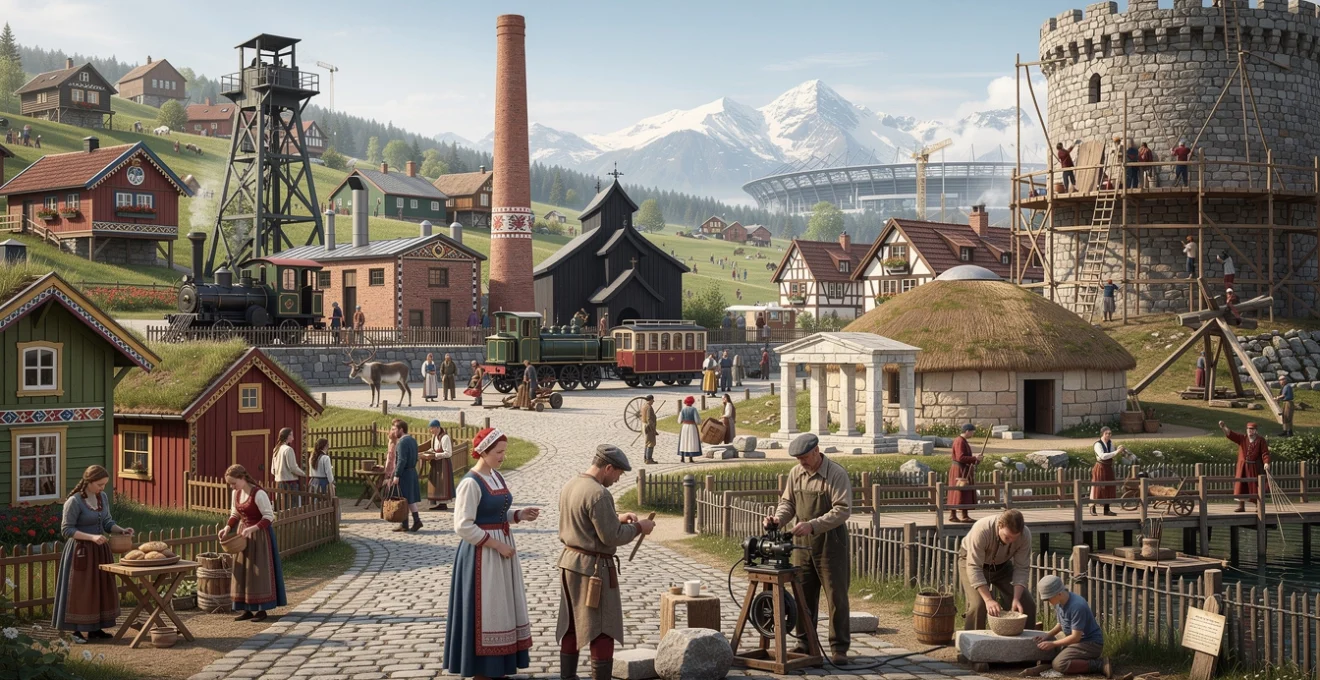
Open-air museums represent one of the most immersive and engaging approaches to cultural preservation, offering visitors the opportunity to step directly into living history. These extraordinary institutions transcend traditional museum boundaries by recreating entire historical environments, complete with authentic architecture, working demonstrations, and interactive experiences that bring the past vividly to life. From Scandinavian folk villages to medieval castle construction sites, these remarkable cultural destinations demonstrate how experiential learning can transform our understanding of heritage and human civilization.
The concept of outdoor museums has evolved dramatically since the late 19th century, when visionary curators first recognized the potential of preserving entire buildings and landscapes rather than simply collecting artifacts. Today, these institutions serve as vital repositories of cultural knowledge, employing cutting-edge interpretation techniques whilst maintaining authentic historical practices. Whether you’re fascinated by ancient agricultural methods, medieval craftsmanship, or industrial heritage, open-air museums provide unparalleled insights into how our ancestors lived, worked, and shaped their communities.
Scandinavian Open-Air museums: skansen and the living history movement
Scandinavia pioneered the open-air museum movement in the 1890s, establishing a model that continues to influence cultural institutions worldwide. The region’s commitment to preserving vernacular architecture and traditional crafts has created some of Europe’s most comprehensive outdoor heritage sites, where visitors can experience centuries of Nordic culture through authentic buildings, seasonal festivals, and traditional demonstrations.
Skansen stockholm: pioneer of immersive cultural heritage preservation
Established in 1891 by Artur Hazelius, Skansen in Stockholm stands as the world’s first open-air museum and remains one of the most influential cultural institutions in Europe. This 75-acre site houses over 150 historic buildings relocated from across Sweden, representing five centuries of Swedish rural and urban life. The museum’s living history approach includes costumed interpreters demonstrating traditional crafts such as glassblowing, pottery, and textile weaving, creating an immersive experience that connects visitors directly with Sweden’s cultural heritage.
Skansen’s innovative approach extends beyond static displays to include a working zoo featuring Nordic wildlife, traditional gardens cultivating heritage plant varieties, and seasonal celebrations that maintain authentic Swedish traditions. The institution’s commitment to educational programming has established it as a benchmark for cultural interpretation, influencing museum development across Scandinavia and beyond.
Norsk folkemuseum oslo: traditional stave church architecture and sami cultural exhibitions
The Norwegian Folk Museum showcases Norway’s diverse cultural landscape through its extensive collection of traditional buildings, including the remarkable Gol Stave Church from the 13th century. This architectural masterpiece demonstrates the sophisticated woodworking techniques that characterized medieval Norwegian construction, featuring intricate dragon-head carvings and complex timber joinery that has withstood centuries of harsh Nordic weather.
The museum’s Sami exhibitions provide crucial insights into indigenous Norwegian culture, featuring traditional lavvu dwellings, reindeer herding demonstrations, and displays of Sami handicrafts. These presentations highlight the sophisticated adaptation strategies developed by Arctic peoples, offering visitors a deeper understanding of sustainable living practices that remain relevant in contemporary environmental discussions.
Den gamle by aarhus: urban historical recreation and merchant quarter reconstructions
Denmark’s Den Gamle By represents a unique approach to urban heritage preservation, recreating three distinct historical periods within a single museum complex. The institution’s 19th-century merchant town features cobblestone streets lined with authentic timber-framed buildings housing working shops, taverns, and residential quarters that demonstrate the evolution of Danish urban life from 1864 to 1974.
The museum’s innovative time-layered interpretation allows visitors to experience the same streets across different eras, observing how social customs, commercial practices, and architectural styles evolved throughout Denmark’s modern period. Interactive workshops enable visitors to participate in traditional crafts such as bookbinding, candlemaking, and brewing, providing hands-on understanding of historical manufacturing processes.
Maihaugen lillehammer: alpine folk architecture and olympic cultural legacy
Situated in the mountainous region of central Norway, Maihaugen preserves the distinctive alpine architectural
Situated in the mountainous region of central Norway, Maihaugen preserves the distinctive alpine architectural traditions of the Gudbrandsdalen valley, with more than 200 historic buildings relocated from across the region. Farmsteads, stave-style churches, and townhouses illustrate how communities adapted to harsh winters and steep terrain through ingenious construction techniques, such as elevated storehouses and turf-roofed dwellings that provide natural insulation. Costumed guides and seasonal activities, from summer haymaking to winter sleigh rides, help visitors understand how climate shaped daily routines and social life in Norway’s highlands.
Maihaugen also plays a prominent role in interpreting Lillehammer’s modern legacy as host of the 1994 Winter Olympics. Dedicated exhibits explore how the city balanced large-scale sporting infrastructure with landscape conservation, offering a useful case study for sustainable tourism and cultural planning. For visitors, this blend of traditional folk culture and recent Olympic history creates a layered experience, demonstrating that open-air museums can address both deep historical roots and very contemporary heritage narratives.
Archaeological Open-Air sites: ancient civilisations brought to life
Archaeological open-air museums bridge the gap between excavation and imagination, transforming academic research into tangible environments you can walk through and touch. Rather than leaving visitors to decode fragments in glass cases, these sites reconstruct dwellings, workshops, and defensive structures based on meticulous archaeological evidence. As you move through them, you effectively step into a three-dimensional hypothesis about how ancient people lived, worked, and interacted with their landscape.
This approach to experimental archaeology has gained momentum over the last few decades, as researchers recognize the value of building full-scale reconstructions to test theories about tools, materials, and construction methods. When a replica roof collapses under snow load, or a clay oven fails to fire pottery correctly, valuable data emerges that written sources alone could never provide. For visitors, this blend of science and storytelling turns ancient civilisations into relatable communities, making complex historical periods as accessible as a visit to a historic village.
Butser ancient farm hampshire: iron age agricultural techniques and celtic roundhouse construction
Located in the South Downs of England, Butser Ancient Farm is one of the most influential archaeological open-air museums in Europe. Established in the 1970s as a research project, the site reconstructs Iron Age Celtic roundhouses, Roman buildings, and early Anglo-Saxon structures using historically accurate materials and tools. Each structure is based on real excavations, allowing archaeologists to test how different roof pitches, wall materials, and internal layouts perform under real-world conditions.
Butser’s fields are cultivated using reconstructed Iron Age agricultural techniques, including ancient cereal varieties, traditional ploughs, and hand tools. By observing how these crops grow and how long tasks such as threshing or milling actually take, researchers refine their understanding of subsistence farming and rural labour patterns. For visitors, hands-on activities such as weaving, wattling, and fire-making turn theoretical history into a memorable, sensory experience—ideal if you’re interested in how everyday life functioned without modern technology.
Archeon alphen aan den rijn: roman villa reconstructions and medieval craft demonstrations
Archeon, in the Netherlands, offers a chronological journey through prehistory, Roman occupation, and the Middle Ages, all within a single open-air museum. Carefully reconstructed Roman villas, bathhouses, and temples are populated by costumed interpreters who demonstrate activities such as military drills, cooking, and religious rituals. These reconstructions draw directly on archaeological finds from across the Rhine delta, making the site a living laboratory for understanding Roman frontier life.
Moving forward in time, visitors enter a bustling medieval town where blacksmiths, potters, and scribes showcase traditional crafts using period-appropriate tools and techniques. Watching an iron bar become a horseshoe or a manuscript page emerge from parchment and ink makes it easier to grasp the complexity of pre-industrial production systems. The site’s use of narrative scenarios—such as market days or feast preparations—helps you connect individual buildings and crafts into a coherent picture of how communities functioned across centuries.
Biskupin archaeological reserve: bronze age lake settlement and lusatian culture exhibits
Biskupin, in north-central Poland, is one of Europe’s most significant archaeological reserves, preserving a fortified lakeside settlement dating to the early Iron Age and associated with the Lusatian culture. The reconstructed wooden ramparts, causeway, and tightly packed houses demonstrate advanced planning and engineering, challenging outdated assumptions that prehistoric communities were loosely organized. Walking along the timber streets, you can appreciate how space was optimized for defence, trade, and domestic life within a constrained island environment.
The on-site museum and open-air reconstructions work together to explain how the settlement was discovered in the 1930s and why it became a symbol of Polish archaeological achievement. Experimental reconstructions of houses, hearths, and storage pits help researchers test theories about diet, climate resilience, and resource management. For travellers interested in early European civilisations, Biskupin offers a rare opportunity to experience a Bronze and Iron Age community at near life-size scale, rather than through isolated artifacts.
Guédelon castle burgundy: medieval masonry techniques and 13th century construction methods
Hidden in the forests of northern Burgundy, Guédelon Castle is an ambitious long-term project to build a 13th-century fortress using only the tools, materials, and techniques available at the time. Started in 1997, the site has become a benchmark for experimental archaeology and medieval construction research. Stonecutters, carpenters, blacksmiths, and rope-makers collaborate daily, allowing scholars to observe how long particular tasks take and how teams organize complex building operations without modern machinery.
For visitors, Guédelon feels like walking into a medieval construction site frozen in time, with cranes powered by human treadwheels, lime mortar being slaked, and oak beams shaped by hand. Informative panels and guided tours explain how design choices are based on surviving castles and contemporary documents, while also highlighting how new discoveries sometimes require rethinking earlier assumptions. If you have ever wondered how cathedrals and fortifications were actually built stone by stone, Guédelon offers an unparalleled, evolving demonstration that is as educational as it is visually striking.
Industrial heritage Open-Air museums: machinery and manufacturing legacies
Industrial heritage open-air museums focus on the factories, mines, railways, and workshops that powered the 19th and 20th centuries. Rather than presenting industry as a purely technical story, these sites emphasize the social and environmental dimensions of rapid industrialization. By preserving full-scale machinery, transport systems, and workers’ housing, they allow you to see how production systems reshaped entire landscapes and communities within just a few generations.
Across Europe and North America, many former industrial complexes have been transformed into open-air museums instead of being demolished. This trend reflects a growing recognition that blast furnaces, pitheads, and textile mills are as culturally significant as castles or cathedrals. When steam engines are fired up, tramways operate, or coal drops are demonstrated, visitors can feel the noise, heat, and scale of industrial work in a way that printed diagrams can never quite convey—much like stepping onto the set of a period drama, but with authentic machinery.
Colonial and pioneer settlement museums: frontier life recreations
Colonial and pioneer open-air museums immerse visitors in the everyday realities of frontier life, from log cabins and trading posts to early townships and mission stations. These sites frequently combine relocated historic buildings with reconstructions, creating cohesive landscapes that show how settlers adapted to unfamiliar climates, negotiated with—or displaced—indigenous populations, and established new social structures. Walking through them, you can trace how modest encampments evolved into organized communities with schools, churches, and civic institutions.
Many such museums now engage more critically with the legacies of colonization, incorporating indigenous perspectives and exploring themes like land dispossession, cultural exchange, and environmental change. Interpreters in period dress might demonstrate spinning, blacksmithing, or open-hearth cooking, while also addressing the inequalities and conflicts embedded in these histories. For travellers, these nuanced narratives provide a richer understanding of how national myths are constructed—and how open-air museums can help reframe them through inclusive storytelling.
Ecomuseum networks: Landscape-Integrated cultural tourism models
Ecomuseums extend the open-air museum concept beyond fenced sites, treating entire landscapes, villages, and ecosystems as living heritage. Rather than concentrating artifacts in a single location, they link multiple points of interest—historic farms, industrial remains, natural habitats—under a collaborative management framework. This networked approach encourages slow, place-based tourism, where you explore an area through walking trails, local guides, and community-run exhibitions instead of rushing through a single attraction.
Originating in France in the 1970s, the ecomuseum model emphasizes community participation and sustainable development. Local residents are not just informants but co-curators, contributing stories, skills, and decision-making power. For visitors, this can feel more like entering a lived-in cultural landscape than a traditional museum: you might attend a village festival, visit an artisan at work, and hike to a historic quarry, all as part of the same interpretive framework. As cultural tourism grows globally, ecomuseums demonstrate how heritage, economy, and ecology can be aligned rather than placed in competition.
Écomusée d’alsace: vernacular architecture preservation and traditional craft workshops
The Écomusée d’Alsace, near Mulhouse in eastern France, is one of Europe’s flagship ecomuseums and a textbook example of vernacular architecture preservation. The site brings together more than 70 half-timbered houses, barns, and workshops relocated from villages across Alsace, many of which were threatened by road building or development. Carefully reconstructed streetscapes evoke different rural settings, from wine-growing communities to farming hamlets, showcasing how local materials and building styles evolved over centuries.
Beyond architecture, the Écomusée functions as a living village where traditional crafts and seasonal agricultural tasks are demonstrated daily. Blacksmiths, potters, bakers, and carpenters work in authentic surroundings, while heritage breeds of livestock and heirloom crops reinforce the connection between built heritage and the surrounding landscape. Visitors are encouraged to join workshops, festivals, and hands-on experiences, which not only enhance learning but also support local artisans economically—a practical illustration of how ecomuseums can sustain both culture and livelihoods.
Beamish living museum durham: edwardian town recreation and colliery heritage interpretation
Beamish, the Living Museum of the North in County Durham, offers a sweeping overview of life in north-east England during the 1820s, 1900s, and 1940s. The meticulously reconstructed Edwardian town includes a functioning tramway, cooperative store, printworks, and sweet shop, all staffed by costumed interpreters who stay in character as they explain daily routines. This urban setting is complemented by rural farmsteads and pit villages, showing how industrial growth affected both town and countryside.
One of Beamish’s most compelling features is its interpretation of colliery heritage, with a recreated coal mine and associated workers’ housing. Visitors can descend into the mine, ride heritage railways, and see how energy production shaped working conditions, family life, and regional identity. By juxtaposing domestic interiors, schoolrooms, and industrial sites, Beamish helps you see the full ecosystem of an industrial society—not just the machinery, but the people and communities behind it.
Black country living museum dudley: industrial revolution manufacturing processes and working machinery
The Black Country Living Museum in Dudley, near Birmingham, sits in one of the cradles of the Industrial Revolution, where ironworking, coal mining, and glassmaking transformed a rural landscape into a powerhouse of global manufacturing. Spread across 26 acres, the museum recreates canals, workshops, and streetscapes typical of the late 19th and early 20th centuries. Original buildings have been moved brick by brick from across the region, including chain shops, lime kilns, and workers’ cottages, creating an immersive industrial townscape.
What sets the Black Country Living Museum apart is its emphasis on working machinery and live demonstrations. Steam engines, rolling mills, and foundry equipment are operated by skilled staff, showing visitors the intense labour, noise, and heat involved in early mass production. Combined with personal stories from former industrial workers and their families, these demonstrations convey both the achievements and human costs of rapid industrialization. For anyone curious about how modern consumer society emerged from coal, iron, and steam, this open-air museum offers an unforgettable, multisensory lesson.
Modern interpretation technologies in Open-Air museum design
As visitor expectations evolve in the digital age, open-air museums are increasingly integrating modern interpretation technologies to complement traditional storytelling. Interactive apps, augmented reality (AR) overlays, and geolocated audio guides allow you to access layered information without disrupting the authenticity of the physical environment. Instead of cluttering historic streets with signage, museums can deliver rich narratives to your smartphone or tablet, adapting content to your language, interests, and accessibility needs.
Many leading sites now experiment with AR reconstructions that show lost buildings, original decoration, or bustling historical scenes superimposed on present-day ruins. At an archaeological farm, for instance, you might point your device at a posthole layout and see a 3D roundhouse rise before your eyes—much like putting on a pair of “time-travel glasses.” Similarly, RFID tags and beacons can trigger multimedia content as you move through different zones, turning a simple walk into a personalized storyline. When implemented thoughtfully, these tools enhance rather than replace human guides, offering multiple entry points into complex histories.
However, digital interpretation in open-air museums also faces challenges. Hardware must withstand outdoor conditions, content requires regular updates, and not all visitors are comfortable with or have access to smartphones or high-speed data. Successful institutions therefore balance high-tech features with low-tech alternatives, such as printed trails, live demonstrations, and tactile exhibits. By treating technology as a flexible layer rather than a crutch, open-air museums can remain inclusive while still appealing to a generation accustomed to interactive, on-demand information.
Looking ahead, emerging tools such as virtual reality (VR) previews, remote live-streamed tours, and participatory mapping platforms are likely to deepen the connection between open-air museums and their audiences. You might explore a site digitally before deciding which areas to visit, or contribute your own family stories and photographs to community archives linked to specific buildings. In this way, modern interpretation technologies do more than simply explain the past—they invite us to co-create living heritage, ensuring that open-air museums remain dynamic spaces where history, technology, and community continually inform one another.