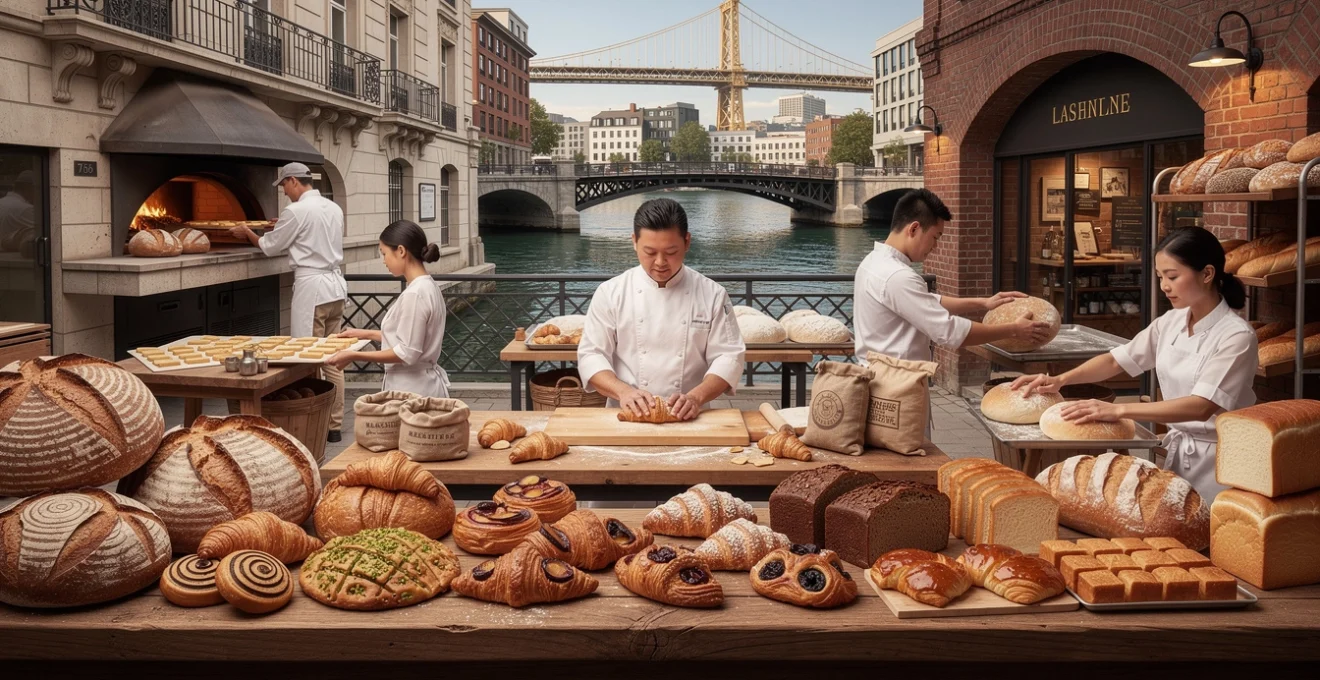
# Legendary Bakeries Famous for Bread and Pastries
The world’s most celebrated bakeries represent far more than simple food establishments—they embody centuries of craftsmanship, innovation, and unwavering dedication to the ancient art of baking. From the cobblestone streets of Paris to the bustling lanes of Tokyo, these legendary institutions have transformed flour, water, and salt into cultural landmarks that draw devoted pilgrims from across the globe. Whether you’re seeking the perfect sourdough with its tangy complexity, the buttery layers of an impeccably laminated croissant, or the pillowy softness of Japanese milk bread, these bakeries have mastered techniques that define their respective culinary traditions. The distinction between a good bakery and a legendary one lies in the meticulous attention to fermentation times, the provenance of ingredients, and the consistency of execution day after day, year after year.
Parisian institutions: poilâne and the art of pain au levain naturel
Few bakeries command the reverence that Poilâne enjoys in the pantheon of artisan bread production. Located in the heart of Saint-Germain-des-Prés, this Parisian institution has been crafting exceptional sourdough loaves since 1932, establishing standards that bakers worldwide still strive to emulate. The bakery’s signature miche—a massive round loaf weighing approximately two kilograms—represents the pinnacle of natural leavening techniques, with each loaf requiring nearly 24 hours of fermentation before it enters the wood-fired oven.
Pierre poilâne’s sourdough revolution in Saint-Germain-des-Prés
Pierre Poilâne founded his bakery during an era when industrial bread production was beginning to dominate France, yet he remained steadfastly committed to traditional methods. His revolutionary approach involved rejecting commercial yeast entirely, instead cultivating wild yeasts captured from the environment to create a levain naturel (natural sourdough starter) that remains alive in the bakery today. This living culture, carefully maintained and refreshed daily, imparts the distinctive tangy flavour and chewy texture that has become synonymous with authentic French country bread. The bakery produces approximately 2,400 loaves daily, each bearing the iconic “P” carved into its crust before baking.
Apollonia poilâne’s continuation of miche tradition
When tragedy struck in 2002, eighteen-year-old Apollonia Poilâne inherited the responsibility of preserving her family’s legacy whilst studying at Harvard University. Her remarkable dedication to maintaining the bakery’s exacting standards whilst introducing subtle innovations has ensured Poilâne’s continued relevance in contemporary baking culture. Under her stewardship, the bakery has expanded internationally whilst never compromising on the fundamental principles established by her grandfather. She has successfully balanced tradition with accessibility, offering online ordering and international shipping without sacrificing the artisanal quality that defines each loaf.
Wood-fired ovens and Stone-Ground flour specifications
Poilâne’s commitment to traditional baking extends to the infrastructure itself. The bakery operates wood-fired ovens that have been continuously maintained since the 1930s, with temperatures carefully regulated to achieve the perfect balance between crust development and crumb structure. These ovens, fired exclusively with apple wood, create a unique baking environment that cannot be replicated in modern deck ovens. The flour specifications are equally precise: Poilâne sources stone-ground wheat from carefully selected French mills, ensuring that each batch contains the full spectrum of nutrients and flavours found in the whole grain. This stone-ground flour, with its coarser texture and higher mineral content, contributes significantly to the bread’s complex flavour profile and rustic character.
The punition cookie: butter shortbread craftsmanship
Beyond the famous miche, Poilâne has achieved legendary status for its punitions—delicate butter shortbread cookies whose name translates to “punishments.” According to bakery lore, these cookies were originally created as treats for children who misb
ehaved at the counter. Today, these bite-sized biscuits have become an emblem of Poilâne’s butter shortbread craftsmanship. Each punition is made from a simple dough of high-fat butter, sugar, and flour, rolled thin and cut into tiny rounds that bake to a deep golden hue. The texture is simultaneously crisp and tender, shattering delicately before melting on the tongue. For many visitors, a small bag of punitions is the easiest way to take a piece of this legendary bakery home, and they serve as a masterclass in how restraint and precision can elevate even the humblest of ingredients.
Du pain et des idées: canal Saint-Martin’s temple of viennoiserie
A short walk north from central Paris, on a sun-drenched corner near Canal Saint-Martin, Du Pain et des Idées has achieved almost cult status among pastry lovers. Housed in a preserved 19th-century boulangerie with painted glass signage and ornate woodwork, the bakery feels like a time capsule dedicated to butter and flour. Inside, the focus is firmly on rustic loaves and extraordinary viennoiseries rather than elaborate cakes. For travellers building a bakery bucket list, Du Pain et des Idées is often described as the place to taste some of the best croissants and pastries in Paris, especially if you want to understand how fermentation and lamination work together in perfect harmony.
Christophe vasseur’s escargot Pistache-Chocolat innovation
At the heart of Du Pain et des Idées’ fame is Christophe Vasseur, a former fashion executive who changed careers to pursue artisan baking. His signature creation, the escargot pistache-chocolat, has become one of the most photographed pastries in Paris. Shaped like a snail—hence the name—this spiral pastry combines laminated dough with a rich pistachio pastry cream and ribbons of dark chocolate. The balance of flavours is meticulous: the nuttiness of the pistachio offsets the bitterness of the chocolate, while the buttery layers provide a crisp, flaky framework. If you are exploring legendary bakeries famous for bread and pastries, this escargot is a textbook example of how a single product can define a modern institution.
Poolish fermentation techniques in croissant production
One of the secrets behind the extraordinary croissants at Du Pain et des Idées is the use of a poolish—a loose, pre-fermented mixture of flour, water, and a tiny amount of yeast. This preferment is typically left to ripen for 10–16 hours, allowing organic acids and aromatic compounds to develop slowly. When incorporated into the final croissant dough, the poolish contributes complexity of flavour, improved keeping quality, and a lighter, more open crumb. For home bakers aiming to replicate bakery-style croissants, adopting a poolish or similar pre-ferment is one of the most impactful steps you can take, even if you do not have access to professional equipment.
Chausson aux pommes: caramelised apple turnover mastery
While the escargots steal much of the spotlight, the chausson aux pommes at Du Pain et des Idées is a masterclass in restraint and technique. Unlike the overly sweet versions often found in supermarkets, Vasseur’s apple turnovers feature slowly caramelised apples, cooked down until their natural sugars intensify and their moisture content reduces. This yields a concentrated filling that does not sog the pastry, preserving the shattering layers of laminated dough. The edges are meticulously sealed to create a distinct, hand-formed shape that stands apart from industrial half-moon turnovers. Biting into one, you experience a contrast of textures—crisp exterior, soft apple interior—that illustrates why classic French pastries endure.
Heritage grain sourcing from french artisan mills
Behind every legendary croissant and loaf is flour, and Du Pain et des Idées places enormous emphasis on grain quality. Vasseur works closely with French artisan mills that specialise in heritage wheat varieties and stone-milling techniques. These grains often have lower yields and more variable baking characteristics, but they offer deeper flavour, higher mineral content, and a stronger connection to regional terroir. For bread enthusiasts, this focus on heritage grain sourcing reflects a broader industry trend: many of the world’s best bakeries are now prioritising traceable, sustainably grown wheat, even if it requires constant adjustment of hydration and fermentation times. The result is bread and pastry with character, rather than uniformity.
Tokyo’s levain bakery: shokupan and French-Japanese fusion
Tokyo’s bakery scene is among the most dynamic in the world, and Levain Bakery stands out as a pioneer of French-Japanese fusion rooted in natural leavening. Nestled in a quiet neighbourhood away from the capital’s neon bustle, Levain has built a reputation on loaves and pastries that marry European techniques with Japanese precision and subtlety. The star of the show is shokupan, the pillowy milk bread beloved across Japan, elevated here through long fermentation and carefully controlled hydration. For travellers interested in legendary bakeries famous for bread and pastries, Levain illustrates how traditional methods can be adapted across cultures without losing their soul.
Shinya tsuchiya’s tangzhong method for milk bread
Head baker Shinya Tsuchiya employs the tangzhong method—also known as a water roux—to achieve the meltingly soft texture of his shokupan. In this technique, a portion of the flour and liquid (milk or water) is heated together to form a thick paste before being cooled and added to the dough. This pre-gelatinises the starches, enabling the dough to absorb more liquid and retain moisture over a longer period. The result is milk bread with an exceptionally fine crumb, cloud-like softness, and a shelf life that outperforms many standard loaves. For home bakers, incorporating a tangzhong is one of the most accessible ways to recreate bakery-style Japanese milk bread at home.
Croissant adaptation using japanese hokkaido butter
Levain’s croissants offer a compelling example of how local ingredients can transform a classic French pastry. Instead of European butter, Tsuchiya uses high-fat butter from Hokkaido, a region renowned for its dairy products. Hokkaido butter has a clean, almost sweet flavour and a fat content that supports a particularly crisp, delicate lamination. Combined with a slightly cooler proofing environment—common in Japanese bakeries to maintain control over fermentation—these croissants develop razor-thin layers and a gentle, nuanced aroma. If you have ever wondered how the same croissant recipe can taste completely different in Paris and Tokyo, the choice of butter and proofing conditions is a large part of the answer.
Baguette tradition meets yudane technique
Beyond milk bread and croissants, Levain experiments with hybrid methods that blend European shapes with Japanese dough science. One notable example is a baguette-style loaf that incorporates the yudane technique, where boiling water is poured over a portion of the flour and allowed to rest overnight. Similar to tangzhong but slightly firmer, yudane improves elasticity and moisture retention, yielding a baguette with a thinner crust and an almost custardy crumb. For customers, it feels like the best of both worlds: the familiar elongated form and scoring of a French baguette, paired with the tenderness and longevity associated with Japanese sandwich bread. Such fusions reflect a broader shift in modern baking, where boundaries between styles are increasingly porous.
Tartine bakery: san francisco’s sourdough renaissance
Across the Pacific, Tartine Bakery in San Francisco has played a decisive role in the global sourdough renaissance. What began as a neighbourhood bakery in the Mission District has grown into an international reference point for naturally leavened bread and pastry. Tartine’s iconic country loaf—often photographed with its blistered crust and open crumb—has inspired countless bakers to pursue long fermentation and high-hydration doughs. In a city already famous for sourdough, Tartine elevated the standard, showing that careful control over time, temperature, and flour selection could produce bread of remarkable depth and complexity.
Chad robertson’s country loaf fermentation protocol
Co-founder Chad Robertson documented his approach to sourdough in detail, and his fermentation protocol has become a benchmark for artisan bakers worldwide. The country loaf typically relies on a levain built 8–12 hours before mixing, with a dough hydration hovering around 75–80%. Bulk fermentation is extended over several hours at room temperature, with periodic stretch-and-folds replacing intensive mechanical kneading. This gentle handling preserves the dough’s structure while promoting even gas distribution. Final proofing often takes place overnight in a cool environment, allowing flavours to develop slowly. For anyone aiming to bake bakery-quality sourdough at home, adopting a similar schedule—long, cool fermentation and minimal mechanical mixing—is more impactful than obsessing over minor recipe variations.
High-hydration dough management in morning buns
Tartine’s reputation is not limited to bread; its morning buns have reached near-mythical status. These pastries begin with a high-hydration laminated dough, which yields a tender interior with a honeycomb structure rather than a dense crumb. Managing such a wet dough requires experience and finesse: the butter must remain cold yet pliable, and the dough must be handled quickly to avoid tearing the layers. After lamination, the dough is rolled with cinnamon sugar and citrus zest, then baked in muffin tins to encourage vertical rise and caramelisation. The result is a pastry that sits somewhere between a croissant and a cinnamon roll, with crackling edges and a soft, aromatic centre—a prime example of how technical precision can translate into pure comfort.
Prune and armagnac danish pastry architecture
Another standout from Tartine’s pastry case is the prune and Armagnac Danish, which showcases what could be called “pastry architecture.” The base is a laminated dough shaped into an open square or envelope, designed to cradle a generous spoonful of prune compote infused with Armagnac. The alcohol is cooked off, leaving behind a deep, almost smoky flavour that complements the natural sweetness of the prunes. Strategic folding ensures that the edges puff dramatically while the centre remains slightly sunken, holding the filling in place. As with many of the world’s best bakeries, Tartine’s most memorable items are often those that pair classic flavour combinations with meticulous attention to shape and structure.
Stone-milled heritage wheat from central milling
Underlying Tartine’s bread and pastry programme is a close relationship with Central Milling, a Utah-based mill that specialises in organic and heritage grains. By using blends that include varieties such as Red Fife and Turkey Red, Tartine achieves loaves with a more complex flavour profile and a broader spectrum of nutrients than standard white bread flour can provide. Stone-milling preserves the wheat germ and bran, which contribute both flavour and nutrition but can also make dough trickier to handle. To compensate, Tartine adjusts hydration and fermentation times based on the characteristics of each batch. This dynamic approach to flour is increasingly common among legendary bakeries famous for bread and pastries, reflecting a move away from standardised commodity grain and towards regionally distinct flours.
E5 bakehouse: london fields’ regenerative grain economy
On the edge of London Fields in East London, E5 Bakehouse has become a flagship for sustainable, community-focused baking. Housed under railway arches, the bakery combines a busy café with an on-site mill and baking school, creating a hub where customers can see the entire journey from grain to loaf. E5 is renowned not only for its sourdough breads and pastries but also for its commitment to regenerative agriculture. By working directly with UK farmers who grow heritage and population wheats using low-input methods, E5 helps to support healthier soils, greater biodiversity, and more resilient local food systems.
Ben mackinnon’s organic wheat sourcing network
Founder Ben Mackinnon has spent years building a network of organic and biodynamic grain growers across the UK. Instead of sourcing flour from a single large supplier, E5 often buys whole grain and mills it in-house, tailoring the grind to each product. This approach gives the bakery unprecedented control over flavour and texture, but it also requires constant adaptation: weather, soil, and variety all influence how each batch behaves in dough. For consumers, the payoff is tangible. Loaves often have a rich, nutty depth and a satisfying chew that sets them apart from more standardised sourdoughs. For bakers interested in sustainability, E5’s model demonstrates how legendary bakeries can act as linchpins in regenerative grain economies.
Sourdough focaccia with british Cold-Pressed rapeseed oil
Among E5’s savoury offerings, the sourdough focaccia has become a local favourite. Departing from the traditional Italian reliance on olive oil, E5 uses British cold-pressed rapeseed oil, which lends a grassy, slightly nutty flavour and has a high smoke point ideal for baking. The dough is naturally leavened, undergoing a long, cool fermentation that develops flavour and improves digestibility. Generous dimpling before baking allows the oil and any toppings—such as cherry tomatoes, rosemary, or caramelised onions—to settle into the surface. The result is a focaccia with a deeply caramelised crust, open crumb, and pronounced grain character, showing how regional ingredients can be woven into classic formats without compromise.
Long fermentation rye bread using shipton mill flour
E5 is also known for its robust rye breads, made using organic flour from producers such as Shipton Mill. High-percentage rye doughs behave very differently from wheat: they are stickier, less elastic, and more dependent on acidity for structure. To manage this, E5 employs extended fermentation with a mature rye sourdough starter, often over 24 hours, which develops lactic acidity and improves shelf life. The baked loaves are dense yet moist, with a pronounced tang and aromatic notes of cocoa and spice. For anyone interested in exploring beyond classic white sourdough, a slice of E5’s rye—perhaps topped with cultured butter or strong cheese—offers a glimpse into the diversity of bread styles that legendary bakeries nurture.
Lune croissanterie: melbourne’s Cube-Shaped lamination excellence
On the other side of the globe, Lune Croissanterie in Melbourne has redefined what a modern croissant bakery can be. Founded by former Formula One aerodynamicist Kate Reid, Lune approaches pastry with the rigour of engineering, treating lamination as a precise, repeatable process rather than an intuitive art alone. The bakery’s minimalist, laboratory-like spaces highlight the choreography of rolling, folding, and shaping, turning croissant production into a kind of performance. Among its most famous creations are the cube-shaped croissants and inventive seasonal flavours, which routinely sell out as customers queue around the block.
Kate reid’s precision lamination: 81-layer technique
Central to Lune’s success is Reid’s obsession with lamination. The bakery typically targets an 81-layer structure, achieved through a series of single and double folds that balance flakiness with structural integrity. Dough temperature, butter plasticity, and resting times are monitored with near-scientific precision; even small deviations can lead to butter leakage or uneven layering. If you think of each croissant as a tiny architectural project, the lamination process is the blueprint that determines how it will rise and flake in the oven. For aspiring bakers, adopting Lune’s disciplined approach—careful temperature control, consistent rolling thickness, and adequate resting—can transform home-baked croissants from heavy and bready to light and aerated.
Cultured butter selection for optimal pastry flakiness
Lune’s croissants owe much of their flavour and texture to the use of high-fat cultured butter. Cultured butter is produced by fermenting cream before churning, which develops lactic notes and a more complex aroma than standard sweet cream butter. The higher fat content and lower water proportion contribute directly to flakiness: as the butter melts and the water turns to steam, it separates the dough layers, creating the distinctive honeycomb interior. Reid and her team test different butters based on plasticity and flavour, selecting those that perform consistently across large batches. This attention to detail illustrates a key principle shared by many legendary bakeries famous for bread and pastries: ingredient choice is not just about provenance, but also about performance.
Twice-baked almond croissant engineering
Among Lune’s most beloved offerings is the twice-baked almond croissant, a clever example of pastry “engineering” that also reduces waste. Day-old croissants are split, soaked lightly in flavoured syrup, and filled with almond frangipane before being reassembled, topped with more frangipane and sliced almonds, and baked a second time. The syrup rehydrates the crumb while the almond cream sets into a moist, fragrant layer, transforming a product that might otherwise be discarded into a premium pastry. The challenge lies in calibrating soak times and frangipane quantity so the final croissant is rich but not soggy, crisp at the edges yet tender inside. For home bakers, this technique offers an excellent way to repurpose surplus croissants, and it serves as a fitting reminder of what sets these legendary bakeries apart: a relentless pursuit of quality at every stage, from grain to final crumb.