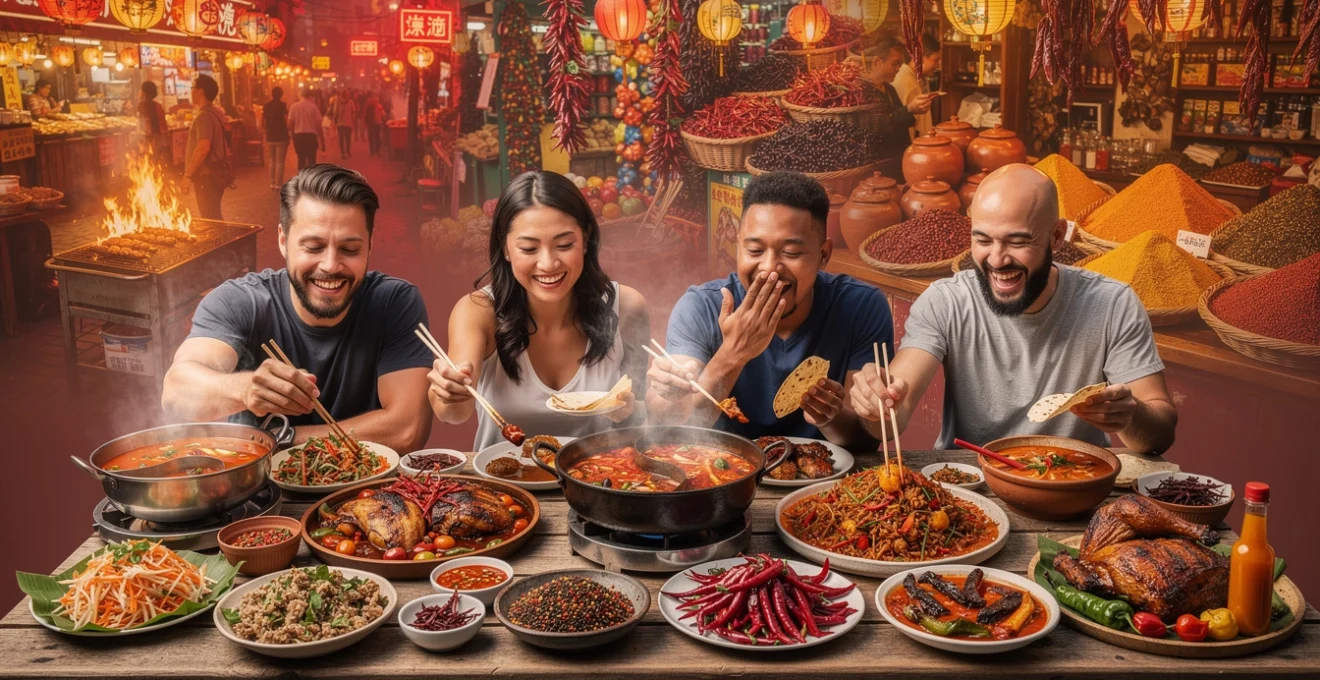
For devoted heat-seekers and capsaicin enthusiasts, the world offers an extraordinary tapestry of fiery culinary traditions that transcend mere spiciness to become expressions of cultural identity, agricultural heritage, and centuries-old gastronomic wisdom. From the numbing complexity of Sichuan peppercorns to the bright, fruity heat of Caribbean Scotch bonnets, authentic spice destinations provide immersive experiences where local ingredients, traditional preparation methods, and regional microclimates converge to create unforgettable flavour profiles. These destinations aren’t simply about endurance challenges or Scoville unit competitions—they represent living food cultures where spice serves functional, medicinal, and spiritual purposes alongside its obvious gustatory appeal. Whether you’re drawn to the fermented funk of Korean gochujang, the smoky depth of Oaxacan chilhuacles, or the fresh herbaceous fire of Thai bird’s eye chillies, understanding the geographical and cultural contexts behind these heat sources transforms casual dining into profound culinary education.
Thailand’s fiery culinary landscape: from bangkok street markets to isaan regional cuisine
Thailand consistently ranks among the world’s most formidable destinations for spice enthusiasts, with regional variations that span from the coconut-tempered curries of the south to the uncompromising heat bombs of the northeastern Isaan plateau. The Thai relationship with capsaicin extends beyond simple heat tolerance into sophisticated flavour balancing, where the interplay between spicy, sour, sweet, and salty creates a multidimensional taste experience that has captivated international food culture. Thai cuisine employs over fifteen distinct chilli varieties, each selected for specific applications based on heat intensity, flavour profile, and visual appeal. The diminutive prik kee noo, or « mouse dropping chilli, » delivers disproportionate heat relative to its size, frequently testing even seasoned spice veterans. Understanding Thailand’s spice geography requires recognising how Buddhist culinary traditions, monsoon agriculture, and historical trade routes have shaped contemporary dishes you’ll encounter from Chiang Mai’s mountain valleys to Phuket’s coastal fishing communities.
Som tam and larb: northeastern isaan heat profiles and capsaicin concentration
Isaan cuisine represents Thailand’s most uncompromising approach to spice application, with dishes like som tam (green papaya salad) and larb (minced meat salad) routinely incorporating six to eight fresh bird’s eye chillies per serving. The region’s agricultural practices favour capsicum varieties with elevated capsaicinoid concentrations, partly due to the dry, hot climate that stresses plants into producing more defensive compounds. Som tam preparation in authentic Isaan contexts involves pounding fresh chillies with garlic, palm sugar, fish sauce, and lime juice in a large wooden mortar, a technique that ruptures cell walls and distributes capsaicin oils more thoroughly than chopping alone. Larb preparations combine roasted rice powder, fresh herbs, and copious amounts of sliced chillies with barely cooked meat, creating a textural contrast between the grainy, nutty rice powder and the explosive heat of raw capsicum. When ordering these dishes at street stalls in Udon Thani or Khon Kaen, vendors will typically ask about preferred spice levels, though the « mild » option by Isaan standards would still register as intensely hot by international benchmarks.
Tom yum and gaeng phet: central thai curry paste fermentation techniques
Central Thailand’s iconic soups and curries achieve their characteristic depth through complex paste preparations that incorporate fermented shrimp paste, galangal, lemongrass, and multiple chilli varieties processed into homogeneous mixtures. Tom yum soup’s distinctive hot-sour profile comes from the combination of fresh bird’s eye chillies, roasted chilli paste (nam prik pao), and the soup’s signature aromatic herbs, creating layers of heat that evolve throughout the eating experience. Gaeng phet (red curry) and gaeng khiao wan (green curry) derive their colours and heat from different chilli processing methods—dried red chillies for the former, fresh green chillies for the latter—each producing distinct capsaicin distribution patterns in coconut milk-based broths. Traditional paste preparation involves extended mortar-and
pestle grinding over twenty minutes, a labour-intensive method that slowly releases aromatic oils and evenly disperses capsaicin. While many urban kitchens now rely on blenders, traditional cooks argue that mechanical blades aerate the paste differently, dulling both aroma and perceived heat. For travellers keen on understanding Thailand’s fiery food culture, joining a cooking class in Bangkok or Ayutthaya that still uses stone mortars can be as illuminating as any street food tour. You’ll notice that freshly pounded curry pastes often taste hotter yet cleaner, with a more rounded chilli presence that lingers rather than simply burns.
Soi rambuttri and yaowarat road: bangkok’s high-scoville street food corridors
In Bangkok, two of the most accessible corridors for spicy food travellers are Soi Rambuttri in the Old City and Yaowarat Road in Chinatown. Soi Rambuttri offers dense clusters of vendors serving tom yum noodles, green curries, and pad kra pao, where you can watch cooks toss handfuls of fresh bird’s eye chillies into smoking woks. Yaowarat, by contrast, overlays Thai heat with Sino-Thai influences, yielding dishes like chilli-laden seafood stir-fries and peppery noodle soups enriched with roasted chilli oil. Both areas stay active late into the night, making them ideal for progressive tastings where you can calibrate your heat tolerance stall by stall. As a rule of thumb, specifying « pet nid noi » (a little spicy) is a practical way for visitors to enjoy authentic flavours without overwhelming burn.
For a structured exploration of these high-Scoville corridors, consider alternating between broth-based dishes and dry stir-fries to manage palate fatigue. Broths like tom yum or boat noodles allow capsaicin to diffuse more gently, while dry dishes concentrate chilli oils on the tongue and lips. Many stalls also keep jars of house-made nam prik (chilli condiments) on the tables, giving you control over incremental heat adjustments. Think of these condiments as a volume knob rather than an on/off switch—you can add a quarter spoon at a time to find your personal sweet spot between flavour intensity and physical comfort. Carrying a small bottle of water or ordering plain rice on the side can also help moderate the heat during long tasting sessions.
Bird’s eye chilli cultivation: prik kee noo varieties in chiang mai province
Further north, Chiang Mai province provides a window into the agricultural backbone of Thai spicy food, particularly when it comes to prik kee noo bird’s eye chillies. Local farmers cultivate multiple landrace varieties, some selected for higher Scoville heat units and others for thicker skins that stand up better to drying and frying. The region’s cooler nights and well-drained mountain soils influence not only yield but also the balance between heat and flavour, much like how terroir shapes wine profiles. Visiting smallholder farms or community markets such as Warorot Market lets you see how chillies are sorted by size, colour, and intended culinary use. You’ll often find separate baskets for green, just-ripening, and fully red chillies, each destined for specific dishes and paste recipes.
Curious how cultivation practices affect what ends up in your bowl? Farmers in Chiang Mai frequently stress plants by limiting water toward the end of the growing cycle, a technique that can slightly increase capsaicinoid concentration and intensify perceived heat. Sun-drying on woven bamboo trays remains common, both as a preservation method and a way to develop deeper, almost smoky flavours without actual smoking. If you’re interested in culinary tourism, arranging a day trip that pairs a farm visit with a local cooking class can connect the dots from chilli field to mortar to plate. This field-to-table perspective sharpens your appreciation of Thailand’s spice culture and shows how agricultural decisions made months earlier shape the immediate burn you feel on your tongue.
Sichuan and hunan provinces: china’s mala spice complex and peppercorn numbing sensations
Moving from Southeast Asia to East Asia, Sichuan and Hunan provinces in China offer some of the planet’s most intricate spicy food ecosystems, built around the interplay of heat and numbing sensations known as mala. In Sichuan, this effect comes from the combination of dried chillies and Sichuan peppercorns, whose active compound hydroxy-alpha-sanshool creates a tingling, buzzing feeling on the lips and tongue. Hunan cuisine, meanwhile, leans into a drier, smokier, and more straightforward chilli heat called gan la, often with fewer numbing agents but a higher overall chilli load. For travellers who love spicy food and want to understand how different cultures engineer heat, these two regions function almost like living laboratories in capsaicin design. You will quickly discover that « spicy » in China is less a single sensation and more a carefully curated spectrum of pain, pleasure, and aroma.
Chongqing hotpot: oil-based broths and facing heaven pepper stratification
Chongqing hotpot is perhaps the most notorious expression of China’s fiery cuisine, famous for its crimson, oil-based broth thick with dried chillies and Sichuan peppercorns. The base typically uses beef tallow or vegetable oil infused with aromatics like ginger, garlic, fermented broad bean paste, and spices, creating a dense medium where capsaicin and sanshool remain suspended. One interesting technical detail is the stratification that occurs in the pot: lighter oil rises, carrying aromatic compounds and chilli oils, while heavier solids and peppercorns sink, producing different heat intensities depending on where you dip your ingredients. Many local restaurants even calibrate zones of intensity within the same pot, offering a « yuan yang » (half-half) setup where a clear, mild broth shares space with a volcanic red base.
For visitors, negotiating Chongqing hotpot can feel like participating in a controlled science experiment on your own pain threshold. Ordering levels range from « Wei La » (slightly spicy) to « Te La » (especially spicy), with locals often gravitating toward the upper end of the spectrum. You’ll notice that thin-sliced meats, tripe, and vegetables absorb chilli oil at different rates, creating a rolling sequence of heat spikes as you eat. To manage the experience, it’s wise to alternate spicy-dipped bites with items cooked in the mild broth if available, or to cool your palate with sesame-based dipping sauces. Think of the hotpot as a customizable heat chamber where you control exposure time, ingredient type, and dipping order to craft your ideal spicy food journey.
Mapo tofu and gong bao: doubanjiang fermentation and sichuan peppercorn hydroxy-alpha-sanshool
Iconic dishes like mapo tofu and gong bao (Kung Pao) chicken demonstrate how Sichuan cuisine uses fermented bases to build complexity around spice. Central to both is doubanjiang, a fermented paste made from broad beans, chillies, salt, and sometimes wheat flour, aged in earthenware crocks for months or even years. This paste doesn’t just add heat; its fermentation process develops deep umami and subtle sour notes that act like a bassline under the treble of fresh or dried chillies. When combined with Sichuan peppercorns rich in hydroxy-alpha-sanshool, the result is a layered sensory effect where numbing, tingling, and burning sensations cascade across your mouth. Mapo tofu, with its soft curds suspended in a glossy, rust-red sauce, is often recommended as a benchmark for understanding the full mala profile.
Gong Bao chicken, while slightly milder on average, provides a useful contrast because it balances dried chillies and peppercorns with sugar, vinegar, and peanuts. Here, the numbing effect of sanshool tempers the sting of capsaicin, much like a shock absorber smoothing out a bumpy ride. Travellers keen on exploring Sichuan’s spicy food scene should pay attention not only to how hot a dish feels, but also to how quickly the numbing sets in and dissipates. Does your tongue tingle before the burn, or does the heat arrive first and the buzzing sensation follow? Asking these questions turns each meal into an experiment, helping you distinguish between dishes heavy on chilli, heavy on peppercorn, or expertly balanced between the two.
Changsha night markets: hunan’s gan la spice methodology and smoked chilli applications
While Sichuan cuisine has popularized mala worldwide, Hunan’s capital Changsha showcases a different philosophy of spice built around gan la, or « dry heat. » Street stalls and night markets feature skewers, stir-fries, and braised dishes coated in chopped fresh chillies, chilli flakes, and sometimes house-smoked peppers. Instead of relying heavily on numbing peppercorns, Hunan cooks focus on straightforward, penetrating chilli heat supported by aromatics such as garlic, scallions, and pickled vegetables. The result is a flavour profile that feels less buzzy than Sichuan but often sharper and more immediate, like switching from a complex perfume to a single, powerful essential oil. Signature snacks like spicy stinky tofu and chilli-crusted grilled fish provide accessible entry points for travellers testing the waters.
Smoked chilli applications are a hallmark of many Hunan kitchens, where sun-drying and smoking over hardwoods such as Chinese tallow wood concentrate flavour and preserve local pepper varieties. These smoked chillies are then chopped into relishes, ground into powders, or stir-fried with pork and preserved vegetables to create dishes that radiate both heat and a gentle smokiness. If you wander through Changsha’s night markets, you’ll see jars of deep red or brick-coloured chilli condiments on display, often sold by weight to local customers. Purchasing a small jar to take home is one of the easiest ways to extend your spicy food travels beyond the trip itself. Just a spoonful can transform a simple bowl of noodles or rice into something that echoes the sensory intensity of a Hunan street corner.
Chengdu’s kuanzhai alley: authentic sichuan restaurant authentication criteria
Back in Sichuan, Chengdu’s Kuanzhai Alley district has become a focal point for visitors seeking « authentic » spicy food experiences. However, with rising tourism, not every restaurant there still cooks with traditional techniques or high-quality ingredients. How can you tell whether a venue is serving textbook Sichuan flavours or a toned-down, tourist-friendly approximation? One clue is the use and freshness of Sichuan peppercorns: authentic spots will showcase a bright citrus aroma when you sniff a dish closely, and you’ll feel a clean, electric tingle rather than a dull, dusty numbness. Another indicator is the presence of visible chilli sediment and red oil separation in dishes like mapo tofu and water-boiled fish (shui zhu yu), suggesting the use of real chilli oil instead of artificial colouring.
Observing the clientele can be just as revealing as reading the menu. Restaurants crowded with local families and office workers during weekday lunches are more likely to maintain traditional levels of heat and mala intensity. You can also look for open kitchens or prep stations where doubanjiang and chilli oils are clearly in use, often ladled directly from large metal buckets or ceramic jars. If you’re unsure what to order, asking staff for « the spiciest local favourite » can yield dishes that haven’t been adjusted for international palates. Think of Kuanzhai Alley as both a performance stage and a quality filter: with a bit of informed observation, you can separate surface-level theatrics from the truly serious practitioners of Sichuan’s spice craft.
Mexican culinary regions: oaxaca’s mole negro to yucatán’s habanero-based salsas
Shifting to the Americas, Mexico offers a vast landscape of spicy food traditions, with each region cultivating its own chilli varieties, sauces, and techniques. From the earthy complexity of Oaxaca’s mole negro to the citrus-bright habanero salsas of the Yucatán Peninsula, Mexican cuisine shows how spice can be woven into daily life at every meal. Capsicum diversity is astonishing here: Mexico is home to dozens of native and domesticated chilli species, ranging from mild anchos to searing habaneros and chiltepins. For travellers, this means you can design itineraries around chilli terroir in much the same way wine tourists chase grape varietals and appellations. Understanding these regional differences helps you order more confidently, choosing between slow-building, smoky heat and quick, sharp burn depending on your preference.
Oaxacan pasilla mixe and chilhuacle negro: rare capsicum chinense terroir
Oaxaca, often called Mexico’s culinary capital, is particularly renowned for rare and region-specific chillies like Pasilla Mixe and Chilhuacle Negro. These varieties, both falling under the broader Capsicum family, are prized less for extreme heat and more for nuanced flavour—think dried fruit, cocoa, and gentle smoke with a moderate burn. Pasilla Mixe is traditionally grown in misty highland areas inhabited by the Mixe people, where cool temperatures and specific soil conditions contribute to its unique taste; limited production and high demand have turned it into something of a chef’s secret weapon. Chilhuacle Negro, meanwhile, plays a starring role in mole negro, contributing colour, aroma, and a slow, enveloping warmth rather than a sharp sting.
Because these chillies are rare and labour-intensive to cultivate, they can be expensive even by local standards, which is why seeking them out is often best done via established markets and reputable restaurants. If you’re touring Oaxaca as a spicy food traveller, visiting communities in the Sierra Mixe or specialized chilli vendors can offer a crash course in chilli terroir. Much like a sommelier describing vineyard characteristics, farmers will explain how altitude, rainfall, and traditional seed-saving practices influence flavour and heat. Tasting sauces or moles made from these peppers side by side with more common varieties is like comparing single-origin chocolate to mass-market bars—you suddenly perceive layers you might otherwise miss.
Puebla’s mole poblano: multi-stage chilli roasting and rehydration protocols
Puebla’s iconic mole poblano illustrates how spicy food doesn’t always announce itself with raw intensity; instead, it can deliver subtle, enveloping warmth embedded within a complex sauce. To build this complexity, cooks typically employ a multi-stage process that begins with toasting dried chillies such as ancho, mulato, and pasilla until aromatic but not burned. This step requires careful control of heat, as scorching can lead to bitterness and acrid flavours that overshadow the sauce’s intended profile. The toasted chillies are then seeded and soaked in hot water until pliable, a rehydration protocol that softens their skins and leaches out some harsher notes.
Once rehydrated, the chillies are blended with nuts, seeds, spices, and sometimes chocolate, then simmered for hours to marry flavours and mellow the heat. For travellers observing a mole preparation in a cooking class or market kitchen, it can feel like watching an orchestral performance, with each ingredient entering at a precise moment to play its part. The final dish, served over turkey or chicken, doesn’t hit you with the outright fire of a habanero salsa, yet its warmth builds gradually and persists, especially at the back of the throat. If you usually associate « spicy food travel » with sweat-inducing dishes, mole poblano is a reminder that heat can whisper as effectively as it shouts.
Mercado 20 de noviembre: oaxaca city’s artisanal chilli vendor infrastructure
In Oaxaca City, Mercado 20 de Noviembre functions as both a daily provisioning hub and a living museum of chilli commerce. Stalls here specialize in dried peppers stacked in fragrant mounds—guajillo, costeño, chilhuacle, pasilla, and more—alongside freshly ground chilli pastes tailored for specific regional dishes. The market’s vendor infrastructure reflects long-standing relationships between rural growers and urban merchants, with some families trading in the same chilli varieties for generations. As you stroll through the aisles, you’ll notice subtle differences in how vendors sort, label, and price their products, hinting at variations in origin, harvest year, and drying method. Many will gladly let you smell, touch, and even taste small pieces, guiding you toward chillies that match your heat tolerance and cooking plans.
For travellers who love spicy food and want to bring a piece of Mexico home, Mercado 20 de Noviembre is a strategic place to buy lightweight, high-impact souvenirs. Whole dried chillies travel better than fresh ones and can be rehydrated or toasted at home to recreate flavours you encountered on your trip. To keep things organized, ask vendors to label bags with chilli names and suggested uses—such as « for mole, » « for salsa, » or « for adobo marinades. » Consider also purchasing small amounts of pre-made chilli pastes vacuum-sealed for transport, as these condense hours of labour into a ready-to-use format. With a modest investment and minimal luggage space, you can stock your pantry for months of post-trip experimentation.
Yucatán habanero cultivation: capsicum chinense heat unit comparisons
On the opposite side of the country, the Yucatán Peninsula is synonymous with habanero peppers, among the hottest commercially grown chillies in the world. Classified as Capsicum chinense, Yucatán habaneros regularly measure between 100,000 and 350,000 Scoville Heat Units (SHU), which can be 50 times hotter than a jalapeño. Local growing conditions—limestone-rich soils, intense sun, and high humidity—contribute to the habanero’s signature mix of floral, citrusy aroma and explosive heat. Unlike some super-hot speciality peppers, habaneros remain firmly embedded in everyday Yucatecan food culture, appearing in salsas, pickles, and table condiments served at nearly every meal.
If you’re exploring Mérida, Valladolid, or coastal towns like Progreso, you’ll quickly encounter habanero salsas ranging from moderately spicy to outright incendiary. Many eateries offer them in small side dishes so you can control dosage, which is wise given the chilli’s high capsaicin content. When tasting, apply the same caution you might use with a strong spirit: start with a drop, not a spoonful, and wait a minute to gauge the full effect. Farmers’ markets and roadside stands sometimes sell fresh habaneros sorted by colour—green, orange, and red—corresponding not only to ripeness but often to subtle shifts in sweetness and heat. For the adventurous, sampling different ripeness stages side by side can be an illuminating way to understand how capsaicin intensity and flavour evolve on the vine.
India’s regional spice architectures: andhra pradesh guntur chillies to kerala vindaloo heritage
India’s contribution to the world’s spicy food map is immense, spanning everything from searingly hot pickles to complex curries layered with dozens of spices. Rather than a single unified culinary style, the subcontinent offers a mosaic of regional « spice architectures » shaped by climate, trade routes, religious practices, and local agriculture. Andhra Pradesh and Telangana are celebrated for chilli-forward dishes that foreground heat, while regions like Kerala and Goa weave chillies into coconut-rich or vinegar-based sauces. For travellers, this means a single trip can encompass radically different expressions of spice—from the slow burn of dried red chillies in North Indian gravies to the fresh green bite of South Indian chutneys. Understanding where favourite dishes and chilli varieties originate adds depth to your itinerary and helps you seek out the most authentic versions on the ground.
Guntur sannam S4 and teja varieties: andhra pradesh’s 40,000 SHU capsicum exports
Andhra Pradesh, particularly the Guntur district, is one of the world’s most important chilli cultivation hubs, exporting significant quantities of Capsicum annuum varieties like Guntur Sannam S4 and Teja. These chillies often register between 30,000 and 50,000 SHU, providing the assertive heat found in many Andhra curries and pickles. Large-scale auctions in Guntur’s chilli markets see tonnes of dried peppers traded daily, their prices fluctuating with harvest quality, moisture content, and colour intensity. The state’s hot, semi-arid climate and irrigated red soils provide ideal conditions for high capsaicinoid concentration, making these chillies popular not only domestically but also in global spice blends.
On the plate, Guntur chillies translate into dishes like Andhra chilli chicken, gongura mutton, and a variety of fiery lentil preparations. Travellers tasting these for the first time often remark on how the heat feels both direct and persistent, coating the tongue and lips rather than fading quickly. To experience this regional profile in situ, look for « Andhra meals » or « Rayalaseema cuisine » restaurants in cities like Hyderabad, Vijayawada, or Guntur itself. Many offer thali-style lunches where multiple dishes showcase different uses of the same chilli, from tempered oil splutters to slow-simmered gravies. If you’d like to bring some home, purchasing a small bag of whole dried Guntur chillies or powdered chilli from a reputable spice shop can be a powerful reminder of your visit.
Chettinad cuisine: tamil nadu’s 32-spice masala grinding techniques
Chettinad, a region in Tamil Nadu, is legendary among food enthusiasts for its intricate masalas, some of which can contain up to 32 different spices. While chillies contribute heat, the cuisine’s reputation rests equally on the precise roasting and grinding of ingredients like black pepper, fennel, star anise, and stone flower (kalpasi). Traditional households still use large stone grinders or heavy mortars to process these blends, believing that slow, manual grinding prevents overheating and preserves volatile aromatic compounds. The result is a style of spicy food where heat is deeply integrated into a complex flavour matrix rather than sitting on top as a separate sensation. Signature dishes like Chettinad chicken or pepper mutton exemplify this, offering both intense warmth and a lingering, almost perfume-like spice trail.
For travellers, understanding Chettinad masala techniques can feel akin to learning how a master perfumer layers notes in a fragrance. Visiting heritage homes converted into guesthouses or attending regional cooking demonstrations in cities like Karaikudi can provide rare, behind-the-scenes glimpses into this process. You’ll often see spices dry-roasted in specific sequences—hardier seeds first, delicate aromatics last—before being cooled and ground. Paying attention to these details helps explain why replicating Chettinad flavours at home with generic curry powder so often falls short. If you’re passionate about spicy food and culinary craft, this region’s devotion to spice architecture makes it a must-visit stop on an Indian itinerary.
Goan vindaloo and sorpotel: portuguese-influenced kashmiri chilli paste preparations
Goa’s coastal location and colonial history have produced a unique fusion cuisine where Indian chillies meet Portuguese preservation techniques. Vindaloo, originally derived from the Portuguese dish « vinha d’alhos » (meat marinated in wine and garlic), evolved in Goa into a fiery curry using vinegar, garlic, and Kashmiri or Byadgi chillies ground into a vivid red paste. These chillies, while not the hottest in India, provide an intense colour and a moderate, lingering heat that works well with pork or beef. Sorpotel, another Goan favourite, uses similar spice pastes but incorporates offal and longer cooking times, resulting in a deep, richly flavoured curry that grows hotter as it matures over several days.
Paste preparation is central to both dishes, typically involving soaking dried chillies in vinegar before blending them with garlic, ginger, and whole spices. This acidic medium not only preserves the paste but also alters how capsaicin is perceived, producing a sharp yet rounded heat that permeates the meat. Travellers staying in Goa can often arrange homestay meals or cooking classes that show how families customize their vindaloo pastes—some dialling up the chilli content, others focusing on tang and aromatics. When ordering in restaurants, you might ask whether the vindaloo is made with house paste or a commercial shortcut, as the difference in flavour depth and heat profile can be dramatic. Tasting a well-made Goan vindaloo is like reading a historical document in edible form, revealing centuries of adaptation and spice trade.
Kolkata’s tangra district: Indo-Chinese schezwan sauce adaptation methods
In eastern India, Kolkata’s Tangra district—often called « China Town »—offers a fascinating case study in how spicy food travels and mutates across cultures. Here, generations of Hakka Chinese immigrants adapted their cooking to local tastes and ingredients, giving rise to what is now known as Indo-Chinese cuisine. One of its signature elements is Schezwan (or Sichuan-inspired) sauce, which borrows the idea of a red, chilli-heavy condiment but substitutes local dried red chillies and occasionally incorporates ginger, garlic, and tomato. The resulting sauce is thicker, slightly sweeter, and often less numbing than true Sichuan chilli oil, yet still delivers a bold, front-of-tongue burn that Indians have embraced enthusiastically.
In Tangra’s restaurants and street stalls, you’ll see this Schezwan sauce spooned over noodles, fried rice, and battered fried vegetables, creating a hybrid heat profile that sits somewhere between Chinese stir-fry and Indian chilli paneer. Preparation methods vary, but many cooks lightly fry crushed chillies and garlic in oil before adding vinegar, soy sauce, and sometimes a touch of sugar, simmering until the mixture thickens. For travellers, tasting Indo-Chinese dishes in Tangra offers insight into how spice preferences can bridge cultures—what began as a regional Chinese concept has been re-engineered to suit a city that already loves robust heat. If you’ve ever ordered « chilli chicken » or « Schezwan fried rice » in an Indian restaurant abroad, visiting Tangra lets you trace those flavours back to their urban, cross-cultural origin.
Korean gochugaru applications: seoul’s jjigae culture and fermented gochujang production
South Korea’s spicy food identity rests heavily on two chilli-based cornerstones: gochugaru (red pepper flakes) and gochujang (fermented red chilli paste). Both ingredients derive from dried red chillies introduced to the peninsula centuries ago, but fermentation and processing have transformed them into something uniquely Korean. In Seoul and beyond, these chilli products find their way into stews (jjigae), braises, stir-fries, marinades, and banchan (side dishes), imbuing everyday meals with a warm, steady heat rather than explosive, one-note burn. For travellers, understanding how gochugaru and gochujang are produced and used is key to decoding the country’s spicy culinary landscape, from bubbling kimchi stews to vividly red fried chicken glazes.
Seoul’s jjigae culture, especially dishes like kimchi jjigae and sundubu jjigae (soft tofu stew), showcases how gochugaru provides both colour and flavour. Rather than aiming for maximum Scoville counts, these stews layer mild to moderate heat with deep savouriness from fermented ingredients like kimchi, anchovy stock, or doenjang (soybean paste). The result is a comforting, almost addictive warmth that encourages repeated spoonfuls, making it ideal for cold winters and late-night meals. You might notice that the heat in jjigae feels more diffuse and body-warming than sharp or mouth-stinging, a difference partly due to how gochugaru is milled and the chilli varieties used.
Gochujang, on the other hand, is a thick, sticky paste made from chilli powder, glutinous rice, fermented soybeans, and salt, traditionally aged in large outdoor earthenware crocks called onggi. During fermentation, enzymes break down starches into sugars, creating a natural sweetness that balances the paste’s moderate heat. This complex flavour makes gochujang indispensable in dishes like bibimbap, tteokbokki, and spicy pork bulgogi, where it acts as both seasoning and colourant. For spicy food travellers, visiting traditional markets like Gwangjang Market in Seoul or specialised jang producers in rural areas can reveal how small variations in fermentation time and ingredient ratios lead to distinct house styles.
One of the most practical ways for visitors to engage with Korea’s chilli culture is to pay attention to condiment trays and self-serve stations in casual eateries. Bowls of gochujang, gochugaru, and chilli-infused soy sauces allow you to modulate spice levels to your liking, effectively personalizing each meal. If you’re curious about production, look out for cooking classes or farm stays that include a gochujang-making component; you’ll typically participate in mixing steamed rice, malted barley, and chilli powder before packing the mixture into crocks to ferment. Think of gochujang as the Korean equivalent of a carefully aged cheese or wine—an everyday ingredient with layers of craft and time hidden behind its familiar presence on the table.
Caribbean scotch bonnet territories: jamaica’s jerk methodology and trinidad’s pepper sauce artisanship
In the Caribbean, the Scotch bonnet pepper reigns supreme as a symbol of both cultural pride and serious heat, particularly in islands like Jamaica and Trinidad. Closely related to the habanero and often registering between 100,000 and 350,000 SHU, Scotch bonnets deliver not only intense burn but also a distinctive fruity aroma reminiscent of tropical fruit and flowers. These peppers anchor some of the region’s most famous spicy food traditions, from smoky jerk meats to vivid, vinegar-based pepper sauces. For travellers, exploring Caribbean chilli culture provides a chance to experience how heat can be integrated into outdoor cooking, street food, and home-style meals in ways that are as communal as they are culinary.
Jamaica’s jerk methodology is perhaps the best-known example, involving a two-step process of dry rub and wet marinade featuring Scotch bonnets, allspice (pimento), thyme, scallions, and other aromatics. Meats—often chicken or pork—are marinated for hours or overnight, allowing the chilli’s capsaicin and aromatic compounds to penetrate deeply before being slow-cooked over pimento wood. This indirect grilling and smoking method creates a charred exterior and juicy interior, with the fruity heat of Scotch bonnets weaving through every bite. Roadside jerk stands and « jerk centres » across the island, particularly in areas like Boston Bay and Port Antonio, offer travellers a chance to taste variations that range from tourist-friendly mild to intensely, tear-inducingly hot.
In Trinidad and Tobago, Scotch bonnet and related peppers form the backbone of a vibrant pepper sauce culture, where small-batch artisans produce condiments in a dizzying array of styles. Typical recipes blend fresh chillies with vinegar, mustard, garlic, culantro (shado beni), and sometimes tropical fruits like mango or papaya, resulting in sauces that balance searing heat with acidity and sweetness. Bottles of homemade pepper sauce often sit on every table, used to enliven everything from doubles (curried chickpea flatbreads) to grilled fish and stews. For spicy food lovers, sampling different producers’ sauces is like tasting through a flight of craft beers; each has its own personality, from citrusy and bright to thick, mustard-heavy, and smoky.
Travellers interested in going deeper can visit local markets in Kingston, Montego Bay, Port of Spain, or San Fernando, where pepper vendors sell fresh Scotch bonnets alongside house-made sauces. Talking with these vendors reveals practical knowledge about handling and cooking with such potent peppers—many recommend removing seeds and membranes to moderate heat, or pairing Scotch bonnets with coconut milk and starchy sides to make dishes more approachable. If you’re tempted to bring bottles home, be sure to pack them carefully and check import regulations, as these liquids are both precious and sometimes subject to customs scrutiny. Approached with respect and curiosity, Caribbean Scotch bonnet cuisine offers some of the world’s most memorable spicy food experiences, marrying fire with flavour in ways that linger long after the meal ends.