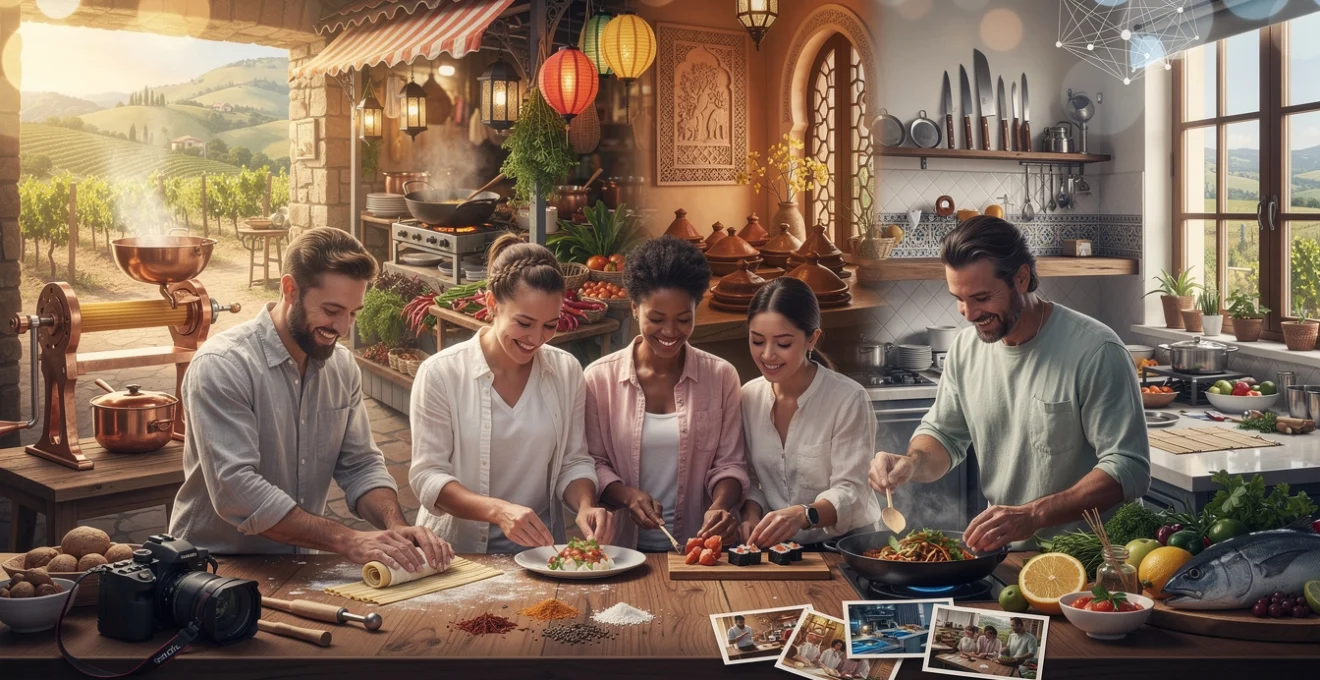
The aroma of fresh basil in an Italian kitchen, the rhythmic chopping of vegetables in a Bangkok street-side stall, the warm spices of a Moroccan tagine wafting through ancient riad walls—these sensory experiences form the foundation of travel memories that endure long after passport stamps fade. Culinary travel experiences have evolved beyond mere restaurant visits to become immersive educational journeys that forge profound connections between travellers and local cultures. When you participate in hands-on cooking instruction abroad, you engage multiple learning pathways simultaneously, creating neural imprints that transform casual holidays into life-changing adventures.
The science behind why cooking classes create such powerful memories lies in their multi-sensory nature and emotional engagement. Unlike passive sightseeing, culinary education demands active participation, requiring you to touch ingredients, smell spices, taste evolving flavours, and observe transformation processes. This comprehensive sensory involvement triggers what neuroscientists call “elaborative encoding,” where information becomes deeply embedded in long-term memory through multiple associative pathways.
Transformative culinary immersion experiences across global destinations
International cooking programmes have revolutionised cultural tourism by offering authentic pathways into local traditions and heritage. These educational experiences transcend language barriers, allowing you to communicate through the universal language of food preparation and shared meals. Modern culinary tourism encompasses everything from intimate home-based lessons with local families to professional-grade instruction in acclaimed cooking academies worldwide.
The global cooking class industry has witnessed remarkable growth, with culinary tourism representing approximately 25% of leisure travel spending according to recent World Food Travel Association data. This surge reflects travellers’ increasing desire for meaningful, participatory experiences rather than superficial tourist attractions. When you choose cooking instruction as part of your travel itinerary, you invest in skills and memories that appreciate in value over time, unlike material souvenirs that often lose their significance.
Tuscany’s farmhouse cooking schools and authentic Pasta-Making traditions
Tuscan farmhouse cooking experiences represent the gold standard of agricultural tourism integration with culinary education. These programmes typically begin with sunrise visits to organic gardens where you harvest vegetables, select herbs, and understand seasonal cooking principles that have governed Italian cuisine for centuries. The tactile experience of rolling fresh pasta by hand, feeling the exact texture that indicates proper gluten development, creates muscle memory that persists long after returning home.
Traditional Tuscan cooking methods emphasise simplicity and ingredient quality over complex techniques. During these sessions, you learn to recognise the visual and aromatic cues that indicate perfect ripeness in tomatoes, the proper consistency of risotto, and the delicate balance required for authentic carbonara. These skills transfer directly to your home kitchen, allowing you to recreate not just recipes but entire culinary philosophies rooted in centuries-old traditions.
Bangkok street food markets and traditional thai cooking techniques
Bangkok’s cooking academies offer unparalleled access to Southeast Asian culinary traditions through market tours and intensive technique workshops. These programmes begin at dawn with visits to floating markets where you observe ingredient selection processes, learn about tropical produce varieties, and understand the complex flavour balance principles that define Thai cuisine. The hands-on preparation of curry pastes using traditional granite mortars and pestles engages your entire body in the cooking process, creating physical memories alongside cognitive learning.
Thai cooking instruction emphasises the interplay between five fundamental taste elements: sweet, sour, salty, spicy, and umami. Through repeated practice and sensory evaluation, you develop the ability to adjust seasoning instinctively rather than relying solely on recipe measurements. This intuitive approach to flavour development becomes a transferable skill that enhances your cooking abilities across all cuisines, not just Thai dishes.
Marrakech riad kitchens and moroccan tagine mastery programs
Moroccan cooking classes within traditional riads provide immersive experiences in North African culinary artistry and spice blending mastery. These sessions typically include visits to traditional souks where you learn to identify quality saffron, understand berbere spice combinations, and witness the social dynamics of marketplace negotiations. The process of building flavour layers in tagines—from initial spice toasting through slow braising techniques—teaches patience and
controlled heat management, reinforcing how time, temperature, and moisture work together to transform humble ingredients into complex, aromatic stews. As you lift the tagine lid and the first cloud of steam escapes, the association between scent, setting, and shared stories becomes locked into long-term memory. Many riad programmes also teach traditional bread baking in clay ovens and the etiquette of Moroccan tea service, adding layers of cultural context to every dish you prepare.
These Moroccan culinary immersion experiences often extend beyond technique into broader lifestyle practices. You might learn why specific tagines are served at weddings, how Ramadan influences menu planning, or why preserved lemons occupy such a central place in the Moroccan pantry. By the time you leave Marrakech, you carry not just recipes but a deeper understanding of how food, faith, and family rituals intersect in daily life.
Tokyo sushi academies and kaiseki culinary philosophy
Tokyo’s sushi academies and kaiseki-focused schools offer an entirely different dimension of culinary immersion, rooted in precision, restraint, and aesthetics. In professional or semi-professional sushi programmes, you are introduced to knife skills that border on surgical, learning proper grip, angle, and pressure to achieve clean cuts that preserve the texture of fish. You also discover the science behind shari—the seasoned rice that forms the foundation of authentic sushi—and how subtle changes in temperature or vinegar ratios can alter the entire flavour experience.
Kaiseki training goes further, presenting food as an edible expression of season, landscape, and philosophy. In these classes, instructors emphasise harmony between colours, textures, and cooking methods within a single multi-course meal. You might prepare a series of small plates that showcase seasonal produce, delicate broths, and charcoal-grilled fish, each arranged with near-meditative attention to balance and negative space. This disciplined approach teaches you to view cooking not just as nourishment or entertainment, but as a structured art form that encodes centuries of Japanese cultural values.
Lima’s ceviche workshops and peruvian fusion cooking methods
Lima has emerged as a global capital of gastronomic innovation, and its ceviche workshops offer a gateway into both traditional and contemporary Peruvian cooking. In these classes, you study the chemistry of “cooking” fish in citrus, learning how acid denatures proteins and why timing and cut size are critical to ideal ceviche texture. Instructors guide you through the selection of local varieties of white fish, ají peppers, and limes, helping you understand why substitutions at home must be made thoughtfully to maintain authenticity and food safety.
Beyond ceviche, many Lima-based schools introduce you to nikkei and chifa—Peruvian-Japanese and Peruvian-Chinese fusion cuisines that reflect waves of immigration and cultural blending. Stir-fried dishes like lomo saltado illustrate how wok hei, soy sauce, and Andean ingredients coexist on the same plate, while nikkei-inspired tiraditos showcase sashimi-like cuts in Peruvian marinades. By participating in these fusion-focused sessions, you witness how culinary traditions evolve over time, and you gain a more nuanced perspective on how globalisation and migration shape what ends up on the table.
Neurological memory formation through multi-sensory culinary learning
The lasting nature of cooking class memories abroad is not accidental; it is grounded in how the brain processes multi-sensory, emotionally charged experiences. When you cook in a foreign environment, your olfactory, tactile, visual, gustatory, and auditory systems activate simultaneously. This cross-modal stimulation encourages the hippocampus—the brain region responsible for consolidating new memories—to encode richer, more detailed representations than it would for passive observation alone.
Neuroscience research suggests that we remember experiences better when they are associated with strong emotions, novelty, and active problem-solving. International cooking classes deliver all three: you are adapting to unfamiliar ingredients, collaborating with new people, and often navigating a language barrier, all while working against a timer or striving to perfect a dish. This combination creates what psychologists call “high arousal states,” which are particularly effective at strengthening long-term memory traces.
Olfactory memory pathways and spice recognition techniques
Of all the senses involved in culinary tourism, smell has the most direct route to memory. Olfactory signals bypass the typical thalamic relay and connect straight to the limbic system, where emotions and long-term memories are processed. This is why a hint of lemongrass can instantly transport you back to a Bangkok cooking school, or the aroma of cinnamon and cumin can evoke a riad kitchen in Marrakech years later.
To intentionally harness olfactory memory while travelling, many cooking instructors teach structured spice recognition exercises. You might be asked to close your eyes and identify individual components of a curry blend or Moroccan ras el hanout, first by scent alone and then in combination. By repeatedly smelling, naming, and then tasting these spices in context, you create layered associations that make it easier to recognise and recreate those flavour profiles at home. Keeping a small “travel spice journal,” where you note aromas and emotional reactions, further reinforces these neural pathways.
Tactile learning through dough manipulation and ingredient preparation
Touch is another powerful yet underrated component of culinary memory formation. When you knead bread in a Tuscan farmhouse or shape dumplings in a Tokyo studio, you are building procedural memories—skills stored in the brain’s motor systems that can be recalled even when explicit details fade. This is the same kind of memory that allows you to ride a bicycle after years without practice; your hands and muscles “remember” movements your conscious mind may not fully articulate.
In international cooking environments, instructors frequently cue tactile checkpoints rather than clock times: “stop kneading when the dough feels like your earlobe,” or “the pasta is ready when it springs back under your finger.” These analogies convert abstract culinary standards into concrete physical sensations you can later replicate. The more you practice noticing texture—of dough, vegetables, meat, or rice—the more deeply those sensations become encoded, making it easier to reproduce authentic results in your home kitchen.
Visual memory consolidation via plating aesthetics and food presentation
Visual information plays a dual role in culinary learning: it helps you follow techniques in real time and later serves as a retrieval cue for the entire experience. Watching a chef’s hands as they debone a fish or fold dumplings activates your mirror neuron system, which is involved in imitation and skill acquisition. When you then replicate those motions yourself, you reinforce neural circuits that link sight and movement.
Presentation-focused cuisines, such as Japanese kaiseki or high-end Peruvian tasting menus, further leverage visual memory through intricate plating. The way microgreens are arranged, how sauces are dotted or brushed, or the precise angles at which sushi slices rest against rice all become distinctive visual patterns. Photographing these plates—or sketching them in a notebook—gives you reference points to reconstruct not only the look of the dish but also the sequence of steps involved in its creation. Over time, you start to recognise recurring visual motifs that signal specific cultural aesthetics and values.
Gustatory imprinting and flavour profile development
Taste completes the memory loop by tying together smell, touch, and sight into a coherent, emotionally resonant experience. When you finally sit down to eat the meal you’ve prepared, your brain performs a kind of “checksum,” comparing anticipated flavours with actual results. This process of expectation and feedback is central to refining your palate and understanding complex flavour architecture.
Many cooking schools abroad now explicitly teach flavour mapping, encouraging you to identify dominant, supporting, and background notes in each dish. You might be guided to notice how citrus acidity lifts the richness of ceviche, or how a hint of sugar tempers chilli heat in Thai curries. By articulating these impressions out loud or in writing, you convert fleeting sensations into stable mental models. Later, when you cook at home, these models help you troubleshoot: if a dish tastes flat, you’ll know whether to reach for acid, salt, fat, or aromatics to restore balance.
Cultural anthropology and gastronomic heritage preservation
Beyond personal memory, cooking classes abroad also function as informal laboratories of cultural anthropology. Every recipe you encounter is a living document that encodes trade routes, colonisation, climate patterns, and religious practices. When an instructor explains why certain ingredients are taboo, why specific dishes appear only at festivals, or how a preparation method evolved from necessity, you gain insight into the socio-economic forces that shaped that cuisine.
Participatory culinary tourism can also support the preservation of gastronomic heritage at risk of disappearing. In many regions, elder home cooks and small-scale producers are the last custodians of techniques not yet written down or standardised. By learning from them directly—and paying for that expertise—you help create economic incentives to keep those traditions alive. Some programmes go further, partnering with NGOs or cultural institutions to document recipes, record oral histories, and promote geographic indication protections for regional specialities.
As a traveller, you can contribute to this preservation simply by being curious and respectful. Ask about the origins of a dish, the stories behind a festival food, or the symbolism of certain ingredients. When you return home and recreate those recipes, you become an informal ambassador, sharing not just a meal but the narrative of a place and its people. In this way, cooking classes abroad transform you from a passive consumer of culture into an active participant in its continuity.
Social learning dynamics in international cooking environments
Cooking classes abroad are rarely solitary; they are social ecosystems where learning is amplified through interaction. You might share a workstation with a couple from another continent, chop vegetables beside a local apprentice, or trade wine recommendations with fellow participants during a communal meal. These group dynamics create what educational psychologists call “social scaffolding,” where observing and collaborating with others accelerates your own skill acquisition.
Working in a multicultural kitchen also enhances your cross-cultural communication abilities. You learn to interpret non-verbal cues, negotiate tasks without a shared first language, and navigate different expectations around time, hierarchy, and feedback. Missteps—like oversalting a dish or misreading an instruction—often become shared jokes that lower anxiety and make the environment feel safer for experimentation. These positive social emotions, in turn, strengthen the memory trace of the experience.
If you are an introvert or anxious about group activities, choosing the right format can make all the difference. Smaller classes, home-based sessions, or semi-private lessons offer more space for questions and quiet observation. Regardless of setting, consider arriving a few minutes early, introducing yourself to the instructor, and sharing any concerns or goals. This small investment in rapport building typically pays off in more tailored guidance and a more relaxed, enjoyable learning environment.
Photographic documentation strategies for culinary travel experiences
Thoughtful photography can significantly enhance the durability of your culinary memories, provided it supports rather than distracts from the experience. Instead of snapping every moment, aim for a curated visual narrative: a few images of the market, key technique steps, ingredient close-ups, and final plated dishes. These photos act as external memory cues that help you reconstruct not only what you cooked but how you felt during the process.
From a practical standpoint, consider organising your images while the trip is still fresh. Create albums labelled by city or class, and add brief captions noting dish names, cooking tips, or flavour impressions. This simple habit turns your photo library into a searchable reference cookbook you can consult when planning dinner parties or revisiting a destination’s cuisine. If you enjoy journaling, pairing images with short written reflections deepens recall even further.
Etiquette matters as well. Always ask before photographing instructors or fellow students, and be mindful not to block others’ views or disrupt the flow of the class. Many schools are happy to pause briefly for “photo moments” once a key step is complete, giving everyone a chance to document without compromising safety or concentration. By balancing presence with documentation, you ensure that your camera enhances rather than replaces your direct engagement with the sights, sounds, and smells around you.
Long-term skill retention and home kitchen implementation techniques
The ultimate test of any cooking class abroad is what happens when you return to your own kitchen. Will those carefully honed tagine skills or sushi techniques survive the shift to different equipment, ingredients, and time constraints? Long-term skill retention depends on two main factors: how soon and how often you revisit what you learned. Cognitive science suggests that spaced repetition—practising skills at increasing intervals—is far more effective than a single, intense burst of activity.
To anchor your new culinary abilities, aim to recreate at least one dish from each class within two weeks of coming home. If you cannot source exact ingredients, treat substitutions as an opportunity to deepen your understanding: what happens when you swap local fish for a Peruvian variety, or use supermarket herbs instead of garden-fresh Tuscan basil? Keep notes on what works and what doesn’t, gradually building a personalised adaptation of the original recipe that fits your context while honouring its roots.
It also helps to break complex dishes into modular skills you can practise in isolation. Maybe you focus one week on perfecting Thai curry pastes, another on mastering fresh pasta dough, and another on refining knife skills learned in Tokyo. Integrating these techniques into your everyday cooking, rather than reserving them only for “special occasions,” turns them into habits rather than novelties. Over time, you may find that your weekday meals subtly echo your travels—a squeeze of lime here, a preserved lemon there, a more intentional approach to plating—creating a continuous thread between your journeys and your daily life.