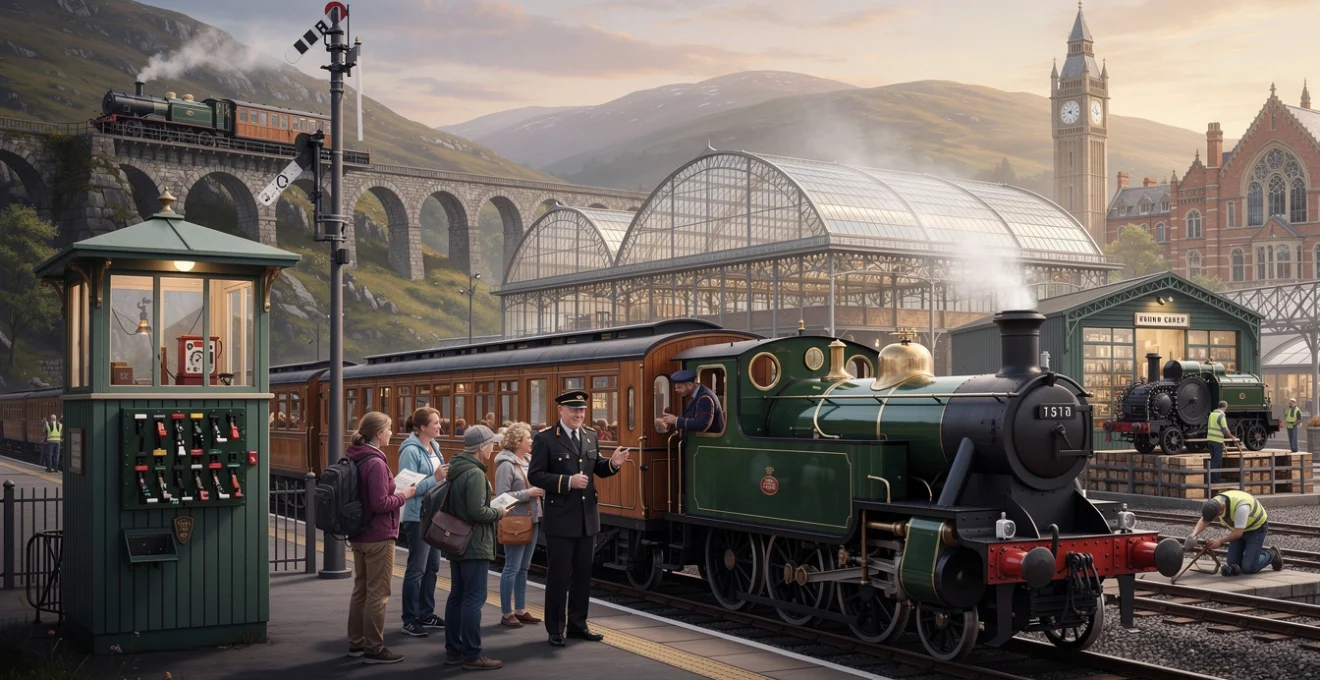
The romance of steam locomotion continues to captivate travellers across generations, drawing history enthusiasts to preserved railway lines and heritage stations throughout the United Kingdom and beyond. Unlike fleeting transport experiences, heritage railways offer immersive journeys into Britain’s industrial past, where the rhythmic chuffing of steam engines, the scent of coal smoke, and the meticulously restored Victorian carriages transport passengers to an era when rail travel revolutionised society. This enduring fascination stems not merely from nostalgia but from a genuine appreciation for the engineering brilliance, social transformation, and cultural significance embodied in these living museums. From the narrow-gauge lines threading through Welsh mountains to the grand Gothic revival terminals of London, railway heritage represents a tangible connection to the innovations that shaped modern Britain and influenced railway development worldwide.
The UK’s heritage railway sector stands unrivalled globally, with over 170 preserved services operating across approximately 600 miles of track and serving 460 stations. These aren’t simply tourist attractions; they’re functioning repositories of industrial archaeology, maintaining operational steam locomotives, preserving Victorian signalling systems, and keeping traditional railway crafts alive. The sector attracts approximately 18.5 million journeys annually, with 95% undertaken by domestic tourists who seek authentic historical experiences beyond what conventional museums can offer. What makes these railways particularly compelling for history-minded travellers is their authenticity—these are genuine working railways where you can witness locomotives maintained using period-appropriate techniques, travel in carriages dating back over a century, and observe traditional railway operations that disappeared from mainline services decades ago.
Preserved steam locomotives and rolling stock collections at living railway museums
Heritage railways function as dynamic museums where locomotives and carriages aren’t merely static displays but working exhibits demonstrating engineering principles from the steam age. These collections represent extraordinary investments in preservation, with many railways maintaining fleets of locomotives spanning different eras, manufacturers, and design philosophies. The diversity of preserved motive power allows enthusiasts to compare the evolution of steam technology, from Victorian-era tank engines to the powerful express locomotives of the 1950s. Each preserved locomotive tells multiple stories: of the engineers who designed them, the companies that operated them, the routes they served, and the communities they connected. This living history approach distinguishes heritage railways from traditional museums, as you can experience these machines in their intended environment, performing the work they were designed for.
The bluebell railway’s victorian and edwardian carriage restoration programme
The Bluebell Railway, operating between Sheffield Park and East Grinstead in Sussex, houses one of Britain’s finest collections of pre-Grouping coaching stock. Their restoration workshops have become centres of excellence for carriage conservation, employing traditional techniques to return Victorian and Edwardian carriages to operational condition. The railway’s collection includes rare Stroudley and Billinton coaches from the London, Brighton and South Coast Railway, featuring exquisite craftsmanship with marquetry panels, etched glass, and elaborate upholstery. Visitors can observe restoration work in progress, gaining insight into the painstaking process of sourcing period-appropriate materials, from horsehair padding to brass fittings manufactured to Victorian specifications. The Bluebell’s commitment to authenticity extends to maintaining historic colour schemes and interior layouts, providing passengers with genuine Victorian and Edwardian travel experiences.
North yorkshire moors railway’s operating heritage fleet and maintenance workshops
Stretching 24 miles across the dramatic North York Moors landscape, the North Yorkshire Moors Railway operates one of Britain’s most diverse locomotive fleets. Their collection spans the entire steam era, from humble industrial tank engines to prestigious named expresses. The railway’s workshops at Grosmont represent a masterclass in steam locomotive maintenance, where skilled engineers and volunteer craftspeople undertake everything from routine servicing to complete overhauls. These facilities demonstrate the extraordinary range of skills required to keep steam locomotives operational—pattern-making, casting, machining, boilersmithing, and copper work. The railway offers behind-the-scenes tours that reveal the complexity of steam locomotive engineering, showing how components manufactured in the 1920s are maintained using both traditional methods and carefully selected modern techniques that preserve authenticity whilst ensuring safety.
Severn valley railway’s collection of GWR and LMS locomotive classes
The Severn Valley Railway’s
collection is particularly appealing to history-minded travellers because it brings together representative examples of Great Western Railway (GWR) and London, Midland and Scottish Railway (LMS) classes that once dominated the main line. Locomotives such as GWR Manor and Hall class engines or LMS Stanier “Black Fives” are not only restored to immaculate condition but regularly rostered on service trains between Kidderminster and Bridgnorth. This means visitors can experience different pre‑nationalisation designs side by side, hearing how each locomotive sounds under load and observing how design philosophies varied between the railway companies. The Severn Valley’s Bewdley and Bridgnorth workshops further illuminate the complexity of heritage railway preservation, with boiler lifts, wheel turning, and heavy mechanical repairs on view during special open days. For those who want to delve deeper, experience days allow participants to ride on the footplate, gaining first-hand insight into how these historic machines are fired, driven, and maintained.
Ffestiniog railway’s narrow gauge steam technology and double fairlie articulated engines
In North Wales, the Ffestiniog Railway offers a contrasting yet equally fascinating strand of railway heritage through its pioneering narrow gauge technology. Originally built to carry slate from the quarries around Blaenau Ffestiniog to the coast at Porthmadog, this line adopted a gauge of just 1 ft 11½ in, enabling tighter curves and steeper gradients than standard gauge railways. To cope with these demanding conditions, engineers developed the distinctive Double Fairlie articulated locomotives, which mount two power bogies beneath a central boiler, effectively producing a locomotive that is symmetrical and bi-directional. For technically minded visitors, seeing these engines at work is like watching a piece of Victorian innovation in motion, perfectly adapted to mountainous terrain and heavy loads.
The Ffestiniog’s workshops at Boston Lodge, themselves of great historic interest, continue to construct and overhaul locomotives and carriages using a blend of heritage and modern methods. Here, you can see how riveted boiler plates, hand‑forged components, and timber-framed carriage bodies are still produced for active service, ensuring continuity with 19th‑century practice. The line’s close relationship with the neighbouring Welsh Highland Railway also helps visitors understand the evolution of narrow gauge transport in Snowdonia, from quarry lines to longer-distance passenger routes. For many history-focused travellers, a journey on the Ffestiniog is not just a scenic ride; it is a chance to observe how specialist engineering, landscape, and industrial need combined to create a unique railway system that remains relevant today.
Grade II listed railway architecture and victorian station infrastructure
While locomotives and carriages provide the movement, it is the stations and railway architecture that frame the heritage experience and root it in place. Across the UK, many key terminals and regional stations are Grade II or Grade I listed, recognised for their architectural, historical, and engineering significance. For the history-minded traveller, exploring these buildings is akin to visiting cathedrals of the railway age, where iron, glass, and masonry were combined to dramatic effect. These stations demonstrate how the Victorian railway companies viewed architecture as both a practical necessity and a statement of civic pride, with grand booking halls, intricate ironwork, and soaring train sheds designed to impress.
What makes railway architecture particularly rich as a heritage subject is the way it captures multiple layers of history in a single site. Extensions, wartime alterations, and modern refurbishments often sit alongside original Victorian or Edwardian fabric, telling a story of continuous adaptation. You might find contemporary high-speed trains gliding beneath 19th‑century roof trusses, or digital departure boards mounted within Gothic arches that once framed hand‑painted timetables. For travellers interested in built heritage, railway stations offer a rare opportunity to see advanced 19th‑century engineering on a monumental scale, still performing their original function in the 21st century.
St pancras international’s gothic revival terminus and barlow train shed engineering
St Pancras International in London is perhaps the most striking example of how Victorian railway architecture and modern transport can coexist. The Midland Railway’s original Gothic Revival hotel frontage, designed by Sir George Gilbert Scott, creates a dramatic street elevation of red brick, spires, and ornate stonework that immediately signals the ambition of the age. Step inside, and the full impact of William Henry Barlow’s train shed becomes clear: a vast single-span iron and glass roof that, on completion in 1868, was the largest of its kind in the world. For visitors, walking beneath this soaring structure offers a visceral sense of Victorian engineering prowess, with the roof’s elegant ribs arching overhead like a giant iron ribcage.
The 21st‑century transformation of St Pancras into the London terminus for Eurostar services adds another layer of interest for history-minded travellers. Rather than erasing the past, the redevelopment carefully restored the original ironwork, brick vaults, and substructure while integrating new platforms, retail spaces, and artworks. This makes St Pancras an exemplary case study in adaptive reuse, showing how historic infrastructure can be modernised without losing its character. As you watch high-speed trains depart for Paris and Brussels from beneath a Victorian roof, you are reminded that railway innovation is an ongoing story, not just a relic of the Industrial Revolution.
Glasgow central station’s edwardian ironwork and underground platforms
Glasgow Central Station, a key hub in Scotland’s railway network, provides a different but equally compelling architectural experience. The current station largely dates from an Edwardian expansion, when a massive glass roof was erected over the platforms and a grand concourse was created above Argyle Street. The intricate ironwork and expansive glazing flood the station with natural light, giving travellers an immediate sense of the scale and complexity of early 20th‑century railway operations. For those interested in social history, the station’s role in wartime troop movements and migration from Scotland to destinations across the empire adds another dimension to its significance.
One of the most intriguing aspects of Glasgow Central is its hidden world of underground platforms, disused tunnels, and forgotten mailrooms beneath the present-day concourse. Guided tours take visitors into these atmospheric spaces, where peeling paint, old signage, and remnants of platform edges evoke a ghostly version of the station’s busy past. It is here that you can best appreciate how railway infrastructure evolved vertically as well as horizontally, with layers of construction reflecting changing traffic patterns and technological advances. For history-minded travellers, this contrast between the bustling main concourse and the quiet, subterranean spaces below is a powerful reminder that major stations are living palimpsests, continually rewritten over time.
York railway station’s curved trainshed roof structure and william peachey design
York railway station, once the largest in the world when it opened in 1877, remains a masterpiece of railway architecture and a key attraction for visitors interested in the history of travel. Designed by North Eastern Railway architect William Peachey, its defining feature is the sweeping curved train shed, supported by elegant iron arches and patterned spandrels. This curvature was not merely aesthetic; it was a practical solution that allowed the tracks to fan out towards multiple routes while maintaining a clear, unified roof structure. Walking along the platforms, you can see how the rhythm of the iron columns and the light filtering through the glass create a cathedral-like atmosphere, reinforcing the sense that railway travel was once a grand event.
York’s station is also closely linked to the nearby National Railway Museum, making it an ideal base for travellers who want to combine architectural exploration with in-depth study of railway technology. The juxtaposition of historic station buildings, working platforms, and museum halls full of preserved locomotives underscores how York has remained a railway city from the Victorian era to the present day. For those who enjoy reading the details of the built environment, original nameboards, enamel signs, and period waiting rooms offer countless small clues to how passengers once experienced the station. In many ways, York demonstrates that a station can be both a functional transport hub and an open-air museum of railway heritage.
Temple meads bristol: brunel’s original tudor-style terminus building
Bristol Temple Meads adds yet another thread to the story of railway architecture through its association with Isambard Kingdom Brunel and the Great Western Railway. The original terminus, built in the 1840s, adopted a Tudor-inspired style, with crenellations, arched windows, and a distinctive square tower that contrasted with the more industrial appearance of later railway structures. Although the station has been expanded and altered several times, Brunel’s early buildings still survive and are now listed, providing tangible evidence of how architects and engineers initially grappled with the challenge of designing for a completely new form of transport. For visitors, standing on the forecourt and looking back at the façade is like glimpsing the moment when the railway age first arrived in the West Country.
Inside and around the station, you can see how subsequent generations adapted and extended the site to accommodate growing traffic and new technologies. Later train sheds, additional platforms, and revised circulation routes reflect changes in traffic patterns, from the heyday of express services to modern commuter flows. For the history-minded traveller, Temple Meads offers a layered experience: you can trace Brunel’s visionary but experimental first steps, then follow the thread through to Victorian expansion, 20th‑century rationalisation, and contemporary regeneration projects. It is a reminder that railway heritage is not frozen in time; stations continue to evolve, and understanding those changes is part of the pleasure of exploring them.
Industrial revolution railway networks and historic route preservation
Beyond individual stations and locomotives, many history-minded travellers are drawn to the broader story of how entire railway networks emerged during the Industrial Revolution and shaped the geography of modern Britain. Early lines, often built to connect coalfields, ports, and industrial centres, laid the groundwork for the national network we recognise today. Preserving sections of these historic routes allows us to follow in the footsteps of the first railway passengers, experiencing alignments and landscapes that defined 19th‑century mobility. In some cases, heritage operations run directly on these original routes; in others, walking and cycling paths trace the trackbeds of lines that have long since closed.
Why does the alignment of a route matter to history enthusiasts? Much like walking the original path of a Roman road, travelling along an early railway line reveals how engineers negotiated gradients, rivers, and settlements using the tools and knowledge available at the time. Curves, cuttings, embankments, and tunnels all tell a story about contemporary surveying techniques and the economic priorities that justified such ambitious construction. For many visitors, journeying along these preserved stretches is the closest they can come to experiencing the transformative impact that railways had on 19th‑century society, compressing time and distance in ways that would have seemed miraculous to earlier generations.
Stockton and darlington railway 1825 pioneering passenger line alignment
The Stockton and Darlington Railway, opened in 1825, is widely regarded as the world’s first public railway to use steam locomotives for passenger services, and its route has become a touchstone for railway historians. Although the original line has been altered, truncated, or absorbed into later infrastructure, key sections of its alignment can still be traced, and various heritage projects aim to interpret its significance. For example, the surviving elements around Shildon and Heighington offer glimpses of early track layouts, simple platforms, and industrial structures that predate the more elaborate stations of the Victorian main line era. For travellers, visiting these sites is akin to standing at the cradle of railway travel, where experiments in steam traction first translated into regular public services.
Interpretive trails, museums, and heritage centres along the Stockton and Darlington corridor help bring the early railway landscape to life. Exhibits explain how the line originally combined horse-drawn and steam-hauled traffic, and how wagons of coal for export were soon joined by passenger coaches that opened up unprecedented mobility for local communities. In a way, following the old alignment is like reading the first chapter of a very long book: you can see tentative solutions to problems that later engineers would refine on a much larger scale. For history-minded travellers planning broader railway heritage tours in the UK, including the Stockton and Darlington corridor provides valuable context for understanding later developments such as the Liverpool and Manchester Railway and the Great Western main line.
Settle-carlisle line’s ribblehead viaduct and victorian engineering challenges
The Settle–Carlisle line, completed in the 1870s, represents the Victorian main line at its most dramatic, crossing wild Pennine landscapes via monumental structures such as the Ribblehead Viaduct. This 24-arch limestone viaduct, soaring 32 metres above the moorland, is a testament to both engineering ambition and human endurance, built by thousands of navvies who endured harsh conditions and high accident rates. For travellers today, passing over Ribblehead on a modern diesel unit or chartered steam train is an evocative experience, combining sweeping views with a palpable sense of history. The surrounding landscape, dotted with remnants of construction camps and temporary railways, still bears the imprint of the workers who carved the line through such remote terrain.
The Settle–Carlisle route itself has become a symbol of successful railway preservation campaigning. In the 1980s, proposals to close the line galvanized local communities, enthusiasts, and politicians into action, ultimately securing its future and prompting major investment in the viaduct and other structures. For history-minded visitors, this adds another layer to the story: the line is not just a relic of Victorian enterprise but also an example of late 20th‑century heritage activism. Travelling the route, stopping at stone-built wayside stations, and exploring nearby walking trails allows you to appreciate the line as both a working railway and a linear monument to Britain’s railway age.
West highland line’s glenfinnan viaduct and remote highland construction
Further north, the West Highland Line showcases how railway engineers pushed into some of the UK’s most challenging terrain, with the Glenfinnan Viaduct as its most famous landmark. Completed in 1901 and built from mass concrete rather than stone, this sweeping 21-arch structure curves gracefully across the valley, framed by lochs and hills. For many travellers, Glenfinnan is instantly recognisable from film and television appearances, but its real interest lies in the story of how a remote, sparsely populated region was connected to the wider railway network. The line’s construction required temporary piers in sea lochs, complex logistics for moving materials, and innovative engineering solutions to cope with unstable ground and severe weather.
Modern services, including scenic trains from Glasgow to Mallaig, enable visitors to experience the same alignment that once carried mail, fish, and crofters between isolated communities and urban markets. Heritage‑minded travellers often combine the rail journey with visits to local museums and walking routes that explain the social impact of the line, from changes in population patterns to the growth of West Highland tourism in the 20th century. Standing on the hillside above Glenfinnan, watching a train cross the viaduct, you can see at a glance how Victorian and Edwardian engineers reshaped the landscape, knitting together regions that had previously relied on arduous sea or land routes.
National railway museum collections and archive documentation systems
For those who wish to delve even deeper into railway heritage, the National Railway Museum (NRM) in York and its sister site in Shildon serve as indispensable resources. Together, they hold the world’s largest collection of railway objects, including over 100 locomotives and rolling stock vehicles, thousands of signalling artefacts, and an extensive photographic and documentary archive. Unlike smaller heritage lines that focus on keeping particular routes and fleets in operation, the NRM provides a panoramic overview of railway history, from early experimental locomotives such as Rocket to modern high-speed trains. This breadth makes it particularly appealing to history-minded travellers who want to place individual heritage experiences within a wider narrative.
Behind the scenes, sophisticated documentation systems ensure that each object’s provenance, technical details, and operational history are meticulously recorded. Archivists and curators manage millions of items, from engineers’ notebooks and timetables to carriage drawings and accident reports, often digitising materials to improve accessibility. For researchers, students, and enthusiasts, these archives are a treasure trove that allows detailed reconstruction of how the railway industry evolved. Even casual visitors benefit from this scholarship, as gallery displays and interpretive panels are grounded in robust historical evidence rather than anecdote. In this sense, the museum acts as both a physical and intellectual hub for understanding Britain’s railway heritage.
The NRM also plays a crucial role in supporting heritage railways and restoration projects across the country. Through loans, technical advice, and collaborative research, it helps ensure that preserved locomotives, stations, and signalling systems are interpreted accurately and maintained safely. Special exhibitions and events often highlight themes that resonate with travelling enthusiasts: sleeper trains, women in railway history, wartime evacuation services, or the global spread of British railway technology. If you are planning a railway heritage tour of the UK, including a visit to the NRM at the start or end of your journey can provide valuable context, tying together the diverse experiences of living museums, historic routes, and architectural landmarks.
Heritage railway volunteering programmes and traditional signalling operations
One of the distinguishing features of UK railway heritage is the extent to which it is sustained by volunteers. Estimates suggest that around 20,000 volunteers contribute to heritage railways nationwide, alongside a few thousand paid staff, collectively providing roughly half of all labour required to run services. For history-minded travellers, this opens up opportunities not just to observe the past but to participate in its preservation. Many lines offer structured volunteering programmes and training schemes that allow you to learn traditional skills, from operating mechanical signal boxes to firing steam locomotives. In an age when many jobs are digital and intangible, the appeal of working with heavy machinery and physical infrastructure is easy to understand.
Volunteering also adds a social dimension to railway heritage, turning lines into communities as much as attractions. Retired engineers share knowledge with younger recruits; local residents work alongside visitors who travel considerable distances to spend weekends maintaining track or restoring carriages. This intergenerational transfer of skills is essential to the survival of traditional railway operations, particularly in areas such as signalling and steam locomotive operation where there are few modern equivalents. For travellers with flexible schedules or long-standing interest in railways, joining a volunteering programme can transform a one‑off visit into an ongoing relationship with a particular line or project.
Mechanical signalbox preservation: semaphore systems and token working methods
While modern main lines rely on computer-based signalling and in-cab control systems, many heritage railways continue to use mechanical signal boxes, semaphore signals, and token working methods. For historically minded visitors, these installations are living laboratories that show how Victorian and Edwardian railways ensured safety and efficiency long before electronics. Inside a traditional signal box, you will find a frame of levers mechanically linked to trackside points and signals, with complex interlocking mechanisms that physically prevent conflicting routes from being set. Watching a signaller pull levers in sequence as a train approaches gives a vivid sense of the choreography involved in running even a small section of railway.
Traditional token systems, used on single-line sections to prevent head‑on collisions, are another fascinating aspect of heritage operations. Here, a train crew must physically receive a token—often a metal staff or hoop-mounted tablet—before entering a section, with instruments in signal boxes ensuring that only one token can be issued at a time. Experiencing this process as a passenger, perhaps seeing the driver exchange tokens on the move, helps you understand how safety was managed in remote areas with limited communication. Many heritage lines offer signalling experience days, where participants can spend time in a mechanical box under supervision, learning the principles of block working and interlocking. It is rather like stepping onto the bridge of a historic ship: you see the control systems as the original operators would have known them.
Fireman and driver training schemes for steam locomotive operation
Operating a steam locomotive is a complex skill that blends physical effort, technical understanding, and teamwork, and heritage railways invest heavily in training new generations of drivers and firemen. For enthusiasts, footplate experience courses provide a structured introduction, typically involving safety briefings, basic theory, and supervised time on the locomotive as it hauls a short train or demonstration freight. Participants quickly discover that managing a boiler is both science and art: you must balance coal, water, and air to maintain steam pressure, rather like keeping a finely tuned furnace at just the right temperature. The driver, meanwhile, must understand gradients, signalling, braking distances, and the locomotive’s mechanical behaviour, all while communicating clearly with the fireman.
Many lines run longer-term training schemes for committed volunteers, progressing from cleaning duties to firing and eventually driving under assessment. These programmes often mirror historical railway apprenticeships, with candidates required to demonstrate competence in safety rules, route knowledge, and locomotive handling before advancing. From a heritage perspective, such schemes are vital, ensuring that practical knowledge does not vanish as those who worked on steam in the nationalised era retire. For travellers who have always wondered what it would be like to stand on the footplate of a working engine, enrolling in a taster course can turn a day out into an unforgettable encounter with living industrial history.
Permanent way maintenance: traditional track-laying and ballast techniques
Railway heritage is not only about glamorous locomotives and grand stations; it also depends on the humble but essential work of permanent way maintenance. Many heritage lines still rely on labour-intensive methods for track inspection, sleeper replacement, and ballast packing, complementing limited use of modern machinery. For visitors who join maintenance gangs on organised volunteer days, the experience can be eye-opening. You quickly learn that keeping rails in good condition is a constant battle against weather, ground movement, and wear—rather like caring for an historic building’s roof, but stretched out over miles of countryside. Tasks such as lifting track, packing ballast by hand, and aligning rails demand teamwork and a keen eye for detail.
From a historical standpoint, these activities replicate the work undertaken by 19th‑ and early‑20th‑century railway labourers, albeit with greater emphasis on safety and ergonomics. Heritage lines often retain older tools and small-scale equipment, allowing volunteers to see how maintenance was carried out before the advent of large tamping machines and mechanised track renewals. Understanding the “invisible” side of railway operation—everything that happens when trains are not running—adds depth to a heritage visit, revealing that the smooth ride passengers enjoy is the result of painstaking, ongoing effort. For those interested in industrial history more broadly, participating in or observing permanent way work illuminates the often overlooked role of manual labour in keeping the great machines of the railway age in motion.
Railway heritage tourism infrastructure and experiential travel packages
As interest in sustainable and experiential travel continues to grow, railway heritage sites have developed increasingly sophisticated tourism infrastructure and packages. Rather than offering simple out‑and‑back rides, many lines now curate full-day or multi-day experiences that combine historic trains with fine dining, themed events, and photography opportunities. Tour operators and holiday companies have also recognised the appeal of slow travel by train, bundling heritage journeys with stays in period hotels, museum visits, and walks reflecting contemporary British lifestyle. For history-minded travellers, this means it is easier than ever to plan itineraries where the journey is as enriching as the destination.
At the same time, heritage operations must balance visitor expectations with the realities of maintaining ageing infrastructure and meeting modern safety standards. Crafting premium experiences—whether luxury dining trains, steam galas, or chartered photo specials—helps generate vital revenue for restoration projects while showcasing railway heritage in its most evocative form. Yet behind the polished presentation lies the same network of volunteers, engineers, and planners who keep regular services running. Understanding this interplay of tourism and preservation can deepen your appreciation of heritage railways: they are, in effect, community enterprises that fund their conservation work through offering memorable experiences to the travelling public.
Luxury pullman dining services: british pullman and northern belle operations
At the top end of the market, luxury Pullman dining trains such as the British Pullman and the Northern Belle revive the golden age of rail travel for contemporary audiences. Using meticulously restored 1920s and 1930s carriages, complete with stained glass, polished brass, and plush upholstery, these services offer multi-course meals prepared onboard as the countryside glides past. For history-minded travellers, the appeal goes beyond gourmet cuisine; it is about stepping into a carefully recreated environment that mirrors the style and etiquette of interwar express services. Staff uniforms, tableware, and even menu design are informed by archival research, resulting in an immersive experience where every detail is curated.
These trains typically operate over the modern main line network rather than preserved routes, but they draw heavily on Britain’s railway heritage in their branding and storytelling. Journeys often incorporate narratives about the lines traversed, the historic cities visited, or the original roles of the carriages themselves, some of which have storied pasts on famous services. For those considering whether such a premium trip is worthwhile, it can help to think of it as a moving heritage hotel and restaurant combined: you are not merely paying for transport but for a time-travel experience crafted around railway history. In turn, revenue from these operations frequently supports ongoing restoration work, ensuring that more heritage stock survives for future generations to enjoy.
Themed steam galas and locomotive charter services at heritage lines
Across the UK, heritage lines use themed steam galas and charter services to attract enthusiasts and casual visitors alike. These events often feature visiting locomotives from other railways or the main line, recreating historic combinations of trains and liveries that would have been common in specific eras. Timetables are sometimes structured to mimic busy operating days from the past, with frequent departures, freight demonstrations, and double‑headed trains. For history-minded travellers, a gala can feel like stepping into a period photograph brought to life, complete with authentic soundscapes, soot, and steam. It is also an opportunity to see rare or newly overhauled locomotives in action, making such events highlights of the enthusiast calendar.
Charter services add another dimension, allowing groups to book bespoke trains for photographic runs, special occasions, or educational use. On these trips, organisers may request specific formations of rolling stock, goods wagons, or liveries that tell a particular historical story, such as wartime evacuation trains or Victorian mixed traffic workings. The revenue generated helps fund major overhaul projects, which can run into hundreds of thousands of pounds per locomotive, while passengers enjoy uniquely tailored experiences. If you are planning a railway heritage holiday, checking the event calendars of key lines for steam galas or charters can significantly enhance your trip, offering richer and more varied operations than on a standard running day.
Railway photography tours: photographic charters and lineside access permits
Railway photography has long been intertwined with preservation, and many heritage lines now cater explicitly to photographers through dedicated tours and charters. On these events, trains are positioned and run at specific speeds or locations to allow carefully composed shots, often at sunrise or sunset when light is at its most dramatic. Participants may be granted supervised lineside access—something not normally available to the general public—enabling vantage points that mirror classic views from the steam era. For enthusiasts who have admired historic railway images in books and magazines, the chance to recreate similar scenes with modern cameras is a powerful draw.
These photography tours also foster a deeper understanding of how railways interact with their surrounding landscapes. You begin to notice how viaducts, cuttings, and station buildings sit within valleys or along coastlines, and how smoke and steam frame the composition like natural elements. Organised charters often brief participants on safety, historical context, and the specific heritage being portrayed, turning what might seem like a purely visual pursuit into a form of active interpretation. Whether you are an experienced photographer or someone who simply enjoys capturing evocative travel images, integrating a photographic charter or lineside workshop into your heritage itinerary can help you see familiar railways with fresh eyes—and, in the process, contribute to the ongoing visual record of railway heritage in the 21st century.