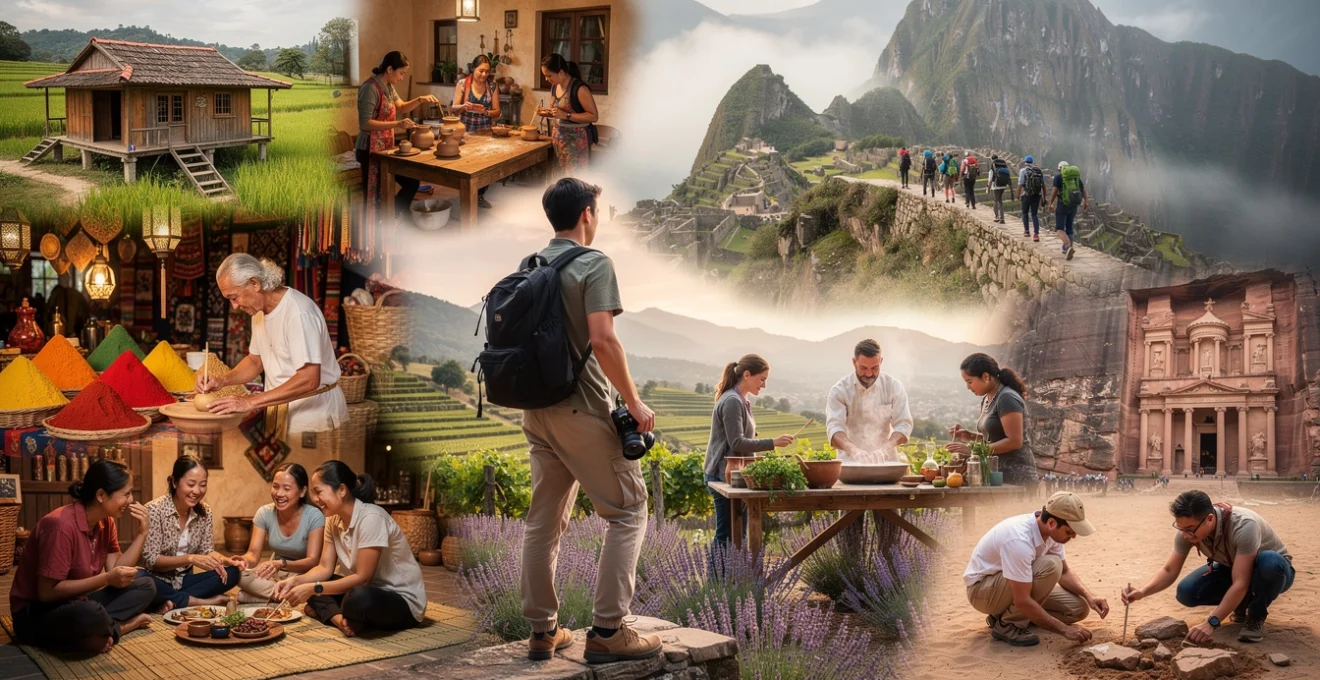
Standing in a bustling Moroccan spice market, the scent of cumin and saffron overwhelming your senses, or sharing a meal with a local family in rural Vietnam—these moments don’t simply fade into the background of everyday life. They become vivid, cherished memories that resurface years later with remarkable clarity. Immersive travel experiences possess a unique power to etch themselves into our consciousness in ways that conventional tourism rarely achieves. The difference lies not merely in where you travel, but in how deeply you engage with the destination, its people, and its culture.
Recent research reveals that 98% of travelers consider unique experiences when selecting destinations, whilst the global experiential travel market has surged beyond $1.2 trillion. These statistics underscore a fundamental shift in how modern travelers approach their journeys. Rather than passive observation, today’s discerning explorers seek transformative encounters that challenge perspectives, stimulate all senses, and forge genuine human connections. The question isn’t whether immersive travel creates lasting memories—it’s understanding precisely why these experiences possess such enduring psychological impact.
Neuroscience behind memory formation during immersive travel
The human brain responds to novel, emotionally charged experiences in profoundly different ways compared to routine activities. When you immerse yourself in unfamiliar environments, multiple neural pathways activate simultaneously, creating a rich tapestry of interconnected memories. This neurological phenomenon explains why a single week of authentic travel can generate more lasting memories than months of everyday routine.
Hippocampal encoding and spatial memory in novel environments
Your hippocampus, the brain region responsible for forming new memories, demonstrates heightened activity when navigating unfamiliar territories. During immersive travel, this structure works overtime to create detailed spatial maps of new environments. Research indicates that the hippocampus doesn’t merely record locations—it weaves together contextual information, emotional states, and sensory details into comprehensive memory networks. When you navigate the narrow streets of an ancient medina or trek through Patagonian wilderness, your brain encodes not just the physical route but the entire experiential context surrounding that journey.
This spatial encoding process intensifies when environments differ dramatically from your everyday surroundings. The more novel the setting, the more robustly your hippocampus engages in memory consolidation. This explains why travelers often recall obscure details from foreign destinations years later, yet struggle to remember last week’s commute to work. The novelty itself becomes a catalyst for exceptional memory retention.
Dopamine release mechanisms triggered by cultural novelty
Cultural immersion triggers substantial dopamine release in the brain’s reward centres, particularly within the ventral tegmental area and nucleus accumbens. This neurotransmitter plays a crucial role in memory formation, acting as a biological highlighter that marks certain experiences as significant and worthy of long-term storage. When you participate in authentic cultural activities—learning traditional dance in Bali, crafting pottery with Japanese artisans, or attending a genuine flamenco performance in Andalusia—your dopamine system responds with enthusiasm.
The anticipation of novel experiences further amplifies this effect. Studies show that dopamine levels rise not only during pleasurable activities but also in anticipation of them. This dual mechanism explains why planning an immersive journey generates excitement and why those preparatory moments themselves become part of the cherished memory. The neurochemical reward system essentially stamps these experiences as important life events deserving permanent storage in your memory banks.
Multisensory integration and episodic memory consolidation
Immersive travel engages all five senses simultaneously, creating what neuroscientists call multisensory integration. Unlike passive tourism, where visual observation dominates, authentic cultural experiences involve tasting unfamiliar foods, hearing foreign languages and traditional music, touching local textiles and materials, and inhaling distinctive scents unique to specific locations. This sensory richness dramatically enhances episodic memory consolidation—the process by which experiences become permanent autobiographical memories.
The parietal cortex and superior temporal sulcus work together to bind these diverse sensory inputs into cohesive memory episodes. Research demonstrates that memories formed through multisensory experiences show significantly greater durability and vividness compared to single-sens
ory memories. In practice, this means that the memory of sipping thick Turkish coffee in a quiet Istanbul courtyard is encoded not just as an image, but as a full sensory scene—the clink of porcelain, the bitter-sweet taste, the warmth of the cup in your hands, and the murmur of conversations around you. The more layers your brain has to work with, the more “hooks” it has to retrieve that immersive travel memory later.
Emotional salience and amygdala activation in travel contexts
Alongside the hippocampus, the amygdala plays a central role in why immersive travel experiences feel unforgettable. This almond-shaped structure evaluates emotional significance and tags certain moments as especially important. When you experience awe watching the Northern Lights, or feel deep empathy during a homestay in a community affected by climate change, your amygdala signals that these events matter and should be stored with priority.
Emotional salience acts almost like a bold font in your mental diary. Studies in affective neuroscience show that emotionally charged events, whether joyful, moving, or even mildly stressful, are recalled more vividly and accurately than neutral ones. Travel naturally amplifies these emotional peaks—uncertainty, wonder, surprise, and connection all activate the amygdala. As a result, immersive travel doesn’t just create more memories; it creates emotionally weighty memories that become reference points in how you understand your life story.
Psychological constructs defining immersive travel experiences
While neuroscience explains what happens in the brain, psychology helps us understand how immersive travel changes the way we think, feel, and grow. Lasting travel memories are not random; they are shaped by specific psychological states that promote deep engagement, reflection, and connection. When you reach these states—whether it is flow, mindfulness, or transformative learning—your immersive travel experiences are far more likely to stay with you for decades.
Flow state theory and complete engagement in destination activities
One of the most powerful psychological drivers of memorable travel is the flow state, a concept introduced by psychologist Mihaly Csikszentmihalyi. Flow occurs when we are so absorbed in an activity that time seems to disappear and self-consciousness fades. Think of learning to surf on a Balinese beach, concentrating intensely as you balance on the waves, or taking a hands-on ceramics class in Kyoto where your full attention is on shaping the clay. These are classic examples of immersive travel experiences that induce flow.
Flow requires a delicate balance between challenge and skill: the task must be demanding enough to engage you, but not so difficult that it becomes frustrating. Well-designed experiential travel itineraries intentionally create these conditions by pairing travelers with expert local guides and carefully pacing activities. Because flow states are accompanied by heightened focus and positive emotion, they are strongly associated with robust memory formation. You remember not just what you did, but the sense of total presence you felt while doing it.
Transformative learning through cultural immersion programmes
Beyond momentary engagement, immersive travel often leads to transformative learning—a deep shift in your perspectives, values, or sense of identity. Educational psychologist Jack Mezirow described this process as re-examining long-held assumptions after encountering disorienting, yet meaningful, experiences. Cultural immersion programmes, such as volunteering with local NGOs, studying language abroad, or joining community-based tourism projects, are designed precisely to trigger this kind of inner change.
Imagine spending several weeks in rural Peru working alongside farmers adapting to changing weather patterns. You do not simply observe; you participate, ask questions, and reflect on your own lifestyle back home. These structured reflection moments—journaling, group discussions, or guided debriefs—help convert powerful experiences into long-term beliefs and behavioral changes. Because these shifts strike at the core of how you see the world, the associated immersive travel memories remain highly accessible, often becoming turning points in your life narrative.
Mindful presence versus digital distraction in tourism settings
Even the most extraordinary destination can become forgettable if you experience it through a screen. Mindfulness—the practice of purposeful, non-judgmental attention to the present moment—acts as a powerful amplifier of memory during travel. When you slow down, put away your phone, and truly take in the scent of rain on a jungle trail or the texture of stone in an ancient temple, you give your brain the time and focus it needs to encode the scene deeply.
In contrast, constant digital distraction fragments your attention and disrupts memory consolidation. Rapidly switching between snapping photos, scrolling social media, and checking messages prevents any single moment from fully registering. Many experiential travel providers now integrate mindful practices into their itineraries: silent morning walks, phone-free dinners, or guided breathing exercises before entering sacred sites. These simple techniques help you inhabit your experiences more fully, ensuring your immersive travel memories are rich and enduring rather than rushed and superficial.
Social bonding and shared memory formation during group travel
Humans are inherently social, and our memories are strongly shaped by the people we share them with. Group travel, whether with friends, family, or small curated groups of strangers, creates powerful opportunities for shared memory formation. When you hike together in the Alps, get lost in a maze-like souk, or cook side by side in a local kitchen, you co-create stories that are rehearsed and retold for years.
Psychological research on collective memory shows that recounting events in groups strengthens recall and adds new layers of meaning. One traveler might remember the sudden downpour during a village festival, while another recalls the kindness of a local who offered shelter. Through conversation, these fragments are woven into a rich, shared narrative. Social bonding also increases emotional intensity—inside jokes, moments of vulnerability, and mutual support—further cementing immersive travel experiences as central chapters in your personal and relational history.
Experiential travel methodologies that enhance memory retention
Not all travel formats are equal when it comes to creating lasting memories. Certain experiential travel methodologies are particularly effective at promoting deep engagement, emotional resonance, and active participation. By understanding how these approaches work—from rural homestays to multi-day treks—you can make more intentional choices about how you travel and how you design your own immersive travel experiences.
Homestays in rural vietnam versus resort-based tourism models
Consider the difference between staying in a resort and living with a host family in rural Vietnam. In a resort-based tourism model, your experiences are often curated for comfort and predictability. You may enjoy beautiful surroundings, but daily routines—buffet breakfasts, poolside lounging, standardized excursions—can blend together, making individual days hard to distinguish in memory. The environment is pleasant yet somewhat detached from local life.
By contrast, a village homestay immerses you in the rhythms of everyday existence: waking to the sound of roosters, helping prepare meals over a wood-fired stove, or joining the family at the local market. These small, unscripted interactions—learning to say “thank you” in Vietnamese, tasting a home-grown herb for the first time, chatting with neighbors—create a mosaic of specific, emotionally rich moments. This active participation and unpredictability mean the experience engages multiple cognitive and emotional systems at once, dramatically increasing the likelihood that your time there becomes a vivid, lifelong memory.
Participatory cultural workshops in oaxaca’s artisan communities
In Oaxaca’s artisan communities, participatory cultural workshops offer another powerful model of experiential travel. Instead of simply browsing handicrafts in a shop, you might spend a day learning natural dye techniques from a Zapotec weaver or shaping clay alongside a family of traditional potters. You listen to stories about symbolism in the designs, hear about generational knowledge transfer, and see how economic realities shape artistic choices.
This form of immersive travel transforms you from spectator to co-creator. The physical act of weaving or sculpting anchors abstract cultural concepts in your body and senses. You feel the roughness of raw wool, smell the earthy scent of clay, and watch pigments change hue in the sun. Later, every time you see the piece you helped make, it acts as a powerful cue to reactivate the entire memory episode—the workshop, the teacher’s laughter, the courtyard where you worked. These participatory elements are precisely why experiential cultural workshops are so effective at enhancing both memory retention and intercultural understanding.
Multi-day trekking experiences along the inca trail to machu picchu
Long, continuous journeys like trekking the Inca Trail to Machu Picchu create a narrative structure that is uniquely conducive to long-term memory. Over several days, you move through distinct landscapes, altitudes, and historical sites, each stage building on the last. You face physical challenges, manage your energy, and adapt to changing weather. These cumulative efforts give the final arrival at the Sun Gate a powerful sense of earned reward that is hard to replicate in single-day excursions.
Psychologically, multi-day treks function like epic stories in which you are both protagonist and narrator. You remember the camaraderie formed over shared blisters, the first view of snow-capped peaks at dawn, or the guide’s tales of Incan engineering. Because there is a clear beginning, middle, and climactic end, your brain encodes the entire trip as a coherent chapter of your life rather than a disjointed series of snapshots. This narrative arc, combined with sustained physical effort and natural beauty, makes multi-day trekking one of the most memorable forms of immersive travel experience.
Culinary immersion through cooking classes in tuscany and provence
Culinary immersion is another methodology that powerfully links travel and memory. In Tuscany or Provence, a cooking class might begin in a local market, where you learn to select seasonal ingredients while hearing stories about regional traditions. You then move into a farmhouse kitchen, kneading dough, chopping herbs, and tasting olive oil as a local chef guides you through recipes passed down through generations.
Food, by nature, is multisensory and emotionally charged. Preparing and sharing a meal builds connection with your hosts and fellow travelers, while the sensory complexity—aromas, textures, flavors—creates dense memory traces. Perhaps most powerful is the fact that you can easily recreate these immersive travel experiences at home. Each time you cook that Tuscan ragù or Provençal ratatouille, you reactivate the memory network formed during your journey, strengthening it over time and keeping those travel moments vividly alive.
Sensory engagement mechanisms in memorable travel moments
If we think of the brain as a storyteller, then the senses are its richest sources of descriptive detail. Immersive travel memories stand out because they are saturated with sensory information—sights, sounds, smells, textures, and tastes that differ from your daily environment. Neuroscience shows that each sensory channel has its own pathways for encoding and recall, which is why a single aroma or sound can transport you back to a distant place in an instant.
Olfactory memory triggers from spice markets in marrakech
Smell has a uniquely direct route to the brain’s emotional and memory centers, particularly the amygdala and hippocampus. This is why a single whiff of cardamom or saffron can evoke a cascade of immersive travel memories from a spice market in Marrakech. As you wander between stalls piled high with paprika, dried rose petals, and cumin, your nose is constantly sampling complex scent combinations that you rarely encounter at home.
These olfactory experiences act as powerful “time machines.” Years later, opening a jar of ras el hanout in your kitchen may instantly recall the sound of bargaining voices, the feel of sun-warmed stone underfoot, or the bright colors of textiles hanging overhead. To intentionally harness this mechanism, you can bring home small, legal quantities of spices or scented oils from your travels. Each time you use them, you reactivate those immersive travel memories with remarkable clarity and emotional intensity.
Tactile learning through hands-on archaeological digs in jordan’s petra
Tactile engagement—what you touch and how you move—plays a critical role in making travel experiences stick. In Petra, joining a supervised archaeological dig turns ancient history from an abstract concept into a physical, memorable reality. Instead of merely looking at ruins from a distance, you kneel in the dust, brush away grains of sand, and feel the cool smoothness of unearthed pottery beneath your fingertips.
This kind of hands-on immersive travel experience combines kinesthetic learning with emotional resonance. You gain a visceral sense of the passage of time and the human lives that once animated the site. Research in educational psychology shows that tactile learning significantly improves retention, especially when paired with storytelling from experts. Long after dates and facts fade, you will remember the exact sensation of lifting a fragment of history from the ground, and that memory will continue to shape your appreciation of archaeology and cultural heritage.
Acoustic landscapes and soundmark recognition in iceland’s natural reserves
Soundscapes—what some researchers call “acoustic landscapes”—are another underappreciated driver of long-lasting travel memories. In Iceland’s natural reserves, you might hear the low rumble of shifting glaciers, the rhythmic crash of Atlantic waves, or the eerie stillness broken only by distant bird calls. These distinctive sounds function as soundmarks, acoustic equivalents of landmarks that help define a sense of place in your memory.
Because we are often less consciously aware of sound than sight, acoustic memories can feel especially transporting when triggered later. A recording of wind across open tundra, or the gurgle of geothermal springs, can instantly summon the raw, otherworldly atmosphere of Iceland. To deepen this sensory engagement, many mindful travelers now take short audio recordings during their journeys, capturing not just images but entire acoustic scenes. Listening back at home allows you to re-inhabit the emotional state you felt in that environment, reinforcing the durability of those immersive travel memories.
Narrative construction and personal identity through travel stories
Memories do not simply sit in the brain like files in a cabinet; they are constantly being organized and reinterpreted into stories. Immersive travel provides especially rich material for this narrative construction. When you recount how you navigated a chaotic bus station in India or shared tea with a family in Jordan, you are not just describing events—you are actively shaping your sense of who you are and what matters to you.
Psychologists describe this process as building a narrative identity, the internal story that gives your life coherence and meaning. Immersive travel experiences often occupy pivotal chapters in this story because they involve challenge, growth, and cross-cultural insight. You might tell the tale of overcoming your fear of heights on a suspension bridge in Nepal, framing yourself as more courageous and adaptable than you once believed. By retelling these stories to friends, writing them in a journal, or posting reflective blogs, you reinforce the associated memories and further integrate them into your identity as a curious, resilient traveler.
Interestingly, the very act of storytelling helps decide which details of a trip are preserved and which fade. Experiences you talk and write about frequently become more accessible, while unshared moments may slowly blur. This is why deliberately crafting and revisiting your own travel narratives—through conversation, creative writing, or even photo essays—can significantly extend the lifespan of your immersive travel memories and deepen their impact on your long-term personal development.
Long-term memory persistence from immersive versus passive tourism
When we compare immersive travel with passive tourism, one key difference stands out: the depth and longevity of the memories each creates. Passive tourism tends to prioritize comfort, predictability, and surface-level sightseeing. You might visit many attractions in a short time, but experience them primarily through bus windows and brief photo stops. The result is a blur of similar days, with few distinct emotional peaks or deeply personal moments to anchor in memory.
Immersive travel, on the other hand, emphasizes participation, connection, and reflection. Activities are designed to engage your senses, challenge your assumptions, and foster genuine relationships with people and places. Because these experiences activate multiple neural and psychological mechanisms at once—novelty, emotion, multisensory input, flow, and storytelling—they are encoded as high-priority memories. Years later, you may struggle to recall which generic resort you stayed at, yet remember in exquisite detail a single evening cooking over a fire with a host family or watching a ritual ceremony by moonlight.
For travelers and travel planners alike, the implication is clear: if you want journeys that truly stay with you, prioritize immersive experiences over passive consumption. Ask yourself before each trip: Will this itinerary give me opportunities to learn, to participate, to connect, and to reflect? The more often the answer is yes, the more likely it is that your travels will become not just a series of photos, but a lasting, meaningful chapter in the story of your life—one that you can revisit with clarity, gratitude, and a renewed sense of wonder for many years to come.