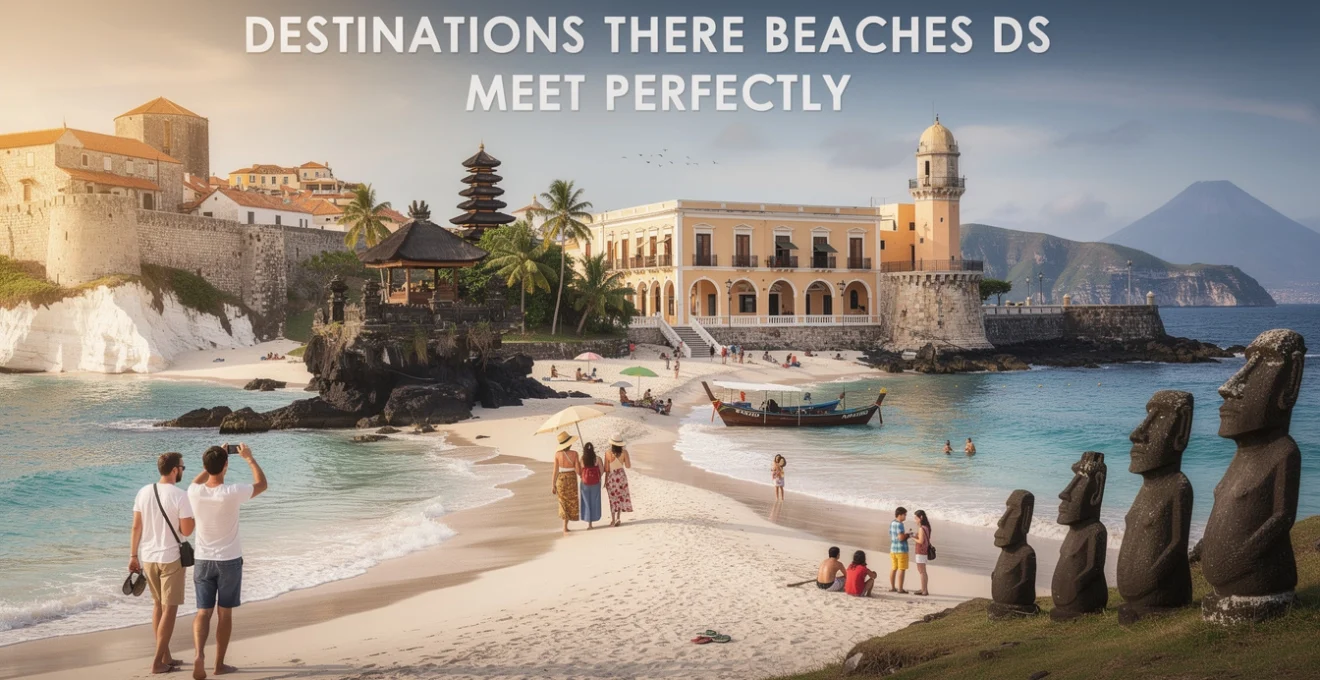
# Destinations where beaches and culture meet perfectly
The eternal travel dilemma – choosing between lounging on sun-drenched shores and exploring centuries-old cultural treasures – no longer requires compromise. Across the globe, remarkable destinations seamlessly blend pristine coastlines with profound historical significance, offering travellers the rare opportunity to experience both relaxation and intellectual enrichment within the same journey. These exceptional locations prove that beach holidays needn’t be culturally vacuous, nor must cultural expeditions sacrifice coastal beauty.
From Mediterranean harbours where ancient civilisations built their maritime empires to Southeast Asian temple complexes perched above tropical waters, the world’s most compelling destinations offer far more than singular attractions. They represent the convergence of natural splendour and human achievement, where the azure waters that once carried traders, explorers, and conquerors now welcome modern travellers seeking authenticity alongside leisure. Understanding which destinations deliver this perfect balance can transform an ordinary holiday into an extraordinary cultural awakening.
Mediterranean coastlines: where ancient civilisations meet azure waters
The Mediterranean basin has witnessed the rise and fall of empires, each leaving indelible marks on coastal cities that continue to captivate visitors millennia later. These destinations offer something increasingly rare in modern tourism: the ability to breakfast amongst medieval ramparts before swimming in crystalline waters by afternoon, creating a rhythm that satisfies both mind and body.
Dubrovnik’s old town and banje beach: croatian adriatic heritage
Dubrovnik’s limestone streets and baroque buildings create one of Europe’s most photographed urban landscapes, yet just beyond the city walls lies Banje Beach, where the Adriatic’s turquoise waters lap against pebbled shores. The contrast between the fortified Old Town – a UNESCO World Heritage Site since 1979 – and the relaxed beach atmosphere demonstrates how seamlessly culture and coastal leisure coexist. Walking the city walls provides panoramic views that encompass both historical architecture and the shimmering sea beyond, offering perspective on Dubrovnik’s strategic maritime importance throughout history.
The beach itself, though modest in size, delivers stunning vistas of the Old Town’s terracotta rooftops against the sea, creating an unparalleled backdrop for relaxation. Summer evenings here are particularly magical, when the setting sun illuminates the city’s fortifications in golden light whilst beachgoers enjoy their final swim of the day. Beyond Banje, the nearby Lokrum Island offers additional beaches alongside a Benedictine monastery and botanical gardens, extending the culture-beach combination further.
Sicily’s valley of the temples and scala dei turchi coastal formation
Sicily masterfully combines Greek archaeological wonders with Mediterranean beaches that rival any in southern Europe. The Valley of the Temples near Agrigento showcases some of the finest Doric temples outside Greece itself, their honey-coloured columns standing testament to Sicily’s role as Magna Graecia. Just 15 kilometres southwest, the Scala dei Turchi presents an entirely different spectacle – brilliant white marl cliffs cascading into impossibly blue waters, creating natural stepped terraces perfect for sunbathing.
This juxtaposition exemplifies Sicily’s dual appeal: archaeological sites that span Greek, Roman, Byzantine, Arab, Norman, and Spanish periods, alongside 1,500 kilometres of varied coastline. The island’s position at the Mediterranean’s crossroads made it a cultural melting pot, evident in everything from architectural styles to culinary traditions. Beach days here aren’t merely recreational breaks from sightseeing – they’re integral to understanding Sicily’s maritime heritage and the civilisations that contested control of these strategic shores.
Rhodes medieval quarter and lindos acropolis beach complex
Rhodes Town’s medieval quarter, constructed by the Knights Hospitaller during the 14th and 15th centuries, represents one of Europe’s best-preserved medieval urban centres. The fortifications, cobbled streets, and Gothic architecture create an atmospheric journey through crusader history. Yet Rhodes offers far more than medieval heritage – the island’s 220 kilometres of coastline include everything from organised resort beaches to secluded coves accessible only by boat.
Lindos, 50 kilometres south, perfectly encapsulates Rhodes’ cultural-coastal duality. The ancient acropolis crowns a dramatic head
land rising above twin bays of brilliant turquoise. Below, Lindos Beach and Saint Paul’s Bay offer sheltered swimming spots and relaxed tavernas, while whitewashed houses cascade down the hillside in classic Cycladic style. Spend the morning wandering through ancient temples and Hellenistic walls, then descend cobbled lanes to cool off in the Aegean – it’s an effortless way to combine cultural immersion with beach relaxation in a single day.
For travellers seeking a beach holiday with history, Rhodes also offers practical advantages. The island’s compact size and reliable bus network make it easy to base yourself near the sea and still access key archaeological sites and the medieval city. Visiting in shoulder seasons – late spring or early autumn – allows you to explore the acropolis and Old Town without the peak-summer crowds, while sea temperatures remain pleasantly warm. This timing gives you the best of Rhodes’ cultural richness and coastal charm.
Marseille’s calanques national park and le panier historic district
France’s oldest city, Marseille, has reinvented itself in recent years as a dynamic Mediterranean hub where maritime heritage, contemporary culture and wild coastlines intersect. At its heart lies Le Panier, the historic quarter of narrow streets and colourful facades that once housed Greek and later Roman settlers. Today, it blends artisan workshops, street art and traditional boulangeries, allowing you to trace Marseille’s multicultural past on foot before heading towards the waterfront.
Just a short bus or boat ride away, Calanques National Park reveals another side of the region: dramatic limestone fjords cutting into the coastline, with hidden coves and pebble beaches accessible via hiking trails or by sea. Here, azure inlets like Calanque d’En-Vau offer some of the most spectacular swimming in the Mediterranean, framed by soaring cliffs. Think of the calanques as Marseille’s wild backyard – a natural amphitheatre where clear waters and rugged rock formations stand in stark contrast to the city’s urban energy.
Planning a cultural beach escape in Marseille is surprisingly straightforward. You can spend one day exploring the Museum of European and Mediterranean Civilisations (MuCEM) and the 19th-century Notre-Dame de la Garde basilica, then dedicate the next to hiking and swimming in the calanques. To minimise environmental impact – a growing concern in this protected area – consider joining a guided small-group excursion, which typically includes information on local flora, fauna and conservation efforts alongside time at the beach.
Southeast asian cultural beach destinations: temple architecture and tropical shores
Southeast Asia offers some of the world’s most coveted coastal escapes, but its beaches are rarely just about sun and sea. From Hindu sea temples perched on cliffs to colonial towns fringed by palm-lined shores, the region’s coastal destinations are layered with religious traditions, trade histories and living cultures. For travellers who want more than a standard resort stay, these locations provide a rich blend of temple visits, local markets and soft-sand beaches within easy reach of one another.
Bali’s tanah lot sea temple and seminyak coastline
Bali is synonymous with spiritual retreats and surf-friendly beaches, and nowhere is this combination clearer than along the island’s southwest coast. Tanah Lot, one of Bali’s most photographed sea temples, sits atop a rocky outcrop battered by the Indian Ocean, especially dramatic at high tide and sunset. Built in the 16th century, it remains an active place of worship, with pilgrims bringing offerings and priests performing blessings as waves crash below.
Less than an hour’s drive away, Seminyak’s long golden coastline offers a more contemporary scene, with upscale beach clubs, boutique hotels and surfing schools. Here, you can watch the sky blaze orange from a beanbag on the sand after a day exploring rice terraces and temples inland. Pairing Tanah Lot with a Seminyak stay allows you to experience both Bali’s spiritual heritage and its modern beach culture, often in the same afternoon.
To deepen the cultural aspect of your Bali beach holiday, consider joining a local guide for a temple etiquette tour or attending an evening kecak dance performance in a seaside setting. You might also balance time on the sand with visits to nearby villages known for traditional crafts such as batik, silver jewellery or woodcarving. Travelling outside peak months of July and August typically means fewer crowds at Tanah Lot’s viewpoints and more affordable beachfront accommodation.
Phuket’s wat chalong buddhist complex and patong bay
Phuket, Thailand’s largest island, is often associated with nightlife and busy beaches, but it also contains some of the country’s most significant Buddhist sites. Wat Chalong, the island’s most revered temple complex, dates back to the early 19th century and honours two highly respected monks who played a key role in local history. The multi-tiered pagoda, said to house a bone fragment of the Buddha, is adorned with intricate murals illustrating his life and teachings.
A short drive away, Patong Bay presents an entirely different atmosphere, with a wide curving beach, water sports, and a lively promenade of restaurants and bars. This proximity means you can start your day in serene temple courtyards, listening to the soft rhythm of chanting and bells, and end it watching the sunset from a beachfront café. For those who prefer something quieter, nearby beaches such as Karon and Kata offer calmer sands while still keeping Wat Chalong within easy reach.
Respectful dress is essential when visiting temples in Phuket, so packing a lightweight scarf or sarong alongside your swimwear is a wise move. If you are travelling with children or first-time visitors to Thailand, combining temple visits with beach time can be a gentle way to introduce local customs and religious practices without overwhelming them. As tourism authorities continue to promote more sustainable travel on the island, choosing locally owned guesthouses and dining at family-run eateries near Wat Chalong also helps support the community beyond the main resort strips.
Hoi an ancient town and an bang beach unesco site
Hoi An, on Vietnam’s central coast, is one of Southeast Asia’s most compelling examples of a preserved trading port, with its Ancient Town designated a UNESCO World Heritage Site. Japanese merchant houses, Chinese assembly halls and ochre-coloured French villas line lantern-lit streets, reflecting the town’s role on historic spice and silk routes. Walking through its pedestrianised centre feels a little like stepping into an open-air museum, yet the town remains very much alive with tailors, tea houses and bustling markets.
Just a 10–15 minute drive away, An Bang Beach offers a long stretch of pale sand lapped by the South China Sea, backed by casual seafood shacks and relaxed bars. Unlike some overdeveloped coasts, construction here has been relatively low-rise, preserving views of the mountains and sea. Travellers can easily spend the morning exploring Hoi An’s temples and museums, then cycle to An Bang for an afternoon swim and freshly grilled fish as the sun sets.
Because Hoi An and An Bang combine culture and coastline so seamlessly, the area has become a popular choice for families and digital nomads looking for more meaningful beach holidays. Visiting between February and May usually brings the most stable weather, with warm seas and comfortable temperatures for city wandering. To avoid midday heat and tour group congestion in the Ancient Town, plan your cultural explorations early in the morning or after dusk, leaving the hottest hours free for the beach.
Galle fort colonial architecture and unawatuna crescent bay
On Sri Lanka’s southwest coast, Galle Fort showcases more than 400 years of layered colonial architecture, from Portuguese origins to Dutch and British additions. Enclosed by thick ramparts that jut into the Indian Ocean, the fort area now houses art galleries, boutique hotels and cafés in restored merchant houses. Strolling along the walls at sunset, with waves crashing below and the lighthouse standing guard, gives a powerful sense of how this outpost once controlled strategic sea routes.
Only a few kilometres away, Unawatuna curves into a near-perfect crescent of golden sand, shaded by leaning palms and dotted with relaxed beachfront restaurants. The bay’s relatively calm waters make it ideal for swimming and snorkelling, particularly around the nearby coral patches. Think of Galle and Unawatuna as two sides of the same coin: one offering cobbled alleys and colonial churches, the other inviting you to slow down with your feet in the sand.
For a culturally rich beach holiday in Sri Lanka, you might base yourself in or just outside the fort and take short tuk-tuk rides to Unawatuna, or alternatively stay by the beach and visit Galle Fort in the cooler parts of the day. Increasingly, responsible tourism initiatives in the area encourage visitors to support heritage conservation projects and locally owned businesses. Simple steps – such as choosing guesthouses within renovated historic buildings or participating in community-led walking tours – help sustain the living culture behind the postcard views.
Caribbean colonial heritage beaches: fortifications and coral sands
The Caribbean is famed for its turquoise waters and white-sand beaches, but its islands also bear the architectural and cultural imprints of centuries of colonial rule. Spanish, Dutch, British and French powers all left behind fortified cities, cobbled plazas and pastel-coloured facades that today sit just steps from palm-fringed shores. If you are looking for beach holidays with culture in the Caribbean, these destinations allow you to trade a few hours of sunbathing for evocative walks through living history.
Cartagena’s walled ciudad amurallada and playa blanca archipelago
Cartagena de Indias on Colombia’s Caribbean coast is arguably one of Latin America’s most atmospheric colonial cities. Encircled by 11 kilometres of thick stone walls built in the 16th and 17th centuries, the Ciudad Amurallada encloses a maze of flower-draped balconies, baroque churches and shaded plazas. Declared a UNESCO World Heritage Site in 1984, the historic centre tells a complex story of Spanish conquest, African heritage and maritime trade, now interpreted through museums and preserved architecture.
For beach time, many visitors head to Playa Blanca on Isla Barú or further into the Rosario Islands, where white sands and clear waters create a classic Caribbean idyll. Day trips by boat from Cartagena combine snorkelling over coral reefs with time to relax beneath thatched umbrellas. While Playa Blanca can get busy, especially at weekends, quieter stretches and eco-lodges elsewhere in the archipelago offer a more tranquil alternative for those willing to stay overnight.
To balance culture and beach in Cartagena, plan at least one full day exploring the walled city – including the hilltop Castillo San Felipe de Barajas fortress – and another dedicated to the islands. Visiting outside peak cruise season (typically December to March) often means fewer crowds both in the streets and on the sand. As Colombia’s tourism sector continues to grow, there is also an increasing emphasis on sustainable practices, making it easier to choose operators who respect marine ecosystems during island excursions.
Havana’s malecón seawall and playas del este
Havana’s appeal lies as much in its crumbling yet charismatic streets as in its coastal vistas. The Malecón, an eight-kilometre seawall running along the city’s northern edge, functions as both a protective barrier and a social gathering place. In the evenings, locals and visitors alike sit on its stone ledge to watch waves crash against the wall, classic cars roll past and musicians play impromptu sets against a backdrop of fading mansions and fortresses.
When you crave sand between your toes, the Playas del Este – a string of beaches around 20 kilometres east of central Havana – provide a convenient escape. Santa María del Mar is among the most popular, with pale sand, shallow turquoise waters and simple facilities, while quieter sections along the same stretch attract those seeking a more laid-back atmosphere. You can easily visit as a day trip by taxi or local bus, returning to Havana’s cultural attractions in the late afternoon or evening.
Because Cuba’s tourism infrastructure differs from many other Caribbean destinations, it’s wise to plan ahead for accommodation and transport, especially in high season. Staying in a casa particular (a licensed private guesthouse) in central Havana allows you to experience daily life more authentically, with hosts often happy to advise on the best beach and cultural combinations. Think of the Malecón and Playas del Este as extensions of the same coastal narrative – one urban and historic, the other relaxed and resort-like.
San juan’s el morro fortress and condado lagoon beaches
San Juan, Puerto Rico’s capital, offers one of the most striking juxtapositions of fortified colonial architecture and city beaches in the Caribbean. Old San Juan, perched on a small islet, is dominated by the vast Castillo San Felipe del Morro, a 16th-century citadel designed to guard the entrance to San Juan Bay. With its thick ramparts, sentry boxes and sweeping Atlantic views, El Morro, together with the nearby Castillo San Cristóbal, forms part of a UNESCO-listed historic site.
Just a short taxi ride away, the Condado district lines a broad stretch of sand and a calm lagoon ideal for paddleboarding and kayaking. Here, modern hotels, chic restaurants and a lively nightlife scene contrast with the cobbled streets and pastel facades of Old San Juan. Visiting both in one stay gives you a sense of how the city has evolved from a strategic colonial outpost to a contemporary Caribbean metropolis.
For travellers from North America, Puerto Rico’s status as a U.S. territory often simplifies logistics, with direct flights and no need for currency exchange if you use U.S. dollars. To make the most of a beach and culture holiday in San Juan, consider allocating mornings to walking tours of the forts and historic streets (when temperatures are cooler), and afternoons to relaxing by the sea or on the lagoon. As with many island destinations, hurricane season from June to November is worth bearing in mind when planning.
Willemstad’s handelskade waterfront and mambo beach boulevard
The Dutch Caribbean island of Curaçao blends European and Caribbean influences in a way that’s immediately visible along Willemstad’s iconic Handelskade. This historic waterfront, lined with gabled buildings painted in pastel hues, overlooks the St. Anna Bay and the famous Queen Emma Pontoon Bridge. The city centre, a UNESCO World Heritage Site, showcases Dutch colonial architecture adapted to tropical conditions, with museums and restored forts telling the story of trade, slavery and cultural exchange.
About a 10-minute drive from central Willemstad, Mambo Beach Boulevard stretches along a sheltered bay with soft sand, calm waters and an array of beach clubs, shops and restaurants. The area has been developed into a pedestrian-friendly promenade, where you can rent loungers, snorkel off the shore or simply enjoy the Caribbean sun. In Curaçao, it really is possible to go from browsing historic alleyways to swimming over coral just after lunch.
Curaçao sits outside the main Atlantic hurricane belt, making it a relatively reliable choice for year-round beach holidays that include culture. Renting a car is often recommended if you want to explore both Willemstad’s heritage sites and more remote coves around the island. To add a responsible tourism dimension to your stay, you might visit the island’s maritime museum or join a guided tour that explains how Curaçao’s diverse communities have shaped its present-day identity.
Pacific rim indigenous cultural beaches: māori and polynesian heritage sites
Across the Pacific Rim, many coastal areas serve not just as holiday destinations but as ancestral homelands rich in indigenous culture. Rather than seeing beaches purely as leisure spaces, Māori and Polynesian traditions often regard them as gateways to the spiritual world, landing sites of legendary voyages or locations of sacred ceremonies. Visiting these destinations with cultural awareness allows us to appreciate both their physical beauty and their deeper significance.
Rotorua geothermal lakes and mount maunganui te maunga summit
New Zealand’s North Island offers a compelling mix of geothermal wonders, Māori heritage and sweeping ocean beaches. Rotorua is renowned for its bubbling mud pools, geysers and hot springs, many of which are located on tribal lands and woven into Māori legends. Cultural centres and marae (meeting grounds) around Rotorua introduce visitors to traditional carving, kapa haka performances and the stories that link land, lake and people.
Less than an hour’s drive north, Mount Maunganui – known to Māori as Maunganui or simply Te Maunga, “The Mountain” – rises at the end of a long sandspit in the Bay of Plenty. A popular walking track circles and ascends the extinct volcanic cone, rewarding hikers with panoramic views of the Pacific Ocean and a sweeping surf beach below. After your climb, soaking in the nearby hot saltwater pools or swimming in the gentle harbour waters makes for an ideal recovery.
For a beach holiday with Māori culture, you might base yourself in Tauranga or Mount Maunganui and take day trips to Rotorua, or vice versa. Many organised tours now emphasise authentic engagement with local iwi (tribes), with guides sharing personal perspectives on traditions and current issues. As with any indigenous cultural site, it is important to follow local protocols, stick to marked trails and avoid entering restricted areas – these courtesies ensure that tourism supports, rather than undermines, cultural preservation.
Tahiti’s marae taputapuātea archaeological complex and matavai bay
On the island of Raiatea in French Polynesia, the Marae Taputapuātea complex is one of the most important cultural sites in the entire Polynesian triangle. Recognised by UNESCO, this sacred open-air temple complex once served as a central meeting and ceremonial place for chiefs and navigators from across the Pacific. Its stone platforms and courtyards, set against a backdrop of lagoon and forested peaks, are tangible reminders of the sophisticated seafaring societies that settled the region long before European contact.
While Taputapuātea itself is not a beach resort, it sits within a lagoon system where white-sand motus (small islets) and coral gardens abound. Many travellers combine a cultural visit to Raiatea with time on nearby Tahiti or Moorea, where Matavai Bay – historically a key anchorage for European explorers like Captain Cook and Bougainville – offers black-sand beaches and mountain-framed vistas. Standing where ancient priests once watched the stars and later ships dropped anchor, you begin to see the Pacific not just as a holiday playground, but as a vast cultural highway.
To experience Polynesian culture alongside beach relaxation, consider a multi-island itinerary that includes both historic marae sites and coastal villages. Local guesthouses and small-scale resorts often organise ‘ori Tahiti dance evenings, traditional feasts and lagoon excursions led by community members. Being mindful of reef conservation – by using reef-safe sunscreen and following snorkelling guidelines – also helps protect the very environments that sustain both cultural practices and tourism.
Rapa nui moai statues at anakena white sand beach
Few places embody the intersection of culture and coastline quite like Rapa Nui (Easter Island), a remote Chilean territory in the southeastern Pacific. Anakena, one of the island’s few sandy beaches, is not just a picturesque cove of white coral sand and coconut palms; it is also a key archaeological site where several restored ahu (ceremonial platforms) and moai statues stand facing inland. According to local tradition, this is where the island’s first Polynesian king, Hotu Matu‘a, is said to have landed.
Swimming in Anakena’s sheltered bay while monumental stone figures gaze over the landscape is an experience unlike any other beach visit. Beyond Anakena, the island contains hundreds of other moai, quarries and ceremonial sites, which collectively form a UNESCO World Heritage landscape. Daily visitor numbers are carefully managed to protect these fragile sites, and guides from the Rapa Nui community increasingly lead tours, sharing their own interpretations of the island’s history and contemporary challenges.
Reaching Rapa Nui requires more effort than many beach destinations – typically a multi-hour flight from mainland Chile – but for travellers seeking depth as well as beauty, the journey is richly rewarded. Staying at least four or five days allows enough time to explore key archaeological zones, attend cultural performances and still spend leisurely hours on Anakena’s sands. As you plan, remember that this is first and foremost a living homeland, not an open-air museum, and treating sites and local customs with respect is essential.
North african medina cities and mediterranean beaches
North Africa’s coastline offers a distinctive blend of Islamic, Berber and Mediterranean influences, where labyrinthine medinas sit within a short drive of breezy beaches. These destinations are ideal if you envision mornings spent bargaining for spices and ceramics in historic souks and afternoons walking barefoot along the shore. As infrastructure improves and more travellers seek culturally rich alternatives to standard resort strips, such cities are gaining attention for their dual appeal.
Essaouira’s portuguese ramparts and plage d’essaouira atlantic coast
On Morocco’s Atlantic coast, Essaouira (formerly Mogador) is a compact port city wrapped in 18th-century fortifications originally designed by European engineers. Weather-beaten ramparts, crenellated bastions and a picturesque harbour testify to its past as a strategic trading post frequented by Portuguese, French and other maritime powers. Within the white-and-blue medina, artisan workshops produce everything from thuya wood marquetry to vibrant textiles, and the air is filled with the scent of grilled sardines and sea spray.
Just beyond the city walls, Plage d’Essaouira stretches along a broad crescent of golden sand buffeted by steady trade winds. These conditions make it a favourite spot for windsurfers and kitesurfers, while camel rides and horse treks are popular along the shore. The water can be cooler and rougher than in the Mediterranean, but paddling and beach walks remain delightful, especially at sunset when the sky glows behind the silhouette of the ramparts.
Essaouira works particularly well as a long-weekend or short-break destination for those based in Europe, with direct flights or easy connections via Marrakech. To make the most of its fusion of culture and coast, consider staying in a traditional riad within the medina and walking to the beach each day. As tourism grows, local authorities have placed greater emphasis on preserving the city’s historic fabric, so your visit also contributes to ongoing conservation and community initiatives when you choose locally owned accommodation and tours.
Tunis medina zitouna mosque and la marsa corniche
The Tunisian capital, Tunis, showcases a fascinating contrast between its bustling historic core and relaxed seaside suburbs. The UNESCO-listed medina centres on the Zitouna Mosque, whose origins date back to the 8th century. Surrounding it is a dense network of souks specialising in everything from perfumes and jewellery to traditional textiles and copperware, all threaded through with caravanserais and palaces that hint at the city’s importance on trans-Saharan trade routes.
Approximately 20 minutes away by suburban train lies La Marsa, a coastal district with a sandy beach, palm-lined corniche and café terraces overlooking the Mediterranean. Nearby Sidi Bou Saïd, perched on a hilltop above the sea, enchants visitors with its blue-and-white houses, cobbled lanes and sweeping coastal views. For travellers undecided between a city break and a beach holiday, Tunis and its coastal satellites offer an elegant compromise.
Practicalities are relatively straightforward: you can base yourself in the medina, the modern city or along the coast and use inexpensive public transport or taxis to shuttle between cultural sites and the beach. Spring and autumn provide comfortable temperatures for both sightseeing and swimming, while summer can be very warm inland. As with any visit to active religious sites like Zitouna Mosque, modest dress and respectful behaviour are essential, particularly during prayer times and Ramadan.
Alexandria’s bibliotheca alexandrina and montaza palace beaches
Alexandria, Egypt’s second city, has long occupied a special place in the imagination as the site of the ancient Library of Alexandria and Pharos lighthouse. While those original wonders have vanished, the contemporary Bibliotheca Alexandrina – opened in 2002 – pays bold architectural homage to their legacy. Its vast tilted-disc structure and seafront location house millions of books, museums and cultural venues, reaffirming Alexandria’s role as a Mediterranean intellectual hub.
To the east of the city centre, the Montaza Palace complex stretches along a scenic section of coast, with landscaped gardens, royal-era architecture and a series of small beaches and coves. While some areas are reserved for hotel guests, public access points allow day visitors to swim, stroll and enjoy sea breezes away from downtown traffic. Elsewhere along the Corniche, urban beaches provide locals with easy access to the water during the long, hot summer.
For travellers fascinated by history, Alexandria offers additional layers, from Greco-Roman ruins and catacombs to Ottoman fortifications such as Qaitbay Citadel, built on the presumed site of the ancient lighthouse. Combining these with Montaza’s seaside setting creates a multifaceted coastal city break. As infrastructure projects continue to modernise the seafront, choosing operators and guides who prioritise heritage protection can help ensure the city’s rich past remains visible alongside new developments.
Indian ocean island heritage: spice trade routes and coral atolls
The Indian Ocean’s islands are often marketed primarily as luxury beach escapes, yet many also played pivotal roles in historic trade networks linking Africa, the Middle East and Asia. Spice routes, slave trades and colonial rivalries have all left their mark in the form of stone towns, fortresses and multicultural communities. For travellers who like their coral lagoons served with a side of history, these destinations offer especially rewarding combinations.
Stone town zanzibar unesco site and nungwi beach dhow harbour
Zanzibar’s Stone Town is a labyrinth of narrow alleys, carved wooden doors and coral-stone buildings that reflect Swahili, Arab, Indian and European influences. Once a powerful trading hub for spices and slaves, it is now a UNESCO World Heritage Site where churches, mosques and merchants’ houses stand side by side. Guided walks reveal the complex stories behind ornate Sultan’s palaces, bustling markets and modest family compounds, bringing to life centuries of cultural exchange.
On the island’s northern tip, Nungwi has evolved from a traditional fishing village into one of Zanzibar’s most sought-after beach destinations. Its wide, powdery beach remains a working shoreline, where wooden dhow boats are still built and launched, particularly at high tide. Watching sail-powered dhows glide across turquoise waters at sunset while you relax on the sand offers a rare sense of continuity between Zanzibar’s maritime past and present.
Because the tide range around Zanzibar can be significant, Nungwi’s relatively deep offshore waters make it a good choice if you want to swim throughout the day without long walks across exposed reef. Balancing time here with at least two nights in Stone Town creates a nuanced understanding of the archipelago beyond its beaches. As tourism expands, choosing operators who respect local customs and marine ecosystems – such as community-run snorkelling tours and lodges with waste-reduction programmes – helps keep this balance intact.
Galle dutch fort ramparts and mirissa whale watching coast
Complementing Galle and Unawatuna, Sri Lanka’s southern coast offers further opportunities to combine maritime heritage with marine wildlife. From the ramparts of Galle Dutch Fort, you can look west along the shoreline towards fishing villages and surfing beaches that stretch for kilometres. The fort itself, originally Portuguese and later heavily fortified by the Dutch, still functions as a living town, with schools, homes and administrative buildings within its walls.
Roughly 35 kilometres east lies Mirissa, a laid-back beach town that has become one of the world’s most notable whale-watching centres. Between November and April, boat trips regularly encounter blue whales, sperm whales and pods of dolphins in the deep waters just offshore. After early-morning excursions, travellers return to palm-fringed sands, where cafés and guesthouses overlook a sheltered bay ideal for swimming and surfing.
Combining Galle and Mirissa allows you to experience both Sri Lanka’s colonial maritime history and its remarkable marine biodiversity during a single coastal stay. However, with whale-watching’s growing popularity, it is vital to select responsible operators who adhere to distance regulations and minimise disturbance to the animals. As an analogy, think of the ocean as a living museum: approaching its inhabitants with care ensures that future visitors can continue to marvel at the same “exhibits” for years to come.
Mauritius aapravasi ghat and trou aux biches lagoon
Mauritius, often described as a tropical paradise, also holds profound historical significance as a crossroads of migration and labour. In the capital, Port Louis, Aapravasi Ghat – now a UNESCO World Heritage Site – marks the landing point where more than half a million indentured labourers from India first arrived between 1834 and the early 20th century. The preserved immigration depot and its interpretive centre shed light on a global system that transformed the island’s demographics and culture, shaping everything from language to cuisine.
About a 25-minute drive north, Trou aux Biches offers one of Mauritius’s most beloved beaches, with soft white sand and a lagoon protected by an offshore reef. The calm, shallow waters here are ideal for snorkelling, paddleboarding and family-friendly swimming, while sunset paints the sky in pastel shades behind bobbing fishing boats. A string of resorts and guesthouses lines the bay, yet careful planning has helped maintain much of its charm compared to more developed stretches.
For travellers seeking a beach holiday with culture in Mauritius, spending a day in Port Louis exploring Aapravasi Ghat, the central market and Chinatown provides important context for the island’s diversity before retreating to the tranquillity of Trou aux Biches. Increasingly, eco-conscious initiatives such as coral restoration projects and marine parks invite visitors to participate in preserving the very ecosystems that make the lagoon so appealing. By engaging with both the island’s human history and natural environment, you gain a far richer understanding of this Indian Ocean gem than any postcard could convey.