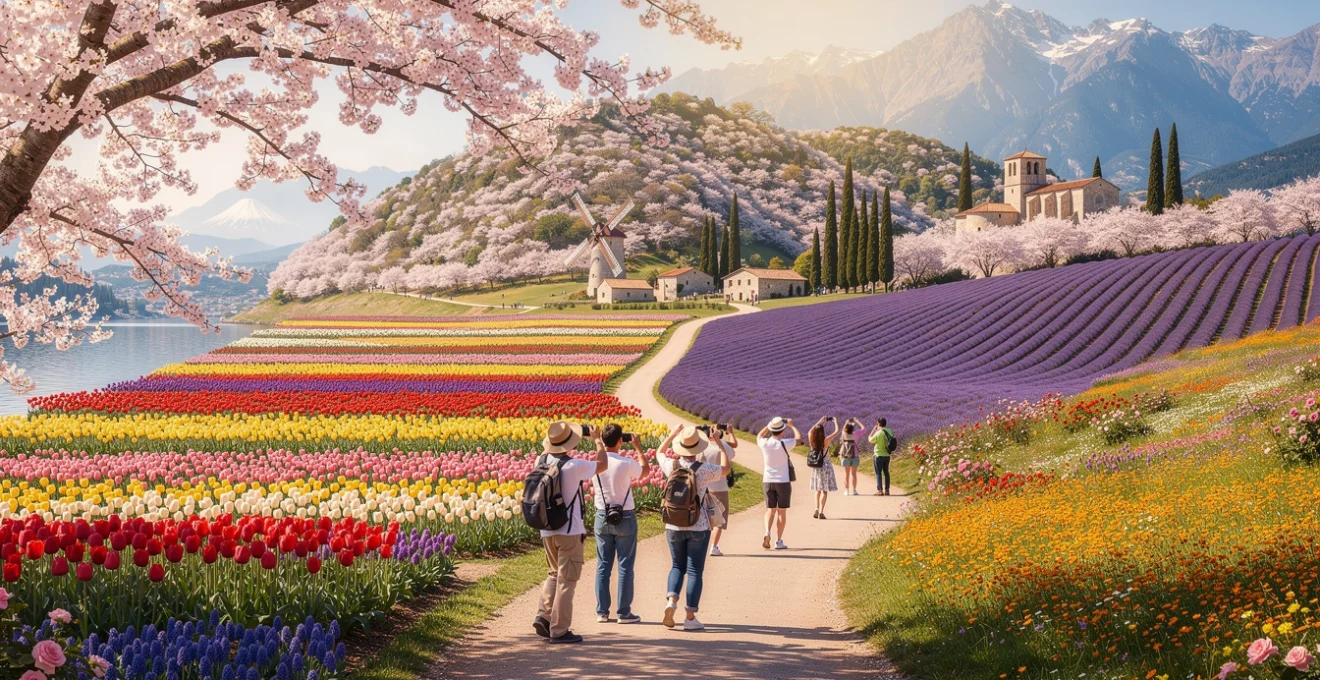
Across the globe, certain destinations have become synonymous with their spectacular floral displays, transforming entire landscapes into living canvases of colour. These remarkable locations represent the intersection of natural phenomena, horticultural expertise, and cultural tradition, creating seasonal spectacles that draw millions of visitors annually. From Japan’s ancient cherry blossom celebrations to the Netherlands’ meticulously planned tulip fields, these destinations showcase how flowers can define a region’s identity and economic prosperity. The timing of these blooms follows predictable patterns shaped by climate, elevation, and centuries of cultivation knowledge, yet each season brings its own unique variations in intensity and duration. Understanding these flowering cycles reveals not just botanical marvels, but the deep cultural connections between communities and their natural environments.
Cherry blossom spectacles across japan’s renowned hanami destinations
Japan’s cherry blossom season represents one of the world’s most celebrated floral phenomena, combining natural beauty with profound cultural significance. The practice of hanami, or flower viewing, dates back over a thousand years and has evolved into a national obsession that affects everything from weather forecasting to economic planning. The Japanese Meteorological Agency issues official bloom predictions months in advance, tracking the sakura zensen (cherry blossom front) as it moves northward across the archipelago from late January through May.
The economic impact of cherry blossom season extends far beyond tourism, generating an estimated ¥616 billion annually across Japan. This figure encompasses not just hotel bookings and restaurant visits, but also the massive logistics operation required to accommodate millions of domestic and international visitors. Hanami parties in parks can last from dawn to dusk, with elaborate preparations including reserved spots marked with blue tarps and sophisticated catering arrangements that have become an art form in themselves.
Yoshino mountain’s 30,000 sakura trees and peak viewing elevations
Mount Yoshino in Nara Prefecture hosts Japan’s most extensive cherry blossom display, with approximately 30,000 trees scattered across four distinct elevation zones. This natural stratification creates an extended blooming period lasting nearly a month, as flowers progress from the lower slopes to the summit. The mountain’s yamazakura (mountain cherry) trees represent over 200 varieties, including some specimens that are centuries old and considered national treasures.
The viewing areas are traditionally divided into four sections: Shimo-senbon (lower thousand), Naka-senbon (middle thousand), Kami-senbon (upper thousand), and Oku-senbon (inner thousand). Each section reaches peak bloom approximately one week apart, allowing visitors to experience the progression of spring up the mountainside. The peak viewing period typically occurs in early to mid-April, though climate change has begun to shift these traditional timing patterns.
Tokyo’s ueno park somei yoshino cultivar blooming patterns
Ueno Park serves as Tokyo’s premier cherry blossom destination, featuring over 1,200 trees dominated by the Somei Yoshino cultivar. This particular variety, developed in the Edo period, produces the iconic pale pink to white flowers that have become synonymous with Japanese cherry blossoms worldwide. The cultivar’s popularity stems from its spectacular synchronized blooming, creating the dramatic “pink cloud” effect that photographers and tourists seek.
The park’s cherry trees follow a remarkably predictable blooming pattern, with full bloom typically occurring 7-10 days after the first blossoms appear.
The Somei Yoshino’s genetic uniformity means that all trees in the park bloom and fade almost simultaneously, creating a brief but intense period of peak beauty that lasts only 3-5 days.
This short window generates massive crowds, with weekends during peak bloom seeing over 100,000 visitors daily.
Kyoto’s philosopher’s path weeping cherry canopy formation
The Philosopher’s Path (Tetsugaku-no-michi) in Kyoto offers one of Japan’s most poetic cherry blossom experiences, with weeping cherry trees creating a natural
vault over the stone-lined canal, forming an arching canopy that feels almost cathedral-like at peak bloom. Unlike the upright Somei Yoshino in Ueno, these weeping cherry trees (shidare-zakura) cascade downward, with branches often brushing the water’s surface. The narrow pathway, stretching roughly 2 kilometers, concentrates the blossoms into an immersive tunnel that changes character throughout the day as light filters through varying densities of petals.
Bloom timing along the Philosopher’s Path generally lags a few days behind central Kyoto due to subtle microclimatic differences and the prevalence of slightly later-blooming cultivars. Peak usually falls between late March and early April, but annual variation of up to a week is common, particularly as spring temperatures fluctuate under climate change. For visitors seeking quieter hanami experiences, early morning walks offer the best chance to enjoy the weeping cherry canopy without heavy crowds. Nighttime visits, when nearby teahouses and homes cast warm light onto the branches, reveal an entirely different atmosphere, emphasizing the ephemeral, almost dreamlike quality of the blossoms.
Mount fuji’s kawaguchi lake sakura festival timing analysis
Lake Kawaguchi, on the northern side of Mount Fuji, combines two of Japan’s most iconic seasonal images: snow-capped volcano and cherry blossoms in full bloom. The lakeshore promenade, especially the northern bank near the Kawaguchiko Music Forest and the so-called “Sakura Corridor,” is lined with hundreds of cherry trees that frame symmetrical views of Fuji when skies are clear. This combination of reflective water, blossoms, and mountain backdrop has made the Kawaguchiko Sakura Festival a key stop for photographers tracking cherry blossom seasons around the world.
Due to its higher elevation (around 830 meters above sea level), Lake Kawaguchi’s cherry blossoms typically bloom one to two weeks later than Tokyo’s, often reaching full bloom between mid and late April. Local tourism boards publish detailed annual bloom forecasts, fine-tuned using historical temperature data and real-time observations, to help visitors plan their trips with precision. The cooler nights around the lake can prolong the full-bloom stage slightly, meaning you may enjoy a longer viewing window here than in urban lowland parks. However, rapid warm spells in recent years have compressed the festival period, emphasizing the importance of checking updated forecasts rather than relying solely on traditional timing.
Netherlands’ keukenhof gardens and dutch bulb industry flowering cycles
The Netherlands has built a global identity around its bulb fields, and nowhere is this more evident than at Keukenhof Gardens in Lisse. Often called the “Garden of Europe,” Keukenhof showcases roughly seven million flower bulbs each spring across 32 hectares, turning the landscape into a carefully orchestrated mosaic of tulips, hyacinths, and daffodils. While the spectacle seems spontaneous, it is the product of meticulous planning by Dutch horticulturists who understand bulb flowering cycles down to the week.
The broader Dutch bulb industry underpins this display, supplying roughly 60% of the world’s flower bulbs and generating billions of euros in export revenue each year. Flowering cycles here are shaped by the cool, maritime climate, sandy soils, and strict crop rotation practices that keep the bulbs healthy. For travelers interested in places famous for flower seasons, the Lisse and Bollenstreek regions illustrate how an agricultural commodity has become a cultural symbol and tourism magnet. The synchronized bloom of fields and gardens is far from accidental; it is engineered through staggered planting times, varietal selection, and long-term soil management strategies.
Lisse region’s seven million tulip bulb cultivation techniques
Keukenhof’s seven million tulip bulbs are replanted annually, following a detailed planting plan created months in advance. Garden designers use a “lasagna planting” technique in some beds, layering early-, mid-, and late-flowering tulip varieties at different depths so that one display follows another in the same patch of soil. This approach ensures that visitors who arrive in March, April, or even early May will still find vibrant tulip displays, despite the natural variability of spring weather.
Commercial fields around Lisse take a different approach, focusing on bulb quality rather than prolonged aesthetic display. Growers plant tulip bulbs in autumn, allowing them to undergo vernalization during the cool Dutch winter, a process essential for robust flowering in spring. Once the flowers open, growers often “head” or decapitate blooms after a short period, redirecting the plant’s energy from flower production into bulb development underground. While this may surprise visitors expecting endless colorful fields, it is a key cultivation technique to maximize bulb size and health for export markets worldwide.
Hyacinth and daffodil succession planting methodologies
To extend the flower-viewing season and avoid a single, short-lived peak, Dutch growers rely on succession planting methodologies across species such as hyacinths and daffodils. These bulbs naturally bloom earlier than many tulip varieties, helping to bridge the gap between late winter and mid-spring. In Keukenhof, designers interplant daffodils, hyacinths, and early tulips in patterned beds so that as one species begins to fade, another reaches its prime, much like a carefully choreographed dance.
On a technical level, hyacinths and daffodils are selected for staggered bloom times even within the same species, with early, mid, and late cultivars planted in adjacent rows or layers. This strategy not only creates visual continuity but also reduces the risk of total display loss from a single cold snap or warm spell. For home gardeners inspired by these famous blooming landscapes, adopting similar succession planting—choosing bulbs with overlapping but not identical flowering windows—can transform a brief spring flourish into six to eight weeks of continuous color.
Bollenstreek route’s commercial flower field management
The Bollenstreek, or “Bulb Region,” stretches roughly between Haarlem and Leiden and is crisscrossed by a popular driving and cycling route that passes extensive commercial flower fields. While these fields look like open-air art installations, they are tightly managed production systems governed by crop rotation schedules, soil testing, and disease control protocols. Growers rotate bulbs with crops like grass or wheat to prevent soil fatigue and reduce pathogen buildup, a bit like a carefully planned financial portfolio that spreads risk over time.
Field management also involves precise irrigation and drainage, crucial in a low-lying country where water levels must be monitored constantly. Flower fields are laser-leveled to ensure even distribution of moisture, and dikes and canals help prevent both drought stress and waterlogging. Because tourism now plays a significant economic role, some growers coordinate with local authorities to maintain portions of their fields in bloom slightly longer for visitors, while still prioritizing the health of bulbs destined for export. Respecting field boundaries and signage is essential; stepping into the rows may compact soil and spread disease, undermining a grower’s entire season.
King’s day tulip peak bloom synchronisation strategies
King’s Day in the Netherlands, celebrated on April 27, often coincides with the tail end of peak tulip bloom in the bulb region. Aligning national festivities with tulip season is no accident; it reflects decades of observation and strategic planning by tourism boards and bulb producers. While exact flowering times shift each year according to temperature and rainfall, growers and garden planners use long-term climatic averages and flexible planting schedules to maximize the overlap between national holidays and the most photogenic floral displays.
One strategy involves selecting a mix of tulip cultivars that collectively cover a broader bloom window, with some bred specifically to flower slightly earlier or later than average. In years when spring arrives early, festival organizers highlight companion blooms like late hyacinths or early summer perennials to maintain visual impact. For visitors hoping to capture classic Dutch tulip photos around King’s Day, monitoring weekly bloom reports published by tourism offices and bulb growers can make the difference between catching fields at full color and arriving just after the flowers have been headed.
Provence lavender fields and mediterranean climate flowering dynamics
Provence in southern France is perhaps the most famous region in Europe for summer flowering landscapes, with lavender fields becoming a global visual shorthand for Mediterranean beauty. While many travelers associate Provence solely with high-summer lavender, the region actually experiences a complex sequence of floral seasons, from spring poppies and irises to late-summer sunflowers. The Mediterranean climate—with its mild, wet winters and hot, dry summers—creates ideal conditions for aromatic shrubs like lavender, thyme, and rosemary, which have adapted to store essential oils as a defense against heat and drought.
Understanding Provence’s flowering dynamics involves looking at both altitude and latitude. Lower valleys warm up earlier, bringing on flower seasons in late June, while higher plateaus may not reach peak bloom until mid-July. Drought cycles and shifting rainfall patterns, increasingly influenced by climate change, also affect the intensity and duration of lavender flowering. For those planning trips around flower seasons and blooming landscapes, tracking local agricultural reports and cooperative distillery updates can be as important as browsing travel brochures.
Valensole plateau’s lavandula angustifolia harvest scheduling
The Valensole Plateau, sitting at around 500–600 meters elevation, is dominated by Lavandula angustifolia and hybrid lavandin fields that stretch in orderly rows across rolling hills. Harvest scheduling here is a finely tuned balance between agronomic needs and the expectations of photographers and tourists who flock to see the fields in full purple bloom. Typically, peak flowering occurs from late June to mid-July, but exact timing depends on spring temperatures and rainfall distribution.
Farmers monitor several indicators to determine the optimal harvest window: flower color intensity, the proportion of open florets, and essential oil content measured through small-scale distillation tests. Harvesting too early sacrifices yield and oil concentration; too late, and the aromatic profile may deteriorate, much like overbrewing a fine tea. Modern growers often use mechanized harvesters that cut and bundle lavender quickly to minimize oxidation before distillation. Visitors arriving in late July may witness active harvesting operations, providing insight into how a picturesque landscape is also a working agricultural system.
Sault village’s altitude-dependent blooming progression
Sault, often called the “other lavender capital” of Provence, sits at a higher altitude than Valensole, around 750–800 meters above sea level. This elevation delays lavender flowering by roughly one to two weeks, creating a natural extension of the regional lavender season. When Valensole fields begin to fade and harvesters move in, Sault’s surrounding plateaus are often just reaching their vibrant peak, typically in late July and early August.
This altitude-dependent blooming progression is a practical example of how microclimates shape famous flower seasons. Cooler nights at higher elevations slow plant metabolism and extend the period during which blooms remain visually striking. Tourism boards in Vaucluse and Alpes-de-Haute-Provence leverage this staggered timing by promoting suggested itineraries that follow lavender north and uphill, allowing travelers to “chase the purple wave” across the landscape. For photographers and nature enthusiasts, planning a route that includes both Valensole and Sault increases the chances of encountering ideal flowering conditions somewhere along the journey.
Luberon valley’s french lavender distillation tourism
The Luberon Valley combines traditional Provencal villages with smaller, patchwork lavender fields interspersed among vineyards, orchards, and oak forests. While the lavender surfaces here may be less extensive than on Valensole, the region has become a hub for distillation tourism, inviting visitors to understand how fragrant flowers are transformed into essential oils and perfumery ingredients. Family-owned distilleries open their doors in summer, demonstrating steam distillation processes that have changed little in principle over decades.
During distillation, freshly cut lavender is packed into large stills, and steam passes through the plant material, carrying volatile aromatic compounds into a condenser, where they separate into essential oil and floral water. Many travelers are surprised to learn that it can take around 130 kilograms of fresh lavender to produce just one kilogram of essential oil, underlining why quality control and harvest timing matter so much. Interactive workshops, where you can blend your own simple perfumes or hydrosols, make the Luberon an engaging destination for those who want more than just scenic photos from their flower-season trips.
Sénanque abbey’s cistercian monastery lavender cultivation heritage
Sénanque Abbey, a 12th-century Cistercian monastery near Gordes, offers one of Provence’s most iconic lavender views: orderly rows of purple leading up to austere stone buildings. The monks have cultivated lavender and other crops here for centuries, following a monastic tradition that emphasizes self-sufficiency and a close relationship with the land. While the fields surrounding the abbey are relatively small compared to commercial plateaus, their historical and spiritual context makes them particularly compelling.
Lavender cultivation at Sénanque follows both practical and symbolic rhythms. Harvests are timed not only around peak essential oil content but also around the monks’ liturgical calendar, with agricultural work integrated into daily prayer and contemplation. Visitors are encouraged to respect silence within the abbey grounds, turning the viewing experience into something closer to meditation than tourism. As you stand at the edge of the lavender rows, it’s easy to see how flowering landscapes can function as both economic resources and spaces of reflection, connecting human communities to seasonal cycles that predate modern travel by centuries.
California poppy superbloom phenomena and desert wildflower emergence
In the American West, few events capture public imagination like a California poppy superbloom. These episodic explosions of orange, yellow, and purple wildflowers transform usually muted desert and grassland ecosystems into vivid carpets visible even from satellite imagery. Unlike more predictable flower seasons in temperate gardens, superblooms result from a rare alignment of factors: well-timed autumn and winter rains, relatively mild temperatures, and limited wind events that might otherwise desiccate young plants.
Areas such as Antelope Valley California Poppy Reserve, Walker Canyon (when open), and parts of Anza-Borrego Desert State Park have become internationally known for these events. However, superblooms do not occur every year; some regions may go several seasons with only modest flowering. For travelers intrigued by these highly variable blooming landscapes, flexibility is crucial. Monitoring rainfall totals, local park service updates, and wildflower reports can help you decide whether a given spring is worth a dedicated superbloom trip or better suited to general desert exploration.
Ecologically, superblooms represent a rapid, opportunistic response by annual species such as California poppies (Eschscholzia californica), lupines, and owl’s clover to favorable conditions. Seeds may lie dormant in the soil seed bank for years, waiting for sufficient moisture before germinating en masse. When they do, they feed pollinators, stabilize soils, and briefly alter entire food webs. Yet the same crowds drawn to these rare spectacles can inadvertently damage them; trampling, off-trail hiking, and illegal parking compact soil and crush seedlings. Staying on marked trails and designated viewpoints is not just a recommendation, but a key part of preserving the possibility of future superblooms.
India’s valley of flowers unesco biosphere alpine meadow ecosystems
High in the Indian Himalayas, Uttarakhand’s Valley of Flowers National Park offers a very different kind of blooming landscape: an alpine meadow system that unfurls in color during the monsoon months. Recognized as part of a UNESCO World Heritage Site, the valley sits at elevations between about 3,200 and 3,600 meters, surrounded by snow-capped peaks and glacial streams. Here, the flowering season runs from July to early September, peaking typically in August when rainfall, temperature, and day length align.
Unlike lowland flower fields, the Valley of Flowers hosts a complex mosaic of native species adapted to thin air, intense UV radiation, and short growing seasons. Marigolds, Himalayan blue poppies, primulas, and a range of orchids and medicinal plants share space in dense, shifting carpets. The timing of each species’ peak bloom varies across the monsoon, so a visit in late July will look very different from one in late August. Trekkers must obtain permits and follow a strict day-use regime within the core area, helping to limit the ecological impact on fragile alpine soils and root systems that can take years to recover from disturbance.
For those planning a trip around this unique flower season, physical preparedness is as important as timing. Reaching the core valley requires several days of trekking from Govindghat via Ghangaria, with steep ascents and potentially slippery monsoon trails. Because the park is closed in winter and only accessible in the warmer months, local communities rely on a brief tourism window for income, making responsible travel practices—such as avoiding litter, using local guides, and respecting trail restrictions—especially impactful. Experiencing the Valley of Flowers can feel like walking through a living botanical encyclopedia, where each week of the monsoon turns a new page in the seasonal story.
Turkey’s cappadocia rose valley cultivation and bulgarian rose oil production regions
In Turkey, the name “Rose Valley” refers to more than one landscape, linking geological wonders with centuries-old rose cultivation for perfumery. In Cappadocia, Rose Valley near Göreme is best known for its pink-hued rock formations and scattered wildflowers that bloom in spring, painting soft colors beneath eroded fairy chimneys. Here, the floral display is more subtle than in manicured gardens; poppies, thistles, and wild roses appear along hiking trails from April to June, adding seasonal texture to an already surreal terrain.
Further west, however, Turkey’s Isparta region—often compared with Bulgaria’s famed Valley of Roses—hosts extensive plantations of Rosa damascena, the Damask rose used in high-grade rose oil production. Blooming typically from mid-May to mid-June, these fields illustrate how flower seasons can anchor entire regional economies. Harvesting is done manually in the early morning, when volatile aromatic compounds are most concentrated in the petals, much like coffee cherries picked at peak ripeness. Workers collect thousands of blossoms per day, which are then distilled within hours to capture their fragrance.
Bulgarian rose oil production, centered around the Kazanlak and Karlovo valleys, follows a similar seasonal rhythm, with fields of Damask roses opening in late May under the foothills of the Balkan Mountains. The rose harvest here has been celebrated for over 300 years, and UNESCO has recognized related rituals and festivals as part of the world’s intangible cultural heritage. Rose oil from Bulgaria and Turkey together accounts for a significant share of the global perfumery market, with prices that can exceed several thousand euros per kilogram due to the enormous quantity of petals required. For travelers interested in flower seasons and blooming landscapes tied directly to luxury goods, timing a visit to coincide with rose harvests in either region offers rare insight into how delicate petals become some of the most prized ingredients in global cosmetics and fragrance industries.