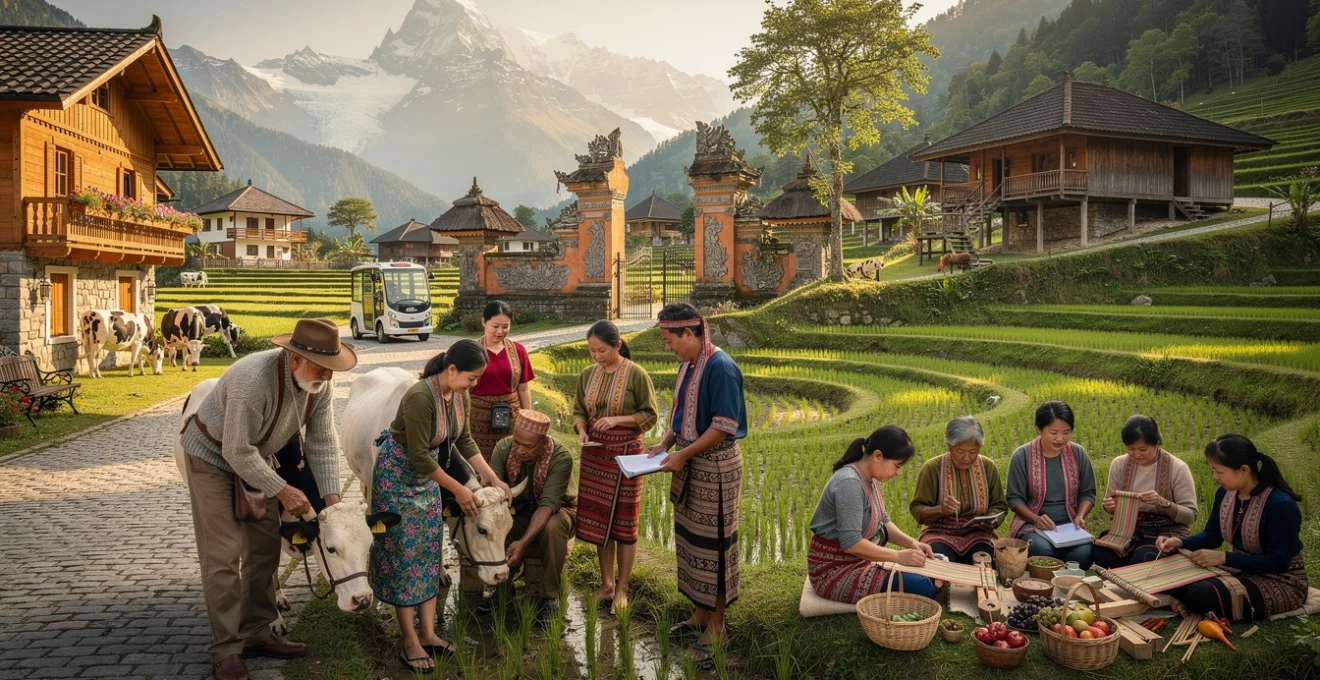
# Immersive Village Stays That Preserve Authentic Ways of Life
The rise of immersive village tourism represents a profound shift in how travellers engage with destinations. Rather than observing cultures from a distance, visitors increasingly seek meaningful participation in daily rituals, traditional crafts, and agricultural practices that have sustained communities for generations. This evolution responds to a growing recognition that authentic cultural exchange benefits both visitors seeking depth and communities preserving heritage. When thoughtfully managed, village stays create economic incentives for maintaining traditional architecture, craftsmanship, and lifeways that might otherwise disappear under pressure from modernization. The most successful programmes balance preservation with adaptation, ensuring that tourism enhances rather than erodes the very authenticity that attracts visitors in the first place.
What defines authentic agritourism and Community-Based village tourism
Authentic agritourism extends far beyond staying in a rustic setting or sampling local cuisine. It encompasses meaningful participation in agricultural cycles, from planting and harvesting to food processing and preparation using traditional methods. Community-based village tourism, meanwhile, centres on genuine cultural exchange where visitors become temporary community members rather than passive observers. These models differ fundamentally from conventional tourism by prioritizing community control over tourism development, ensuring that local residents determine how their culture is presented and shared.
UNESCO cultural heritage village designation criteria and standards
UNESCO’s cultural heritage village designations establish rigorous standards for authenticity and preservation. Villages must demonstrate continuous habitation and cultural practices spanning generations, with architectural integrity maintained through traditional building techniques and materials. The designation process evaluates tangible elements like vernacular architecture and historic landscapes alongside intangible heritage including oral traditions, festivals, and craftsmanship. Communities must also present robust management plans demonstrating capacity to balance tourism development with heritage conservation, ensuring that visitor numbers remain sustainable and that tourism revenue supports preservation efforts rather than accelerating cultural commodification.
Participatory rural appraisal methods in sustainable tourism development
Participatory Rural Appraisal (PRA) methods revolutionize tourism planning by placing community voices at the centre of development decisions. These techniques employ visual tools like community mapping, seasonal calendars, and Venn diagrams to help residents articulate their priorities, concerns, and vision for tourism integration. Through PRA workshops, villagers identify which aspects of their culture they wish to share, establish boundaries around sacred or private practices, and determine appropriate visitor capacities. This bottom-up approach contrasts sharply with conventional tourism planning, where external consultants impose development models with minimal local input. Studies show that communities involved in PRA processes report 60% higher satisfaction with tourism outcomes and demonstrate stronger cultural pride compared to villages where tourism was externally imposed.
Traditional livelihood preservation through controlled tourist integration
The most successful village tourism models maintain rather than replace traditional livelihoods. Farmers continue cultivating ancestral crop varieties using heritage techniques, artisans practice time-honoured crafts, and fishermen employ traditional methods—with tourism providing supplementary income that makes these practices economically viable. In contrast to mass tourism destinations where residents abandon traditional occupations to work in hotels and restaurants, controlled integration ensures that tourism supplements rather than supplants existing economic activities. This approach preserves not just cultural practices but the knowledge systems underlying them, from understanding seasonal weather patterns to maintaining seed varieties adapted to local microclimates over centuries.
Architectural vernacular conservation in heritage accommodation settings
Preserving vernacular architecture while adapting structures for guest accommodation presents complex challenges. Traditional buildings often lack modern amenities like private bathrooms, heating systems, and electrical infrastructure that contemporary travellers expect. The most thoughtful conservation approaches incorporate necessary modern elements while maintaining structural integrity and aesthetic authenticity. This might involve concealing electrical conduits within traditional wall construction, installing underfloor heating beneath historic stone pavements, or creating bathroom facilities in previously utilitarian spaces like storage rooms rather than subdividing main living areas. Successful projects employ master craftsmen who understand traditional construction techniques—from lime mortar application to timber joinery—ensuring that renovations use compatible materials and methods that won’t compromise structural longevity.
European alpine villages leading ethical tourism models
Alpine communities across Switzerland, Austria, and Italy pioneered sustainable village tourism models now
serve as benchmarks for how immersive village stays can support authentic ways of life while welcoming visitors. These destinations have learned, often through trial and error, that protecting everyday culture and fragile alpine ecosystems requires firm rules, clear zoning, and close collaboration between residents, local government, and tourism operators. Their experience shows that agritourism and community-based village tourism can thrive in high-demand regions when mobility, accommodation growth, and seasonal flows are managed with long-term community well-being in mind.
Zermatt’s Car-Free infrastructure and walliser cultural programmes
Zermatt in Switzerland is one of the clearest examples of how infrastructure design can protect both landscape and lifestyle. The village has been car-free since 1961, with access limited to electric taxis, hotel shuttles, and horse-drawn carriages, and private vehicles required to stop in Täsch several kilometres away. This traffic-free core reduces noise and air pollution, making it easier for traditional activities—such as alpine cheese production, haymaking, and seasonal cattle drives—to continue in close proximity to visitor areas without being overwhelmed by congestion.
While many visitors associate Zermatt with luxury chalets and skiing, the municipality also invests in programmes that showcase Walliser (Valaisan) culture. Heritage barns and raccards are conserved along themed walking routes; village festivals highlight Alpine horn music, local dialect, and raclette made from raw-milk mountain cheese. Carefully curated village tourism experiences invite guests into alpine farms at specific times—often early morning milking or late-summer alpine cheese-making days—so that visitor numbers remain manageable and do not disrupt daily tasks. Revenue from these visits often flows through local cooperatives that support small-scale producers rather than individual intermediaries.
Zermatt’s model illustrates how immersive tourism can be integrated into an advanced resort economy without turning traditional life into a static performance. Visitors still encounter farmers, craftsmen, and mountain guides going about their routines, but the rhythms of village life are protected by strict building codes, limits on short-term rentals, and mobility rules that keep the valley liveable for year-round residents.
Hallstatt’s UNESCO world heritage tourism management framework
Hallstatt in Austria provides a contrasting case: a tiny alpine village that became globally famous through social media and UNESCO World Heritage status. With only around 800 permanent residents but more than a million visitors annually in recent years, Hallstatt’s story underscores the need for robust tourism management frameworks to protect authenticity. To avoid becoming a backdrop for day-trippers alone, the municipality has introduced measures such as caps on tour-bus arrivals per day, designated photo zones, and clear signage that separates residential areas from visitor thoroughfares.
Within the UNESCO management plan, priority is given to safeguarding traditional salt-mining culture, wooden lakefront houses, and the fragile lakeside ecosystem. Residents are directly consulted on issues such as noise, waste management, and the placement of viewpoints, using a process similar to participatory rural appraisal. Community-based initiatives encourage visitors to extend their stay and engage more deeply, for instance by joining small-group heritage walks led by local historians, visiting active or former salt mines, or staying in restored historic guesthouses that follow strict architectural guidelines.
For travellers seeking genuine immersive village stays in Hallstatt, this framework provides clarity: staying overnight, visiting during shoulder seasons, and booking guided experiences with local providers are strongly encouraged over short, high-impact day trips. The result is a tourism model that strives—imperfectly but persistently—to convert mass attention into slower, more meaningful, and less extractive encounters with village life.
Swiss alpine farming cooperatives in grindelwald and lauterbrunnen
In the Bernese Oberland, villages like Grindelwald and Lauterbrunnen have long histories of combining alpine farming with tourism. Mountain pastures, or Alpen, are often managed by cooperatives that coordinate grazing rights, cheese production, and trail maintenance. Rather than separating visitors from working landscapes, these communities invite guests into the heart of farm operations through seasonal hut stays, cheese dairies open to the public, and farm-based guest rooms that double as family homes.
Cooperatives use detailed pasture plans and rotational grazing schedules to avoid overuse of meadows popular with hikers and skiers. In some cases, visitors contribute physically by helping with haymaking days or repairing dry-stone walls that stabilise slopes, turning short agritourism activities into hands-on heritage conservation. Income from these immersive stays and experiences is typically pooled, then distributed according to transparent rules that reward both hosting and behind-the-scenes labour such as trail upkeep, herd care, and landscape management.
For you as a traveller, this means that booking a night in an alpine hut or a room on a dairy farm in Grindelwald or Lauterbrunnen is more than a scenic choice. It helps sustain a cooperative system that maintains centuries-old land-management practices, ensures that young farmers can stay in the valley, and keeps the mosaic of meadows, forests, and villages intact despite pressure to convert land into more lucrative second homes or resorts.
Southeast asian traditional village homestay networks
While European alpine villages offer one model of ethical, immersive tourism, Southeast Asia’s diverse rural communities have developed their own approaches rooted in long-standing communal life, spiritual beliefs, and subsistence economies. From the terraced highlands of Vietnam and Bali to the rainforests of Borneo and the mountains of northern Thailand, village homestay networks seek to preserve traditional ways of life by welcoming guests into family homes, longhouses, and farm compounds. These networks often operate under national community-based tourism guidelines and rely on rotational hosting systems to ensure that benefits are spread throughout the village rather than concentrated in a few households.
Hmong hill tribe villages in sapa and mai chau vietnam
In northern Vietnam, Hmong communities around Sapa and Mai Chau have become synonymous with trekking routes and homestay experiences. Authentic stays here are typically in wooden stilt houses or earth-walled homes where guests sleep in shared loft spaces or simple private rooms partitioned from the main family area. Meals are prepared over open fires, using vegetables from terraced fields, maize from hillside plots, and, in some cases, pigs and poultry raised under the house. For visitors, immersing in this daily routine offers insight into how hill tribe families balance subsistence farming with growing tourism income.
To protect cultural integrity, many villages coordinate tourism through local committees that set fixed homestay prices, organise trekking guide rotations, and regulate the sale of handicrafts. This collective governance helps to prevent undercutting and reduces pressure on individual families to over-commercialise their traditions. In better-managed villages, children’s school attendance is prioritised, with clear rules limiting their involvement in selling souvenirs to tourists. You might still be invited to join in rice planting, hemp spinning, or batik dyeing, but these activities are scheduled around genuine agricultural calendars rather than staged continuously for visitors.
However, the popularity of Sapa in particular has also revealed challenges: unregulated construction, aggressive touting, and the risk of Hmong embroidery becoming a mere commodity. Travellers can support more sustainable models by choosing villages that participate in accredited community-based tourism schemes, spending at least one or two nights instead of doing day trips only, and seeking experiences that focus on mutual learning rather than bargain hunting.
Balinese subak rice terrace communities and tri hita karana philosophy
In Bali, the world-famous rice terraces of places like Jatiluwih and Tegalalang are not just photogenic landscapes; they are manifestations of the subak system, a UNESCO-recognised cooperative irrigation network governed by water temples. At its core lies the Balinese philosophy of Tri Hita Karana—the harmonious relationship between humans, nature, and the divine. Authentic agritourism and village homestays in these areas aim to bring visitors into this cosmology, rather than treating the terraces as scenic backdrops for drone footage.
Immersive village stays in subak communities may involve lodging in family compounds built according to traditional spatial principles, where shrines, kitchens, rice barns, and sleeping pavilions are arranged around a central courtyard. Guests might rise before dawn to walk along bunds as farmers set out to tend their paddies, learn how water-sharing decisions are made collectively at the subak temple, or participate in small-scale rituals tied to planting and harvest cycles. Because these rituals are not performances but deeply felt acts, access is often carefully mediated by village elders and temple priests to avoid disruption.
Tourism revenue, when channelled through subak cooperatives, can support terrace maintenance, temple restoration, and youth education in traditional arts. Yet pressures remain: land conversion to villas and cafes, rising water demand from tourism infrastructure, and changing aspirations among younger generations. You can contribute to preserving Tri Hita Karana–based tourism by favouring family-run homestays over large resorts, paying fair guiding fees for in-depth walks with subak members, and respecting temple protocols even when they limit photo opportunities.
Longhouse stays among iban communities in sarawak borneo
In Malaysian Borneo, Iban longhouses along rivers in Sarawak offer another form of immersive village tourism rooted in communal living. A longhouse is both an architectural structure and a social institution: multiple nuclear families share a single elongated building, each with its own apartment-like bilik (room) opening onto a communal veranda called the ruai. Guests staying in such settings are invited into an ongoing social world where ceremonies, craftwork, food preparation, and evening storytelling unfold in shared space.
Responsible longhouse stays are usually coordinated through local cooperatives or partnerships with community-based tourism NGOs. They ensure that a portion of visitor fees goes into communal funds used for roof repairs, school materials, or communal rice barns, while also compensating individual households for hosting. Cultural immersion can include learning about shifting cultivation practices, joining fishing excursions using traditional traps, or watching intricate weaving of pua kumbu textiles whose patterns encode myths and clan histories. Alcoholic rice wine, tuak, is often shared during ceremonies, but reputable hosts will also set boundaries to avoid the problematic expectation of continuous partying that some early backpacker tourism created.
Because some Iban communities have experienced exploitative tourism in the past, many now insist on pre-arranged visits with small groups and clear itineraries, rather than unannounced arrivals. As a visitor, showing patience, following house rules, and asking permission before photographing sacred objects or people are essential steps in building the trust that underpins memorable, respectful longhouse homestay experiences.
Karen and lahu weaving villages in northern thailand’s chiang mai province
In the mountains of northern Thailand, Karen and Lahu villages around Chiang Mai, Chiang Rai, and Mae Hong Son attract travellers interested in trekking, textile traditions, and highland agriculture. Authentic village stays here are rooted in everyday tasks: tending small terraced fields, caring for pigs and chickens, gathering forest products, and, in many Karen communities, weaving back-strap loom textiles in distinctive patterns and natural dyes. Lahu villages, meanwhile, are known for their strong communal ethos and elaborate costumes worn during festivals.
Over the past decade, Thailand has worked to move beyond problematic “hill tribe villages” set up primarily for staged photo opportunities. More ethical models are emerging through community-based tourism networks that limit group sizes, rotate homestays among households, and foreground local decision-making. In Karen weaving villages, for instance, visitors may sleep in simply furnished wooden houses, share meals with hosts, and, if interested, join multi-day textile workshops learning spinning, dyeing with plants, and basic weaving techniques. The income from these stays and textile purchases can provide a crucial supplement to farming incomes, especially as climate change alters rainfall patterns.
The Lahu, known for living in close harmony with forest ecosystems, often emphasise storytelling and ritual as part of the visitor experience, explaining cosmologies that link forest spirits, ancestral deities, and everyday ethical behaviour. Because some Lahu communities have chosen to limit outside contact, working with reputable local organisations that have built trust over time is essential. By choosing certified homestays, you help ensure that Karen and Lahu village tourism remains a tool for cultural pride and economic resilience rather than a source of exploitation.
Traditional craftsmanship immersion programmes and artisan apprenticeships
Beyond sleeping in village homes, many immersive stays now offer structured opportunities to learn traditional crafts directly from artisans. These programmes range from half-day workshops to multi-week apprenticeships in disciplines such as pottery, weaving, woodcarving, metalwork, and instrument making. For communities, they serve a dual purpose: providing income that rewards painstaking manual skills and creating pathways for younger generations to see value in professions sometimes perceived as “old-fashioned” or less prestigious than urban employment.
Effective craftsmanship immersion programmes are designed more like short-term apprenticeships than quick souvenir-making sessions. Rather than producing a perfect finished product in a single sitting, participants might spend several days understanding raw materials, basic tool use, and design principles before attempting more complex work. For example, learning ikat weaving in an Indonesian village may begin with preparing cotton, tying resist patterns, and dyeing yarns before a single line is woven on the loom. Similarly, an apprenticeship in Japanese-style carpentry or Mediterranean stone masonry could start with sharpening tools and reading grain patterns, echoing the way local apprentices are traditionally trained.
Pricing models for these experiences increasingly reflect the time-intensive nature of true skill transfer. Instead of cheap, high-volume craft classes, communities are developing premium multi-day packages explicitly marketed as artisan immersion travel, attracting visitors who value depth over speed. Income is often shared between master artisans, assistants, and community funds, with a portion earmarked for training young apprentices. This is critical in regions where aging craft masters fear that their knowledge will disappear if economic incentives for learning are too weak.
For travellers, the key question is often: how can I tell if a craft experience is genuine? Look for signs such as transparent information about the artisan’s background, clear explanation of how fees are distributed, limited group sizes, and visible integration of workshops within living communities rather than stand-alone tourist complexes. When you leave with calloused hands, partial projects, and a deeper understanding of why a single piece of textile or pottery commands a certain price, you know that the experience has moved from consumption to genuine cultural exchange.
Indigenous knowledge transfer through Eco-Cultural tourism experiences
Many of the most meaningful village stays revolve around the transfer of indigenous ecological knowledge—understandings of land, water, plants, and seasons accumulated over centuries. Eco-cultural tourism experiences create structured ways for elders, hunters, herbalists, and farmers to share this knowledge with visitors while reinforcing its value within the community itself. Done well, these encounters feel less like guided tours and more like walking seminars, where each plant, rock, or ritual site is a chapter in a living textbook.
Consider, for instance, guided forest walks with Dayak communities in Borneo, Sámi reindeer herders in northern Scandinavia, or First Nations hosts along Canada’s Pacific Coast. In each case, visitors may learn how to read subtle environmental indicators—mushroom growth signalling soil health, bird calls hinting at predator presence, cloud formations predicting weather shifts. This is knowledge that rarely appears in conventional guidebooks but is crucial for the survival of traditional livelihoods. By framing such walks as co-learning experiences, indigenous guides assert their role not simply as service providers but as experts whose intellectual property deserves respect and fair compensation.
Eco-cultural tourism can also function as a form of language revitalisation. Many indigenous concepts for landforms, kinship with animals, or spiritual realms do not translate neatly into dominant languages. When guides use local terms and explain their layered meanings, visitors witness how language encodes relationships with place. Some programmes encourage basic language learning during village stays—greetings, names for staple foods, or respectful forms of address—so that guests can interact with hosts on more equal footing. It is a small but powerful gesture that acknowledges that we are entering someone else’s linguistic and cultural home.
At the same time, communities must navigate sensitive boundaries. Not all knowledge is shareable; some is sacred, gender-specific, or restricted to certain lineages. Strong eco-cultural tourism frameworks make these boundaries explicit, using consent-based protocols much like academic research ethics. For travellers, accepting “no” or “not for tourists” as legitimate answers is part of responsible participation. When in doubt, you can ask: how can my presence support the continuity of indigenous knowledge systems, rather than extract stories and images without giving back?
Measuring Socio-Economic impact through community benefit distribution models
As immersive village stays grow in popularity, communities and partners increasingly ask a fundamental question: who truly benefits? Answering this requires moving beyond simple visitor counts or occupancy rates to examine how tourism income flows through households, cooperatives, and local institutions. Community benefit distribution models provide a framework for tracking these flows and ensuring that agritourism and village homestays reduce rather than deepen local inequalities.
One common approach is the rotational hosting system, where households take turns receiving guests according to a schedule managed by a village committee. This system, used in many Himalayan, Southeast Asian, and Latin American communities, prevents a small number of families from monopolising tourism income. A portion of each guest’s payment typically goes into a communal fund that supports shared priorities such as school repairs, water systems, or cultural festivals. Transparent accounting—posting income and expenditure summaries in communal spaces or discussing them in village meetings—helps maintain trust and allows residents to adjust rules if imbalances emerge.
More sophisticated models incorporate explicit indicators to measure socio-economic impact over time. Villages might track metrics such as the percentage of tourism income retained locally (versus paid to external operators), changes in household debt levels, educational enrolment, or the number of young adults who choose to remain in the community rather than migrating. Some projects partner with universities or NGOs to conduct periodic participatory evaluations, where villagers graph income changes across groups (farmers, artisans, single-parent households, elders) and identify who may be left out. These evaluations can lead to targeted interventions—such as training programmes for women artisans or accessibility upgrades for elders—so that benefits spread more equitably.
For travellers, understanding these models allows more informed choices. Asking homestay hosts how fees are divided is not intrusive when done respectfully; it signals that you care about fair distribution. You might prefer to book through cooperatives or community-based organisations even if the booking process is less slick than major platforms, because a higher share of your spending remains in the village. Ultimately, immersive village tourism that preserves authentic ways of life depends as much on these invisible financial structures as on visible experiences. When economic roots are strong and widely shared, the cultural branches—festivals, crafts, rituals, and everyday hospitality—have a much better chance of flourishing for generations to come.