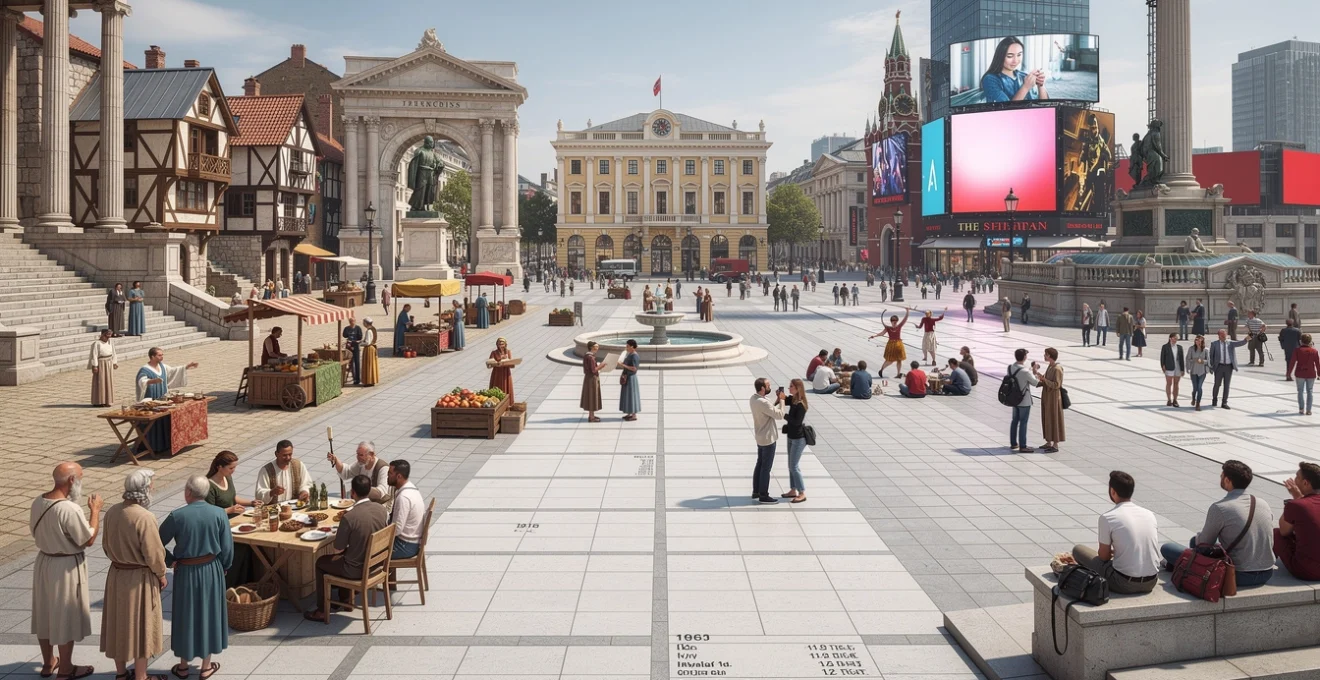
Public squares serve as mirrors to society, reflecting the deepest values, aspirations, and social dynamics of the cultures that create and inhabit them. These urban spaces transcend their physical boundaries to become living testimonies of human civilisation, embodying centuries of cultural evolution, political transformation, and social interaction. From ancient Greek agoras to modern digital-age plazas, public squares have consistently functioned as stages where the drama of community life unfolds, revealing fundamental truths about how societies organise themselves, express power, facilitate commerce, and foster human connection.
The relationship between public squares and cultural identity operates on multiple levels, encompassing spatial design, social rituals, economic activities, and political expressions. Each square tells a unique story about its community’s relationship with authority, tradition, innovation, and collective memory. Whether examining the bustling markets of Marrakech, the imperial grandeur of Moscow’s Red Square, or the commercial spectacle of Times Square, these spaces demonstrate how physical design choices reflect and reinforce cultural values while simultaneously shaping future social behaviours.
Historical evolution of public square design and cultural expression
The historical development of public squares reveals a fascinating chronicle of cultural priorities and social organisation across different civilisations. Each era has left distinctive architectural and spatial signatures that reflect prevailing ideologies, technological capabilities, and social structures. Understanding this evolution provides crucial insights into how contemporary squares continue to embody and express cultural characteristics while adapting to modern urban challenges.
Ancient agora systems in greek democratic societies
The ancient Greek agora represents perhaps the most influential model of public square design in Western civilisation, establishing fundamental principles that continue to shape urban planning today. These spaces were deliberately designed to facilitate democratic discourse and civic engagement, with their open layout encouraging free movement and spontaneous gatherings. The agora’s spatial organisation reflected Greek values of equality and participation, with raised platforms providing speaking opportunities for citizens while maintaining visual and auditory accessibility for gathered crowds.
Archaeological evidence from sites like the Athenian Agora reveals sophisticated understanding of proxemics and social dynamics. The Greeks strategically positioned commercial, religious, and political functions within the same space, recognising that economic activity naturally draws people together and creates opportunities for political discourse. This integration of functions became a hallmark of successful public squares, demonstrating how cultural values of civic participation could be embedded within spatial design principles.
Roman forum architecture and imperial social hierarchies
Roman forum design marked a significant departure from Greek democratic principles, instead reflecting the hierarchical nature of imperial society through monumental architecture and controlled access patterns. The Roman approach emphasised grandeur and imperial authority, with massive colonnades, elevated platforms, and carefully orchestrated sight lines that reinforced social stratification while accommodating large gatherings for public announcements and spectacles.
The Forum Romanum exemplifies how architectural choices can communicate political messages and cultural values. Unlike the relatively egalitarian Greek agora, Roman forums featured designated areas for different social classes, with restricted access to certain sections based on citizenship status and social rank. This spatial hierarchy reflected broader Roman cultural values that prioritised order, authority, and imperial power over democratic participation, creating lasting influences on European urban design traditions.
Medieval market squares and Guild-Based community structures
Medieval European market squares evolved organically around economic activities, reflecting the decentralised nature of feudal society and the growing importance of merchant guilds in urban governance. These squares typically developed at strategic locations such as crossroads, river crossings, or near religious institutions, with their irregular shapes and varied sizes reflecting practical considerations rather than grand design schemes.
The guild system profoundly influenced medieval square design, with different areas often designated for specific trades and crafts. This spatial organisation reinforced professional identities and social hierarchies while facilitating quality control and price regulation. Market squares became centres of cultural exchange, where travelling merchants brought news, ideas, and goods from distant lands, making these spaces crucial nodes in medieval information networks and cultural diffusion processes.
Renaissance piazzas and humanistic urban planning principles
Renaissance piazzas represent a revolutionary approach to public square design, combining classical architectural principles with humanistic philosophy to create spaces that celebrated both individual dignity and collective civic life. Italian architects like Brunelleschi and Bramante developed sophisticated geometric layouts that used mathematical proportions and perspective techniques to create visually harmonious environments that encouraged
harmonious social interaction and visual enjoyment. The careful framing of churches, palazzi, and fountains within these piazzas reflected Renaissance beliefs about proportion, order, and the centrality of the human experience in urban life.
Unlike the more organically formed medieval market squares, Renaissance piazzas were often the result of deliberate, top–down planning by powerful families or civic authorities seeking to project cultural sophistication and political stability. Spaces such as Piazza della Signoria in Florence or Piazza Navona in Rome became open-air galleries of power, displaying statues, fountains, and façades that communicated civic pride and humanistic ideals. Their design encouraged promenading, public debate, and artistic performance, turning the square into both a political stage and a theatre of everyday life.
Architectural morphology and spatial configuration analysis
To understand how public squares reflect the social life of a culture, we need to look beyond surface aesthetics to the deeper logic of spatial configuration. Architectural morphology examines how the form, scale, and arrangement of built elements influence movement, behaviour, and social interaction. When we combine this with urban theory—from proxemics to pattern languages—we gain powerful tools for decoding why some squares feel vibrant and inclusive while others seem sterile or intimidating.
Proxemic theory applications in square layout design
Proxemic theory, developed by anthropologist Edward T. Hall, explores how people use space to regulate social distance and interaction. In public squares, proxemics helps explain why certain configurations naturally invite conversation, lingering, or quiet reflection. For example, smaller, human-scale plazas with clear edges and multiple seating options often support intimate social distances, allowing friends, families, and small groups to gather comfortably without feeling exposed.
Designers who apply proxemic principles intentionally vary zones of distance—intimate, personal, social, and public—within a single square. You might see café terraces supporting personal-distance interactions along the edges, broad central areas for public events, and semi-enclosed corners suitable for quieter, reflective use. Cultures that value close social bonds often favour dense, flexible layouts that allow people to cluster, whereas societies that prioritise privacy or hierarchy may create larger, more open voids that keep individuals at arm’s length. In both cases, the square becomes a physical map of culturally preferred social distances.
Kevin lynch’s imageability concepts in public space navigation
Urban planner Kevin Lynch introduced the concept of imageability—the ease with which people can form a mental picture of a place. In public squares, high imageability supports orientation, comfort, and a sense of belonging, all of which are essential for vibrant social life. Lynch identified elements such as paths, edges, districts, nodes, and landmarks that, when well-articulated, make urban spaces memorable and easy to navigate.
Squares with strong landmarks—iconic statues, towers, fountains, or distinctive façades—tend to anchor local identity and collective memory. Clear edges and legible paths help visitors understand how the square connects to surrounding streets and neighbourhoods, encouraging movement rather than confusion or avoidance. When we encounter a square where “you always know where you are,” we’re usually experiencing high imageability, which in turn reflects a culture’s investment in legible, inclusive public environments.
Jan gehl’s social life methodology for activity mapping
Danish urbanist Jan Gehl shifted attention from buildings to people by systematically observing how citizens actually use public spaces. His methodology of activity mapping—recording stationary activities, movement patterns, and behaviour over time—provides empirical insight into the social life of squares. Instead of assuming how a space should function, Gehl’s approach asks: who is here, doing what, and for how long?
When planners conduct such observations, striking cultural patterns emerge. In some cities, people primarily traverse squares as transit corridors, reflecting a culture of efficiency and speed; in others, they linger, sit, and watch, revealing norms that value sociability and street life. By measuring “staying activities” such as chatting, playing, reading, or eating, Gehl’s framework helps distinguish between squares that merely move people and those that meaningfully support public life. For contemporary designers, these insights are invaluable in tuning public square design to local social habits rather than generic templates.
Christopher alexander’s pattern language in square organisation
Architect Christopher Alexander proposed that successful environments are built from recurring “patterns” that respond to human needs at multiple scales. Applied to public squares, a pattern language might include elements such as “outdoor rooms,” “street cafés,” “public outdoor living rooms,” or “activity nodes.” Each pattern describes a problem in human use of space and offers a flexible spatial solution, which can be adapted to local culture and context.
For instance, the pattern of an “outdoor room” suggests that squares should have defined edges—buildings, trees, or colonnades—that create a sense of enclosure without fully closing the space. The pattern of “small public squares” emphasises that people feel more comfortable and socially engaged in spaces scaled to human perception rather than vast, empty expanses. When we see a square that feels like a welcoming living room rather than an anonymous void, we are often encountering a successful application of Alexander’s patterns, interpreted through the lens of local cultural expectations about gathering, privacy, and display.
Contemporary case studies of cultural manifestation through square design
While historical examples provide essential context, contemporary public squares offer vivid, real-time evidence of how cultures continue to project and negotiate their identities through urban space. From spectacle and storytelling to state power and protest, these squares operate as both physical environments and symbolic arenas. Examining a few emblematic cases reveals how different societies design, appropriate, and reinterpret their central public stages.
Djemaa el-fna marrakech and north african storytelling traditions
Djemaa el-Fna in Marrakech is one of the most evocative examples of a living cultural square, where the social life of the city unfolds through performance, commerce, and tradition. Unlike rigidly planned plazas, Djemaa el-Fna functions as a dynamic, ever-changing field where storytellers, musicians, food vendors, snake charmers, and healers share space in a constantly shifting mosaic. Its loose spatial organisation reflects North African and Berber traditions of oral culture, where knowledge, history, and values are transmitted face-to-face.
UNESCO’s recognition of Djemaa el-Fna as a Masterpiece of the Oral and Intangible Heritage of Humanity underscores how public squares can safeguard intangible cultural heritage. The square’s design—essentially a large, open surface surrounded by souks and cafés—allows micro-worlds to form and dissolve throughout the day and night. For visitors, it can feel like stepping into a living theatre; for locals, it is a familiar stage where cultural memory is performed and renewed. The absence of permanent structures in the centre preserves flexibility, enabling the space to adapt to seasonal rituals, religious celebrations, and everyday storytelling traditions.
Times square new york and american consumer capitalism
In stark contrast, Times Square in New York City exemplifies how a public square can embody the logic of consumer capitalism and digital-age spectacle. Once a notorious red-light district, it has been transformed into a hyper-visual plaza dominated by colossal LED billboards, branded experiences, and continuous streams of tourists. Here, architecture and media merge, creating an environment where advertisement becomes the primary visual language of public space.
Pedestrianisation efforts over the past decade have converted much of Times Square into a car-free zone, increasing dwell time and making the square more accessible for people-watching, street performance, and informal gathering. Yet even these human-scale interventions exist within an environment saturated by corporate messages and entertainment industries. As a result, Times Square serves as a physical manifestation of American values around consumption, branding, and individual self-display—what better stage for the global ritual of the New Year’s Eve ball drop, broadcast worldwide as a symbol of collective celebration in a media-driven public realm?
Red square moscow and socialist monumentalism expression
Red Square in Moscow offers a different narrative, one rooted in state power, military display, and ideological symbolism. Flanked by the Kremlin walls, Lenin’s Mausoleum, St Basil’s Cathedral, and the GUM department store, the square condenses centuries of Russian political and cultural history into a single monumental ensemble. Its scale and austere paving emphasise the smallness of the individual relative to the state, especially during carefully choreographed parades and official ceremonies.
Under Soviet rule, Red Square became an iconic stage for projecting socialist power to both domestic and international audiences. Tanks, soldiers, and banners turned the space into a theatre of ideology, where the social life of the culture was defined less by informal gathering and more by participation in state-orchestrated rituals. Today, while it welcomes tourists and occasional public festivities, the spatial logic of the square continues to echo its monumental past, reminding visitors of the enduring relationship between public space and political authority.
Trafalgar square london and british imperial memory
Trafalgar Square in London illustrates how public squares can act as repositories of imperial memory and sites of evolving civic identity. Dominated by Nelson’s Column and flanked by the National Gallery, the square commemorates Britain’s naval victory at Trafalgar and, by extension, its historic global dominance. The statuary, fountains, and axial vistas encode a narrative of military prowess and imperial confidence, reflecting nineteenth-century values about nationhood and hierarchy.
However, the social life of Trafalgar Square has shifted dramatically over time. It is now a key site for protests, celebrations, cultural festivals, and everyday tourism, illustrating how communities can reinterpret inherited monumental spaces. Whether serving as the focal point for anti-war demonstrations, climate marches, or mass gatherings during sporting events, the square has become a contested terrain where official narratives of empire intersect with contemporary claims for social justice, diversity, and democratic expression.
Tiananmen square beijing and chinese state authority display
Tiananmen Square in Beijing may be the most emblematic example of a public square designed explicitly to project state authority. Vast in scale and framed by monumental buildings such as the Great Hall of the People and the National Museum of China, it creates an overwhelming sense of openness that, paradoxically, can feel tightly controlled. The sheer size of the space allows for mass gatherings during national celebrations, military parades, and flag-raising ceremonies, reinforcing the centrality of the state in public life.
The square’s design and management underscore how access, surveillance, and symbolic architecture can shape the social meaning of a place. While tourists and citizens visit daily, informal, spontaneous uses are constrained, and the memory of the 1989 protests remains highly sensitive. In this context, Tiananmen Square reflects a culture where public space is closely tied to national identity, historical narrative, and the visible presence of political authority, reminding us that not all public squares primarily serve as platforms for everyday sociability.
Ethnographic research methods for public space social dynamics
To grasp how public squares reflect the social life of a culture, it is not enough to analyse plans and photographs; we must also study how people actually inhabit and experience these spaces. Ethnographic methods—participant observation, interviews, mapping, and visual documentation—offer rich insights into the lived realities of public squares. By spending time on site, talking to users, and systematically recording activities, researchers can uncover subtle social norms, power dynamics, and patterns of inclusion or exclusion that might otherwise remain invisible.
One common ethnographic approach is time-lapse observation, in which researchers document how the population of a square changes across hours, days, or seasons. Who uses the space early in the morning versus late at night? Which groups feel comfortable lingering, and which pass through quickly? Structured interviews with vendors, local residents, tourists, and marginalised groups—such as street workers or unhoused people—add qualitative depth, revealing how different communities perceive safety, belonging, and ownership in the same square. When combined with simple activity maps or sketches, these insights can directly inform more responsive and equitable design interventions.
Digital transformation impact on traditional square functions
Digital technologies are reshaping how public squares function as arenas of social life, often in ways we are only beginning to understand. Smartphones, social media, and location-based apps have introduced new layers of interaction, turning squares into both physical and virtual stages. People now experience public space while simultaneously connected to online networks, coordinating meetups, sharing live videos, or engaging in “hashtag protests” that can rapidly scale from a local gathering to a global event.
This digital augmentation offers both opportunities and challenges for urban public squares. On one hand, online platforms can mobilise people into the streets for civic action, cultural festivals, or flash mobs, revitalising the square as a site of collective presence. On the other, constant connectivity can fragment attention, with individuals physically co-present yet mentally elsewhere. Designers and policymakers must therefore consider how free public Wi‑Fi, digital screens, interactive installations, and data-driven management systems influence behaviour. Are we using technology to support inclusive, accessible, and democratic public life, or merely to push advertising and monitor crowds?
Urban planning policy frameworks for culturally responsive square development
Creating public squares that genuinely reflect and support the social life of a culture requires more than good design; it depends on thoughtful policy frameworks and long-term governance. Zoning regulations, heritage protection laws, accessibility standards, and participatory planning processes all shape what is possible in these spaces. When policies prioritise local cultural practices—markets, festivals, informal play, street performance—squares are more likely to become authentic expressions of community identity rather than generic “plazas” imported from elsewhere.
Culturally responsive development typically involves early and ongoing engagement with local residents, traders, cultural groups, and vulnerable communities. This might mean legalising and organising informal markets, as happened at Corona Plaza in Queens, or preserving central gathering spaces during reconstruction, as in the Dong villages’ drum tower squares or Dujiangyan’s Xijie Historic District. Policies can also guard against subtle forms of exclusion by addressing hostile architecture, over-policing, and excessive commercialisation. Ultimately, when we treat public squares as essential civic infrastructure—on par with housing, transport, and education—we recognise their unique role in sustaining democratic culture, social cohesion, and everyday well-being.