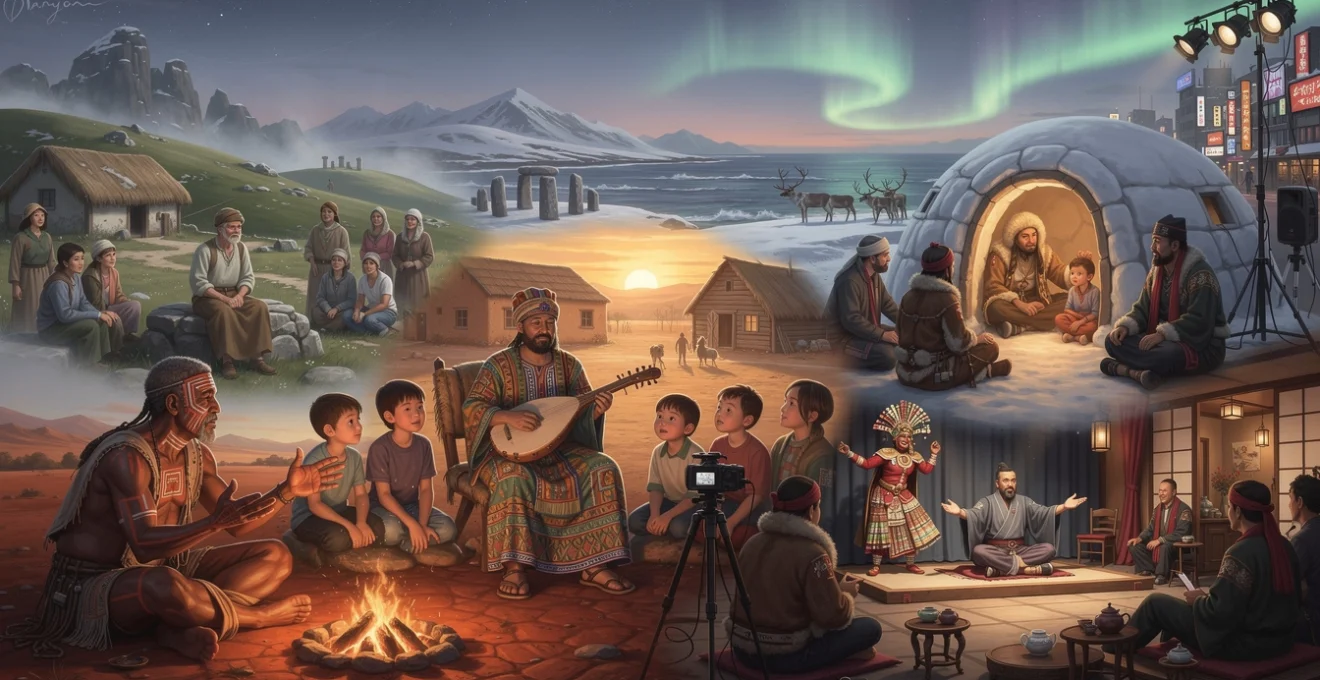
In an era dominated by digital screens and rapid technological advancement, the ancient art of storytelling continues to pulse with vibrant life across numerous communities worldwide. From the Aboriginal Dreamtime narratives of Australia to the griot traditions of West Africa, oral storytelling traditions persist as vital cultural arteries, transmitting wisdom, preserving history, and maintaining community bonds. These living traditions represent far more than mere entertainment; they serve as repositories of cultural knowledge, spiritual guidance, and collective memory that have survived centuries of change.
The resilience of these storytelling cultures demonstrates humanity’s fundamental need for narrative connection and shared meaning. While technology has transformed how stories are preserved and transmitted, the essence of oral tradition remains unchanged – the intimate exchange between storyteller and audience, where tales breathe with the rhythm of human voice and adapt to the needs of each unique gathering. Understanding where these traditions thrive today offers profound insights into the enduring power of human narrative and the diverse ways cultures maintain their identity through story.
Indigenous oral narrative preservation in aboriginal australian communities
Aboriginal Australian communities maintain one of the world’s oldest continuous storytelling traditions, spanning over 65,000 years of unbroken cultural transmission. These oral narratives, deeply intertwined with spiritual beliefs and land connection, continue to serve as fundamental pillars of Aboriginal identity and knowledge systems. The sophistication of these storytelling traditions lies not merely in their antiquity, but in their complex integration of geographical, spiritual, and practical knowledge that guides daily life and cultural practice.
Contemporary Aboriginal communities face the dual challenge of preserving traditional stories while navigating modern pressures and technological influences. Many communities have developed innovative approaches that honour traditional protocols while ensuring stories reach younger generations. Elders work closely with community cultural centres, schools, and digital platforms to document and share appropriate narratives while maintaining the sacred boundaries that protect ceremonial knowledge from inappropriate exposure.
Dreamtime storytelling protocols among arrernte people of central australia
The Arrernte people of Central Australia maintain strict protocols governing the sharing of Dreamtime stories, with different narratives designated for specific audiences and occasions. Men’s stories, women’s stories, and children’s stories each serve distinct educational and spiritual purposes within the community structure. These protocols ensure that cultural knowledge is transmitted appropriately, with sacred stories remaining protected while foundational narratives provide essential cultural education for all community members.
Modern Arrernte storytellers work within established community frameworks to share appropriate stories with visitors and researchers while maintaining the integrity of sacred knowledge. Cultural centres in Alice Springs and surrounding communities provide platforms for approved storytelling sessions, where trained Aboriginal guides share creation stories, moral tales, and historical narratives that demonstrate the deep connection between landscape and cultural identity.
Traditional knowledge transmission systems in yolŋu clans of arnhem land
The Yolŋu people of Arnhem Land maintain sophisticated clan-based storytelling systems where narratives serve multiple functions: preserving genealogical knowledge, transmitting ecological wisdom, and reinforcing social structures. Each clan possesses specific stories tied to their ancestral territories, creating a complex web of narrative ownership and responsibility that governs cultural transmission. These stories often incorporate detailed environmental knowledge, including seasonal patterns, animal behaviour, and sustainable resource management practices.
Contemporary Yolŋu communities utilise both traditional and modern methods to ensure story preservation. Young people participate in formal cultural education programs where elders teach appropriate stories alongside practical skills like hunting, gathering, and ceremony preparation. Community-controlled recording projects document stories with elder permission, creating archives that serve future generations while respecting cultural protocols around access and distribution.
Sacred site narratives and songline documentation in pitjantjatjara territory
Pitjantjatjara storytellers maintain intricate songline narratives that map ancestral journeys across vast desert territories, encoding navigation knowledge, water source locations, and spiritual significance within poetic verse. These songlines function as both geographical reference systems and spiritual roadmaps, requiring years of study to master their complete meaning. The stories attached to each songline segment provide detailed instructions for survival, ceremony, and proper relationship with country.
Modern preservation efforts within Pitjantjatjara communities involve collaboration between elders and younger community members to document songline fragments appropriate for broader sharing while protecting sacred elements. Cultural mapping projects combine traditional storyt
cultural mapping projects combine traditional storytelling with GPS and community-drawn maps, helping to record route segments, place names, and associated narratives. While some material is kept within closed cultural archives, selected stories are shared through visitor centres and ranger programs so that non-Indigenous visitors can understand why specific waterholes, rock formations, and desert tracks are protected. In this way, Pitjantjatjara songlines remain living maps of country rather than static historical artefacts.
Intergenerational story-keeper roles in torres strait islander communities
In Torres Strait Islander communities, storytelling is inseparable from song, dance, and the sea. Elders and story-keepers hold responsibility for transmitting island histories, migration tales, and seafaring knowledge that link individual islands into a shared cultural seascape. These oral histories often trace family lineages, inter-island alliances, and the spiritual significance of winds, tides, and reefs that sustain everyday life.
Intergenerational transmission typically unfolds in communal settings such as evening gatherings, church events, and cultural festivals, where younger Islanders learn not only the words of stories but the protocols that govern who can tell them, and when. Contemporary initiatives, including school-based language programs and island media centres, support elders to record stories in local languages while encouraging youth to re-interpret traditional narratives through film, hip hop, and theatre. Rather than replacing oral practice, these technologies act like new “canoes” carrying old stories across modern waters.
Celtic folkloric transmission methods in contemporary ireland and scotland
Across Ireland and Scotland, Celtic storytelling traditions continue to shape community identity, even as English dominates mainstream media. In rural regions and Gaelic-speaking areas, oral storytelling is not merely a nostalgic pastime but a living practice that reinforces language use, local history, and a sense of place. From pub sessions to dedicated festivals, contemporary storytellers adapt ancient myths, heroic cycles, and ghost stories for new audiences while preserving key narrative structures and motifs.
These practices mirror the functions of traditional oral storytelling around the world: they entertain, instruct, and bind communities together. Whether we encounter them in a Gaeltacht kitchen, a Highland village hall, or a modern arts centre, these Celtic narratives still carry encoded social norms, moral lessons, and political memories. Crucially, they also demonstrate how minority languages such as Irish and Scottish Gaelic can remain vibrant through performance, not just in classrooms.
Seanchaí performance traditions in gaeltacht regions of county donegal
In the Gaeltacht regions of County Donegal, the figure of the seanchaí – the traditional storyteller – continues to evolve. Historically, seanchaí travelled from house to house, trading news and tales in exchange for food and lodging. Today, while this itinerant lifestyle has largely disappeared, their performance style lives on in community events, local storytelling evenings, and regional festivals. The Donegal seanchaí blend humour, folklore, local history, and sharp social observation into extended narratives told in Irish and English.
What makes these performances distinctive is the careful pacing and musicality of the language, with storytellers using repetition, alliteration, and dramatic pauses to hold the room. Cultural centres and Gaeltacht summer colleges now invite elder storytellers to perform for younger learners, helping students acquire natural idioms and rhythms that rarely appear in textbooks. Audio and video recordings support preservation, but it is the shared experience in small, often informal gatherings that keeps the seanchaí tradition rooted in community life.
Highland clan history preservation through gaelic storytelling in skye
On the Isle of Skye, Gaelic storytelling remains central to how many residents understand their connection to land and clan. Local storytellers recount tales of famous battles, migrations, and love stories that link particular families to glens, lochs, and ruined castles scattered across the landscape. These clan histories, often embellished over generations, function much like family archives, preserving memories that were never formally written down.
Guided walks, ceilidhs, and small heritage museums on Skye often incorporate live storytelling sessions, allowing visitors to hear narratives in both Gaelic and English. Through these events, you can experience how a single story can act as a “verbal map,” connecting place names, ancestral figures, and moral lessons into one coherent thread. For younger Gaelic speakers, listening to these stories reinforces both language skills and a sense that their local history is not a relic, but a living, evolving narrative they are part of.
Traditional irish wake narratives and commemorative storytelling practices
Traditional Irish wakes have long been spaces where storytelling softens grief and celebrates a life lived. In rural communities especially, night-time vigils for the deceased often include humorous anecdotes, heroic tales, and family legends chanted or recounted by relatives and neighbours. These stories help situate the deceased within a broader lineage, reminding listeners that individual lives are woven into a long chain of community memory.
Although modern funerary practices have shortened or simplified many wakes, commemorative storytelling is far from disappearing. Families increasingly record stories on video or curate digital archives of memories gathered from older relatives. Community groups also host remembrance evenings where people share tales of past residents, turning personal grief into a shared act of cultural preservation. In this way, Irish wake narratives continue to function as both emotional support and informal community history.
Eisteddfod competitive storytelling formats in welsh cultural revival
Wales offers a distinctive example of how competitive formats can support oral tradition through the Eisteddfod, a national festival celebrating Welsh language arts. While most famous for poetry and music, many local and national Eisteddfodau include categories for storytelling and cynghanedd (a complex system of Welsh poetic harmony). Storytellers perform original or traditional narratives in Welsh, judged on language accuracy, creativity, and delivery.
This competitive structure might seem at odds with the informal nature of many oral traditions, yet it has become a powerful tool for Welsh language revitalisation. Schools prepare students months in advance, encouraging them to research older tales and adapt them for performance. For audiences, hearing stories told with confidence and linguistic richness reinforces the everyday value of Welsh in a largely English media environment. The Eisteddfod thus turns storytelling into a visible, celebrated skill, ensuring that narrative arts remain attractive to younger generations.
African griot heritage systems across west african communities
Across West Africa, griots – known by various local names such as jeli, gewel, or aoidoi – continue to act as living archives of community memory. These hereditary storytellers, musicians, and historians preserve genealogies, epics, and legal precedents through performance rather than paper. While urbanisation and digital media have changed how often and where they perform, griots still play indispensable roles at naming ceremonies, weddings, political events, and conflict mediations.
Far from being static repositories of old tales, many contemporary griots blend traditional instruments like the kora or balafon with modern genres, recording albums and appearing on radio while maintaining core oral techniques. Their capacity to improvise around a narrative skeleton allows them to address current events within long-standing story frameworks. For visitors interested in places where storytelling traditions are still alive today, West African communities offer powerful examples of how oral narrative can adapt without losing its essence.
Mandinka griot genealogical recitation techniques in gambian villages
Among Mandinka communities in The Gambia, griots specialise in genealogical recitations that can stretch back 20 or more generations. At key life events, a griot may stand before a family and chant their lineage, linking present-day individuals to historical figures, migrations, and alliances. These recitations are not simple lists of names; they are woven with brief anecdotes, praise lines, and moral commentary that highlight exemplary behaviour or past conflicts.
To master this art, apprentice griots train for years under senior relatives, memorising complex structures and learning how to adapt them to different audiences. Mobile phones and inexpensive recorders now help document these performances, yet the true impact comes from the immediacy of the griot addressing a living family. For many Mandinka, hearing their ancestry recited aloud is akin to opening a “living family tree,” reminding them of obligations, inherited honour, and shared resilience.
Wolof oral chronicle preservation methods in senegalese traditional courts
In Senegal, Wolof-speaking griots historically served as custodians of oral chronicles in royal courts and local tribunals. Their tasks included recounting precedents in disputes, narrating the rise and fall of rulers, and preserving treaties or land agreements through formulaic phrases. Even today, in some rural areas, community leaders consult respected storytellers when seeking to recall the specifics of long-ago agreements or boundary arrangements.
These oral chronicles are maintained through regular performance at ceremonies and through targeted teaching within griot families. While written law now dominates formal legal processes, informal dispute resolution often still draws on remembered narratives. Radio programs in Wolof sometimes feature griots telling historical stories, offering a bridge between traditional courts and contemporary media. In effect, the griot’s narrative becomes a kind of “spoken archive,” consulted when paper records are absent or contested.
Yoruba ifá divination storytelling protocols in nigerian religious practices
In southwestern Nigeria and parts of the diaspora, Yoruba Ifá divination blends sacred poetry, philosophy, and narrative into a highly structured storytelling system. Babalawo (Ifá priests) consult divination trays and palm nuts or chains to select specific odu, or sacred signs. Each sign corresponds to a set of verses containing origin stories, parables, and historical episodes that guide decision-making in areas ranging from health to business and relationships.
The storytelling protocols of Ifá emphasise both precision and interpretation. Apprentices spend years memorising thousands of verses, learning how to choose appropriate stories within an odu and how to adapt their lessons to a client’s circumstances. You might think of the Ifá corpus as a vast, living library where each consultation “checks out” a cluster of relevant stories. Efforts in Nigeria and abroad to transcribe and publish some Ifá texts have expanded access, but many verses remain guarded within priestly lineages to protect their sacred character.
Akan sankofa narrative traditions in ghanaian ceremonial contexts
Among Akan communities in Ghana, the concept of Sankofa – often translated as “go back and fetch it” – captures the idea that we must return to the past to build a better future. This principle is not only a symbol on textiles and architecture; it is embedded in narrative practices at ceremonies such as outdooring rituals, funerals, and festivals. Storytellers and elders recount episodes from community history, tales of resistance, and proverbs that frame current challenges in light of ancestral experience.
During these events, narrative and proverb function like two strands of a rope: stories provide dramatic context, while concise sayings crystallise their lessons. Community-based organisations and cultural education programs in Ghana increasingly use Sankofa storytelling workshops to engage youth with topics like environmental stewardship or entrepreneurship. By drawing on historical examples of innovation and resilience, narrators show that traditional stories are not obstacles to progress, but tools for imagining new possibilities.
Arctic indigenous storytelling cultures among inuit and sami populations
In Arctic regions, storytelling has long been central to how Inuit and Sami communities navigate extreme environments and maintain social cohesion. For Inuit across Canada, Greenland, and Alaska, traditional tales explain the origins of animals, sea ice, and weather patterns, while also encoding survival strategies and social norms. Stories about hunters who disrespected seals, for instance, convey both moral and ecological lessons in memorable, often haunting narratives.
Even as television and the internet reach remote communities, elders continue to share stories during hunting trips, community feasts, and language classes. Many narratives are told in Inuktitut or other Inuit languages, reinforcing linguistic knowledge that might otherwise fade. Similar dynamics exist among the Sami of northern Scandinavia and the Kola Peninsula, where joik – an ancient vocal tradition – blends song and story to evoke people, animals, and landscapes. Contemporary Sami artists incorporate joik and storytelling into concerts and theatre, demonstrating that traditional narrative forms can thrive alongside modern creative industries.
Digital projects now document Arctic stories through video archives, interactive maps, and language apps, but community leaders stress that these tools must complement, not replace, in-person telling. What is the value of hearing a hunting tale only on a screen if you never sit beside an elder on the tundra or sea ice? For many Inuit and Sami, the answer is clear: technology can store words and images, but the felt knowledge of place emerges when a story is told where it happened, in the language of those who lived it.
Asian traditional narrative arts in contemporary cultural practice
Across Asia, a remarkable diversity of narrative arts continues to flourish in theatres, tea houses, temple courtyards, and city streets. Many of these traditions intertwine spoken word, music, and movement, blurring the boundaries between storytelling, drama, and ritual. Despite pressures from mass media and global entertainment, performers and cultural institutions have revitalised classical forms and created new contexts where audiences can experience them firsthand.
From Japan’s minimalist rakugo stages to India’s elaborate Kathakali theatres, these practices reveal how oral storytelling adapts to urbanisation and tourism without losing its core. For travellers seeking places where storytelling traditions are still alive today, visiting these venues offers a way to encounter living heritage rather than museum pieces. At the same time, local communities use these art forms to debate social change, preserve regional languages, and affirm cultural pride.
Rakugo verbal entertainment techniques in modern tokyo performance venues
In Tokyo, rakugo continues to draw audiences to small theatres where a single performer sits on a cushion and conjures entire worlds with nothing but voice and gesture. Originating in the Edo period, rakugo centres on humorous or poignant monologues that juggle multiple characters through rapid shifts in pitch, facial expression, and head angle. The storyteller remains seated throughout, relying on timing and vocal nuance rather than physical movement.
Modern rakugo performers face the challenge of making centuries-old material resonate with contemporary audiences. Many respond by updating settings – perhaps turning a feudal-era misunderstanding into a commuter-train mishap – while preserving classic punchlines and narrative arcs. Regular performances in Tokyo’s traditional yose theatres, as well as rakugo-themed podcasts and television shows, ensure that this art remains both accessible and anchored in its original techniques. For visitors, attending a rakugo show (even with limited Japanese) offers insight into how much meaning can be carried through tone and rhythm alone.
Kathakali dance-drama storytelling methods in kerala’s cultural institutions
In the southern Indian state of Kerala, Kathakali stands out as a highly codified dance-drama tradition that retells episodes from Hindu epics like the Mahabharata and Ramayana. Performers undergo years of rigorous training to master the complex hand gestures (mudras), eye movements, and facial expressions that convey narrative and emotion. Elaborate costumes and make-up transform actors into gods, demons, and heroes, turning the stage into a living canvas.
Kathakali schools and cultural institutions in Kerala balance tourist-oriented shows with longer, temple-linked performances that can last through the night. In both settings, the underlying storytelling methods remain consistent: sung narrative verses are interpreted visually through movement, creating a multi-layered experience where even viewers unfamiliar with the language can follow the plot. Workshops and lecture-demonstrations help demystify the symbolic code, showing how a subtle shift of the eyebrows or a specific hand shape can change the story’s meaning, much like a key phrase alters the course of a spoken tale.
Mongolian epic recitation traditions through khöömei throat singing
In Mongolia, epic storytelling has long been intertwined with unique vocal techniques such as khöömei, or throat singing. Epic singers historically performed lengthy narratives about heroes, battles, and legendary journeys, often accompanied by the horsehead fiddle (morin khuur). These performances could last for hours or even days, with singers modulating their voices to represent different characters, natural forces, and emotional states.
Today, Mongolian epic recitation is recognised by UNESCO as intangible cultural heritage, and revival efforts focus on training young performers in both narrative repertoire and vocal technique. Cultural centres in Ulaanbaatar and regional towns host concerts where epics are presented in condensed form for modern audiences, while rural communities still hear longer versions at festivals and family gatherings. For listeners, the layered tones of khöömei can feel like hearing several voices at once, an auditory analogue to the way oral tradition carries multiple layers of history, myth, and personal meaning within a single story.
Chinese tea house storytelling revival in shanghai’s cultural districts
In China, urban redevelopment and cultural policy have helped spark a revival of traditional tea house storytelling, particularly in cities like Shanghai. Historically, tea houses served as social hubs where professional storytellers entertained patrons with historical romances, martial arts sagas, and comedic sketches. These performances, often delivered in regional dialects, combined narrative with simple props and musical interludes.
Contemporary cultural districts in Shanghai now feature renovated tea houses where storytellers perform classic tales as well as modern stories about city life. Audiences sip tea while listening to narratives that may shift fluidly between Mandarin and Shanghainese, reflecting ongoing language change. For younger Chinese and international visitors, these venues provide a tangible sense of how public storytelling once functioned as both mass media and community gathering place. Listening to a tale unfold over an hour – rather than in 30-second clips – can feel almost radical in a fast-paced digital world.
Digital documentation and revitalisation initiatives for endangered oral traditions
Across all these regions, one theme recurs: oral traditions are not frozen relics but evolving practices negotiating their place alongside modern technologies. Digital tools now play a crucial role in documenting endangered languages and stories, from smartphone recordings of elders to interactive maps linking audio clips with specific landscapes. Universities, museums, and community organisations collaborate with tradition-bearers to create archives that future generations can access, often under culturally agreed protocols.
Yet many storytellers emphasise that recording a narrative is only the first step. A video of a tale told decades ago is like a pressed flower: it preserves some beauty but not the fragrance or the feel of a living plant. Revitalisation therefore focuses not only on storage but on use – integrating stories into school curricula, community events, podcasts, and theatre so that new tellers emerge. Projects that pair elders with youth to co-create digital content, for example, help younger people gain technical skills while absorbing narrative structures, moral frameworks, and performance techniques.
For travellers and learners wondering how to support places where storytelling traditions are still alive today, practical steps include attending local performances, seeking community-led tours, and purchasing recordings or books produced by tradition-bearers themselves. When we treat oral stories not as tourist curiosities but as sophisticated knowledge systems, we help ensure they are valued and sustained. Ultimately, technology can act as an extended memory for humanity, but it is our willingness to listen – in person, with patience and respect – that keeps the heart of storytelling beating strongly into the future.