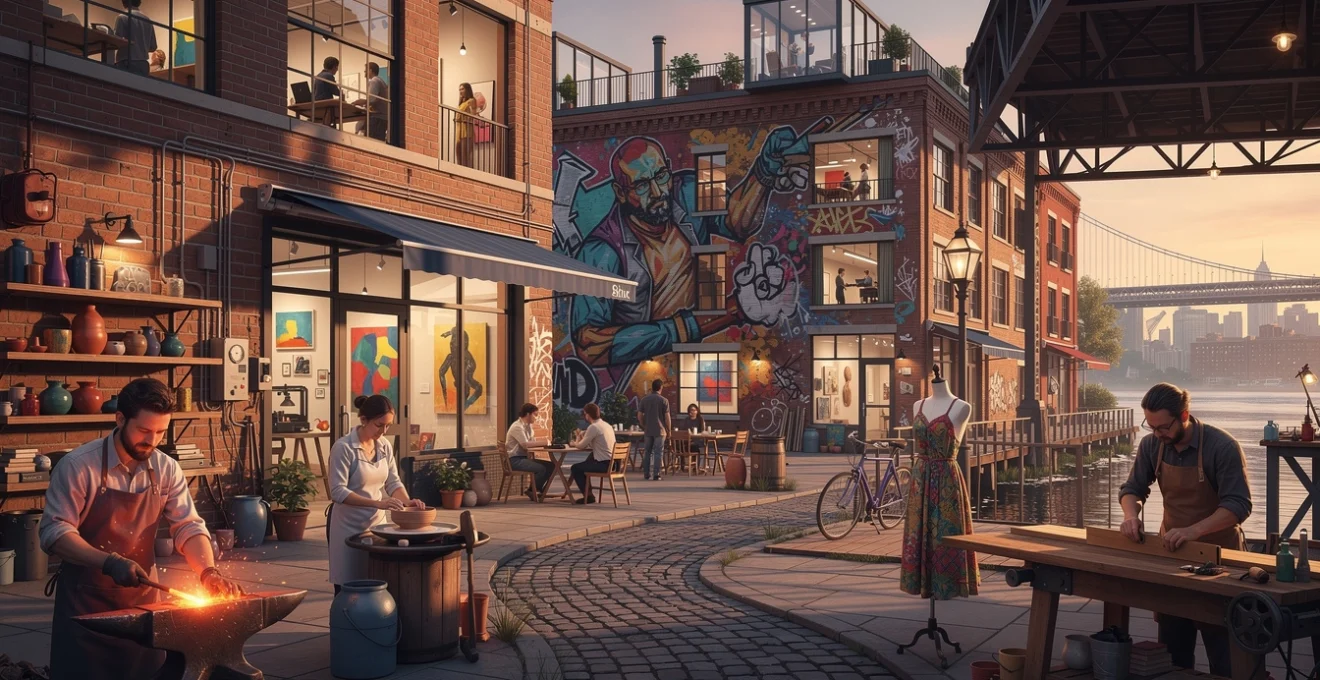
The transformation of urban landscapes through creative communities represents one of the most significant cultural phenomena of the 21st century. From former industrial warehouses converted into bustling maker spaces to heritage buildings reimagined as contemporary artisan workshops, creative districts are reshaping how cities approach economic development and community building. These vibrant neighbourhoods showcase the profound impact that artistic communities can have on urban regeneration, often emerging organically in areas with affordable rents and distinctive character.
Creative quarters serve as catalysts for broader urban transformation, attracting diverse populations and fostering innovation across multiple sectors. Research indicates that neighbourhoods with high concentrations of artists and creative professionals experience 23% faster economic growth compared to traditional commercial districts. The symbiotic relationship between artistic expression and place-based identity creates environments where creativity thrives whilst simultaneously addressing urban challenges such as vacant property utilisation and social cohesion.
Cultural quarters and creative precincts: mapping urban artistic ecosystems
Understanding the anatomy of successful creative districts requires examining how artistic communities organise themselves within urban environments. These ecosystems typically develop around clusters of affordable workspace, cultural venues, and supportive infrastructure that enables collaboration between diverse creative disciplines. The spatial organisation of these districts often reflects organic growth patterns rather than top-down planning, with artists and makers naturally gravitating towards areas that offer both practical advantages and cultural resonance.
Creative precincts function as interconnected networks where individual studios, galleries, and workshops contribute to a larger cultural economy. The density of creative businesses within these areas creates opportunities for knowledge exchange, collaborative projects, and shared resource utilisation. Studies from urban planning research demonstrate that creative clusters generate approximately 40% more cross-sector partnerships compared to dispersed creative businesses, highlighting the importance of geographical proximity in fostering innovation.
Shoreditch’s street art heritage and contemporary gallery networks
East London’s Shoreditch exemplifies how grassroots creative movements can transform entire neighbourhoods whilst maintaining their authentic character. The area’s evolution from derelict industrial zone to internationally recognised cultural quarter demonstrates the power of artist-led regeneration. Beginning in the 1990s, affordable warehouse spaces attracted pioneering artists seeking alternatives to expensive West End galleries, gradually establishing a reputation for cutting-edge contemporary art and street culture.
The integration of street art with formal gallery spaces creates a unique artistic ecosystem where emerging and established artists coexist within the same geographical area. This multi-layered approach to creative expression has generated an estimated £2.8 billion in annual cultural economy activity across East London, with Shoreditch serving as the primary catalyst for this growth. The neighbourhood’s success lies in balancing commercial development with preservation of its rebellious artistic spirit.
Barcelona’s el raval district: catalonian craft renaissance
El Raval showcases how traditional Mediterranean craft traditions can be revitalised within contemporary urban contexts. The district’s narrow medieval streets house a remarkable concentration of artisan workshops specialising in ceramics, metalwork, and textile arts. Local policies supporting artesania (traditional craftsmanship) have enabled master craftspeople to establish workshops alongside contemporary designers, creating intergenerational knowledge transfer opportunities.
The neighbourhood’s transformation strategy emphasises cultural preservation whilst encouraging innovation, resulting in workshops that produce both traditional Catalonian crafts and contemporary design pieces. This approach has attracted international attention, with craft tourism generating approximately €45 million annually for the district. The success of El Raval demonstrates how creative districts can honour historical identity whilst embracing contemporary artistic practices.
Brooklyn’s DUMBO creative waterfront development
The Down Under the Manhattan Bridge Overpass (DUMBO) area represents a carefully orchestrated transformation of post-industrial waterfront into a thriving creative district. Former manufacturing buildings have been converted into mixed-use spaces combining artist studios, galleries, and creative businesses with residential developments. The area’s success stems from preserving the industrial architectural character whilst introducing modern amenities and infrastructure.
Strategic planning initiatives in DUMBO include affordable artist housing programmes, public art installations, and creative business incubation services. The neighbourhood now hosts over 300 creative businesses generating approximately $1.2 billion in annual economic activity. This development model has influenced waterfront regeneration projects globally, demonstrating how thoughtful planning can create sustainable creative communities without displacing existing artistic populations.
Melbourne’s fitzroy laneway culture and
independent studios illustrates how micro-scale interventions can reshape an entire district’s reputation. Once a working-class suburb marked by light industry, Fitzroy leveraged its dense network of laneways as informal galleries, performance spaces, and test-beds for experimental retail. Small-format storefronts and upper-floor workshops provide affordable entry points for emerging makers, while street art and ephemeral installations create a constantly changing outdoor gallery that invites repeat visits.
This laneway culture supports a rich ecology of independent studios, print workshops, and small batch fashion labels operating side by side with record shops, cafés, and music venues. Crucially, local planning frameworks in Melbourne have protected mixed-use zoning and small-grain lot patterns, allowing creative entrepreneurs to occupy spaces that might otherwise have been amalgamated into larger commercial developments. The result is a neighbourhood where the boundaries between production, retail, and cultural experience are deliberately blurred, and where visitors can observe craft processes in real time rather than encountering finished products in isolation.
Artisan workshop infrastructure and creative space architecture
Behind every thriving artisan district lies an infrastructure of well-designed creative spaces. These are not simply buildings with character; they are purposefully adapted environments that support specialised equipment, irregular working hours, and collaborative workflows. The architecture of creative districts often reflects a careful negotiation between heritage conservation, building performance, and contemporary occupational health and safety standards, ensuring that workshops remain both inspiring and functional.
At an urban scale, the configuration of studio buildings, public courtyards, and shared circulation routes can either encourage or inhibit collaboration. Districts that perform best from an innovation perspective tend to cluster studios around shared amenities such as materials libraries, digital fabrication labs, and exhibition spaces. In this way, the physical layout of creative infrastructure operates much like a well-designed research campus, engineering serendipitous encounters that spark new ideas and partnerships.
Live-work studio conversions in former industrial buildings
Former warehouses and factories have proven particularly suited to live-work studio conversions because they offer generous floor-to-ceiling heights, robust structures, and flexible floor plates. When carefully retrofitted, these buildings can accommodate both heavy-duty craft processes and comfortable residential environments within the same envelope. This co-location reduces commuting time for artisans, increases time-on-practice, and strengthens street-level activity throughout the day and evening.
Successful conversions typically follow a set of emerging best practices. These include acoustic separation between living and making zones, dedicated loading access for materials and finished works, and adaptable partition systems that allow studios to expand or contract as practices evolve. In cities such as Berlin’s Kreuzberg or Montreal’s Mile End, municipal incentives for live-work conversions have helped stabilise artisan populations that might otherwise have been pushed out by speculative office development.
Maker space design principles for multi-disciplinary crafts
Multi-disciplinary maker spaces lie at the heart of many contemporary artisan districts, providing access to tools and technologies that would be prohibitively expensive for individual practitioners. Designing these facilities requires careful consideration of how different craft disciplines coexist. Woodworking, metal fabrication, textiles, and digital media each have distinct requirements for ventilation, power, noise control, and storage, yet they must be integrated within a coherent spatial framework.
Effective maker space design often relies on zoning principles similar to those used in laboratories: high-impact, noisy processes are grouped together and acoustically isolated, while clean, low-impact activities cluster around shared project tables and critique areas. Circulation routes are kept wide and uncluttered to accommodate material movement and to double as informal exhibition corridors. When you walk through a well-designed maker space, you should be able to see, almost at a glance, the full spectrum of creative activity taking place, much like viewing different research projects along a single corridor.
Heritage building adaptive reuse for contemporary artisan practice
Adaptive reuse of heritage buildings allows creative districts to retain a tangible connection to their urban history while supporting contemporary forms of artisan practice. Former breweries, tram depots, and post offices are increasingly reimagined as shared studios, craft schools, and design showrooms. This approach offers more than visual charm; the patina of age and the layering of past uses contribute to a sense of authenticity that is highly valued by both makers and visitors.
From a technical standpoint, adaptive reuse projects must address seismic strengthening, accessibility, and environmental performance without erasing historic character. Architects often deploy lightweight mezzanines, reversible partitions, and discreet services routing to maintain original volumes and materiality. The result is a building that functions like a finely tuned instrument: calibrated to support dust extraction and digital projection while still revealing brick vaults, timber trusses, and industrial hardware that tell the story of the neighbourhood’s evolution.
Co-working creative hubs and shared equipment facilities
Alongside traditional individual studios, co-working creative hubs have emerged as key anchors in artisan districts. These hubs offer flexible memberships that give designers, illustrators, filmmakers, and digital artists access to desk space, meeting rooms, and shared equipment such as large-format printers, photography studios, or sound booths. For early-career practitioners, this lowers the entry threshold and allows them to test business models before committing to long-term leases.
Shared equipment facilities also promote a culture of peer learning. When textile designers share laser cutters with jewellery makers, or when furniture designers access the same CNC routers as public artists, new techniques and hybrid disciplines often emerge. In economic terms, these hubs operate as efficiency engines: by pooling capital-intensive resources, they enable more of each euro or dollar of creative revenue to be reinvested in experimentation and skill development rather than overheads.
Economic models sustaining independent creative communities
While the romantic image of the artisan district often focuses on atmospheric streets and studio windows, its long-term success depends on robust economic models. Independent creative communities must navigate fluctuating demand, rising property values, and the precarity of self-employment. Districts that endure over decades do so because they blend diverse revenue streams, policy support, and community governance mechanisms that protect creative production from being displaced by pure consumption.
One increasingly common approach is the establishment of community land trusts or cultural real estate cooperatives that acquire and hold key buildings in perpetuity for creative use. By decoupling workshop rents from speculative land values, these entities help stabilise costs for artisans and prevent the familiar pattern where artistic activity makes an area desirable, only for rising rents to push creators elsewhere. Complementary models include business improvement districts with dedicated cultural levies, micro-grant schemes funded by local tourism taxes, and tiered rent structures where more commercially successful tenants cross-subsidise experimental practices.
Digital platforms also play a growing role in sustaining artisan districts. E-commerce channels allow neighbourhood makers to access global markets without abandoning their local production base, while online booking systems support short-term studio rentals, residencies, and skill-sharing workshops. When combined with on-the-ground events such as open-studio trails and night markets, these models create a resilient ecosystem where income is diversified across retail, teaching, commissions, and licensing.
Traditional craft revival in post-industrial neighbourhoods
As manufacturing has retreated from many Western cities, a new wave of small-scale craft production has emerged to occupy vacated industrial spaces. Rather than replicating mass production, these contemporary artisan districts focus on high-skill, low-volume work that emphasises durability, provenance, and narrative. The revival of traditional craft in post-industrial neighbourhoods responds both to consumer demand for more meaningful products and to local desires to preserve industrial heritage in a future-oriented way.
These craft revivals often operate as living laboratories for circular economy principles. Offcuts become raw material for other makers, repair services sit alongside retail, and apprenticeship programmes reconnect young residents with hand skills that had all but disappeared from urban labour markets. Importantly, the most resilient districts integrate long-standing communities into these new craft economies, ensuring that regeneration benefits are broadly shared rather than confined to a narrow creative class.
Metalworking and blacksmithing renaissance in detroit’s corktown
Detroit’s Corktown neighbourhood has become emblematic of the blacksmithing renaissance in North American cities. Building on the city’s deep legacy of metal fabrication, a new generation of artisan blacksmiths and metalworkers has established studios in refurbished garages and small industrial units. Their output ranges from architectural hardware and public-art commissions to custom tools and small-batch furniture components.
What differentiates Corktown’s contemporary metalworking scene from its industrial past is the emphasis on visible process and community engagement. Many studios run introductory forging workshops, host open-fire demonstrations during neighbourhood festivals, and collaborate with local schools on STEM-and-craft blended curricula. For residents, the sound of hammer on anvil has shifted from an industrial soundtrack to a marker of neighbourhood identity, reinforcing a sense that Detroit’s making culture is being reinterpreted rather than erased.
Ceramic arts clusters in Stoke-on-Trent’s cultural quarter
Stoke-on-Trent, long known as “The Potteries”, offers a striking example of how a legacy industry can be reconfigured into a contemporary artisan ecosystem. In the city’s cultural quarter, disused factory sites have been converted into ceramic studios, galleries, and education centres, many of which still use historic bottle kilns as landmarks and occasionally as working equipment. Small-batch ceramicists produce tableware, architectural tiles, and art objects that draw on regional glaze recipes and clay bodies while adopting contemporary forms.
Supported by local universities and heritage organisations, these ceramic clusters benefit from shared technical resources such as kilns, clay recycling systems, and materials testing labs. Visitors can trace the full production cycle from raw clay to finished piece along studio trails, deepening their understanding of both the craft and the city’s history. In economic terms, the rebranding of Stoke-on-Trent as a centre for high-quality ceramic arts has attracted design tourism and specialist collectors, diversifying the local economy beyond traditional mass manufacture.
Textile artisan networks in east london’s fashion districts
In East London’s fashion districts, traditional textile skills have found new relevance within contemporary design networks. Areas such as Hackney and Bethnal Green host dense concentrations of pattern cutters, sample machinists, embroiderers, and small-run manufacturers who collaborate closely with independent fashion labels. Many of these practitioners are second- or third-generation migrants whose families worked in the garment trades, now combining inherited skills with digital patterning tools and sustainable material sourcing.
The strength of these textile artisan networks lies in their proximity and interdependence. Designers can iterate prototypes rapidly because the entire supply chain—from fabric sourcing to finishing—is located within a few streets. Initiatives such as shared fabric libraries, open-access dye labs, and collective branding campaigns (“Made in East London”) help small producers compete with offshore manufacturing by emphasising quality, transparency, and locality. For consumers seeking ethical fashion with a tangible story, these districts offer a compelling alternative to anonymous global supply chains.
Woodworking collectives in portland’s southeast division
Portland’s Southeast Division corridor has seen the emergence of woodworking collectives that blend traditional carpentry with contemporary design sensibilities. Shared workshops equipped with table saws, planers, CNC routers, and finishing booths allow independent furniture makers, luthiers, and interior fit-out specialists to operate at professional standards without incurring prohibitive equipment costs. Many collectives also maintain street-facing showrooms where prototypes and limited-edition pieces are exhibited.
Sustainability is a defining feature of these woodworking districts. Reclaimed timber from deconstructed buildings, urban tree salvage, and certified local hardwoods form the basis of production, with offcuts often repurposed into smaller objects or donated to community projects. Public programming—such as tool-lending libraries, “fix-it” clinics, and introductory joinery classes—further embeds these collectives within the social fabric of the neighbourhood, turning what might otherwise be closed workshops into accessible community resources.
Digital arts integration within physical creative districts
The rise of digital arts has not diminished the importance of physical creative districts; instead, it has layered new forms of practice on top of existing craft ecosystems. Projection mapping, interactive installations, and augmented reality experiences are now common features of artisan neighbourhoods, transforming façades and public spaces into dynamic canvases. For many districts, digital arts provide a bridge between local heritage and global audiences, allowing stories embedded in the built environment to be reinterpreted through contemporary media.
Hybrid studios that combine coding, animation, sound design, and fabrication are increasingly locating themselves alongside traditional makers. This proximity encourages productive cross-pollination: a ceramicist might collaborate with a game designer on tactile controllers, or a weaver might integrate programmable LEDs into textiles developed with electronics specialists. From an economic standpoint, digital integration also opens up non-local revenue streams, as creative districts export intellectual property—such as motion graphics, virtual sets, or interactive experiences—without uprooting their physical footprint.
For city planners and community leaders, the key challenge is providing the right infrastructure for this convergence. High-speed broadband, robust power supply, and flexible black-box spaces for testing immersive works are now as important as kilns and extraction systems. When these elements are planned together, districts can position themselves at the forefront of “phygital” creativity, where the boundary between online and offline cultural experience becomes increasingly permeable.
Community-driven placemaking and neighbourhood identity formation
At their best, artisan districts are not simply places where creative work happens; they are co-authored narratives of neighbourhood identity. Community-driven placemaking ensures that residents, makers, and local organisations are active participants in shaping how their district looks, feels, and functions. Rather than imposing a single aesthetic or branding strategy, successful creative precincts nurture multiple overlapping identities that reflect the diversity of people and practices present.
Participatory tools such as co-design workshops, temporary street closures for cultural festivals, and micro-grants for resident-led projects help surface local ideas and priorities. You might see a community-curated exhibition in a vacant shopfront, a cross-cultural craft fair in a repurposed car park, or a series of public benches designed and built by local apprentices. These initiatives do more than beautify; they build social capital, foster intergenerational knowledge exchange, and give residents a tangible sense of ownership over the changes occurring around them.
Of course, community-driven placemaking must navigate tensions around gentrification and displacement. Transparent governance structures, long-term affordability strategies, and explicit commitments to cultural equity are essential if artisan districts are to remain inclusive over time. When creativity is embedded in neighbourhood decision-making rather than added as an afterthought, artisan districts can become powerful platforms for social cohesion, economic opportunity, and collective imagination—places where, quite literally, creativity defines the neighbourhood.