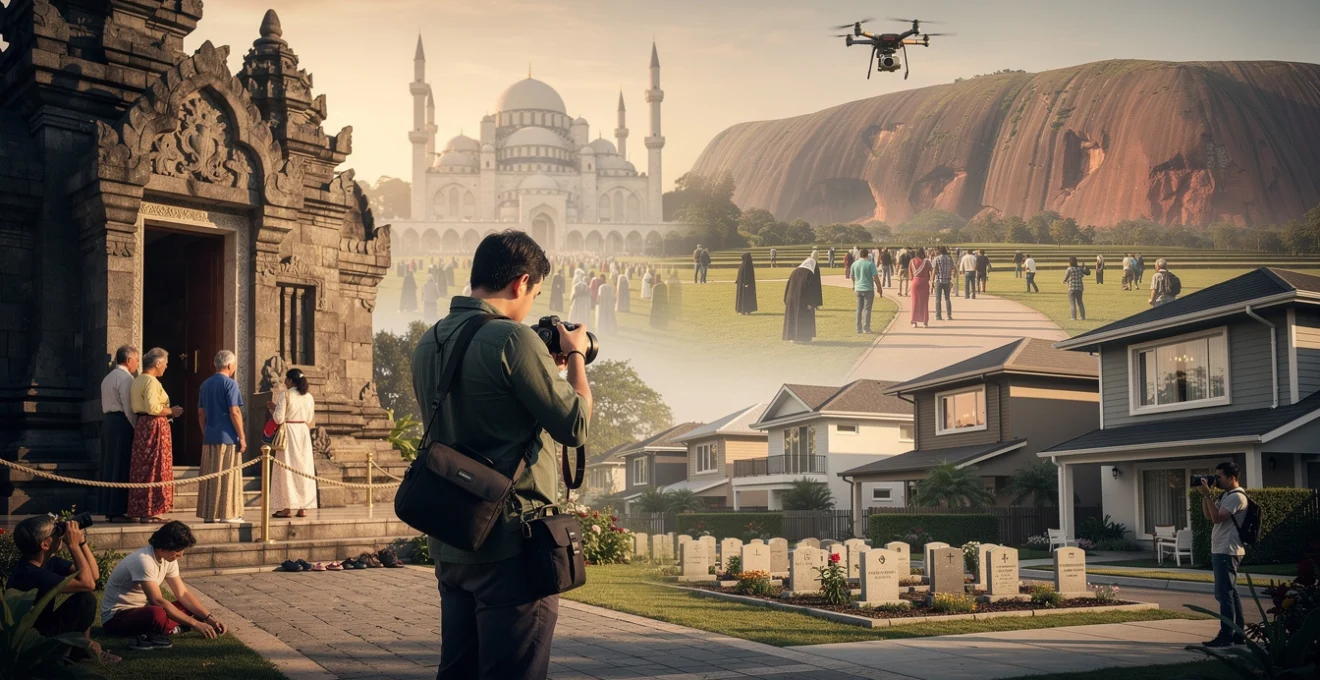
Photography whilst travelling presents unique challenges that extend far beyond technical camera settings and composition techniques. The intersection of cultural sensitivity, legal considerations, and ethical responsibilities creates a complex landscape that every photographer must navigate carefully. Modern travel photography demands an understanding of diverse cultural norms, religious protocols, and legal frameworks that vary significantly across different regions and contexts.
The proliferation of social media and smartphone photography has democratised travel documentation, yet this accessibility has also intensified the need for proper etiquette and awareness. What might seem like an innocent photograph could inadvertently violate sacred customs, infringe on privacy rights, or breach local regulations. Understanding these nuances becomes essential for creating meaningful travel imagery whilst maintaining respect for local communities and their traditions.
Successful travel photography requires balancing creative expression with cultural responsibility. This delicate equilibrium ensures that your photographic pursuits contribute positively to cross-cultural understanding rather than perpetuating harmful stereotypes or disrespectful practices. The following comprehensive examination explores the intricate protocols governing photography in various sensitive environments.
Sacred site photography protocols: religious and cultural sensitivity guidelines
Sacred sites worldwide maintain distinct photographic protocols rooted in centuries-old traditions and contemporary preservation concerns. These locations serve as spiritual sanctuaries for millions of believers, making photographic etiquette particularly crucial for maintaining their sanctity. Religious photography guidelines often stem from theological principles about the nature of sacred space and the appropriate behaviour within these environments.
Many sacred sites implement photography restrictions for multifaceted reasons beyond simple reverence. Conservation concerns play a significant role, as flash photography can damage ancient artwork and delicate architectural features. Additionally, the spiritual atmosphere maintained through contemplative silence can be disrupted by the mechanical sounds of camera equipment and the behaviour of photographers seeking the perfect shot.
Understanding the spiritual significance of sacred spaces requires recognising that photography policies often reflect deeper theological and cultural values about the relationship between the material and spiritual worlds.
Temple photography restrictions at angkor wat and borobudur heritage sites
Angkor Wat represents one of the world’s most photographed heritage sites, yet specific protocols govern appropriate photographic conduct within this sacred complex. The Cambodian authorities permit external photography throughout most areas of the temple complex, but certain inner sanctuaries maintain strict restrictions during active religious ceremonies. Visitors must remain particularly mindful during Buddhist festivals when local communities gather for religious observances.
Borobudur’s photography guidelines emphasise preservation alongside cultural sensitivity. The Indonesian authorities restrict flash photography throughout the monument to prevent damage to the ancient stone reliefs and Buddha statues. Climbing restrictions apply to certain areas where photography from elevated positions could compromise both structural integrity and spiritual protocols. Professional photography requiring tripods or extensive equipment necessitates advance permits and specific timing arrangements.
Mosque etiquette standards: blue mosque istanbul and sheikh zayed grand mosque
Islamic architecture photography requires understanding fundamental principles of mosque etiquette that influence photographic permissions. The Blue Mosque in Istanbul maintains a delicate balance between accommodating millions of annual visitors whilst preserving its function as an active place of worship. Photography restrictions intensify during the five daily prayer times when the mosque serves its primary religious purpose.
The Sheikh Zayed Grand Mosque in Abu Dhabi exemplifies contemporary approaches to balancing tourism with religious function. Designated photography zones allow visitors to capture the mosque’s architectural grandeur whilst maintaining appropriate distances from prayer areas. Specific dress codes apply universally, with photography permissions contingent upon compliance with modest attire requirements that respect Islamic customs.
Indigenous sacred ground documentation: uluru and machu picchu access regulations
Indigenous sacred sites present particularly complex photography considerations that interweave spiritual beliefs with contemporary tourism management. Uluru’s photography restrictions reflect the deep spiritual significance this monolith holds for the Anangu people, who consider certain angles and perspectives inappropriate for documentation. The traditional owners actively discourage photography that captures the rock’s climbing routes, respecting their cultural prohibition against ascending this sacred formation.
Machu Picchu’s photography protocols balance archaeological preservation with respect for Incan spiritual traditions. Peruvian authorities restrict drone photography throughout the archaeological site and surrounding sanctuary to protect both the physical integrity of the ruins and the spiritual atmosphere maintained by local Quechua communities. Professional photography sessions require advance coordination with SERNANP
(Servicio Nacional de Áreas Naturales Protegidas), and regulations change frequently as authorities respond to overtourism and conservation pressures. Tripods, lighting equipment, and commercial shoots are generally prohibited during normal visiting hours, and you may be required to join a guided tour if your gear suggests professional intent. As with Uluru, the most respectful approach at Machu Picchu is to prioritise the site’s cultural and spiritual meaning over the desire for a “perfect” photograph.
Cemetery and memorial site photography codes: père lachaise and arlington national cemetery
Cemeteries and memorials occupy a sensitive middle ground between public space and deeply private grief. At Paris’s Père Lachaise Cemetery, photography is broadly permitted, yet visitors are expected to maintain a quiet, reflective demeanour and avoid intrusive close-ups of mourners. Zoom lenses and discreet angles can help you document historic graves and elaborate tombs without capturing identifiable faces during personal moments of remembrance.
Arlington National Cemetery in the United States has more formalised photography etiquette reflecting its role as a national military burial ground. The site’s regulations request that visitors refrain from disruptive behaviour and explicitly discourage posing for playful selfies, loud conversations, or staged fashion-style shoots among the headstones. At ceremonial sites such as the Tomb of the Unknown Soldier, photography is generally allowed but must never interfere with guards, wreath-laying ceremonies, or funeral processions.
Across both locations, and indeed in most cemeteries worldwide, a fundamental rule applies: if you would hesitate to raise your camera at a funeral in your own community, you should not do so abroad. When in doubt, step back, lower your camera, and allow moments of grief and remembrance to remain unrecorded. Ethical travel photography means recognising that some experiences are meant to be witnessed with your eyes, not your lens.
Private property and residential area photography ethics
Beyond sacred sites, travel photographers frequently encounter complex etiquette questions when photographing private homes, small businesses, and residential neighbourhoods. While the law in many countries allows photography from public spaces, ethical practice often requires a higher standard than the bare legal minimum. The rise of social media and geotagging has amplified concerns about privacy, security, and unwanted exposure, particularly when images go viral without the knowledge of those depicted.
Understanding the difference between what is legal and what is respectful is central to responsible travel photography. Just because you can take a photograph of someone’s balcony, courtyard, or garden from the street does not always mean you should. The most sustainable approach is to combine basic knowledge of local privacy laws with empathetic, common-sense judgement about how you would feel if the situation were reversed.
Portrait rights and model release requirements for street photography
Street photography sits at the intersection of artistic freedom and individual privacy rights. In many jurisdictions, you are legally permitted to photograph people in public spaces without explicit consent, provided the images are used for editorial or personal purposes rather than commercial advertising. However, the line between personal travel photography and content that effectively functions as commercial media has blurred with influencer marketing and monetised social channels.
Model release forms become important when photographs of identifiable individuals are used to promote products, services, or brands—even subtly. If you plan to license your travel portraits for stock agencies, advertising campaigns, or tourism marketing, obtaining written consent protects both you and your subjects. In practice, this may mean carrying simple, multilingual release forms or using a digital signing app where internet access allows.
Even when the law does not require a release, seeking verbal consent before making close-up portraits often leads to more authentic, collaborative images. A friendly introduction, a brief explanation of your project, and a willingness to accept “no” without pressure go a long way. Think of consent as part of the creative process: you are not only capturing a face, but also building a relationship—even if that relationship lasts only a few minutes.
Architectural photography permissions: private estates and commercial properties
Architectural photography etiquette becomes more complex when buildings are privately owned yet visually dominant in the cityscape. Grand estates, luxury hotels, modern office towers, and shopping centres often have distinct photography policies that differ between exteriors and interiors. In many countries, photographing the exterior of a building from a public street is lawful, yet entering a private courtyard or lobby may subject you to restrictions imposed by the owner or management.
Large commercial properties—such as malls, casinos, or corporate campuses—typically classify photography as a controlled activity. Security staff may ask you to stop shooting, delete images, or obtain a permit, especially if you are using professional-looking equipment like tripods or large lenses. While these requests may feel arbitrary, refusing to comply can lead to removal from the premises or, in rare cases, legal escalations.
When you anticipate wanting interior architectural photographs, an advance email to the property’s communications or marketing department can be invaluable. Written permission clarifies what areas you may access, whether tripods or flashes are allowed, and how images may be used. This proactive approach not only protects you legally but also builds goodwill, sometimes resulting in privileged access to viewpoints not available to the general public.
Telephoto lens usage boundaries in residential neighbourhoods
Telephoto lenses can feel like visual superpowers, allowing you to pull distant scenes close and compress layers of a cityscape into striking compositions. Yet in residential neighbourhoods, that same reach can easily cross ethical boundaries by intruding into private lives. Balconies, bedroom windows, rooftop terraces and small courtyards may all seem like attractive subjects, but they often reveal more of people’s intimate spaces than they would ever willingly share.
As a guiding principle, you should avoid photographing into any space where individuals could reasonably expect privacy, even if you can see it from a public road. Using a long lens to capture someone cooking in their kitchen or children playing in a fenced garden risks turning your camera into a surveillance tool rather than a storytelling instrument. Ask yourself: would the person be comfortable if they saw the final image online, clearly recognising their home or children?
When in doubt, step back and look for broader scenes that convey the character of the neighbourhood without isolating identifiable details. Consider focusing on architectural patterns, street life, or anonymous silhouettes instead of faces and interiors. Respectful telephoto usage is less about focal length and more about intention—choosing not to record what people have not consciously chosen to reveal.
Drone photography regulations over private land and GDPR compliance
Drone photography has transformed travel imagery, offering aerial perspectives that were once the preserve of helicopters and aircraft. However, flying over private property or populated areas raises serious privacy and data protection concerns, particularly in regions governed by strict frameworks like the European Union’s General Data Protection Regulation (GDPR). Many countries now require drone registration, pilot certification, and adherence to “no-fly” zones around airports, government buildings, and dense urban districts.
From an ethical standpoint, operating a drone above residential areas without consent can feel intrusive, even where it is technically permitted. Cameras can easily capture back gardens, swimming pools, and rooftop terraces, inadvertently collecting personal data such as licence plates, faces, and identifiable daily routines. Under GDPR and similar regulations, consistently recording identifiable individuals without a clear lawful basis for processing their data may be problematic, especially if footage is published or monetised online.
Before flying, research national aviation authority guidelines and local bylaws, and use built-in geofencing tools where available. Avoid hovering near apartment windows or over private compounds, and be prepared to land immediately if residents express discomfort. Treat your drone not as a toy but as an aircraft carrying a camera—subject to safety, privacy, and cultural expectations that demand your full attention.
High-traffic tourism location management techniques
Busy tourist hubs—iconic plazas, famous viewpoints, historic districts, and popular markets—pose both practical and ethical challenges for travel photographers. Crowds can clutter compositions, limit mobility, and intensify the risk of disruptive behaviour as everyone competes for the same vantage points. At the same time, these public spaces often function as living cultural stages, where photographing the ebb and flow of people can authentically communicate a destination’s energy.
Managing photography in crowded places requires a blend of tactical planning and considerate behaviour. Simple decisions about timing, vantage point, and equipment can dramatically reduce conflict and frustration, both for you and the people around you. How can you create compelling images without blocking pathways, monopolising viewpoints, or treating fellow visitors as obstacles rather than co-experiencers of the place?
One of the most effective strategies is time-shifting your visits. Early mornings and late evenings often provide softer light and fewer people, while still capturing the essence of the location. Where opening hours and safety allow, arriving just before opening or staying until closing can mean the difference between chaotic snapshots and composed, reflective images. Patience, too, becomes a creative tool: waiting a few extra minutes for a brief gap in the crowd often yields cleaner compositions without the need for aggressive positioning.
Compositionally, you can turn the presence of crowds into an advantage rather than a hindrance. Focusing on architectural details, reflections, or overhead angles helps minimise visual clutter, while using the crowd itself as a storytelling element can show scale, diversity, and atmosphere. For instance, a long exposure that transforms moving tourists into soft blurs around a static monument can emphasise the endurance of history amid constant human movement.
Etiquette is equally important. Avoid standing for long periods in the exact centre of a popular viewpoint, especially with tripods that narrow pathways. Take your shot and then step aside so others can enjoy the same perspective. If you wish to photograph specific individuals, ask first rather than pointing your camera directly at them from close range. In high-traffic locations, a small gesture of courtesy can defuse tension that might otherwise escalate in a congested, high-stress environment.
Cultural photography taboos and regional customs awareness
Beneath formal rules and posted signs lies a subtler layer of cultural norms that strongly influence how your camera will be perceived. What is harmless documentation in one country may be seen as deeply offensive in another. Certain gestures, body parts, religious symbols, or gendered interactions can all carry meanings unfamiliar to visitors, yet central to local concepts of respect and honour.
For example, in many Buddhist and Hindu cultures, the head is considered the most sacred part of the body and the feet the lowest. Photographing someone’s feet, or posing with your feet pointed towards a religious object or elder, may be considered disrespectful. In parts of the Middle East and North Africa, photographing women—particularly in conservative communities—requires extreme caution, and often explicit permission from a male family member. Some Indigenous communities believe that photographs can capture or disturb spiritual essence, especially when taken during rituals or of sacred objects.
The most reliable way to navigate these taboos is through research and conversation. Guidebooks, cultural briefings, and local guides can highlight common sensitivities, but on-the-ground observation is equally instructive. Are locals photographing a particular ceremony, or do they put their phones away? Do market traders welcome cameras, or do they turn their faces aside? When in doubt, asking a simple question—“Is it okay to photograph this?”—demonstrates humility and respect.
It can help to think of photography etiquette as a form of visual “dress code.” Just as you might adjust your clothing to match local expectations in a temple or village, you adjust your photographic behaviour to align with community norms. Being flexible and willing to put your camera down at times often leads to deeper human connections and, ultimately, more meaningful images when opportunities do arise.
Legal framework navigation: international photography laws and permit requirements
While etiquette is guided by empathy and cultural awareness, travel photography also operates within a patchwork of legal frameworks that vary widely by country. Public versus private space distinctions, personal data protection rules, national security concerns, and heritage conservation laws all shape what you can and cannot photograph. As global tourism rebounds, many destinations are updating regulations in response to crowding, commercialisation, and privacy worries.
Some countries maintain relatively liberal rules, allowing photography in most public areas with few restrictions beyond military sites and critical infrastructure. Others require permits for professional equipment, limit tripod use in busy streets, or prohibit commercial shoots without prior authorisation. Famous landmarks may carry specific intellectual property protections—for instance, the Eiffel Tower’s night-time light display is treated as a copyrighted artwork, restricting commercial publication of after-dark images without permission.
Understanding these nuances does not require a law degree, but it does call for proactive preparation. Before travelling, consult official tourism websites, national park services, or cultural heritage authorities for up-to-date information on permits and restricted zones. For drone operations, check civil aviation authority guidance, which often includes interactive maps of no-fly areas. When you arrive, pay close attention to posted signs and instructions from staff or security personnel, recognising that local interpretation of rules can be more conservative than online summaries.
When your images include identifiable individuals, data protection regulations such as the EU’s GDPR may apply if you later process or publish those images in ways that go beyond purely personal use. While casual travel blogging is unlikely to trigger enforcement action, commercial exploitation or systematic profiling could. A simple rule of thumb is to treat personal data—faces, licence plates, house numbers—with care, limiting unnecessary detail and respecting takedown requests when people object to their appearance online.
Navigating international photography laws ultimately reinforces the broader philosophy of ethical travel photography: your right to make images is inseparable from your responsibility to the people and places you photograph. By combining basic legal awareness with cultural sensitivity and considerate fieldcraft, you can create powerful visual stories that honour both your subjects and your craft.