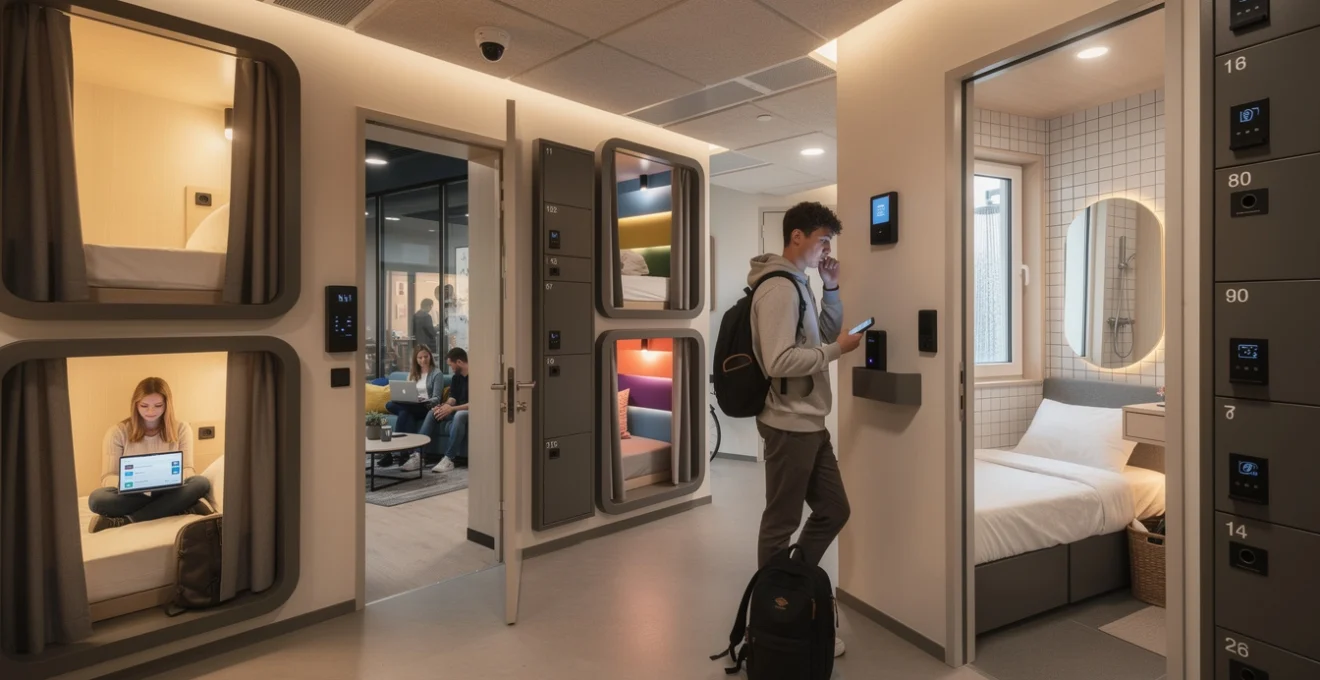
The budget accommodation landscape has shifted dramatically over the past decade. Travellers no longer need to choose between affordable rates and personal space. Modern hostels have evolved beyond cramped dormitories with flimsy curtains, offering sophisticated privacy solutions that rival mid-range hotels whilst maintaining competitive pricing. This transformation reflects a fundamental change in what budget-conscious travellers expect: genuine rest, personal security, and control over their immediate environment without the premium price tag traditionally associated with private accommodation.
Privacy in shared accommodation isn’t merely about physical barriers. It encompasses acoustic insulation, digital security, spatial design, and access control systems that work together to create genuinely private spaces. Whether you’re a solo female traveller seeking enhanced security, a digital nomad requiring quiet video call spaces, or simply someone who values quality sleep, understanding the technical specifications and design philosophies behind privacy-focused hostels can dramatically improve your accommodation choices. The industry has developed measurable standards, certification schemes, and technological solutions that separate genuine privacy-enhanced properties from those simply marketing traditional dormitories with marginally improved curtains.
Private room configurations in budget hostels: pods, Micro-Rooms, and capsule accommodation
The architecture of privacy in budget accommodation has diversified considerably. Traditional private rooms in hostels typically charge double occupancy rates with substantial single supplements, often making them comparable to budget hotels in cost. However, innovative spatial configurations have emerged that maximise privacy whilst maintaining affordability through clever use of vertical space and modular design principles. These configurations fall into several distinct categories, each with specific advantages for privacy-conscious travellers.
Capsule accommodation represents the most space-efficient privacy solution, originating from Japanese design principles where every cubic centimetre serves a purpose. Modern capsules extend far beyond simple sleeping tubes, incorporating ventilation systems, power outlets, adjustable lighting, and secure storage within a footprint of approximately 2 square metres. The enclosed sleeping environment provides psychological privacy that curtained bunks cannot match, creating a genuinely personal territory within shared spaces. Advanced capsule designs now include sound-dampening materials in walls and electronically controlled privacy screens.
Pod configurations occupy a middle ground between traditional dormitories and private rooms. These structures typically measure 3-4 square metres and feature floor-to-ceiling partitions, lockable doors, and individual climate control. Unlike capsules which focus purely on sleeping, pods accommodate small desks, shelving, and space to stand whilst dressing. This additional square footage translates to enhanced comfort without the cost implications of full private rooms. Some properties have pioneered staggered pod layouts where units don’t directly face one another, eliminating visual privacy concerns entirely.
Japanese-style capsule hostels: nine hours kyoto and the millennials shibuya
Nine Hours pioneered the refined capsule hotel concept with obsessive attention to privacy details. Each capsule features a three-layer construction: an outer shell providing structural integrity, a middle layer incorporating acoustic foam, and an inner surface with integrated lighting and ventilation. The entrance employs a weighted roller blind system that blocks 99.8% of external light whilst maintaining airflow. Capsule dimensions measure 200cm length, 100cm width, and 100cm height—sufficient for most travellers to sit upright comfortably. Temperature control operates independently for each unit, preventing the common hostel problem of rooms too hot or cold for individual preferences.
The Millennials Shibuya represents evolution in capsule design, incorporating smart technology throughout. Guests control lighting, alarm settings, and privacy screens via smartphone applications. Each capsule includes two USB-C ports, traditional USB-A connections, and standard power outlets with surge protection. The biometric locker system located beneath each capsule provides 45 litres of secure storage—adequate for standard backpacks and carry-on luggage. Soundproofing utilises 50mm acoustic panels with a noise reduction coefficient of 0.85, effectively dampening conversation and movement from adjacent capsules.
European pod hotels: CitizenM and yotel privacy solutions
CitizenM properties blur the distinction between hostels and hotels through modular pod rooms that function as compact hotel rooms rather than shared dormitory spaces. Each unit measures approximately 14 square metres and includes a private bathroom, queen-sized bed, and workspace.
What makes these privacy-focused pod hotels relevant to hostel guests is not just their style but their efficiency: layouts follow a near-identical template worldwide, so you know what level of privacy to expect before you arrive. Yotel has applied a similar logic with its “cabins”, which typically range from 7–10 square metres in airport locations and 10–14 square metres in city centres. Sliding doors, integrated storage beneath beds, and wall-mounted desks keep the footprint compact while still delivering genuine acoustic and visual separation from neighbours. Whilst CitizenM and Yotel often price above classic hostels, they set a benchmark for compact, privacy-first design that many high-end hostels now emulate in their private pod and micro-room configurations.
Hybrid dormitory-private room layouts in generator hostels
Generator Hostels exemplify the hybrid model that bridges the gap between traditional shared dormitories and full private rooms. Many Generator properties offer rooms with four to six beds arranged in semi-enclosed pods or bunks, each with privacy curtains, reading lights, individual sockets, and integrated shelving. Rather than a single open-plan dorm of twenty or more beds, floors are broken into smaller clusters, reducing perceived crowding and noise transfer. This approach gives you an affordable bed in a shared room while still carving out a defined personal territory.
Some Generator locations further enhance privacy by providing “shared ensuite” formats, where small dorms have their own bathroom facilities accessible only to occupants of that room. For travellers who value hostel social life but dislike walking down public corridors in a towel, this hybrid dormitory-private configuration can be a sweet spot. Bed spacing, room volume, and ceiling height are carefully planned to maintain adequate air circulation and thermal comfort even at full occupancy. When comparing Generator-style layouts with cheaper hostels, pay attention to maximum beds per room and whether semi-private pods are part of the design; this has a direct impact on both sleep quality and perceived safety.
Boutique hostel private ensuites: selina and freehand property standards
Boutique hostel brands such as Selina and Freehand specialise in private ensuites that blend hotel-level privacy with hostel-level social infrastructure. A typical Selina private room ranges from 10–18 square metres, often with a full private bathroom, work desk, and wardrobe, while still granting access to coworking spaces, communal kitchens, and curated events. Freehand properties adopt a similar standard, with design-led interiors, high-thread-count linens, and more robust acoustic separation between rooms than most traditional hostels. These boutique hostels often attract digital nomads and couples who want hostel community without sacrificing quiet and cleanliness.
From a privacy perspective, the key differentiators in these boutique ensuites are wall construction, door quality, and bathroom ventilation. Many Selina and Freehand properties use hotel-style solid core doors and double-layer plasterboard partitions, significantly reducing corridor noise compared with budget hostel doors. Bathrooms are usually fully enclosed rather than using partial frosted glass or open-plan “wet room” concepts that can compromise acoustic privacy. While nightly rates for these ensuite rooms are often within 10–25% of nearby budget hotels, the value proposition lies in integrated social spaces and coworking infrastructure that hotels seldom match at the same price point.
Acoustic insulation standards and soundproofing technologies in shared accommodation
When privacy matters as much as price, acoustic insulation is just as important as locks and curtains. A hostel can market “private pods” or “private rooms”, but if you can hear every hallway conversation or 3 a.m. suitcase being dragged across tiles, your privacy is compromised. Modern privacy-focused hostels increasingly treat sound control as a measurable performance metric rather than a design afterthought. They borrow techniques from hotel and office acoustics, using quantified decibel reduction targets and specialized materials to create quieter shared environments.
Understanding how soundproofing works helps you interpret property descriptions and reviews more critically. If a hostel mentions STC (Sound Transmission Class) ratings, acoustic panels, or dedicated quiet zones, it signals a higher-than-average commitment to noise control. Conversely, frequent guest complaints about thin walls, slamming doors, or noisy bars on the ground floor should raise a red flag if you are a light sleeper. In many cases, an extra €5–€10 per night for a better-designed property buys a level of acoustic privacy that can transform your stay.
Decibel reduction materials: acoustic panels and mass-loaded vinyl implementation
Two of the most common materials used to reduce sound transmission in privacy-conscious hostels are acoustic panels and mass-loaded vinyl (MLV). Acoustic panels, often made from foam or mineral wool wrapped in fabric, absorb mid- and high-frequency noise such as speech, keyboard tapping, and clinking dishes. You will typically see these panels mounted on walls and ceilings in lounge areas, hallways, and even inside larger dorm rooms. Their job is not to block sound entirely but to stop it from bouncing around and amplifying, much like adding soft furnishings to an echoey room.
Mass-loaded vinyl serves a different purpose: it adds density to walls, ceilings, and sometimes floors, blocking sound transmission between adjacent rooms or pods. High-density MLV can provide up to 20–30 dB of additional sound reduction when combined with double-layer plasterboard, which is substantial in a shared environment. In practical terms, this can mean the difference between clearly hearing your neighbour’s phone call and only perceiving a faint murmur. If a hostel highlights the use of soundproof materials, or you notice thick, padded wall panels in photos, it is often a sign that MLV or similar dense barriers are part of the construction.
White noise systems and sound masking in premium hostel chains
Some premium hostel chains deploy white noise systems and sound masking technologies to improve perceived privacy without rebuilding their entire structure. White noise generators emit a consistent, neutral sound—often reminiscent of airflow—that helps mask intrusive noises such as footsteps or distant conversations. Rather than making the building physically quieter, these systems make sudden sounds less noticeable, smoothing out the acoustic environment so your brain can relax. It is a bit like dimming bright lights so small flickers are no longer distracting.
Sound masking is increasingly integrated into HVAC systems and communal areas in design-forward properties. You may not even realise it is operating, only that the dorm feels calmer and less chaotic than in older hostels. For privacy-conscious travellers, earplugs and personal white noise apps remain essential tools, but institutional sound masking adds another layer of protection. When reading reviews, comments like “surprisingly quiet for the location” or “slept well despite being above a bar” often indicate that the property has invested in some form of acoustic management, whether through white noise, double glazing, or both.
Structural soundproofing: floating floors and decoupled wall assemblies
The most effective acoustic privacy solutions occur at the structural level. Floating floors—where the walking surface is isolated from the building’s structural slab by resilient materials—reduce impact noises such as footsteps, dropped items, and moving luggage. This is particularly valuable in multi-storey hostels where sound from upper levels can otherwise transmit directly into rooms below. A well-designed floating floor can reduce impact sound transmission by 15–25 dB, which travellers typically interpret as “I couldn’t hear people walking above me.”
Decoupled wall assemblies operate on a similar principle, separating layers of wall material so vibrations don’t travel directly from one room to the next. Techniques such as staggered studs, resilient channels, and double-stud walls are common in modern hotels and are slowly appearing in new-build hostel projects. While you won’t see these details in marketing photos, architects and operators sometimes mention “decoupled walls” or “hotel-grade construction” in technical descriptions. If you’re choosing between an older converted building and a purpose-built hostel advertised as acoustically optimised, the latter is generally a safer bet for genuine sound isolation.
Digital security infrastructure: keycard systems, smart locks, and RFID access control
Physical privacy in hostels increasingly depends on digital security infrastructure. Instead of traditional metal keys—which are easy to copy and awkward to manage—many privacy-focused hostels use electronic keycards, RFID wristbands, or smartphone-based digital keys. These systems allow for granular access control: your credential might open the main entrance, specific floor, your room or pod, and your personal locker, but nothing else. For travellers, this reduces the risk of unauthorised entry and offers a traceable log of who accessed which spaces and when.
From a privacy perspective, robust access control protects not only your belongings but also your sense of personal space. Knowing that only registered guests can access a floor, and only roommates can open a specific dorm, significantly reduces anxiety—especially for solo travellers and those carrying valuable equipment. When comparing properties, pay attention to whether electronic access is used consistently across entrances, rooms, and lockers, or only at the front door. A mixed system with digital room locks but unsecured internal corridors or open luggage areas often falls short of true privacy-focused design.
Salto and ASSA ABLOY electronic locking mechanisms
Two of the market leaders in electronic locking systems for accommodation are Salto and ASSA ABLOY. Many modern hostels deploy Salto XS4 or ASSA ABLOY VingCard systems, which support RFID keycards, mobile keys, and centralised management. For you as a guest, the brand name is less important than what it implies: industry-standard encryption, the ability to instantly deactivate lost cards, and detailed access logs. Properties that invest in these systems typically also invest in broader safety protocols, such as 24/7 reception monitoring and secure emergency exits.
Salto and ASSA ABLOY systems can be integrated with property management software, allowing hostels to configure access rights down to the room or even pod level. In some pod hostels, your keycard will not only unlock the dorm door but also activate power to your individual pod and locker. This reduces energy waste and prevents non-guests from casually entering sleeping areas. When a listing mentions specific systems like Salto or VingCard, it is a good indicator that the hostel treats security and privacy with the same seriousness as mid-range hotels.
Individual locker specifications: sizing, material, and biometric access points
Lockers are a core element of privacy in shared accommodation because they allow you to secure valuables without booking a full private room. However, not all hostel lockers are created equal. In privacy-focused hostels, you will often find lockers large enough to hold a 60–70L backpack or airline-standard carry-on suitcase—typically around 90–110 cm in height and 40–50 cm in depth. Lockers constructed from steel or high-pressure laminate rather than thin plywood provide better physical security and are less prone to warping or breakage.
Some advanced hostels now integrate digital or biometric access into lockers, using RFID, PIN codes, or fingerprint scanners instead of padlocks. These systems eliminate the need to carry separate locker keys or purchase locks at reception, simplifying your daily routine. Biometric locker access, while still relatively rare, is particularly appealing for travellers who want to minimise the number of objects they must keep track of. When reading hostel descriptions, look for mentions of “laptop-sized lockers”, “under-bed lockers with power outlets”, or “RFID-secured storage”; all of these features support a higher standard of privacy and personal security.
CCTV placement ethics: monitoring common areas whilst preserving guest privacy
CCTV is a double-edged sword in hostels: it can enhance safety in communal spaces, but excessive or poorly placed cameras risk undermining guest privacy. Responsible operators follow clear guidelines, concentrating surveillance in entrances, reception areas, luggage rooms, and main corridors, while avoiding direct coverage of beds, bathrooms, and changing areas. The goal is to deter theft and unauthorised access without creating a sense of constant personal surveillance. Ethically operated systems also post visible signage so guests understand where they are being recorded.
Privacy-conscious travellers should pay attention to how hostels describe their security measures. Phrases such as “CCTV in all public areas” are generally positive, provided they are paired with respect for private zones. If guest reviews mention cameras trained directly on bunks or within locker rooms, that’s a significant privacy concern. Weigh the trade-off: you want theft deterrence and incident documentation, but not at the cost of feeling watched while you sleep. A balanced CCTV policy is part of a broader culture of respecting guest boundaries.
Personal device charging stations with integrated security features
With laptops, cameras, and smartphones now central to travel, secure charging has become a key aspect of hostel privacy. Many modern hostels integrate power outlets and USB ports directly inside pods or bunks, allowing you to charge devices within your personal space instead of leaving them unattended in common areas. Some properties go further, offering lockable charging drawers or small safes with integrated power, so you can charge electronics while they remain physically secured. This is especially valuable on checkout days when you need to top up devices after vacating your bed.
In coworking lounges and shared desks, look for anchored power strips and cable management systems that reduce the risk of someone casually unplugging your equipment. A few high-end hostels have introduced RFID-controlled charging lockers specifically designed for laptops and tablets, borrowing designs from airport charging stations. When evaluating a privacy-focused hostel, consider whether its electrical infrastructure supports your workflow and security needs; having to choose between charging your laptop and keeping it safe is a compromise you no longer need to accept in well-designed properties.
Spatial design metrics: square footage per guest and personal territory allocation
Spatial design is an often-overlooked dimension of hostel privacy, yet it directly affects your comfort and stress levels. At its simplest, square footage per guest refers to how much floor area is allocated to each person in a dormitory or pod room. Hostels that treat privacy as a priority typically aim for 3.5–4.5 square metres per bed in shared rooms and at least 10–12 square metres for private micro-rooms, not including bathrooms. This extra space reduces crowding, allows for better circulation, and lowers the likelihood of accidental physical contact when people move around.
Beyond raw square metres, “personal territory allocation” considers how furniture, beds, and circulation paths are arranged. For example, staggered bunks, angled pod entrances, and partial partitions create visual separation even when physical distances are small. Smart design can make a 4-bed dorm feel more private than an 8-bed room with the same total area. When reviewing floor plans or photos, ask yourself: is there a clear boundary between sleeping zones and circulation paths, or are beds crammed edge-to-edge? Properties that prioritise defined personal territory often deliver better sleep and reduced social friction, even at similar price points to more crowded competitors.
Privacy-focused hostel certification schemes and industry benchmarks
As privacy becomes a key differentiator in budget accommodation, formal certification schemes and industry benchmarks help travellers distinguish marketing claims from measurable standards. While there is not yet a global “privacy certification” exclusively for hostels, several rating systems and quality frameworks indirectly assess aspects of privacy, from noise control and cleanliness to security and management processes. Understanding these benchmarks can help you quickly filter options and focus your research on properties that align with your expectations.
Certification is not a guarantee of perfection, but it does indicate that a hostel has submitted to external evaluation and continuous improvement processes. Combined with guest reviews and your own due diligence, it forms a robust lens for choosing hostels where privacy matters as much as price. So, which labels and metrics should you actually pay attention to when booking your next stay?
Hostelworld privacy ratings and TrustScore methodology
Hostelworld remains one of the dominant booking platforms for shared accommodation, and its rating system provides useful signals for privacy-conscious travellers. Beyond the overall score, categories such as “security”, “location”, “staff”, and “value for money” can be filtered and sorted, often revealing more about privacy than the headline number. A property with a security rating above 9.0, for example, is likely to have reliable access control, lockers, and staff presence. Recent reviews mentioning quiet floors, pod-style beds, or strong Wi-Fi in private rooms further corroborate these indicators.
While Hostelworld does not operate a dedicated “privacy” metric, its aggregated TrustScore effectively weights multiple factors that influence privacy, including cleanliness, sound levels, and perceived safety. When comparing hostels, look for consistency over time: a long-standing score above 8.5 with dozens or hundreds of recent reviews is more meaningful than a perfect 10/10 based on a handful of stays. Use the filtering tools to prioritise properties with high security and overall ratings, then read several of the most recent reviews that mention keywords like “noise”, “pod”, “capsule”, or “private room” to gauge real-world privacy performance.
ISO 9001 quality management in accommodation services
ISO 9001 is a global standard for quality management systems, not specific to hospitality, but increasingly adopted by hotels and larger hostel chains. Properties certified under ISO 9001 have demonstrated that they follow documented processes for service delivery, customer feedback, and continual improvement. How does this relate to privacy? In practice, it means the hostel is more likely to have formal procedures for maintaining security systems, managing guest data, and responding to complaints about noise or cleanliness.
If a hostel or its parent company advertises ISO 9001 certification, you can infer a baseline of operational discipline that many independent properties lack. Issues like malfunctioning keycard locks, broken locker doors, or inadequate housekeeping protocols are typically addressed more quickly under a quality management framework. While ISO 9001 will not tell you how thick the walls are or how spacious the pods feel, it does suggest a culture of accountability—useful when you are trusting a property with your belongings and personal space.
European hostel standards: DTV classification and privacy criteria
In parts of Europe, hostels may voluntarily adhere to national or regional classification systems, such as the Deutscher Tourismusverband (DTV) standards in Germany. These schemes often include criteria related to room size, bed quality, sanitary facilities, and sometimes noise protection and security. For instance, minimum space per bed, availability of lockable storage, and separation between sleeping and sanitary areas may be explicitly defined. Higher classification levels usually require more generous space allocations and better-equipped private rooms or family units.
When searching in European markets, pay attention to mentions of DTV or other national hostel classifications, as they can act as shorthand for certain privacy and comfort thresholds. However, always cross-reference with recent guest feedback; a hostel that technically meets classification criteria might still suffer from design choices that impact privacy, such as positioning quiet rooms directly above a late-night bar. Used thoughtfully, these formal standards are one more tool in your kit for identifying hostels where privacy has been considered from the planning phase onward.
Booking platform filters and search parameters for privacy-conscious travellers
Even the best-designed hostel is only useful if you can find it, and that’s where smart use of booking platform filters becomes crucial. Major platforms such as Hostelworld, Booking.com, and Airbnb now offer granular search parameters that help you prioritise private rooms, pod configurations, and high-security ratings. You can usually filter by room type (entire place, private room, or shared room), property type (hostel, capsule hotel, aparthotel), and guest rating thresholds. Combining these filters with a minimum review score of 8.5 or higher quickly narrows your options to properties that value both price and privacy.
To refine your search further, use keyword filters in the review section: terms like “capsule”, “pod”, “quiet”, “soundproof”, “keycard”, and “locker” often surface the most relevant feedback. On some platforms, you can also filter for amenities such as “24-hour front desk”, “safety deposit box”, or “coworking space”, all of which correlate with a more privacy-focused environment. Before confirming a booking, scan several recent reviews for mentions of noise levels, bathroom sharing, and the behaviour of other guests; this qualitative data complements the quantitative ratings and helps ensure the hostel’s real-world experience matches the privacy you are seeking, at a price that still fits your budget.